
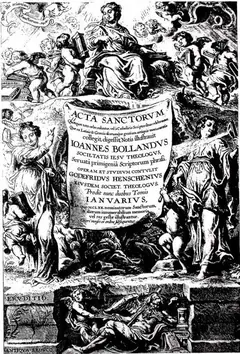
BOLLANDISTS. - A scholarly society made up of a small group of Belgian Jesuit fathers, which has devoted itself for three centuries to the publication of the Acta Sanctorum, or a critical collection of contemporary documents on the saints. It takes its name from its founder John Bolland (v.).
I. HISTORICAL OUTLINE
The origins of Bollandism go back to Fr. Heribert Rosweyde (1569-1629) of Utrecht. Having entered the Society of Jesus at Tournai (1588) and taken his degree at Douai (1591), he had prepared himself for scholarly work, visiting, in the times that teaching left free, the numerous monastic libraries of Belgium, where he collected documents, among them numerous lives of saints of Christian antiquity, which slowly offered him the outlines of a vast hagiographic collection. The idea, already mature in 1603, encouraged by his superiors, was set out by him in a small volume entitled: Fasti Sanctorum quorum vitae in belgicis bibliothecis manuscriptae (Antwerp 1607) in which, with the plan of the framework within which he proposed to fit the materials he had collected, he sent out an appeal to scholars for their collaboration. Rosweyde specified his future plan in these points: to restore the authentic text of the old hagiographic documents; to give the complete text of the mutilated ones; to publish the lives of saints still unpublished; to accompany the texts with explanatory commentaries. He foresaw the execution of his design in 18 folio volumes: 3 preliminary (documents relating to the history of Jesus Christ and the feasts of his mysteries; to the life and feasts of the Madonna; to the acts of the saints and martyrs who enjoy particular cult); 12 of lives of saints; 2 of notes and indexes; 1 of martyrologies. Before beginning the great work, however, he wished to shed some light on an intricate preliminary question connected with the subject: the martyrology. Thus in 1613 he published the martyrology of Ado, preceded by the Parvum romanum, entitled: Martyrologium romanum... accedit Vetus Romanum Martyrologium hactenus a Card. Baronio desideratum una cum martyrologio Adonis... recensito (Antwerp 1613). Another work preliminary to the Acts of the saints is the great edition of the Vitae Patrum. De Vita et verbis Seniorum libri X (ibid. 1616) in large folio of LXXIV-1044 pp. and 118 unnumbered pp. of indexes; a provisional monument like the preceding one, but whose importance has been commonly recognized.
Rosweyde, who during his life had allowed himself to be tempted by other subjects of historical scholarship, died on 5 Oct. 1629 without having written a line of the great projected work. Fortunately the vast documentary material he left was not dispersed; Bolland, who was to give the work his own name, called by his provincial to examine the writings left by Rosweyde, knew how to assess their importance, declaring himself also ready to rearrange them for publication. He knew Christian antiquity well, had an inclination for scholarship, and a tenacious application to work, which made him suited to the new task, to which he set himself at the age of 36, when he was already prefect of studies in the college of Malines, which he left definitively to move to the professed house of Antwerp. Bolland broadened Rosweyde's program by extending the field of investigation also to saints not represented in hagiographic literature, but whose existence is attested by the martyrology or by cult; he also modified the division announced by Rosweyde's Fasti, deciding that the documentation on a saint should form a single whole with its accessories. And since meanwhile, with the increase of materials, the time to use them was diminishing, there was granted to him, at his request, an assistant in the person of a former pupil of his: Godfrey Henschen (Henschenius), b. in 1601, who joined him in 1635. The choice was fruitful in results: Henschen, having immediately devoted himself to the study of the saints of February, made his debut with a study on the saints Vedast (Vast) and Amand, in which the lives of the two saints were the object of accurate investigations. Going beyond the philological problem, Henschen's commentaries resolutely tackled questions raised by the very nature of the documents studied: history, chronology, topography, sources and literary parallels. Bolland, who was already engaged in printing the first sheets of the volume of the saints of January, did not hesitate, in the face of that revelation, to recast the work in order to give a definitive form to the first beginning of the Acta Sanctorum, of which he may be called the second founder.
Thus at the end of a common and conscientious labor there appeared in 1643 the two volumes of the saints of January, welcomed with true enthusiasm by the learned world. Another fifteen years of work were necessary for the publication of the three volumes on the saints of February (1658). But for the rigor of method and the clear-sightedness of the research, these were noticeably superior to the first two. Admiration grew and even in Protestant circles homage was paid to the learning and scientific probity of the Jesuit hagiographers. To the praises was added the invitation of Alexander VII for Bolland to go to Rome. Prevented by illness and infirmities, he sent there Henschen, who took with him a young collaborator recently assigned to the editing of the Acta Sanctorum: Daniel Van Papenbroeck or Papebroch, b. in 1628 and destined soon to make a name for himself in the field of hagiographic scholarship. With this recruit the future of the Acta took on substance after painful beginnings, because Papebroch was made to identify himself with the work itself. His commentaries would soon reveal him as a penetrating critic served by a good pen, an indefatigable researcher, rich in information, solid in reconstruction, never embarrassed by minute details. A modest man, but also courageous, he knew how not to conceal the truth once he was persuaded he had found it.
The journey of the two b. lasted two years; after a stay in Rome of nine months, they visited other libraries of Italy and France, returning to Antwerp on 21 Dec. 1662 with a rich harvest of documents transcribed from 1400 manuscripts, but also with a new experience gained in the meantime: the necessity of giving a larger place to Byzantine hagiography, which Bolland's plan left behind. The last stage of the Bollandian plan, enlarged and perfected on the data of experience, is noted in the three volumes of March, with which Papebroch's collaboration begins. But Bolland did not see them, because he died on 12 Sept. 1665 at the age of 69, three years before their publication (1668). To take the place left by the deceased, Conrad Janninck was called in March 1669, b. at Groningen in 1650. He was initiated into the secrets of the trade while still a scholastic for two and a half years; then he was sent to the Gregorian University to study theology. In his absence Fr. Baert was called, who, besides rendering distinguished services to the temporal administration of the work, also collaborated on volumes IV of May and V of June.
Meanwhile Henschen ceased to live on 11 Sept. 1681, after 46 years of indefatigable collaboration on the Acta for the first 24 volumes, of which 14 were published during his lifetime.
The tranquil work of the hagiographers was disturbed after the publication of the I volume of April in which were discussed the acts of St. Albert of Jerusalem, from which the hermits of Carmel received their Rule. The implicit condemnation of the tradition that would have traced the origins of the Order back to the prophet Elijah marked the beginning of a bitter quarrel on the part of the Carmelites, ended with the intervention of the Spanish Inquisition, which condemned Papebroch, the author of those commentaries in 1695. The incident came to an end in 1715 with the full rehabilitation of the slandered Bollandist, who however did not see that day, having died on 14 June 1714 at the age of 87. The work he left behind is surprising not so much for its extent as for its variety and value. The volumes of the Acta to which he lent his collaboration (March-June) have been judged by Father Delehaye to be the best of the old collection.
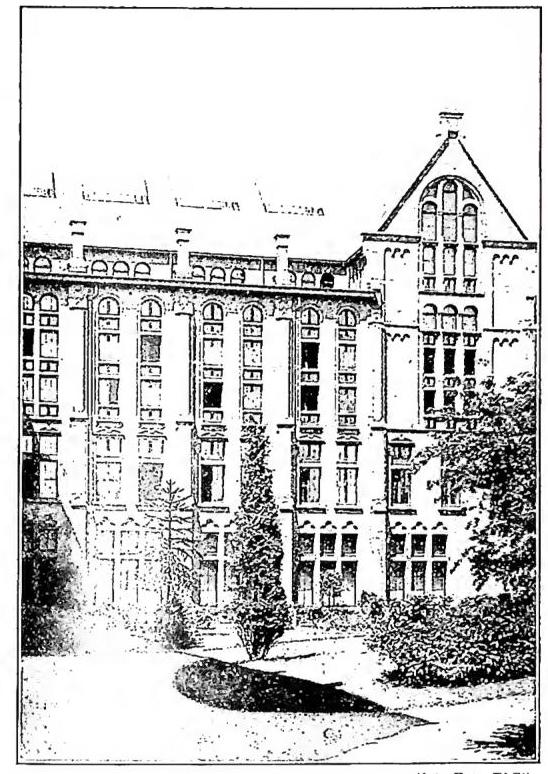
(Ist. Era. Thill)
After the death of Papebroch, the presidency or seniority passed to Father Baert, who died a few years later (27 Oct. 1719). On the day of his funeral a cerebral congestion struck Janninck, who died in 1723, the last survivor of the generation which, through Henschen and Papebroch, was linked directly back to Bolland.
From 1723 until the suppression of the Society of Jesus, which saw the Bollandist work scattered as well, there remained still a considerable period of unflagging activity, throughout which the efforts, the difficulties and in part also the successes of the earlier era were repeated. If on the whole the powerful personalities of the first generation, who founded the method of research and criticism, are lacking, nevertheless certain figures of this second period stand out clearly both for their personal qualities and for the contribution they made to the work, such as Fathers Du Sollier, Stiltingh and De Bye. For Father G. B. Du Sollier a robust health, an exact memory as well as a strong intelligence made it possible to sustain for 40 years an intense application in order to disseminate his commentaries through the 7 volumes of July and the first 3 of August, as well as to attend to the administration of the Museum Bollandianum. Upon him in particular fell the whole weight of the work, after the retirement of Papebroch and the illness of Janninck. His principal work is the edition of the martyrology of Usuard, inserted in the June supplements, judged one of the most valuable contributions to historical martyrologies.
A companion of Du Sollier, who died in 1740, was from 1713 onward Pien, who followed him to the grave nine years later. He took a notable part in the Acta of July and his commentary on St. Ignatius of Loyola still constitutes a source of information, as are also esteemed his works on the ancient liturgies of Spain. Pien, already old, remained alone after the retirement of Du Sollier and the death of another Bollandist, Father Peter Van den Bosche, who had remained barely fifteen years at the editing of the Acta (1723-37). He was given an aid of undoubted value, in whom his contemporaries believed they saw Papebroch again, because he was endowed with an extraordinary faculty of assimilation, being capable of rapidly acquiring vast knowledge on every subject.
This was Father John Stiltingh, who, having arrived in 1737, when vol. V of August was beginning to be printed, oriented himself so quickly in the new office that he was able to prepare two thirds of the work for that folio volume which appeared in 1739. From then until Feb. 1762, when he ceased to live not yet sixty years old, even amid the difficulties due to the scarcity of new collaborators, he wrote no fewer than 250 commentaries, which for the most part filled the ten volumes published while he lived. Such facility of composition also gives the reason for the rapid aging of his work in comparison with so many others of the Acta. In his lifetime he acquired the reputation of a prestigious talent, which he really possessed, and enjoyed a great authority, which the sureness of his criticism does not however justify to an equal degree. But his credit served Bollandism in order to traverse the difficult years that were being prepared.
Father Cornelius De Bye, among the many who in this period succeeded one another within the Bollandist work, had the gifts to become a figure of great prominence in the line of the ancient hagiographers. Less brilliant than Stiltingh, he had however the clarity of vision necessary to maintain the Acta at the level of their past. Adverse events reserved for him only the place of victim, borne moreover with courage. Together with the other editors, he followed the fortunes of the work after the suppression of the Order, housed in 1775 by the abbey of Cawdenberg near Brussels. The reforms of Joseph II and the suppression of Cawdenberg in May 1786 imposed a new move and it was necessary to adapt to a wing of the former college of the Jesuits at Brussels. But the destruction of the Museum Bollandianum was by now decided and was made public on 16 Oct. 1788. The storehouse of publications and the library were to be sold for the profit of the State treasury. To avoid the dispersal of precious materials the Bollandists entered into negotiations with the Premonstratensians of Tongerloo. The abbey accepted the conditions and with the Bollandist equipment received also, as guests, the hagiographers in order to give them the possibility of resuming the work. With the French invasion of 1792 the last hopes of saving the laboriously preserved work were destroyed: documents and library were dispersed.
After the restoration of the Society of Jesus in 1814, Bollandism waited still several years before reconstituting itself, because the Belgian Jesuits were overloaded with works and colleges, for which the available active forces could barely suffice. But toward the end of 1836 the lively interest of the rector of the Catholic University of Louvain, De Ram, both with the government and with the superiors of the Society in Belgium, for the resumption of a national work envied by the whole world, obtained the desired effect and on 29 Jan. 1837 the provincial Father Van Lil announced to the head of the government that the Society of the Bollandists was reconstituted and would soon set to work. It was composed of Fathers J. B. Boone, J. Van der Moere, Pr. Coppens, and later also of Father J. Van Hecke. The new editorial team had to face uncommon technical difficulties, because what remained of the old inheritance was only a plan to which to conform; but the continuation of the tradition of school formed during a century and a half was lacking, and with it the thousand secrets of execution, besides the scientific equipment, which had to be remade painfully for many years still, during which the publication of the Acta of October had to be pushed forward, which, as is obvious, felt the effects of the conditions of inferiority in which the tasks of the resumption were faced.
The difficulties of the beginning were alleviated after a few years (1840) by the arrival of two recruits of value: Anthony Tinnebroek and Victor de Buck, still students. The first contributed to vol. VII of October fully 500 pages of personal contribution. The promises announced by this talent were unfortunately cut short after his return from theology (1850); he died of tuberculosis five years later. Victor de Buck, his companion in studies, left instead a memorable trace within the Bollandist work. Spirit, memory, will and intelligence were in him of sturdy temper. For his ardor in study and his uncommon faculty of assimilation he was the providential man of the moment. Having returned from theology in 1850, after having previously spent five years of scientific apprenticeship at the Bollandist Museum, De Buck was one of the first who intuited the importance of Christian archaeology for the study of ancient hagiography, to which the discoveries of G. B. De Rossi opened broad perspectives. The progress made by de Buck in this field was seen in his dissertation De Phialis rubricatis, which marks a date in the history of hagiographic criticism, even if at the moment it brought upon the author attacks and troubles from laggards. Today no one any longer contests his conclusions, namely that the so-called blood ampullae (v.) are not a sign of martyrdom.
The volumes of the saints of October beginning from VII all had his collaboration, and the numerous commentaries signed by him have been judged the best of this series. He is reproached nevertheless with the defect of not having known how to resist certain tendencies of the generation previous generation, chiefly the exaggerated importance accorded to the dissertation.
The progress announced by Fr. de Buck seemed confirmed by the promising contribution of Fr. Eugène Carpentier and Fr. Henri Matagne. The former seemed destined to do pioneering work in Eastern hagiography. His commentary on the acts of the martyrs of Najran, included in vol. X of October and judged the fruit of original and solid erudition, was completed by him with rudimentary means in uncharted territory. Death took him in 1868 at the age of 46. At an even younger age Fr. Matagne died at thirty-nine in 1872, while de Buck, himself also in the prime of life, was being reduced to a relative inactivity because of the illness that was undermining him. When he died, on 22 April 1876, not yet sixty years old, there was a moment of crisis for the Acta, entrusted to weak shoulders; a crisis that would have been fatal had there not arrived a worthy continuator of the work: Fr. Charles de Smet, called to direct its fortunes in 1882. A professor of ecclesiastical history at the scholasticate of Louvain, Fr. de Smet during the years of his teaching had followed the progress of the historical method and the development of scholarly works. He had written a small book that became famous: Principes de la critique historique (1872), which produced a half-revolution in ecclesiastical circles, where historiography was in a pitiful state and especially hagiography, in which false legends and false traditions triumphed. Appealing to common sense, he showed by what characteristics historical truth makes itself known to those who seek it, and he fought against the spirit of tendentiousness and preconceived bias. In concrete terms, everything came down to a technical problem in which only a sure method, rigidly applied, made it possible to reduce the risk of error to a minimum, and the entire plan of reform he had long meditated for the edition of the Acta came down to a simple question of method. His predecessors believed they could escape from the complicated maze of hagiographic literature by taking as the basis for the history of a saint the life or the text that seemed most acceptable, writing dissertations around it and seeking to make the other surviving strands converge upon it. He, by contrast, thought that the texts themselves had to be passed through the sieve of criticism; therefore the documentation of a saint must include all the documents of the tradition concerning him (this was fundamentally the method of the ancient hagiographers, although not always applied).
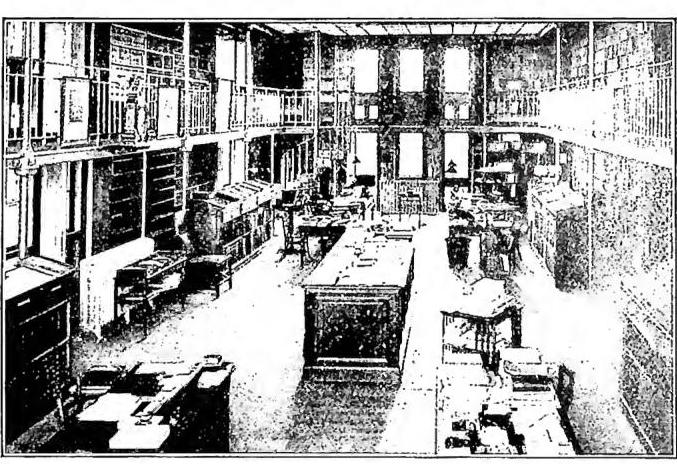
Hence the necessity of providing as complete a census as possible of all hagiographic sources. This is in fact provided by the publication of two series of repertories: of the sources already published (Bibliotheca hagiographica latina; Biblioth. hagiogr. graeca; Biblioth. hagiogr. orientalis) and of the sources still in manuscript, scattered through the various libraries of Europe (Catalogi), which found a place in a new section later entitled: Subsidia hagiographica.
To Fr. de Smet also goes back the idea of adding to the Acta a periodical organ intended to streamline the main collection of all the preliminary works and those susceptible of revision. Thus from 1882 came the journal Analecta Bollandiana, which from vol. X (1891) onward regularly provides a bibliographical bulletin of hagiographic publications.
This body of preparatory work noticeably slowed the pace of publication of the Acta, but the wait was fully justified, and in the volumes on the saints of November, the first after Fr. De Smet's reform, along with the excellence of the new method adopted, one also notices a broadening in the field of research: not only did Byzantine hagiography take the place it deserved, but also, beginning with vol. IV, the complicated Christian literature of the ancient East. Fr. de Smet, who died in 1911, was succeeded by Fr. Delehaye (v.) as senior, who has gained so much authority and prestige for the work of the Bollandists through his vast scholarly work, continued until the eve of his death (1941). At present, Fr. P. Peeters is in charge of directing the fortunes of the work.
II. THE BOLLANDIST METHOD
This method is judged by some, not well informed, to be a kind of iconoclasm aimed at demolishing the cult of the saints, especially of the saints of antiquity. The reality is quite different, because the criticism is directed at the hagiographic texts, very often founded on elements that are easily dissolved. The historical truth of a saint is not necessarily connected with a text, since there is no necessary relation between the value of a narrative and the right that a saint has to cult. This remains fully justified as soon as one arrives at the hagiographic coordinates, or simple and essential elements, of which one is of a topographical order (that is, the place where a saint's remains were deposited) and the other of a chronological order, that is, the anniversary of the deposition: the day and the month.
When one has these elements, there is nothing obscure or suspect at the point of departure, when the cult of a saint becomes established in the normal way. The legend (Acta) begins afterwards, but by demolishing it, one does not suppress the reality of the person.
III. THE BOLLANDIST PUBLICATIONS
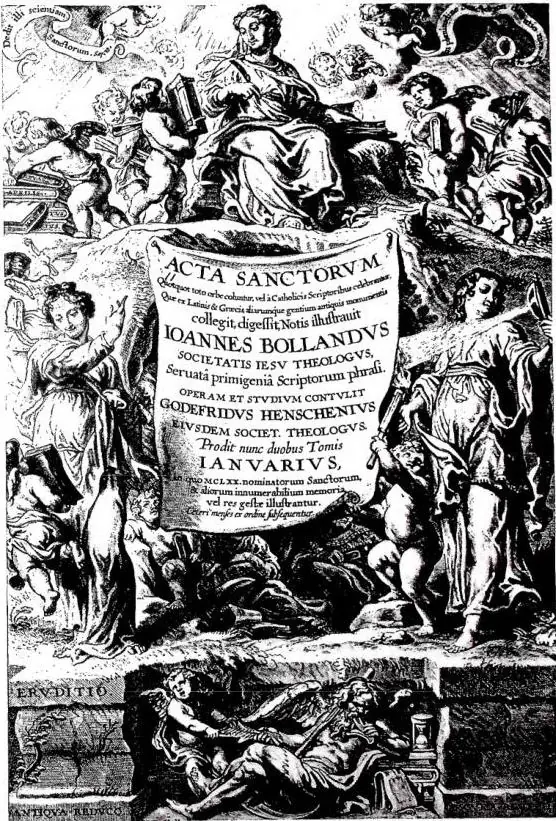
1. Acta Sanctorum. There are three different editions of the Acta: the original edition, the Venice edition and the Paris edition.
The original edition consists of 50 vols. printed at Antwerp, one volume printed at Tongerloo and 16 vols. printed at Brussels, plus the Auctaria. At Antwerp were printed the 2 tomes of January (1643), 3 of February (1658), 3 of March (1668), 3 of April (1675), 7 of May (1680-88), together with the Propylaeum Maii, 7 of June (1695-1717), 7 of July (1719-31), 6 of August (1733-43), 8 of September (1746-1762), October (the first three tomes: 1765-70). At Brussels saw the light vols. IV and V (1780-86); vol. VI at Tongerloo (1794); the remaining ones of October (VII-XIII) were printed at Brussels during the period 1845-83, followed by the first 4 of the month of November (1885-1925), to which must be added the Propylaeum ad Acta SS. Nov. (Synaxarium Ecclesiae Constantinopolitanae) in 1902; the Pars Posterior, tomes II (Commentarius in Martyr. Hieronymianum) in 1931; and finally the Propylaeum ad Acta SS. Dec. (Martyr. Romanum) in 1940.
The Venice edition, begun in 1734, reaches vol. V of September (1770). The distribution of the days and the pagination are identical to those of the Antwerp edition, except for the last 4 volumes of May.
The Paris edition, begun in 1863 by the publisher Victor
Palmé, was edited by a priest of the diocese of Langres, J. Carnandet, and consists of 60 vols. which reach as far as vol. XII of October (1867), plus one volume of indexes (1875). The distribution of the days is identical to the original, except for the months of May and June; but the pagination is different.
2. Analecta Bollandiana is the quarterly journal of the Bollandists, begun publication in 1882, which from vol. X (1891) onward always carried, appended to every issue of the journal, a Bulletin des publications hagiographiques.
In the Analecta, besides unpublished texts and dissertations, there have found a place the catalogues of hagiographic manuscripts scattered through the various libraries of Europe, which have been published separately whenever they could not find a place in the journal because of their length. To date 3 volumes of indexes have appeared: I, 1882-1902 (Brussels 1904); II, 1902-22 (ibid. 1931); III, 1923-44 (ibid. 1944).
3. Subsidia Hagiographica
This series comprises works that fall within the programme of the Analecta, but which, because of their proportions, require to be published separately. Thus in this series have found a place the volumes of published hagiographic sources: Bibliotheca hagiographica latina antiquae et mediae aetatis (1898-1901); Bibliotheca hagiogr. graeca (5th ed. 1909); Bibliotheca hagiogr. orientalis (1910). Furthermore various volumes of hagiographic codices scattered through the various libraries: Catalogus codicum hagiographicorum bibliothecae Bruxellensis (2 vols., 1886-89); Cat. cod. hagiogr. latinorum in bibliotheca nationali Parisiensi (4 vols., 1889-93); Cat. cod. hagiogr. graecorum bibl. nation. Parisiensis (1896); Cat. cod. hagiogr. graecorum bibl. Vaticanae (1899); Cat. cod. hagiogr. lat. bibliothecorum romanorum praeter quam Vaticanae (1909); Cat. cod. hagiogr. lat. bibl. Vaticanae (1910); Cat. cod. hagiogr. graec. Germaniae Belgii Angliae (1913). To these must be added the 4 vols. of the Repertorium hymnologicum edited by U. Chevalier (1892-1912) and the various works of hagiographic criticism by Fr. H. Delehaye, to mention the principal numbers of the collection.
4. Pseudo-Bollandists. The Bollandists have nothing to do with the works listed below, which from their title seem to wish to link themselves to the Acta. They are distinguished by an absolute lack of criticism: 1st Les petits bollandistes. Vies des saints de l'Ancien et du Nouveau Testament... par mgr. Paul Guérin (7th ed., 17 vols., Paris 1888); 2nd Supplément aux vies des saints... par dom Paul Piolin (3 vols., Paris n.d.); 3rd Les actes des saints d'après les bollandistes... edited by J. Carnandet et J. Fèvre (4 vols., Lyons 1865-68); 4th Supplément aux Acta Sanctorum pour des vies de l'époque méronningienne, par l'abbé C. Barbey (3 vols. in-fol., Paris 1899 ff.). - See Pl. CV.
Bibliography4 works
Mario Scaduto