
SINAGOGA - Pictorial decoration of the s. of Dura Europos (245-56 A. D.).
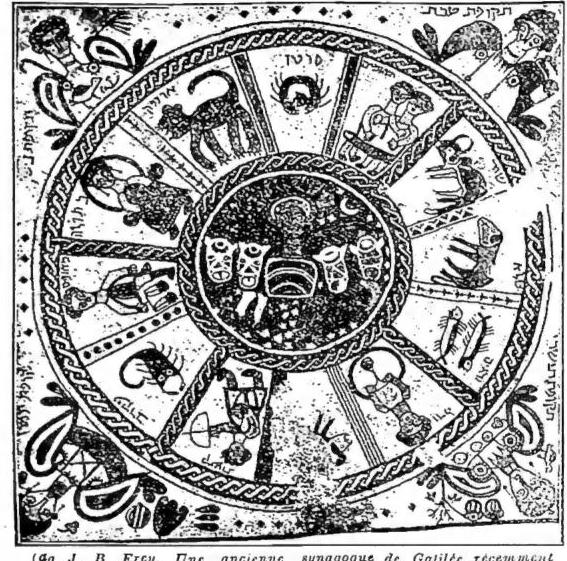
SINAGOGA - The signs of the zodiac and the chariot of the sun. Mosaic of the s. of Bejt-Alfah (ca. 518-27).
also daily. The s. was the center of the various Jewish communities, especially in the diaspora. Its builders were considered benefactors of the whole group (cf. Lc. 7, 4), while the expulsion of a Jew from this place of common prayer was considered a grave punishment (cf. Io. 9, 22; 12, 42; 16, 2).
At Hamman-Lif (Tunisia) between 1883-84, a synagogue was found consisting of a hall measuring 9 x 5.25 meters, with a mosaic floor featuring decorations partly of animals amidst plant tendrils, partly of fish and ducks, and partly of a handled amphora approached by two peacocks; the field is bordered by two date palms. In the middle is the inscription: « Sancta Sinagoga Naron(itana) pro salutem suam ancilla tua Iulia Nap. de suo proprium teselavit ». The inscription is enclosed between two medallions with the seven-branched menorah; to the left are also the etrog and the lulav. In a second hall, also with a mosaic floor, is the inscription « Asterius filius Rustici arcosinagogi Margaritari d(omus) D(e)i paterni portici tesselavit ». In a third room, also with a mosaic floor, one reads: « Istrumenta servi tui Naritanus; Istrumenta servi tui Amaroni ». It was deduced from the inscription that the scrolls of the Torah were kept in this room. Explorations carried out in 1908-1909 brought to light several terracotta lamps with the seven-branched menorah. In 1916 H. Kohl and C. Watzinger published the explorations of sixteen synagogues from the 2nd or 3rd century AD, namely those of Tell Hüm (Capernaum), Keräzeh (Chorazin), Irbid (Arbela), Umm-el 'Amad, Meron, Kefr Bir'im, en-Nebratajn, el-Giš (Giscala) in Galilee; ed-Dikkeh and Umm el-Kanätir in Transjordan, and Hirbet Semmakah on Mount Carmel. In the synagogue of Na'aran, some Hebrew-Aramaic inscriptions commemorate contributors, such as: « to the good memory of Benjamin Phinees son of Joseph. May those who have associated themselves, collaborated with gifts, or taken part in the work for this holy place also be in happy memory; fortunate people, people of good will, people of all conditions; may they be granted, if it pleases God, their share in this holy place. Amen »; further: « to the good memory of the presbyter Pinchas, son of Iosbah, who gave with his money the price of the mosaic and the roof » (Revue biblique, 30 [1921], p. 581); « to the good memory of Khalifon daughter of rabbi Safrah who collaborated in this holy place. Amen » (loc. cit.). « May all those who have associated themselves and have given or will give for this holy place, whether gold, silver, or whatever value, be in happy memory. May they not lose their contribution in this holy place. Amen » (ibid., 28 [1919], p. 540).
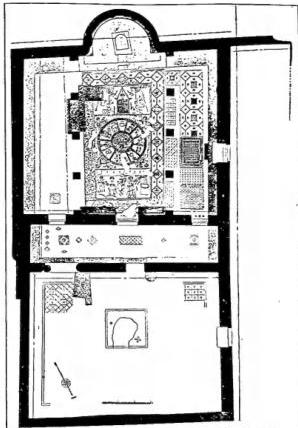
The synagogue of Beth-Alpha, in the valley west of the Jordan and south of Mount Tabor, was discovered in 1929; the building as a whole measures 27.70 x 14.20 meters; the assembly hall measuring 10.75 x 12.40 meters is divided into three naves by two rows of quadrilaterally shaped pillars. The ark containing the scroll of the law and the seven-branched menorah were in the apse. By the second column to the east was the raised Bema, where the rabbi read the law. The entire floor of the central nave was decorated with mosaic. In the part near the apse was represented the holy ark (arōn haq-qādēš) between two seven-branched menorahs and the symbols of Jewish worship, namely the lulav, the etrog, the sacred horn, and the case containing the scroll of the law. The arōn is surmounted by a triangular pediment and two birds are perched on its two corners; guarding the ark are two lions depicted with open jaws. In the center of the mosaic are represented the twelve signs of the zodiac, with their names in Hebrew, surrounding the solar chariot; at the corners are the symbols of the four seasons. Below is represented the sacrifice of Abraham, according to the biblical text with the two servants (Gen. 22:3), the donkey, a ram tied to a tree, and the Hebrew words « and behold a ram » (ibid. 22:13); above Abraham, identified by his name in Greek, is the divine hand stopping him and the Hebrew words « do not lay your hand » (ibid. 22:12); nearby is Isaac with his name in Hebrew and the lit altar for the sacrifice. The mosaic border surrounding the aforementioned representations contains birds and animals; a basket of fruit, bunches of grapes, geometric decorations, and two inscriptions, one in Greek and the other in Aramaic.
In the synagogue of Na'aran, a mosaic was found depicting Daniel in the lions' den; in that of Jerash in Transjordan, the animals leaving the ark; Shem and Japheth were depicted there with their names in Greek, along with certainly the other members of Noah's family.
Regarding the synagogue of Dura: V. DURA EUROPOS.