
ACTIVISM. - Active school, activism, child activity, work school are terms frequently used in modern pedagogy. With these, the entire movement is indicated which, in the name of the child's freedom and spontaneity, has sought and seeks to transform the old traditional school—criticized by activism as entirely based on verbalism and the child's passive adherence to a body of knowledge that is solely the fruit of the teacher's research and elaboration, to which the child remains extraneous. While the term activism may be considered new, what it signifies dates back, at least in some principles, to the pedagogical tradition, from Plato to Pestalozzi; a tradition that has indeed never failed to address the problem, which is identical to the problem of method and learning itself. Activism proceeds from the principle that true education, true knowledge is that which we acquire not only from the center of our spirit but also from our direct experience. The principle that one truly knows only what one does is, in brief, the creed upon which all activist pedagogical thought is founded. The teacher who provides definitions or conclusions without awakening in the child a center of interest, and who, through a particular process of research and inquiry, does not guide the child toward the discovery of those definitions, conclusions, laws, or principles, is a teacher who has deprived pupils of the best that school could offer them: the joy of being themselves and of knowing themselves as the discoverers of their own knowledge. Pedagogical activism also does not forget another principle: that the nature of the child is fully expressed in doing, and thus their personality develops best through the work of the hands, direct observation, and personal research. Eyes and hands contribute more to learning than ears, and experience teaches better than precepts.
I. PRECEDENTS
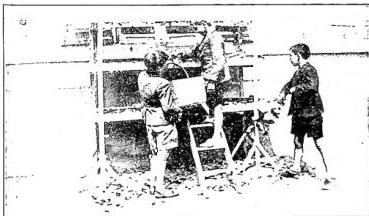
Now, without diminishing the importance of the current movement for new or active schools, one cannot say that an activistic principle is entirely absent from the pedagogical tradition from ancient to modern times. Socrates, Plato, St. Augustine, St. Thomas, and the pedagogues of the humanistic era—spanning a long period of pedagogical thought—affirm principles of knowledge that, being entirely internal to man, presuppose in him, for their realization and manifestation, the full interior activity of the pupil, without which his thought would remain hidden and unknown to himself. In ancient pedagogical thought, knowledge is an act of the child’s direct inquiry and thus the fruit of his personal conquest. Even in humanistic pedagogy, scattered felicitous intuitions reveal how, already in the fifteenth century, our pedagogues had a clear vision of knowledge as the fruit of the child’s interior elaboration. Such intuitions are found in P. P. Vergerio (v.), Vegio (v.), PALMIRA (v.), Alberti (v.). Vegio, for example, states that one learns better with the eyes than with the ears and that children require examples rather than precepts. Moreover, to arouse interest in the classroom, Vegio speaks of a teacher of his who liked to divide the class into two teams so that, through competition and dispute, interest might arise in the children alongside noble emulation. A system later adopted by the Jesuits in their schools, which, with appropriate modern adaptations, gave rise to the current team or agonistic system (cf. M. Casotti, Didattica, Brescia 1938, p. 22 ff.). Already in the fifteenth century, Alberti had identified education in the exercise of the mind and the exercise of the hands; « you would never become a writer or a painter by not writing or not painting, » says Alberti, a thought later echoed by Comenius when he affirmed that one learns « to do by doing. Masters of mechanical arts do not keep beginners with fine theoretical lessons but immediately set them to work so that by building they learn to build, by chiseling to sculpt, by painting to paint. Likewise, in schools, children must learn to write by writing, to speak by speaking, to reason by reasoning. » Starting from the empirical principle that knowledge is acquired through the senses, Comenius suggests the « golden rule » that everything possible be presented to the senses: « visible things to sight, audible things to hearing. » Vico, further still, with the enunciation of his principle « verum et factum convertuntur », affirming that we know what we ourselves make, establishes that knowledge—our knowledge—can only be the fruit of our experience and inquiry, and that outside of these there is no true knowledge. These principles later become central to Rousseau’s great pedagogical system, placing knowledge as a conquest that the child’s mind achieves through contact with nature and its phenomena. Gian Gia-ACTIVISM - Pupils training in silkworm cultivation. Turate, state school.
as he will never give his Émile definitions, rules, precepts, or conclusions; he will not properly teach him geography, astronomy, geometry, or physics. Émile will learn everything through his own experience, which will always arise from the particular interest he develops in this or that problem. There are no books in this school, because books speak from the outside, whereas nature is grasped from within. Indeed, Émile will learn all the things he needs and can derive directly from his own observation. Active schooling in Rousseau is virtually born. For it to be realized in the sense we now understand, it is enough to bring the pupil not from society to nature, but from nature to society; that is, to ensure that the environment in which the child must be educated and live becomes natural rather than conventional, and that the principle is recognized that the mind, being active, does not need to receive knowledge but rather to produce it and arrive at conclusions. Pestalozzi inherited the Genevan’s legacy, realizing his educational ideal—more than anywhere else—in his institute at Yverdon, ensuring that pupils contributed to their mutual formation and developed in freedom. For “left to themselves, up to a certain point, they are generally cheerful; they are always at work, because life there is active whether playing or working; that exuberance, which is a privilege of their age, is at every moment employed in exercises that strengthen and amuse at the same time” (cf. M. A. Julin, Esprit de la méthode d'éducation de Pestalozzi, Milano 1812, pp. 69-73 and passim). Pedagogical activism, as it is commonly understood today, is usually said to have begun in England in 1889 with Cecil Reddie’s new school, which will be discussed further below. However, one should not forget Lambruschini, De Sanctis, Gabelli, and s. Giovanni Bosco, who, aware of the truth that all knowledge is truly ours only when discovered by ourselves, sought—even with different methods—to apply in their school activities or pedagogical systems a type of schooling that could only be called active. In his school at S. Cerbone, LAMBRUSCHINI, LUIGI (v.) did not fail to engage his young pupils in agricultural and gardening work, entrusting them with the responsibility of managing a modest sum. He taught geometry with solids, numeration with grains of wheat, and natural sciences in the midst of nature. If one then considers that the pupils of S. Cerbone went so far as to compile a handwritten newspaper, L’Aurora, which exchanged issues with another, Il Miettore, from the school at Meleto of Marquis Cosimo Ridolfi, it becomes clear how Lambruschini attempted a school that, conceived as a community, produced knowledge not through cold repetition of notions but through continuous and active inquiry, kept alive by the experimental method (cf. A. Gambaro, Schizzo biografico di R. Lambruschini, Torino 1939, passim). De Sanctis was conscious of the pedagogical value of the child’s activity not only when he sought to realize in his “second school” the plan to associate young people with his work, “making each lesson the product of collective labor,” but also when, recalling Puoti’s school, he extolled its method, which he called Socratic and could be termed active. “The best teacher,” De Sanctis thought, “is the one who thinks least of appearing himself and lets the young do, concealing his work and creating in them the illusion that what they learn is something they themselves have discovered. What we acquire with the sweat of our brow is what we hold onto; all the rest easily enters and just as easily leaves the memory.” And he invoked Pasquale Villari in this regard, lamenting that the eminent historian, then Minister of Public Education, recommended these practical exercises, as used in Puoti’s school, following the example of England, when he could have easily found them in the school from which Villari himself had come. Another pedagogist who resolves his experimental vision of schooling into an active method is Aristide Gabelli, who had ideas that, if not profound, were clear, and saw the school as serving a formative function, possible to realize only if it abandoned outdated bookish and mnemonic methods to cling to experience, observation, and inquiry, which alone could contribute—by arousing fervor, love, and interest in pupils—to forming what the school must and can only provide: the “thinking tool,” as Gabelli himself called II.
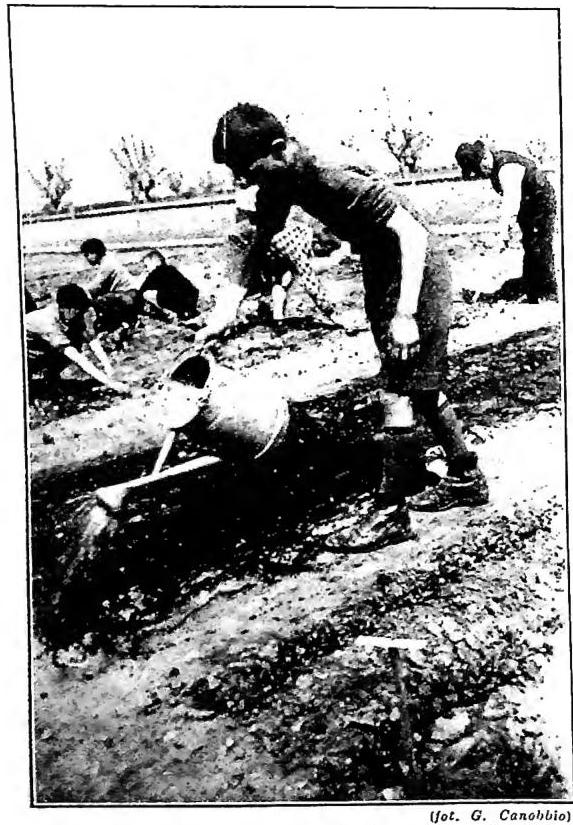
ACTIVISM - A pupil watering the ground for vegetable cultivation - Turate, state school.
After the period of pedagogical spiritualism of the Risorgimento, Herbartianism on one side and positivism on the other rigidified the nature of the child into preconceived formulas and schemes, mortifying all his spirituality in an empiricist didacticism. However, toward the end of the last century, Rousseau, Pestalozzi, and Fröbel broke the chains of the "thick curtain" in which Herbartianism—and even more so, positivism—had enveloped pedagogy, returning to fertilize the new pedagogy, now stripped of what, especially in the first, was either paradox or insufficiency of a sound religious vision.
II. ACTIVISM IN ENGLAND
Among the active schools that took shape in Europe and America over the last half-century, the first manifestations appeared in England. Indeed, in 1889, at Abbotsholme near Derbyshire, Dr. Cecil Reddie founded the first school attended by children aged 11 to 18. Later, in 1893, Dr. Haden Badley (b. 1865), who had been at Reddie’s school, established a mixed boarding school at Bedales in Sussex (southern England).Reddie believed that the old school no longer met the necessities and needs of modern life; a school where dead languages were taught seemed useless to the demands of present-day existence. Indeed, he considered it a waste of time, as young people remained ignorant of everything concerning modern life: the practice of things and their relations with society. These assertions are highly debatable, for one should first determine what the school is meant to prepare for and whether classical languages—which Reddie called dead languages—truly contribute nothing to the formation of the individual. Reddie also felt that the system of games required reform, stating that "athletic overload is no less real than classical overload." The entire school system still seemed to him devoid of its own function, entirely bent toward higher university education. The school’s task, in his view, is to prepare the child for life. To this end, the school environment must not be conventional but practical, meaning it should prepare for life rather than deny II. Reddie’s and Badley’s schools were set in the countryside; children lived a free life in an environment more familial than scholastic. The knowledge of these children arose from participation in common life, and their subjects of study were modern languages, sciences, and manual labor.
III. ACTIVISM IN FRANCE
The new schools began with Edmond Demolins (1852-1907), who sought to develop the child’s personality through his Ecole des Roches (1899), named after the location where it stood, the Roches estate in Normandy.Demolins’ school welcomed children and adolescents aged 6 to 20 and was situated in the countryside, allowing pupils not only to move freely and feel at ease but also to live in an environment full of fresh vitality. Instead of residing in a single building, the children—grouped in numbers of 25 to 35—were distributed among separate houses, spaced apart and comfortably, if simply, furnished, so that the school might better replicate family life. The pupils themselves attended to household tasks. While the school aimed to foster the child’s personality, it did not neglect preparation for public examinations. In the afternoons, children engaged in games, sports, and manual work. Older pupils took care of the younger ones. In Demolins’ school, direct experience and observation were always prioritized over lessons or theoretical study. The Ecole des Roches cannot be said to have sparked a broader educational renewal in France in the activist sense. Demolins’ example remained rather an isolated case.
Nevertheless, two other educational initiatives should be noted for their alignment with the vision of the active school. The orphanage at Cempuis (Oise), founded by Paul Robin and his collaborators and active from 1880 to 1894, based the entire formation of its pupils on their spontaneous initiative. Another was the group called La Nouvelle éducation, led by Dr. Roger Cousinet.
Cousinet’s method is known as travail par équipes (teamwork). Under this approach, children gather in groups of five or six and choose and organize their work as they would their games. The chosen task is carried out collaboratively, with each team member contributing to the common effort. The group’s success is the success of each individual. Beyond the interest this competitive method arouses in pupils, it fosters solidarity and morally guides children to overcome their egoism.
IV. ACTIVISM IN GERMANY
The first implementation of the active school took place in 1898 through the work of Dr. Hermann Lietz, who founded his first school in Ilsenburg. Lietz (1869-1919) had completed his apprenticeship at Abbotsholme. His first school was intended for children aged 7 to 12; two other schools followed: one in Haubinda, Thuringia (1901), for children aged 12 to 16, and another in Bieberstein near Fulda (1904) for youths aged 16 to 20.Lietz’s plan, as illustrated by Ferrière (in Trois pionniers de l'éducation nouvelle, Paris 1928, p. 47), was to «combine what is good in the scientific school with a life of affection and intimacy like that of a family; to offer young people the opportunity to engage in free activity and to dedicate themselves to healthy work in the countryside, and finally to create school communities within which characters could blossom freely and individually, beyond any external constraint». Lietz’s schools were called «Country Education Homes» (Landerziehungsheime). Two other German innovators joined Lietz: Gustav Wyneken, founder in 1906 of the Freie Schulgemeinde (Free School Community), and Paul Geheeb, who first founded the Odenwaldschule in 1910 and later, in Geneva and Fribourg, L'école de l'humanité. Wyneken exaggerated Rousseau’s principles of education, advocating the absolute freedom of the child, who educates himself outside the family, school, and adult authority. Children provide for their own instruction and education. Wyneken’s attempt, and that of others who followed his example, was bound to result, as could be foreseen, in a vague and indistinct need to escape from school and traditional bourgeois life, without, however, producing anything truly wholesome.
An experiment of great significance in Germany, however, was that of Georg Kerschensteiner with his work school, in which children were to develop a sense of initiative and personal experience through labor.
Work in Kerschensteiner’s school was practical; its aim was to «accustom pupils to work with absolute precision according to models to which the finished product must fully correspond. Measuring, weighing, working attentively, objectively controlling the product of work according to the concept of activity directed toward a well-defined end, that is, toward production that has intrinsic value» (G. Gaspari, Educazione e lavoro in Kerschensteiner, Florence 1940). A value that is morality, in the sense that not all work is educational, but only when the skills and qualities it creates serve real values. «Education must never forget,» says Kerschensteiner in his Concetto della scuola del lavoro (Italian trans., Florence 1935, p. 46 ff.), «that wherever it demands work, such a demand cannot overlook the possibility of a complete capacity for producing objective value». In other words, work outside the aim of moral formation is not work, but merely technical skill that remains external to the personality and thus devoid of objective value, that is, of moral—
ACTIVISM - Pupils engaged in working the land. Turate, State school.
(photo: G. Cunabble)
This goal is achieved by introducing the child to work as the best act he can perform for his own good and that of the community in which he is inserted. The school must therefore be organized, as Lietz and Dewey advocate—a position studied by Kerschensteiner—as a community of work. And since the school must educate children in self-government, it is appropriate for the children themselves to organize the life of their small community democratically, so that it truly prepares them for the larger community of which they will one day be part.
V. ACTIVISM IN THE UNITED STATES OF AMERICA
The particular industrial and social conditions of America are more conducive to the flourishing of a new education. The advocate of new schools in America is John Dewey.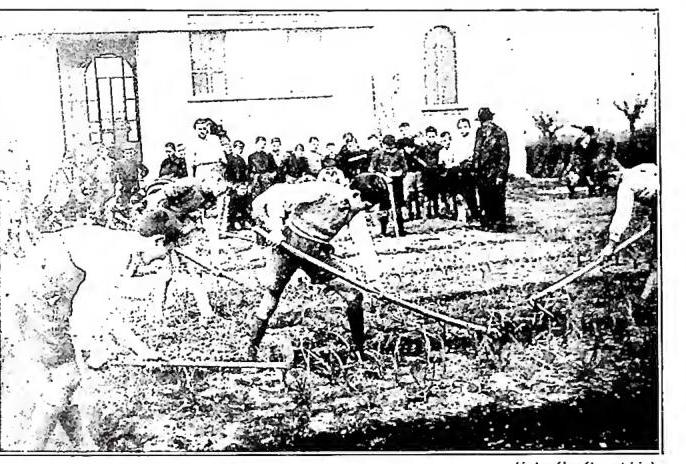
(photo: Ministry of Public Education)
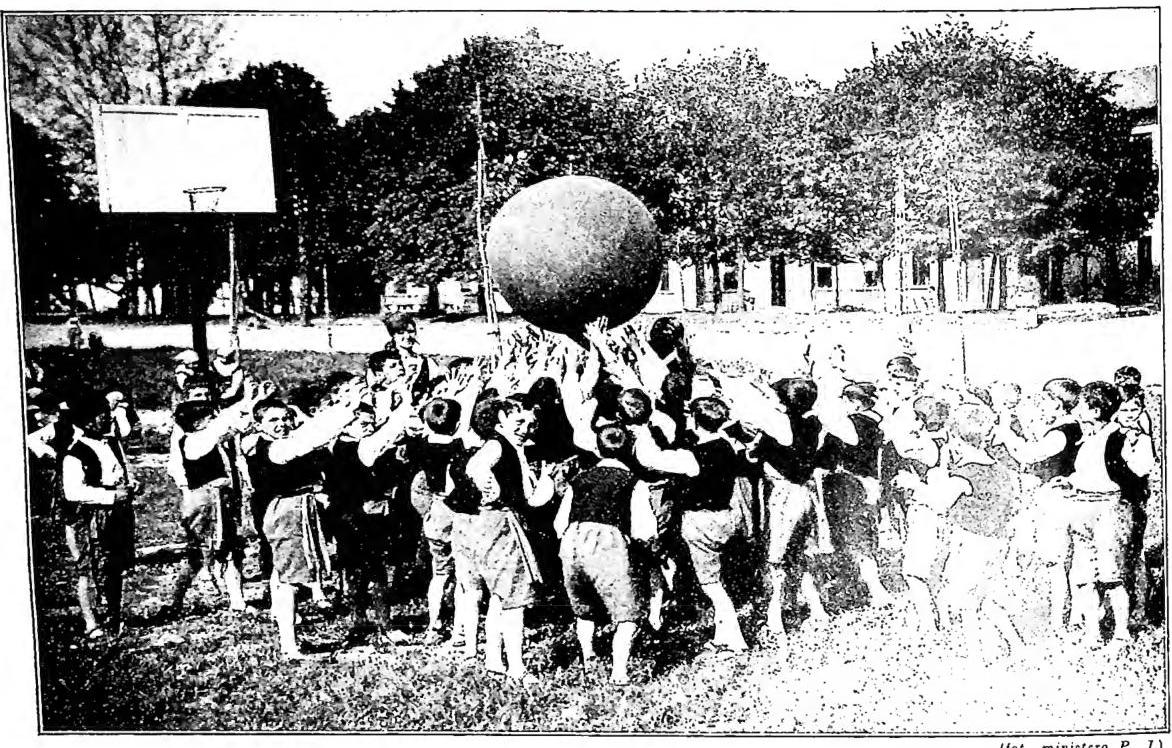
ACTIVISM - Outdoor games - Milan, "Umberto di Savoia" school.
tion, so that they may clearly discern its meaning and independently discover its validity. Children must be educated in sociality. Play, work, gardening exercises, and various other types of activities are useful, but they are not educational if performed as mere repetition of acts. In such cases, they are mechanical reproductions and thus do not educate. If the school is to shape the entire personality of the child, every form of mechanicity, of prearranged play and work, must be banished. Interest—and thus education—arises from the process that transforms raw material into a state of perfection. Gardening, for example, does not interest as a means of instructing in the technique of sowing and harvesting certain products, but insofar as it serves to attain a higher intellectual knowledge. Indeed, the sciences gradually developed from the useful occupations of men, and the school is truly active when it ensures that its subjects are interconnected in such a way that the mind perceives them as its own conquest, that is, as an act of its formation. The humanism envisioned by Dewey is not that which arises from letters—or at least not solely from them—but that which arises from any interest that, through action, the mind engages to liberate intelligence and enrich the spirit with further conquests. In Dewey’s conception, there are no liberal studies on one side and utilitarian studies on the other. The former must meet the latter in the sense that, just as a liberal education would be vain if it did not arise from an inner need and the spirit’s participation in culture, so too would a knowledge of practical notions be vain if they remained mere notions, without merging and finding unity in the fundamental spiritual life in which alone they can live. Subjects are studied as life’s situations present them. And for these situations to be real and engage the child, Dewey utilized the child’s innate tendency—play—which must become the center of his entire life. The play Dewey advocates could be called social, in the sense that children are called to a game that engages them collectively. Play as a social activity of children is the foundation of the kindergarten as well as other school levels. Thus, if in kindergarten the object of play may be, for example, a doll, in elementary school it may be history, geography, or the sciences, which, when felt and studied in close connection with real situations, offer great opportunities for interest and educational insights. The new pedagogical movement promoted by Dewey found an interpreter in America in William Heard Kilpatrick (b. 1871).
The active school found another fervent supporter in America in Carleton Wolsey Washburne, born in Chicago in 1889. He is responsible for the renewed schools of Winnetka, a suburb of Chicago. Washburne is the author of various pedagogical and didactic works. A synthesis of his thought is found in his Living Philosophy of Education (New York 1940). In Washburne’s school, the system of classes or groups is replaced by that of free groupings, allowing each pupil to proceed freely in their school curriculum. The Winnetka schools, as Washburne himself states, must strive "to be centers where children live happily, where they have freedom to create, to live in society, to express themselves as children, and where, at the same time, they are prepared in a complete and scientific manner to participate in the life that surrounds them." Thus, the program is divided into two distinct parts. One comprises the knowledge and techniques through which a common level is sought for all pupils; the other consists of stimuli and opportunities provided for creative work that interests the community. The school aims to achieve a goal common to all, but since children are differently endowed with intelligence, a method has been devised that enables each intelligence to reach that result according to its own capacity. This result comprises three levels. Once the objectives to be achieved are precisely established, they can be reached by every normal child. For children below normal ability, there is a modified program; for all others, it is required that they achieve all the predetermined objectives. The material in these schools is designed to be self-educative. The child proceeds independently at each level of study. After completing one level, they move on to the next. They correct their daily work and their progress tests themselves—tests that verify the presence or absence of certain skills. The control tests made available to the child are designed to refer them to the corrective exercises necessary to remedy the gaps revealed by these tests. A pupil who fails a test performs the indicated practical work, then submits to the same test, presented in a different form. This work of acquiring knowledge and technique occupies half of the pupil’s morning and half of the afternoon and is individual work. The other parts of the morning and afternoon are left free for collective and creative activities. The classroom in which the child works is suited to the age of the children with whom they can best group themselves. This creative activity includes the critical listening of music, the critical study of art and literature, playground life, and the editing and illustration of the pupils’ newspaper. The purpose of this collective activity is not to acquire knowledge but to create social awareness in children; this is why human work is presented in a social context. The school organization of Winnetka includes two bodies: the research section and the educational advisory section. The former addresses general school problems, while the latter serves as a child guidance laboratory, where the physician, psychiatrist, and teacher, each following their investigations, indicate which methods and procedures can be adopted for each child.
Another American initiative, always within the general framework of the active school, is the Dalton Laboratory Plan, devised by the American educator Helen Parkhurst (b. 1889), who attended Maria Montessori’s courses in 1914 and felt the influence of her method. From 1911 to 1913, in Dalton, an American town, Parkhurst experimented with transforming the school to adapt it to the individual work of each pupil. She continued this experiment in New York.
BIBL.:
Per l'attivismo in generale: J. Dewey, Democrazia e educazione, trad. it., Firenze 1949; id., Esperienza ed educazione, trad. it., Firenze 1949; W. H. Kilpatrick, Il metodo dei progetti, trad. it., Firenze 1950; A. Patri, Un maestro di scuola di una grande città, trad. it., Milano 1920; C. W. Washburne, La scuola di Winnetka, trad. it., Firenze 1930; H. Parkhurst, Il piano Dalton, trad. it., Firenze 1925. Per l'attivismo in Italia: G. Lombardo Radice, Lezioni di didattica, Palermo 1923; G. Calò, La scuola attiva, Firenze 1925; L. Credaro, La nuova educazione, Roma 1928.
The Parkhurst method concerns children from the age of 10 upwards and is based on the assumption that children should live freely at school as they do at home. It is not the teachers who must provide notions and information; rather, the pupils initiate their own personal research, while the teachers assist them by offering suggestions and advice, indicating readings to be done and selecting them from the class library. In the Dalton Plan system, pupils are not bound to their class either in terms of the curriculum or time. When a pupil has completed the curriculum of a class at any time during the year, they move on to the next class. Consequently, classrooms are not organized by class but by subject (laboratory). Pupils are assigned a monthly task (20 days), divided into work units by subject. Students are free to organize their own work. Teachers have the task of advising and monitoring their work. The workday is divided into various periods: one dedicated to work (laboratory period), one reserved for guiding pupils (organization period), and one reserved for instruction (conference period). In the Dalton Plan, individual work and common class work intersect, so that, depending on the nature of the tasks, young people may work either individually or in groups. Individual and group work must be understood in the sense that every pupil’s activity is partly one and partly the other, and while one works independently, their work integrates and becomes a part of the work of others. There is no uniformity of work, but rather a differentiation of work in view of a common goal. Parkhurst illustrated her method in the work: Education on the Dalton Plan (London 1922).
VI. ACTIVISM IN ITALY
The active school found impetus in the pedagogy of Maria Montessori. Montessori, while studying methods for the education of deficient children, became convinced that, whereas these methods "had nothing special in the instruction of idiots, applied to normal children they would develop their personality in a marvelous, surprising way" (M. Montessori, Il metodo della pedagogia scientifica applicata alla educazione infantile nelle case dei bambini, Rome 1909, p. 27).The child in its development, Montessori believes, encounters innumerable obstacles; it must be freed from these obstacles and helped to live. The adult must change their approach toward the child. The child must be left free to express and develop itself. But "the environment" in which the child lives is disproportionate to its strength and its small hands; the environment thus constitutes an impediment to the expression and development of its activity. To this end, it is necessary to create an environment proportionate to the nature and state of children, an environment that will allow
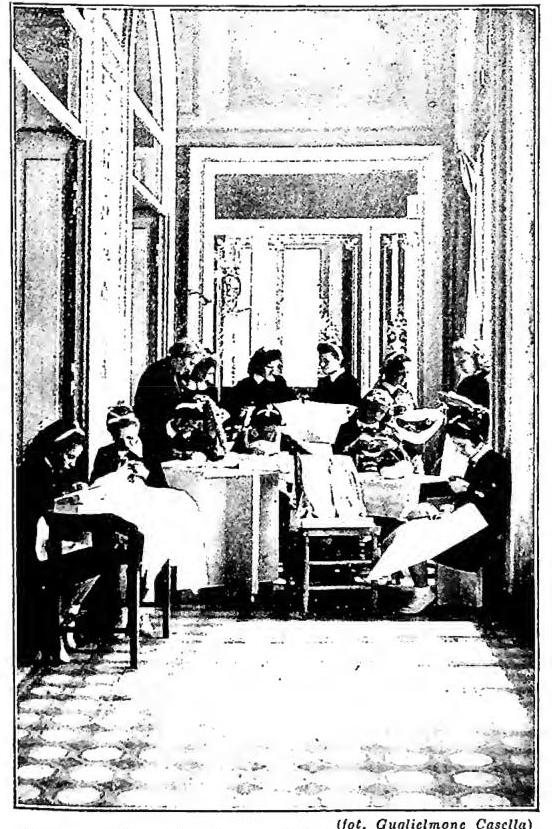
ATTIVISM - Sewing and linen-making course - Genoa, Prà, vocational training school «Regina Margherita».
allows the child to «achieve an ordered activity that tends toward reasonable goals» (M. Montessori, Manuale di pedagogia scientifica, Naples 1935, p. 5 ff.). The environment in which the child lives must not stand as an obstacle between the child and the environment itself, for the environment contains the means of development. It is no longer the teacher who educates; she does not have a properly positive function of formation and education, but rather of mediation between the environment and the child. It is the child who is active because it is the child who must know how to choose the means by which to exercise himself; the teacher’s function consists in giving him the capacity for choice, organizing work suited to the society in which the child lives. «The most important objects in the environment — says Montessori (op. cit., p. 63) — are those that lend themselves to systematic exercises of the senses and intelligence, with a harmonious collaboration of the entire psychic and moral personality of the child; and which gradually lead him to conquer, with exuberant and powerful energy, the most arduous fundamental learnings of culture: such as reading, writing, singing». The «material, established in Montessori schools, is, as a whole, a systematic instrument of psychology that can be compared to a gymnasium of the spirit, where the child, exercising spontaneously, progresses in his development and thus also in the acquisition of culture» (Montessori, op. cit., p. 65). The materials carefully prepared and arranged by the teacher, always within reach of the children, are freely chosen by them according to their needs. The teacher intervenes only when she sees the child in need of advice. She must also establish the average correspondence between individual objects and the child’s age. On this fact is based the practical ability to recognize, from the children’s reactions, useful or productive acts from those that instead dissipate energies «in order to confidently direct and assist the marvelous group of little workers, concentrated in their work». Older children can fulfill other tasks such as gardening, fieldwork, etc. The «Children’s Houses» arose in Rome around 1906, when the Institute of Estates decided to gather the children, aged three to seven, of the tenants of large apartment buildings in a room, under the guidance of a teacher. The «Children’s Houses» spread widely, both in Rome and throughout the world. Montessori’s method certainly had more followers outside than within Italy. Italy, a country of older civilization and more experienced culture, perhaps perceived in the Montessori method the limit that, despite its undeniable fervor, prevents it from rising toward a higher pedagogy. The environment and the material in Montessori’s approach end up attracting all attention to themselves, letting slip that living element, that real person who is the child. Sensory education, certainly good in itself, remains insufficient if it does not translate into an interior knowledge, valid not for the purposes of feeling and seeing, but of understanding and judging. The entire pedagogical act cannot be exhausted in sensory education; this can be a means to that higher education which is moral and intellectual. The vaunted freedom on which the «Children’s House» is founded is compromised when one considers — as some have — that the purely mechanical conception of development, as gymnastics of the organs aided by specially chosen apparatuses, bears the imprint of passivity, so much in contrast with Montessori’s assertion (cf. S. Hessen, Fondamenti della pedagogia come filosofia applicata, Palermo 1937, p. 126 ff.). Not to mention that the environment of the «House», which claims to proclaim the freedom of children, ends up circumscribing and limiting it, insofar as it encloses all the child’s action within the limits imposed by the environment itself. Despite this inability of the Montessori method to overcome the particularism and mechanism implicit in it, and to elevate the school toward an ideal unity of human formation, the programs for elementary schools of 1923 and those for method schools for maternal education did not fail to incorporate elements of Montessori pedagogy.
Among the attempts at active schools in Italy, the rural schools of La Montesca and Rovigliano by L. and A. Franchetti, who opened the first Montessori kindergarten at La Montesca, and the «Scuola rinnovata» of Giuseppina Pizzigoni (b. 1870) in Ghisolfa, a working-class district of Milan, should also be recalled. The Pizzigoni school, established as a moral entity in 1927, consists of an eight-year elementary course; it follows the official program of elementary schools, but respects the freedom and activity of the pupils, in the sense that the teacher’s lesson does not exhaust the entire school, as the pupils’ action precedes the teacher’s lesson. Gardening, play, outdoor life, workshop work, and excursions hold great importance in this school. Pizzigoni illustrated her method in several writings, among which may be mentioned: Linee fondamentali e programmi della scuola rinnovata secondo il metodo sperimentale (Milan 1927) and Il lavoro delle cinque classi elementari della scuola rinnovata di Milano (ibid. 1940).
Other experiments with active schools in Italy, though with limited influence, have not been lacking; those of Giovanni Cena (v. CENA) in the Agro Romano, of Alessandro Marcucci, and others in the schools of the «Associazione per gli interessi del mezzogiorno» and the «Ente nazionale di cultura di Firenze» should be recalled. Within the framework of the active school, the kindergarten of Mompiano by the Agazzi sisters should also be considered. Perhaps more than Montessori’s, the Agazzi kindergarten corresponds to the needs of the Italian conscience. The Agazzi kindergarten bases children’s education on spontaneity and doing. In the kindergarten, children find an environment suited to their conditions; they directly attend to all the needs of communal life: cleanliness, order of the environment, gardening, baths; the older ones help the younger ones in their needs; singing, music, spontaneous drawing, all contribute to making the child’s life joyful, free from any artifice, and to promoting his physical, intellectual, and moral development. In the Agazzi kindergarten, the material, so carefully chosen and based on scientific criteria in the Montessori school, has nothing special or recherché; it is constituted and prepared by the teacher and the pupils; anything can serve to enrich the school museum: a print, a plant, a fossil, a crafted object, etc.
Another experiment worth mentioning is the «Scuola-città Pestalozzi», promoted by Ernesto Codignola and opened in Florence in 1945 in the premises of a municipal school. «It is centered — writes Codignola himself in a publication from which many of the details reported here have been taken (Le scuole nuove e i loro problemi, Florence n.d.) — on the concept that the very organization of collective life in all its multiple aspects should spontaneously educate in social and moral discipline and in knowledge. It aims to be a collectivity that educates itself in self-government, learning the exercise of freedom by spontaneously submitting to its own law. More than a school in the traditional sense of the word, it seeks to be a working community in which all, in turn, participate in all aspects of collective life, from the humblest to the highest tasks».
removing them from family discipline and leading them to live on the streets with all the temptations and moral dangers these presented in large cities immediately after the war. The youths, generally aged between 12 and 18, live freely in the village. Their education is not to arise from precepts but from the very organization of communal life. The village is a true community: justice, banking, cleanliness, policing, and the most diverse trades are carried out by the youths themselves. The administration of the village and the exercise of justice are achieved through regular elections. Each day, in the assembly that gathers all citizens, the problems concerning the community are discussed. The boys live in the village on the fruits of their own labor. Work, whatever it may be, is remunerated with a currency that circulates within the village. With the proceeds of their labor (the currency is called "merits"), the boys satisfy all their needs: food, lodging, etc. Whenever the boys wish to leave the village, they can exchange their "merits" for lire at the local bank's exchange office, according to the value of a day's work. There is no doubt as to the educational value of this system if one considers that it aims to educate in self-government children previously led astray and given to vice. The organization soon found ready imitation elsewhere.
VI. To complete this overview of the active school, two more names must be mentioned: those of Decroly and Ferrière.
Dr. Ovide Decroly (1871-1932) was led—like Montessori—to the study of pedagogical problems through his contact with disabled children at the polyclinic in Brussels. Decroly sought to apply to normal children the same methods used for abnormal ones. In 1907, he opened in Brussels the École de l'Ermitage, so named after the street where it was established. Decroly starts from the principle that for a child to learn, interest must arise within him. Children generally share the same interests as early humans: nourishment, defense, struggle against obstacles and enemies, work. These are the centers of interest common to children. Thus, such criteria in the first four grades of Decroly's school are posited as central and fundamental themes, as trunks from which an entire series of knowledge and notions can branch out. Around these centers of interest, the child's activity works, driven to research by the interest that arises from that central theme. Decroly aimed to develop in children the spirit of observation, which, combined with the need to collect, enabled the children themselves to contribute to enriching didactic material. Furthermore, through short trips and the interest children take in current events—drawing their attention to facts that would otherwise remain outside their experience—a school is realized whose fundamental motive is interest. Beyond the centers of interest, Decroly affirmed, for the purpose of learning to read, the global method, which, incidentally, had been discussed in the nineteenth century by our Lambruschini, who started from the elementary principle that the child learns to read as he learned to speak, that is, receiving the word as a unit and not in its syllabic decomposition. Decroly, who in 1914 was a professor of pedagogy at the Institut supérieur de Buls Temps in Brussels, is the author of various pedagogical works, among which are to be remembered Vers l'école renouvelée (in collaboration with Gérard Boon, Paris-Brussels 1921); La fonction de globalisation et l'enseignement (ibid. 1929); Études de psychogéné (ibid. 1932); Comment l'enfant arrive à parler (ibid. 1934).
Adolphe Ferrière, to whom reference was made above, is the other pedagogue who became a proponent of the active school in Europe. Ferrière was born in Geneva in 1879. His work is linked to that carried out by other Swiss pedagogues,
such as Bovet, Claparède, and Piaget. Ferrière senses the spiritual richness that lives within the child and advocates a school in which the child is placed in a position to assert himself as spontaneity and freedom. In 1899, Ferrière founded the Bureau international des écoles nouvelles in Brussels, which lasted until 1925, and in 1926 the Bureau international de l'éducation. In 1921, the Ligue internationale pour l'éducation nouvelle was founded in Calais.
BIBL.:
- For the Boys' Villages: A. Rivolta, Il Villaggio dei ragazzi, Milan 1948; E. J. Flanagan, Boys Town, New York 1947.
- For Decroly: O. Decroly, Vers l'école renouvelée, Paris-Brussels 1921; Id., La fonction de globalisation et l'enseignement, Brussels 1929; G. Boon, L'école Decroly, Brussels 1934.
- For Ferrière: A. Ferrière, L'école active, Neuchâtel 1922; Id., La loi biogénétique et l'éducation, Geneva 1927; Id., Transformons l'école, Paris 1948.
- General works: G. Lombardo Radice, Lezioni di didattica, Florence 1923; A. Agazzi, La scuola attiva, Brescia 1946; G. Flores d'Arcais, La pedagogia contemporanea, Turin 1947.
G. GIOVANNINI
(di A. Ferrière), in La scuola attiva di A. Ferrière, trad. ital., Firenze 1929; E. Huguenin, A. Ferrière, in L'Education, 1936; A. Renard, La pédagogie et la philosophie de l'Ecole nouvelle d'après l'œuvre d'A. Ferrière, Parigi 1941. Nino Sammartano