
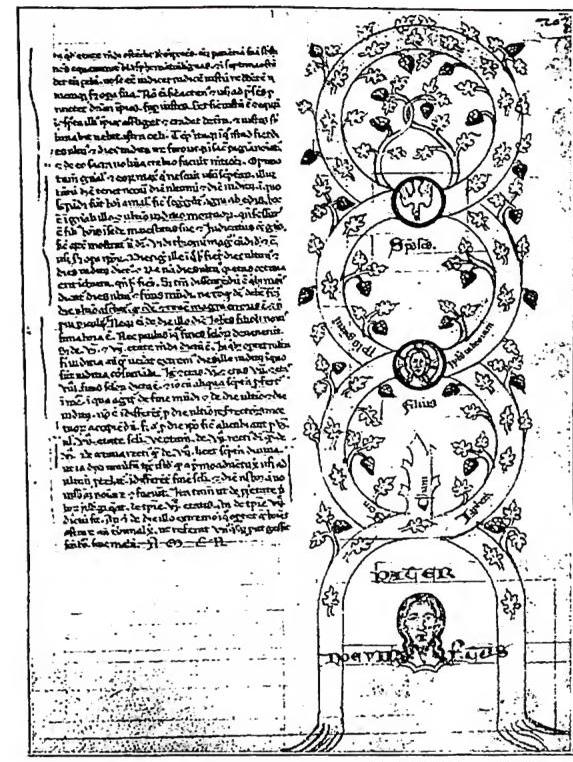
JOACHIM OF FIORE. - He is one of the most representative, but also most complex, figures of medieval spirituality: mystic, reformer, prophet, theologian, exegete; venerated as a saint by some, considered an impostor by others. St. Thomas acknowledges the holiness of his life, but holds that in some of his prophecies he failed.
I. BIOGRAPHY
Born at Celico (Cosenza) around 1130. It is highly debatable that he spent his youth as a page at the Norman court. From a youthful journey of his to the Holy Land, reminiscences surface in his Tractatus super quatuor Evangelia. On his return, around 1155, he entered among the Cistercians of the Sambucina (Luzzi), where he was a porter and where he began to preach. Having moved to the monastery of Corazzo, he was ordained a priest by the bishop of Catanzaro and, in 1177, elected abbot. In 1182-83 he was a guest at Casamari, and from there he went to Veroli to Pope Lucius III, to obtain authorization to put his exegetical ideas on Holy Scripture into writing. At Casamari he dictated to Luke, his future biographer, the Concordia N. et V. Testamenti and part of the Psalterium. In 1186 he reached Urban III at Verona. The Pope urged him to compile the Expositio in Apocalypse. It is pure legend that from Verona he went to Venice to give suggestions on the composition of the famous mosaics, among them those prophetic ones on Sts. Dominic and Francis, of which the Venetian and Franciscan chroniclers have spoken so much. Clement III, on 8 June 1188, addressed an Admonitorium to him to exhort him to complete his works and to submit them to the judgment of the Holy See. Shortly afterwards he separated from the Cistercians and founded the Florense Congregation, which had its center in S. Giovanni in Fiore. It was approved, despite the opposition of the Cistercians, by a bull of Celestine III of 25 April 1196. To 1200 dates his Testamento spirituale, called into doubt by E. Buonaiuti, rather out of prejudice, and defended by H. Grundmann. He died at Canale (Cosenza) on 30 March 1202. His relics were transferred to the archicoenobium of S. Giovanni in Fiore, where he had public cult, to which the Church never gave official sanction. On the tomb was placed a Latin epitaph, which was summarized in the antiphon of Vespers, echoed in turn by Dante in the famous verses of canto XII of the Paradiso, in which G. is placed among the luminaries of knowledge between St. Thomas and St. Bonaventure and precisely for the spirit of prophecy, which on the contrary had been denied him by the Aquinate.
II. THE DOCTRINAL WORK
Joachimite exegesis is not original; but it pushes allegorical interpretation, which is the basis of his system, to the point of the incredible.
As a theologian he received a mortal blow with the condemnation of his Libellus de essentia Trinitatis contra Lombardum by the Fourth Lateran Council, in 1215. The pamphlet has been lost; but its content is known through the expressions of the conciliar condemnation: G. reproached Peter Lombard for a misunderstood quaternity, while he in turn defended a unity by similitude, which came to destroy the unity of essence. F. Foberti, while admitting the conciliar condemnation to be just, contests G.'s authorship of the pamphlet, considering it a forgery presented under his name to the Council. But his defense is weak; no less weak is the defense of G.'s orthodoxy in the matter of the Sacraments and of the Church.
More fortunate, on the other hand, is E. Denifle's clarification concerning the nature of the third age, the cornerstone of the Joachimite message.
The advent of the third age, that of the Holy Spirit, following that of the Father (of fear) and of the Son (of Grace), must not be understood as a new economy or revelation of the Third Divine Person, but as an «intelligentia spiritualis» of the Christian Revelation. It was a deformation of Joachimite thought, carried out by the Franciscan Spirituals, especially by Gherardo da Borgo S. Donnino, that of passing off G.'s three principal works as the «Eternal Gospel». Hence the denunciation to the Holy See and the condemnation of 23 Oct. 1255. Alongside Gerard, among the best-known Joachimites are to be remembered: Giovanni da Parma, general of the Franciscans, Salimbene de Adam, Ubertino da Casale and Angelo da Chiarino in Italy; Ugo de Digne and Pier di Giovanni Olivi in France; Arnaldo da Villanova in Spain and others of lesser note in Germany and in England.
On the subject of influences, it is to be excluded that the Joachimite message found its fulfiller in St. Francis of Assisi; but it cannot be denied that Joachimite arguments were also adopted by St. Bonaventure and by St. Bernardino of Siena; nor can it be ignored that the whole movement of the Flagellants, of the Spirituals, of the Fraticelli and of the Beghini traces back to G. Joachimite influences, direct or indirect, have likewise been detected in Savonarolan prophetism, in the philosophy of history of G. B. Vico, in the lucubrations of Telesforo di Cosenza, in the aspirations of Cola di Rienzo, even in Giuseppe Mazzini and in the Norwegian poet Ibsen, as G. Manacorda has pointed out.
But the most debated question is the asserted Dantean Joachimism, brought to the fore by very recent studies, so as to make of it one of the fundamental motifs of the Comedy. Barbi's warning against exaggerations and deviations has been of no avail; indeed the recent discovery of the Codex of Figures, by L. Tondelli, has only accentuated the tendency.
Bibliography11 works
Francesco Russo