LIBER DIURNUS ROMANORUM PONTIFICUM. - This title (which is not original) designates a collection of formulas for ecclesiastical documents, largely pontifical, preserved in two different redactions in three 9th-century manuscripts, which offers uniquely important information on the administration and discipline
It was believed to be a formulary of the papal Chancery, used daily for the drafting of documents: very recent studies have shaken this conviction and, although research is still underway, the present tendency is to consider it a canonical collection of a private nature, which does not diminish the documentary value of the individual texts.
SUMMARY:
I. Discovery and first edition
II. Manuscripts
III. The text
IV. Date of the collection and date of the individual formulas
V. Nature of the work
VI. Editions.I. SCOPERTA E PRIMA EDIZIONE
Nel 1646 il celebre bibliotecario vaticano Luca Holste ritrovò a Roma fra i codici del monastero di S. Croce in Gerusalemme un antico manoscritto di cui comprese l'eccezionale importanza. Il giorno stesso della sco-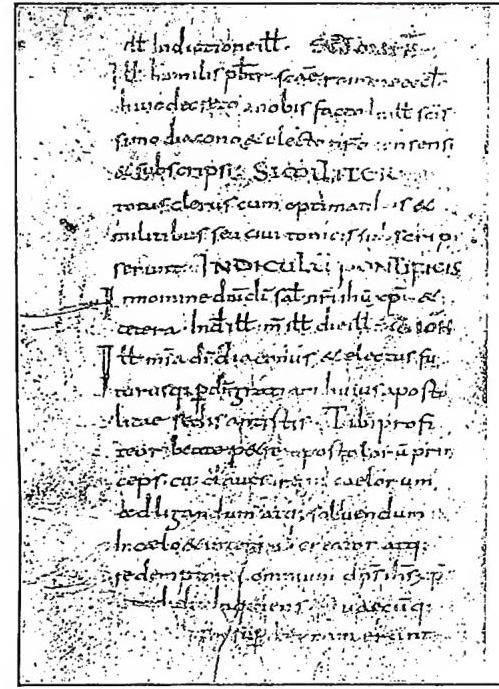
LIBER DIURNUS ROMANORUM PONTIFICUM - The Decretum of the election of the Pope and the Professio of the newly elected in the different redactions of the Vatican codex (fol. 69°) and the Ambrosian codex (p. 132): the text of the Vatican manuscript probably refers to the election of Gregory II (715) and that of the Ambrosian probably refers to Leo III (795) - Vatican Archive and Ambrosian Library.
covery (July 23) he gave notice of it to Card. Francesco Barberini, his illustrious friend.
Immediately around this text, which had become famous, lively polemics began. Having obtained permission from the abbot of S. Croce, Ilarione Rancati, Holste made a copy of it, certainly thinking of prompt publication. It was later rumored that this copy had been made in the space of a single night and "against pledged faith", but A. Ratti definitively dispelled the legend.
Fr. Sirmond sent to Rome the other recently known manuscript, which was in the Jesuit College of Clermont, and preparation for the edition began: but Holste was held back by the concern that the condemnation of Pope Honorius expressed in the Pope's Professio fidei would be exploited, if not suitably understood, by the enemies of the Church. It was a time of polemical tension between France and the Pope, in which the claims of the Gallican Church and papal infallibility were questions of current political interest. The authority attributed to the Formulary was undisputed: it was considered the official book of the papal Chancery and written in the 7th-8th centuries. Lacking a title, it was derived from the Collectio canonum of Deusdedit, which reproduced eleven formulas, three of which bore the indication "Ex libro Romanorum Pontificum qui dicitur (vocatur, appellatur) Diurnus".
It seems that Holste hoped to publish it by 1650, according to a handwritten note in which one reads the title page thus prepared: Diurnus sive vetus formularium, quo S. Rom. Ecclesia ante annos M. utebatur. Lucas Holstenius edidit cum notis. Romae, typis Lud. Griniani, MDCL. The approval of the censors was lacking and upon Holste's death (Feb. 2, 1661) the work, largely printed, was unfinished. Cardinal Barberini, his universal legatee, made haste to solicit printing permission; Fr. Giovanni Bona, consultant of the Index, expressed the judgment (extra congregationem, that is, without official character) that, since the announced notes were not found and since the condemnation of Pope Honorius "pravis
Haereticorum assertionibus fomentum impendit, praestat non divulgari opus". The edition was therefore suspended, not suppressed; the printed sheets were kept in a room of the Vatican Palace until 1685 when, completed with the title page and the missing pp. 225-32, they were put into circulation with a false date: L. D. R. P. ex antiquissimo codice ms. nunc primum in lucem editus studio Lucae Holstenii. Romae, typis Iosephi Vannacci, 1658. A few years earlier, in 1680, the Jesuit Fr. Garnier had published the L.D.R.P. based on Sirmond's codex. The vicissitudes of this laborious edition and the suspicion that greeted Garnier's edition show the atmosphere of fear regarding political repercussions. In 1662 even the apostolic nuncio in Paris intervened to obtain the few sheets that Holste had sent him two years earlier from Msgr. Pietro de Marca, archbishop of Toulouse and later of Paris. Such prejudices lasted in part until the final decades of the last century, when the progress of historical criticism overcame unjustified susceptibilities. It is no longer the question of Pope Honorius that is at the center of interest in the L.D.R.P., but the complex of precious information that it offers and its very nature, internal formation, date of composition, and use.
II. MANUSCRIPTS
In 1889 a third ancient exemplar was discovered by Mons. Antonio Ceriani, bringing to three the total number of manuscripts upon which knowledge of the text is based: 1) Codex Vaticanus (=V), the oldest, attributed to the end of the 8th or, better, the beginning of the 9th century; this is the one discovered by Holste at Santa Croce, where it remained until the end of the 18th century, subsequently passing to the Vatican Archive: following the fate of the latter, it was taken to Paris in 1810 and returned to Rome in 1815. It seems certain that the codex, before being at Santa Croce, belonged to the monastery of Nonantola. 2) Codex Claromontanus (=C), brought from Italy by Fr. Sirmond in 1608 and deposited in the College of Clermont, disappeared after 1746 with the sale of the Library that took place following the suppression of the Jesuits. It was thought to be lost; in 1937 it was donated to the Benedictine monastery of Egmont in Holland. It is attributed to the mid-9th century. 3) Codex Ambrosianus (=A), acquired for the Ambrosian Library by Card. Federico Borromeo in 1606, originates from Bobbio; it appears to correspond to the Diurnus sancti Gregorii liber mentioned in a 10th-century Bobbio catalog.To the 17th and 18th centuries belong six other manuscripts, which are copies made by scholars. In addition, eleven formulas are also transmitted through the Collectio Canonum of Deusdedit, dedicated in 1087 to Victor III (v. the ed. by Wolf von Glanvell, Paderborn 1905, bk. II, pp. 109-12; bk. III, pp. 145-50; bk. IV, p. 427); one formula is included in the Decretum Gratianum, c. 8, dist. XVI.
III. THE TEXT
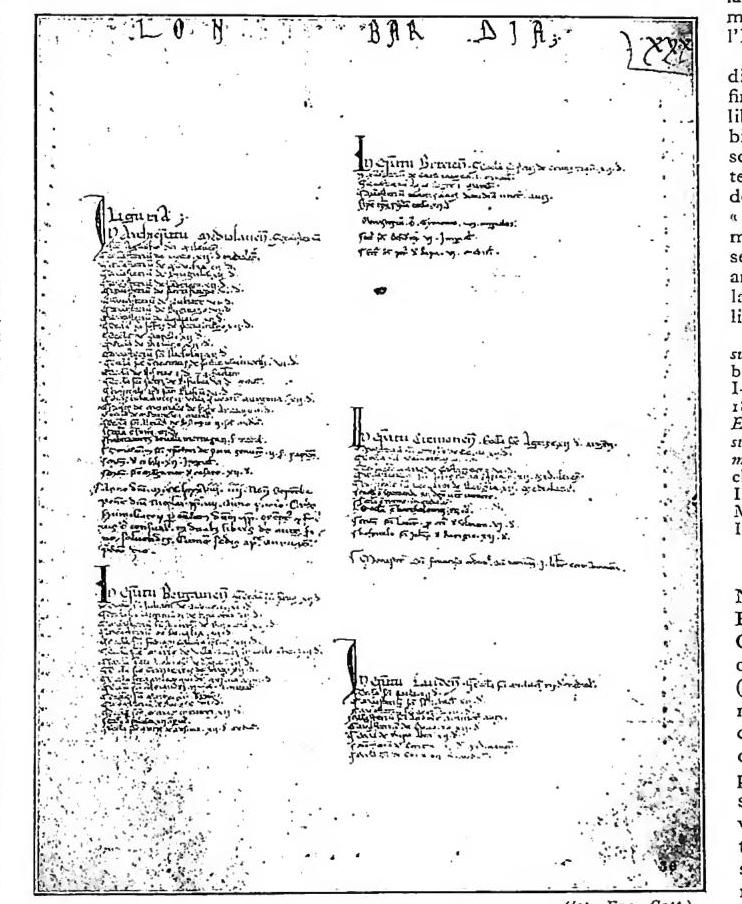
The collection is formed of documents and parts of documents reduced to formulas by suppressing the date and replacing proper names with the pronoun ille; only a few escape this rule by retaining proper names. The number and order of the formulas are not the same in the three manuscripts: cod. V contains 99 formulas, though incomplete at the end; cod. C contains 100, of which 92 are in common with V and 8 are new; cod. A contains 106 (117 in the Ratti ed., because formula I of cod. V bears the numbers I-XII), of which the last three are not included in the other manuscripts.All three codices begin with a series of examples relating to the manner of expressing the superscriptio and subscriptio in letters addressed by the pope to various personages. The subsequent formulas up to XXX are also in the same order in the three codices, while the remaining ones are in a different order; in cod. V, texts on related subjects are repeated at intervals, whereas in codices A and C there is a more orderly distribution of subjects, rightly considered as proof of a later redaction; the order of C is not entirely known, though it seems to agree in general with cod. V. In citations, it is common practice to refer to the numbering of the Sickel ed., which follows the order of cod. V, adding at the end eight formulas from cod. C (from the Garnier ed.).
IV. DATE OF THE COLLECTION AND DATE OF THE INDIVIDUAL FORMULAS
The post quem non limit for the formation of the collection is evidently given by the age of the manuscripts: that is, for the compilation of cod. V, the end of the 8th or the beginning of the 9th century; for the compilation of cod. C and A, respectively, the first half and the beginning of the second half of the same 9th century. The other post quem limit is derived from the text itself, which attributes the most recent formula to the year 795.Much more complex and in many respects more important is the dating of the individual formulas, since they do not belong to the same period. A good portion undoubtedly goes back to St. Gregory the Great (Peitz); perhaps some are pre-Gregorian, such as formulas 73 and 85, which Peitz traces back to the beginning of the 5th century; formula 87 refers to the restoration of the monastery of S. Stefano at S. Paolo fuori le Mura carried out under Gregory II (years 715–31); many name the Emperor with reference to the Empire before Charlemagne, and the Exarch of Italy, whose office ceased in 751; formula 93 names Queen Cynegild with reference to the years 787–88.
It is therefore certain that the L.D.R.P. does not represent the historical conditions of a given moment, but is made up of documents from different times, some of which were no longer current at the time the manuscripts were copied.
V. NATURE OF THE WORK
Until the studies of Th. Sickel there had been no doubts regarding the unitary character of the collection, which was considered the work of an unknown compiler. Sickel recognized in it a successive formation in three stages: Collectio I (formulas 1-63 of codex V), the most ancient nucleus formed ca.the year 625; Appendix I (formulas 64-81) added at the end of the 7th century; Collectio II (formulas 82-99) from the time of Hadrian I, and Appendix II (formulas 100-107) added shortly after the year 800, at the same time that an unknown compiler gave a new arrangement to the four parts (redaction of codices C and A). The question of its formation is linked to the other, more important one of the book's value, whether official or private.
Already in 1680 Fr. Fr. Marchesi (Clypeus fortum..., Roma 1680, p. 276) had denied that the L.D.R.P. was composed in the papal Chancery for its own use, though without well-founded arguments; more solidly, Card. Pitra (Analecta novissima, 1 [1885], pp. 103-105) observed that the subjects are too few compared to those treated by the popes in their letters; beyond this, "more than half of the formulas concern episcopal chanceries, models for writing to the pope, for corresponding between bishops, for drafting chapter, episcopal, and monastic acts regarding an oratory, a baptistery, a reliquary, for a foundation, an oblate, etc.". In reality, over 15 formulas are of non-papal documents.
The studies of Th. von Sickel and the authority of his edition gave new credit to the older theory: with the presupposition that the formulas of certain papal documents (especially those on the election of the pope, including the Professio fidei) could interest only the papal Curia, it was taken for granted that the L.D.R.P. had been written and actually used in the Chancery of the popes; and since codex V (then the only surviving one) is in Caroline minuscule script, given its antiquity, the theory of the Roman origin of this script thus arose. However, this was a hypothesis based on another hypothesis.
Sickel's theory on the origin and nature of the L.D.R.P. was considered definitive until, between 1936 and 1939, a series of new studies subjected many aspects of the question to revision. Already the discovery of codex A and then the finding of codex C modified the state of the manuscript tradition, both being of monastic origin; the presumption that V must have been of chancery origin thus fell away. The new studies have not resolved all questions, but some points can now be considered certain. Santifaller ascertained that only 6 or 7 formularies were actually used as models in the drafting of papal privileges from the 9th to the 11th century: far too little to consider the L.D.R.P. as the official formulary. Fr. Peitz insisted on considering the L.D.R.P. as an official book of the chancery, which had undergone successive evolutions within the chancery itself, but ended up admitting that the three manuscripts represented a literary tradition of it, that is, they were not the codices actually used, but copies of them. Fr. Mohlberg observed that the misunderstanding already lay in the title, because the only source is Deusdedit, who cites a Liber Romanorum Pontificum, where the addition qui dicitur Diurnus derives from the erroneous monastic tradition of a supposed Diurnum B. Gregorii: he therefore considered it a private collection, similar to other famous ones arisen between the 6th and 7th centuries, such as the Leonine Sacramentary.
It seems certain that the L.D.R.P. is a private collection compiled for canonistic interest, perhaps for school use, and therefore copied and studied in monasteries and subject to additions and reworkings. It is certainly of Italian origin; it cannot be excluded that it was composed in Rome, but it does not constitute the formulary of the papal Chancery. In any case, no doubt subsists regarding the historical authenticity of the individual texts of which it is formed.
VI. EDITIONS
The first edition, prepared by L. Holste and left unfinished at his death, then published with the false date of 1658, has been described above; it reproduces cod. V while utilizing C in part. Based on cod. C was the second: I. Garnerius, L.D.R.P. ex antiquissimo codice ms. nunc primum in lucem editus (Paris 1680). In 1687 J. Mabillon published in the Museum Italicum (I, II, p. 32 seq.) the Libri Diurni R. P. Supplementum with 8 formulae from cod. V to complete Father Garnier's edition. Void of scientific value with respect to the text, because derived from the preceding ones, are all the