
ACCUSATIONS AGAINST CHRISTIANS. – These were the insults and calumnies hurled by the Jews and pagans against the followers of the religion of Jesus Christ during the first three centuries; they served as a pretext for the Roman State’s policy of persecution against them.
The Jews who had persecuted and crucified Jesus showed themselves from the outset to be determined enemies of his disciples. The principal accusations they directed against Christians may be inferred from the Dialogue of St. Justin with the Jew Trypho, according to which the Jews reproached Christians: a) for not observing the Law—that is, for not being circumcised and for not observing the feasts and the Sabbath (Dial., 10); b) for professing a false doctrine, namely, for denying the God of Abraham, Isaac, and Jacob (Dial., 11); c) for placing their hope in a crucified man (Dial., 10), regarding him as the promised Messiah, whereas, according to the Jews, he had not yet been born or was living in hiding, because Elijah had not yet returned, he who was to prepare his way, anoint him, and make him known to all (Dial., 8).
Jewish hostility soon found a counterpart in the hostile attitude and persecution of Christianity by the pagans.
At first, that is, when the religion of Christ was regarded by the pagans as a sect of Judaism, Christians, in the words of Tertullian
When the distinction between Christianity and Judaism became clear—officially during the persecution of Nero (64–68)—the Christians found themselves opposed by pagans both from the populace and from the educated classes.
The populace accused them of atheism, cannibalism, and incest: « Tria nobis - writes Atenagora, Legatio pro Christianis, 3 - affligunt crimina: atheismum, Thyesteas coenas, Oedipeos concubitus ».
The crime of atheism, already attributed to the Jews, was charged against Christians during the persecution of Domitian. Dione Cassio (Hist. Rom., LXVII, 14) reports, in fact, that Flavio Clemente and Flavia Domitilla, along with many others, were condemned for the crime of atheism. During the martyrdom of s. Policarpo (cf. Eusebio, Hist. eccl., IV, 15), the assembled crowd shouted « down with the atheists », and the judge demanded that the martyr repeat the cry. S. Giustino (Iᵃ Apologia, 6) wrote: « athei appellamur » and reported of the Cynic philosopher Crescente (Iᵃ Apologia, 3): « ... publice testatur... atheos et impios esse Christianos, ad gratiam... plebiculae ».
In 177 the martyr Vezzio Epágato, speaking on behalf of the other martyrs of Lyons, openly demonstrated that there was neither atheism nor impiety among Christians (cf. Eusebio, Hist. eccl., V, 1). Atenagora (Legatio pro Christianis, 13 and 14) states that the pagans « nos atheos esse criminantur », and Minucio Felice (Octavius, VIII, 2) has the pagan Cecilio Natale say that Christians are worse than Diagora, « cui ἀθεον cognomen adposuit antiquitas ». Finally Tertulliano (Apologeticum, 24 and 27) recalls that Christians were charged with the « crimen lesae romanae religionis », « crimen irreligionis », « crimen lesae divinitatis », which was also designated by the name « sacrilegium » (Apol., 10).
The crime of cannibalism, commonly called the crime of « Thyestean banquets » (Atenagora, Legatio pro Christianis, 3; Atti dei Martiri di Lione, in Eusebio, Hist. eccl., V, 1) and sometimes also that of the « Mysteries of Saturn » (s. Giustino, IIᵃ Apologia, 12) or « infanticide » (Minucio Felice, Octavius, IX, 5; XXVIII, 2; Tertulliano, Apol., 2, 4, 9), is first recalled, indirectly, in the Dialogo con Trifone, 10, when s. Giustino asked his interlocutor: « utrum hanc de nobis opinionem vos quoque accepitis, humanis nos vesci carnibus ». From the testimonies of the Apologists of the 2nd and 3rd centuries, it appears that this accusation was directed against Christians almost everywhere: in Syria, Asia Minor, Greece, Africa, and Italy. There is no doubt that the accusation of cannibalism directed against Christians was connected with the Eucharistic practice of eating the flesh of the divine Lamb.
The crime of incest or Oedipal unions was charged against Christians more or less in the same places as the crime of cannibalism (s. Giustino, Iᵃ Apologia, 26; Dial., 10; Atti dei Martiri di Lione, in Eusebio, Historia eccl. V, 1; Atenagora, Legatio, 3 and 31; Teofilo Antiocheno, Ad Autolicum, III, 4; Epistola ad Diognetum, V, 7; Minucio Felice, Octavius, IX, 6–7; XXXI, 1; Tertulliano, Apol. 4, 9).
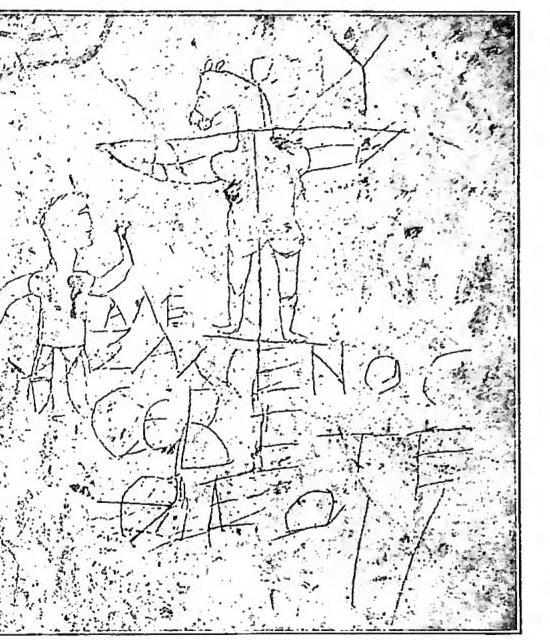
Alongside these three accusations, there were others of lesser importance and more limited circulation. These included, for example, the accusation of onolatry (Minucio Felice, Octavius, IX, 3; XXVIII, 7; Tertulliano, Ad nationes, I, 11, 14; Apol. 16; Tacitus would have been the one to accuse Christians; Graffito del Palatino); and the accusation of worshipping the « genitalia sacerdotis » (Minucio Felice, Octavius, IX, 4; XXVIII, 10).
In Minucio Felice’s Octavius (IX, 3–7), the pagan Cecilio Natale presents the last four accusations we have enumerated against Christians as follows: « Audio eos (Christianos) turpissimae pecudis caput asini consecratum inepta nescio qua persuasione venerari... Alii eos ferunt ipsius antistitis ac sacerdotis colere genitalia et quasi parentis sui adorare naturam... Iam de initiandis tirunculis fabula tam detestanda quam nota est. Infans farre conectus, ut decipiat incautos, adponitur ei qui sacris imbuatur. Is infans a tirunculo farris superficie quasi ad innoxios ictus provocato caecis occultisque vulneribus occultitur. Huius, pro nefas! sitientem sanguinem lambunt, huius certatim membra dispertiunt, hac foederantur hostia, hac conscientia sceleris ad silentium mutuum pignerantur! Haec sacra sacrilegiis omnibus taetriora. Et de convivio notum est; passim omnes loquuntur, id etiam Cirtensis nostri testatur oratio. Ad epulas sollemni die coeunt cum omnibus liberis, sororibus, matribus, sexus omnis homines et omnis aetatis. Illic post multas epulas, ubi convivium caluit et incestae libidinis ebrietatis fervor exarsit, canis, qui candelabro nexus est, iactu offulae ultra spatium lineae, qua vinctus est, ad impetum et saltum provocatur. Sic, everso et extincto conscio lumine, impudentibus tenebris nexus infandae cupiditatis involvunt per incertum sortis, etsi non omnes opera, conscientia tamen pariter incest, quoniam
voto universorum adpetitur quicquid accidere potest in actu singulorum ».
The accusation of onolatry, as we have seen, had already been directed against the Jews; that of worshipping the « genitalia sacerdotis » is almost certainly related to the attitude of Christians during the sacrament of penance.
The accusation of worshipping the sun, mentioned by Tertulliano (Apol. 16) and Minucio Felice (Octavius, XXVIII, 10), is related to the position Christians adopted during prayer, facing east.
S. Giustino repeatedly attributes to the Jews responsibility for having invented and circulated the calumnies that pagans attributed to Christians: « ... scelestos viros, tunc (after the resurrection and ascension of Christ) Hierosolymis in universum orbem misistis, impiam christianorum haeresim prodisse dicentes, eaque spargentes quae in nos ab iis omnibus, quibus noti non sumus, dicuntur. Itaque non vobis solum iniquitatis causa estis, sed aliis etiam omnibus prorsus hominibus... » (Dialogo con Trifone, 17). Origene asserts the same thing, particularly with regard to the accusations of cannibalism and incest (Contra Celsum, VI, 27).
The Christians were also accused of magic, of raising winds and storms, of calling down famine and plague, and of exercising malign influence over sacrifices. Tertullian, gathering up the popular echo that presented Christians as the cause of all evils, wrote (Apol., 40): « Si Tiberis ascendit moenia, si Nilus non ascendit in arva, si caelum stetit, si terra movit, si fames, si Iues, statim: - Christianos ad Iconem - adclamatur ». Lactantius (De mortibus persecutorum, 10) relates that the persecution of Diocletian was supposedly occasioned by the malign influence through which the Christian officials had prevented the response that the emperor expected from the haruspicy performed at Antioch after the sacrifice had been offered. At least, this was the explanation that the chief of the haruspices, called Tagi, gave to Diocletian. Frequent insistence was placed on the vain and terrifying fantasies spread by Christians (Minucius Felix, Octavius, V, 6 ff.).
The educated people of the pagan world did not treat Christians any better than the common people, whose prejudices they did not hesitate to follow when called upon to express their judgment.
Pliny the Younger (d. in 113) judged Christianity to be a « superstitio prava et immodica » (Epist., X, 96, 8); Tacitus (d. in 119) defined it as a « exitialis superstitio » (Annales, XV, 44); Suetonius (d. in 160) called it a « superstitio nova ac malefica » (Vita Neronis, 16, 2).
The Cynic philosopher Crescens (active ca. 160), an opponent of s. Giustino, publicly repeated in his διατριβαι the accusations of atheism and impiety against the Christians (s. Giustino, IIᵃ Apol., 3).
Frontone di Cirta (d. ca. 170), tutor to the emperor Marcus Aurelius, in a speech delivered either in court or in the Senate, repeated against the Christians the vulgar calumnies of cannibalism and incest (Minucius Felix, Octavius, IX, 6; XXXI, 2). Luciano di Samosata (d. in 180), in the De morte peregrini, wishing to satirize the Cynic philosophers in general and his contemporary Teagene in particular, chose as the protagonist of his Dialogo Proteo Peregrino, who had been a Christian, then an Egyptian ascetic, and finally a Cynic philosopher and suicide. In this way he succeeded in making the Christians ridiculous on account of their heroic contempt for torments and for death itself.
Celso (d. ca. 180) wrote in 175 a lengthy refutation of Christianity, Ἀληθής λόγος, which has been lost, but which Origene, in refuting it around 248, preserved almost halfway in his own text, while also giving its entire structure. According to this, the work consisted of four parts: in the first, a Jew refuted the Christians’ faith in the promised and come Messiah; in the second, a pagan criticized the messianism of the Jewish people; in the third, the same pagan polemicized against Christianity, denying the incarnation of the Word because it was contrary to Plato’s theory of divine transcendence, and regarding Jesus as a mere man, who deserved the condemnation of death on the cross and the betrayal of his own disciples, « omni peccato nequiores »; in the fourth, Celso defended the State religion as the principal source of the greatness of the Roman Empire and urged Christians to abandon their faith and return to the religion of their fathers.
A century after Celso, around 268, Porfirio resumed the struggle against Christianity with a great work in fifteen books, κατὰ χριστιανῶν. In its particulars he often coincides with Celso, from whom he differs in polemical aims and in his keen concern for the destiny of the Roman Empire, concerns foreign to Porfirio’s mind or which, at the very least, left him indifferent. To judge from the surviving fragments of the work, preserved in the Apocriticus of Macario Magnete, Porfirio saw in Christianity nothing but obscurity, incoherence, illogicality, and lies. For him, a decisive struggle was under way between the ancient civilization, represented by tradition and law, and the new, impudent, and barbarous civilization, represented by Christianity, which threatened its very existence. In this struggle he threw himself into the fray with all his partisan soul.
During the persecutions of Diocletian, some pagan writers joined that great religious war. Lactantius (Institutiones divinae, V, 7) recalls an unnamed philosopher who had supposedly « vomited » three books against the « Christian name », with mediocre success. By contrast, he considers dangerous the pamphlet of a judge who is generally identified with Sossiano Gerocle, governor of Lower Egypt. Internal elements of the pamphlet, entitled Λόγος Φιλαλήθῆς, lead one to believe that its author knew Porfirio’s great work and made skilful use of II.
Quite a few philosophers, sophists, rhetoricians, and grammarians, even after the official recognition of Christianity by the Roman State, continued stubbornly in the schools to cultivate the worship of ancient literature and the old religion, thereby contributing to its persistence among the intellectual class.
Once the Roman State succeeded in clearly distinguishing Christianity from Judaism, and once it saw in the Christian program the destruction of paganism—that is, of the official religion of the Empire (cf. Minucius Felix, Octavius, VIII, 1: « ... hanc religionem ... dissolvere aut infirmare... »)—it began against the Christians that bloody struggle extending from Nero to Constantine, from 64 to 313, from which Christianity emerged victorious (v. PERSECUZIONI CONTRO I CRISTIANI). In the trials against the followers of Christ, almost all the accusations that the common people and the educated attributed to them came to light, but the accusation on which the Roman State based its repressive action, denying Christianity the right to exist, was always the accusation of atheism. The refusal to sacrifice to the statues of the gods and of the emperor was the sole point of conflict between State and Church,
and they therefore found themselves irreconcilably at odds. Tertullian (Apol., 10) wrote: « Sacrilegii et maiestatis rei convenimur, summa haec causa, imo tota est », and consequently the Christian Apologists rightly asserted that the « nomen ipsum » was punished with death, since experience showed that the true follower of Christ would never sacrifice: « quorum nihil posse cogi dicuntur qui sunt revera Christiani » (Pliny, Epp., X, 96, 5).
How deeply the above-mentioned accusations affected the minds of all their contemporaries is confirmed by the Apologies that, in the second and third centuries, Christian writers addressed to emperors whom they considered more enlightened, or to pagans in general, or to private individuals. All were directed toward erasing that unfavorable impression, either by describing the pure and charitable life of Christians and their perfect loyalty, or by turning the accusation back through a just and severe critique of the pagan world.
Benedetto Pesci ACEFALI. -
I. ERESIA
Nome dato a quei monofisiti che rifiutarono di accettare la formola di fede promulgata dall'imperatore Zenone nell'anno 482 con l'Enotico. Vennero così chiamati perché per qualche tempo non furono in comunione con nessuno dei cinque patriarchi che si dividevano l'alta giurisdizione su tutti i vescovi della cristianità: erano dunque senza capo (ἀλέξανλοι), cioè senza patriarca, quantunque non fossero senza vescovi. Essi diedero luogo alla prima scissione importante tra gli avversari del Concilio di Calcedonia. Ma tale scissione fu di breve durata; anzi, si può dire che cessò prima ancora che l'Enotico fosse ufficialmente revocato dall'imperatore Giustino I nel 518, perché, in quell'epoca, gli a. non erano più senza capo, avendo conquistato i tre patriarcati di Alessandria, Costantinopoli ed Antiochia, mentre il solo patriarcato di Gerusalemme continuava a mantenersi aderente alla formola enotizzante.Morto l'imperatore Zenone, Anastasio, suo successore (491-518), abilmente raggirato dal monaco Severo, principale esponente degli a. divenne loro nettamente favorevole. Nel 511 un prete acefalo, Timoteo, prese sulla cattedra di Costantinopoli il posto dell'enotizzante Macedonio II, che era stato deposto. L'anno seguente, Severo veniva eletto patriarca di Antiochia, mentre Alessandria si trovava già in possesso di un a. Oramai il nome non aveva più ragione di essere, ma i cattolici continuarono a servirsene per indicare i monofisiti dissidenti autonomi nell'Egitto e nella Siria. Nei secc. VIII e IX s. Giovanni Damasceno e s. Teodoro Studita componevano ancora trattati contro gli a.
La storia del movimento a. tra gli anni 482 e 518 presenta molte complicazioni, specialmente in Egitto ed in
Palestina. La grande maggioranza dei monaci di questi paesi coi loro archimandriti furono a. Oltre Severo d'Antiochia, i principali capi del movimento furono Filosseno di Mabbug, Pietro l'Iberiano, vescovo di Maiuma, e il nubiano Nephalios, che poi passò al partito enotico (v. MONOFISITI).