BERNARDO, archdeacon of AOSTA, saint. —
SUMMARY:
I. Life
II. Iconography and sacred representations
III. Hospice of the Great Saint Bernard
IV. Hospice of the Little Saint Bernard.I. LIFE
Born of a noble lineage (a recent hypothesis makes him a member of the family of the viscounts of Aosta) at the dawn of the eleventh century; an eloquent and indefatigable preacher, he was archdeacon of Aosta, and the founder, or more properly the restorer, of the hospice on Mons Jovis, later called the Gran S. Bernardo, and probably also of that of the Colonna di Giove, later called the Piccolo S. Bernardo. His feast is celebrated on 15 June.From Novara, where he was preaching, B. went to Pavia (April 1081) to meet the emperor Enrico IV, who was preparing to undertake hostile action against the countess Matilde and Gregorio VII, in order to dissuade him from such a project; on his return to Novara he died there on 15 June of the same year, leaving behind a widespread reputation for holiness. He was buried in the church of the monastery of S. Lorenzo. From a document dated 15 June 1424 it is inferred that he was canonized by the bishop of Novara, Riccardo (1115–21); however, his introduction into the Roman Martyrology dates only from 9 August 1681. His cult was, and still is, very widespread in Piedmont, in the Valais (Switzerland), and in Tarentaise (France). He was introduced into the Proprio of the Canons Regular of the Most Holy Savior of Bologna by the General Chapter of 1481 (cf. G. Grisostomo Trombelli, Memorie istoriche concernenti le due canoniche di S. Maria di Reno e di S. Salvatore, Bologna 1752, p. 190). Pius XI proclaimed him, on 20 August 1923, patron of mountaineers, inhabitants, and travelers of the Alps (cf. AAS, 15 [1923], pp. 437–42).
No trace has yet been found of the life of B. written by his brother Azolino; consequently, the few reliable facts known about B. must be sought in the Vita (or rather, panegyric of the Saint) preserved in two slightly different versions, the oldest manuscripts of which are found at Novara (twelfth–thirteenth century) and Aosta (thirteenth–fourteenth century).
II. ICONOGRAPHY AND SACRED REPRESENTATIONS
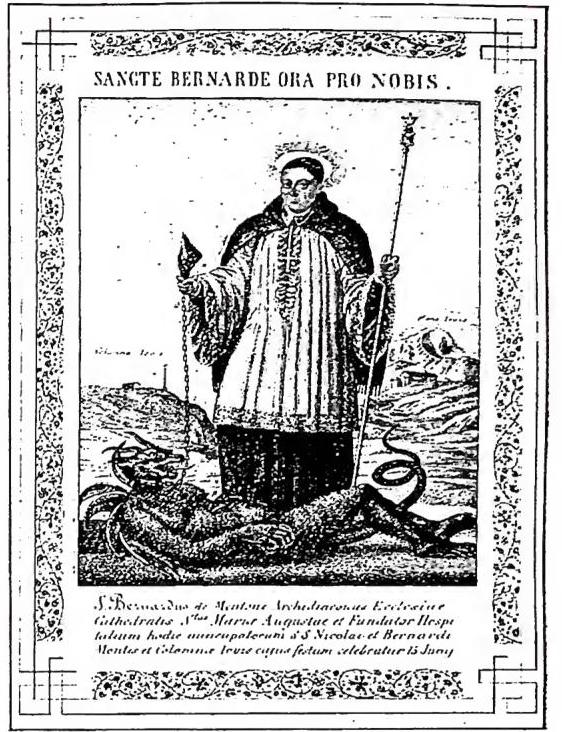
S. B. is generally represented in canonical choir dress: rochet, almuce, and archidiaconal staff; often, from the fifteenth century onward, he holds the devil chained at his feet with the stole transformed into an iron chain, an iconographic motif shared with certain other saints, among them St. Bernardo di Chiaravalle. An anonymous fifteenth-century author staged the life of the Saint in the drama entitled Mystère de s. B. de Menthon, performed several times at the Gran San Bernardo and at Aosta; it unfolds over three days and comprises 4,340 lines. More recently, Henry Ghéon reworked it in his Merveilleuse histoire du jeune B. de Menthon, Paris 1924, performed that same year at Annecy.Literature: among the many ancient and modern lives of little critical value, we mention only those by R. Vior, Mireir de toute sainteté en la vie de s. B. de M., Lyon 1627 (Latin version, Monaco 1652; Italian version, 1655); [G. Dorsaz], Vie de s. B. de M., Paris 1862; P.-A. Pidoux de La Maduère, S. B. de M., Lille 1923
(Italian version S. Lesna, Ivrea 1931); id., s. V. in DHG, VIII, cols. 690–96; C. Mazzone, S. B. da M., Varallo Sesia 1925.
The recent works of J.-A. Duc deserve particular mention. A quelle date est mort s. B. de Menthon, in Misc. di Stor. Ital., s. II, XVI (XXXI), Turin 1893, pp. 343–88; L. Quaglia, S. B. de Montjou [*G. S. Bernardo 1939], in lithography; A. Donnet, S. B. et les origines de l'hospice du Mont-Joux, St-Maurice 1942 (a work of considerable critical merit); L. Quaglia, S. B. de Montjou d'après les documents liturgiques, in Zeitschrift für schweizerische Kirchengeschichte*, 38 (1944), pp. 1–32.
III. HOSPICE OF THE GREAT S. B. — The pass on which the hospice stands is situated at an altitude of 2473 m above sea level, in a narrow and wild gorge east of M. Bianco in the Pennine Alps. It was known and traversed long before the Romans and was sacred to the god
Penn, whence its name of «Alpis Poenina, Poeninum, Summus Poeninus». The Romans consecrated it to Jupiter Penninus (hence the new designation Mons Iovis, Mont-Joux, Plan de Jupiter, Plan de Joux, Monte di Giove), and erected there a small temple and two shelter houses («mansiones»), improving the access roads. When pagan worship ceased toward the end of the 4th century (cf. S. Agostino, De Civ. Dei, V, 26), the shelters also fell into decline, and nothing more is heard of them until the end of the 8th century (cf. Letter of Pope Adriano to Carlomagno, Jaffé-Wattenbach, 2471); the pass became unsafe. The hospice rebuilt in the Carolingian period, dedicated to S. Pietro and entrusted to the care of monks, probably Benedictines, stood not on the pass but somewhat lower down on the Swiss slope, where Bourg-St-Pierre now stands. When the pass again became unsafe because of the Saracen and Hungarian invasions (10th century and part of the 11th), s. B. decided to build a hospice there (mid-11th century), replacing the destroyed Carolingian one, and entrusted its custody from the outset, it seems, to a community of Canons regular (v.), still existing and flourishing. S. B. dedicated the hospice to s. Nicola, but already in the following century the founder’s name was added to that of the titular saint, who soon became secondary: «Hospitium Bernhardi, domus hospitalis s. Bernardi». The work of s. B. must be numbered among the most heroic initiatives of Christian charity and human solidarity: that it was always held in such esteem is attested by the very numerous donations of immovable property, which a bull of Alessandro III dated 18 June 1177 already records as existing not only in the neighboring valleys, but in Italy, Sicily, France, Switzerland, and England (cf. Jaffé-Wattenbach, 12.872). The provosts of the Congregation also resided at Aosta. The Congregation experienced alternating periods of prosperity and decline, but its saddest period was that which began with the commendatory provosts (1465-1586) and ended with its suppression in the Savoy States by Benedetto XIV (1752). The Congregation then regained new vitality in Swiss territory. The Canons enjoyed Napoleone’s favor because of the welcome they gave him in May 1800, when he crossed the pass with his troops. Since the beginning of the 19th century, the Canons of the Great S. B. have also administered the hospice erected on the Simplon Pass in the canton of Valais. Since 1933 they have operated the «Missione del Tibet», situated on the borders of Burma, Tibet, and China, with its center at Weisi (Yünnan); from 1936 they began work on the construction of a hospice on the Lassa Pass, at an altitude of 3800 m above sea level, a much-frequented transit point between the valleys of the Mekong and the Saluen (Yünnan).
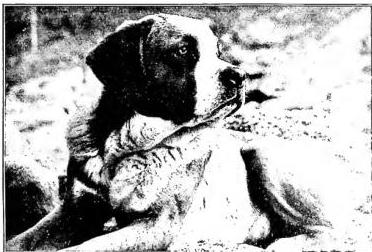
In the hospice, in addition to a collection of sacred objects and vestments, there are the archives, the library (approximately 30,000 volumes; 17 manuscripts from the 11th century onward, some illuminated; 16 incunabula, including a breviary from Moûtiers in Tarantaise dated 1486), and a museum with rich collections of local interest: archaeological (more than 3,000 Gallic, Roman, and medieval coins, numerous ex votos to Jupiter, etc.), entomological, ornithological, and mineralogical. Also characteristic are the dogs of San Bernardo, larger than Newfoundland dogs, with long hair, a short and broad muzzle, drooping lips and ears, and exceptionally keen senses. They provide valuable assistance in searching for travelers lost in the snow; the famous Barry saved more than 40 people in the last century. The first information about their pre-