
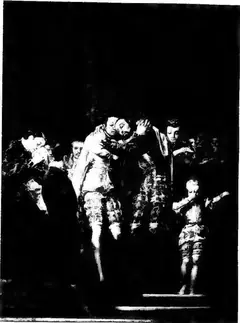
FRANCIS BORGIA (de Borja), Saint. - Third prepostor general of the Society of Jesus, b. at Gandia (Spain) on 28 Oct. 1510, d. at Rome on 30 Sept. 1572. Great-nephew of Pope Alexander VI and of Ferdinand the Catholic. After an early education that was largely within the family, under the influence of his grandmother and of an aunt who was a Poor Clare, he took refuge, on the occasion of an uprising, at Saragossa with his uncle the archbishop, where he devoted himself to studies, music and arms. In 1523-35 he lived at Tordesillas (Valladolid) as a page of Joanna, mother of Charles V, and, having returned from his uncle's, he completed his studies in philosophy. In 1528 he went to the court of the Emperor and the following year, at the wish of Charles V, he married donna Leonora de Castro, a favorite lady of the Empress, and was named Marquis of Lombay and chief equerry. F. B. was already distinguished at that time for piety, honesty and nobility. The death of the Empress and the meditation on the vanities of the world at the sight of her putrefied corpse, at Granada (1539), brought about a full conversion of the Saint to God, reinforced by the counsels of St. John of Avila. Appointed viceroy of Catalonia (1539-45) and having become Duke of Gandia (1543), F. B. governed his peoples with great wisdom and prudence, until at the death of his wife (1546) he was accepted into the Society of Jesus by St. Ignatius. Having taken his solemn vows in 1548, he remained, with a dispensation from the Pope, still at the government of the duchy, until he had settled the position of his children. On 31 July 1548 he obtained from Paul III the bull Pastoralis officii, which approved the book of the Spiritual Exercises, and on 15 Oct. 1549 another, Licet debitum, which granted important privileges to his Order, to which he also entrusted the university college erected at Gandia. In 1550, having gone to Rome for the Jubilee and having been received there solemnly, he decided on abdication, which he carried out on his return to his homeland, to great emotion throughout Europe.
Ordained a priest (23 May 1551), he began journeys of preaching with great gatherings of crowds. Appointed commissary general for Spain and Portugal (1554), the Saint extended and strengthened the young Order, organizing 3 provinces with their dependent missions (Florida, New Spain and Peru), founding houses (Placencia, Valladolid, Seville, Simancas, etc.). Charles V, who had always esteemed him, wished to have him near him several times in the convent of San Justo, where he had retired, leaving him his executor (1558). There followed a period of trials, of misunderstandings with Philip II, because the malicious had slandered the Saint, of perplexity over the condemnation by the Spanish inquisitor of the works of F. B. Only later was it learned that the measure was due to the fact that the publishers, unknown to the Saint, had printed together with his works also the scarcely orthodox writings of certain unknown persons. Summoned to Rome by Pius IV, F. B. was appointed assistant of Spain and vicar general and, after the death of St. Llanes, he succeeded him in the government of the whole Order (1565), which he strengthened internally and externally, arranging for a new (Latin) version of the Constitutions, promulgating the Regulae communis (1567), and formulating better those of the individual offices. The spiritual practices and customs were fixed with greater definiteness. F. B. founded the Roman College, the novitiate of Sant'Andrea al Quirinale, the College of Penitentiaries and the Roman Seminary. He obtained the growth of the Society of Jesus in France and in Germany, its introduction into Poland and into the missions of the West Indies. He was held in great esteem by St. Pius V, to whom however he respectfully resisted when the Pope wished, by changing the constitutions, to introduce into the Order the obligation of the choir. Sent by the Pope on the legation to Spain, Portugal and France for the league against the Turks, and having discharged the important assignment (1571), F. B. died at Rome. He was beatified in 1624 and canonized by Clement X on 12 Apr. 1671. - See plate CV.

Bibliography6 works
Arnoldo Lanz