
CANDELABRUM. - I. LITURGY. - The liturgical candlestick derives its origin from the usual furniture of Roman houses, and for this reason its form has nothing typically sacral about it. The first Christian iconographic examples are found in sepulchral art. St. Athanasius (Epist. Encyclica, 4: PG 25, 229) speaks of candlesticks affixed to the walls of the church, removed by the pagans who also carried off the candles to burn them before idols: Prudentius notes golden candlesticks (Peristephanon, II, 5, 71: PL 60, 300), and the Statuta Ecclesiae Antiquae (Denz-U, 154) require that the ordination of the acolyte be performed with the handing over of the cereoforaleum. In the Ordines Romani, in fact, it is the acolytes' task to carry before the Pontiff the septem cereostata, which were of gold and silver, or two before the Gospel (Ordo Rom., I, 8; 3, 1; 11, 1). In the Lib. Pont. too there is frequent mention of candlesticks donated to basilicas. We have no indication whether the candlesticks that preceded the celebrating Pontiff were set down on the altar when he reached it. In the oldest representations of altars candlesticks never appear. On the ivory cover (9th century) of an evangeliary preserved at Frankfurt am Main the two candlesticks are placed beside the altar. The various Consuetudines of the 11th and 12th centuries speak of candlesticks placed before and behind the altar. At the same period, however, altars with candlesticks appear. The first who supposes them placed on the altar is Innocent III (De Sacro Altaris Mysterio, II, 21: PL 217, 811). A very ancient custom, on the other hand, was that of placing small candlesticks on processional crosses and on the ciboria of altars, or on iconostases. Nowadays there are, against all the rules, including aesthetic ones, as many as thirty or forty.
Ecclesiastical legislation requires that the candlesticks be placed on the surface of the altar. The Decreta authentica, no. 3759, permit the candlesticks to stand on the small raised surface that completes the rear part of the altar, while it remains forbidden to affix them to the wall (Decr. aut., no. 3137, 1 and 4). The Caeremoniale Episcoporum would have it that on feast days the candlesticks be of silver, or at least of bronze or gilded copper, and be graduated in such a way that the two central ones are the tallest, and the cross taller than they. But general usage is by now contrary (Decr. aut., no. 3035, 7): v. CERO, CEROFERARIO.
Bibliography4 works
Salvatore Marsili
II. ART
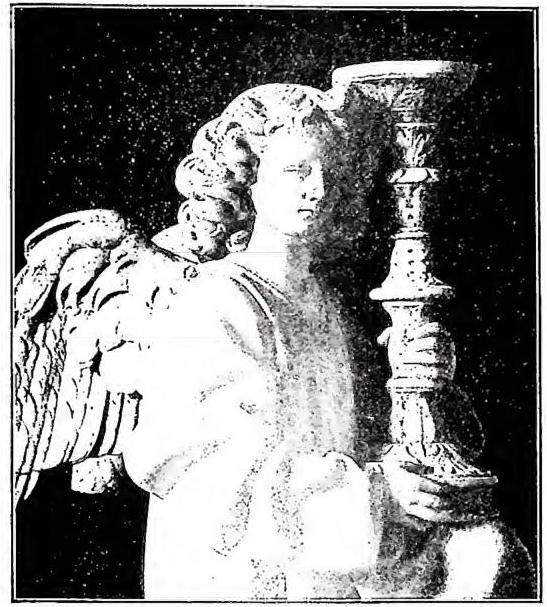
Any support in wood, iron or stone intended to hold candles. In particular use, that of the altar; if of large dimensions or intended for several candles it is generally called a candelabrum. From records and representations we know that the candlesticks of the early Christian age and of the early Middle Ages generally had the form of a stem resting on three or four feet and supporting a cup. There were some of bronze, of silver, of gold. During the Romanesque age the decorative taste of the time was reflected in the candlesticks. E.g.: the silver ones of the cathedral of Hildesheim and the grand candelabrum of the cathedral of Milan, the work of Nicholas of Verdun.
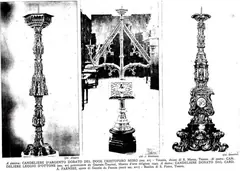
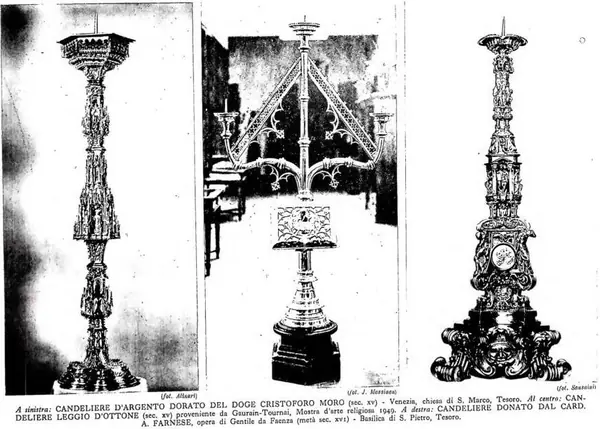
In the Gothic period the shaft, the base and the knops of the candlestick become densely filled with ornaments reflecting forms and decorative motifs characteristic of the new style. Thus in the candlestick donated by Doge Cristoforo Moro (1462-71) to the basilica of St. Mark in Venice. In the Renaissance the candlesticks reflect with full evidence the architectural taste of the time and the importance that was then attributed to the beauty of forms in every human activity. E.g.: the candlesticks by Andrea Riccio for the church of the Santo in Padua and by Antonio Gentili in the treasury of St. Peter's in Rome. Benvenuto Cellini too made candlesticks for the bishop of Salamanca.
The new decorative richness reflected in the churches during the Baroque period also manifested itself in the candlesticks, which were often modeled by the same goldsmith-sculptors who executed the crosses and the cartegloria that furnished the same altar with a sense of unity. Gian Lorenzo Bernini certainly intervened with his advice in the bronze candlesticks executed for St. Peter's at the time of Alexander VII. Among the candlesticks of the 18th century are to be remembered the very beautiful ones by Arrighi and by other Roman goldsmiths and sculptors worked at the time of Benedict XIV for the chapel of St. John in S. Rocco in Lisbon.
In modern production, besides repeating ancient forms, an attempt is made to impress upon candlesticks too the simple and essential lines responding to the taste of the new architecture.
Bibliography5 works
Emilio Lavagnino
III. - FEAST OF THE C. - In Sassari, the feast of the c. is still celebrated with great pomp on 14 August, for the Assumption. It is so called because seven (once eight) enormous c. are carried in procession, wooden constructions made up of three parts: the pedestal, supported by means of poles by eight men, the column, about 3 m. high, and the capital, variously adorned with a taste somewhere between the popular and the baroque.
Each c. corresponds to one of the eight guilds (in dialect gremi) into which the people of Sassari were gathered (four major, of the rustici; and four minor, of the cittadini). In the early hours of the morning the banner of the gremio of the massai (farmers) is carried to the town hall and displayed together with the Sardinian flag and that of the Commune, while the bases and columns of the c. are transported into the church of the Rosary, the capitals remaining with each of the heads of the 7 gremi, who are required to deck them out with bows, ribbons and little flags. The procession forms, and as it passes before the Town Hall it offers the occasion for the mayor and the council to hand over the flag to the head of the massai, while the valets and mace-bearers salute by striking the silver maces made expressly from the origin of the feast. The ceremony concludes in the church of St. Mary, where the c. are deposited near the Assumption, which in Sardinia is always portrayed on her deathbed. The feast goes on until evening, with the firing of firecrackers and amid merriment and dancing. It was instituted in 1580 at the cessation of a cruel plague, whose end happened to coincide precisely with the feast of the Assumption. By the citizens who had escaped the scourge, a candle of one hundred pounds was vowed to the Virgin. Then each gremio wished to offer its own: in time the candles were replaced by large c. with lighted torches; and since these caused some damage, the present wooden constructions came about. Following the example of Sassari, the feast of the c. has spread also to some neighbouring villages, such as Nulvi and Ploaghe. Apart from the historical circumstance that gave rise to the feast, it is to be seen in it as one of the manifestations of popular worship, which find frequent analogies in the customs of other regions. - See Pl. XLI.
Bibliography2 works
Paolo Toschi