
LAUSANNE, GENEVA AND FRIBOURG, DIOCESES OF. - The diocese comprises four cantons: Fribourg, Vaud (except the triangle which, south of Lake Geneva, extends to the gates of St-Maurice and which has always formed part of the diocese of Sion), Geneva and Neuchâtel, with a total of about 300,000 Catholics distributed among 227 parishes, served by about 400 diocesan priests. There are moreover 350 religious, a theological seminary, 42 male religious communities and 320 female (1949). The proportion of Catholics is about 9/10 in the canton of Fribourg, about half in that of Geneva, 1/6 in that of Vaud and 1/7 in that of Neuchâtel. The rest of the population is of Protestant religion, except for a few Israelites and a small fraction of "Old Catholics" in the cantons of Geneva and Neuchâtel.
Originally the diocese embraced the territory which in Roman times constituted the "civitas Helvetiorum", that is, the greater part of the Swiss plateau (between the Jura to the north and the Alps to the south) with Avenches (Aventicum), south-west of Lake Morat, as its capital.
The first known bishops are those who in the 6th century appear in the Merovingian councils. They resided at that time at Windisch (Vindonissa, near Brugg, that is about halfway between Basel and Zurich), a city that arose near the place where the Roman legion stationed in Switzerland had its camp.
The Alemanni, pagan barbarians, who little by little had invaded what today constitutes, north of the Alps, German-speaking Switzerland, occupied the territory of the Burgundians, also Germans, but Christians (Arians) and far more gentle, who had merged, in present-day French-speaking Switzerland, with the Gallo-Roman population existing there and had adopted its language. This continuous advance decided, in all likelihood, the bishop, in the second half of the 6th century (perhaps in 561, at the time of the partition of the Kingdom of Chlothar I among his sons) to leave Vindonissa in order to settle (perhaps after a brief stay at Avenches, then almost in ruins) at Lausanne. The transfer had certainly taken place by 594, the year in which the bishop had himself buried at Lausanne. The eastern part of the diocese entered instead into that of Constance, created at this time.
The boundaries of the diocese of Lausanne, from the early Middle Ages until the "Reformation", were the following: to the north, the Jura; to the west the present Franco-Swiss border, then the Aubonne, a small river that flows into Lake Geneva between Lausanne and Geneva; to the south the chain of the Bernese Alps as far as the Grosse Scheidegg, and, to the east, the entire course of the Aare, from Lake Brienz to 6 km downstream of Solothurn. Like that of Geneva, the diocese of Lausanne had, at first, as its metropolitan the archbishop of Vienne in France. From about the year 600 onward, that of Besançon. Among the bishops are remembered: St. Marius (Marius 574-94), St. Protasius (c. 561-?), St. Amadeus (1144-59), a disciple of St. Bernard and abbot of Hautecombe before occupying the episcopal see of Lausanne; St. Boniface Clutine (1230-39), of Belgian origin.
At the time of the conquest of the country of Vaud, in 1536, by the Bernese, who introduced the "Reformation" wherever they could, the bishop, Sébastien de Montfalcon, abandoned the diocese. The Bernese seized his Cathedral, his Episcopal Palace, the lands of the bishopric; the canons were dispersed and the canton of Vaud (except, in the centre, the district of Echallens) was forced, little by little, to embrace Protestantism. Similarly it happened, in the course of the years 1530-38, in the principality of Neuchâtel, which passed to the "Reformation" following the preaching of Farel, with the exception of the two localities of Cressier and Landeron.
The bishop, who was usually presented to Rome by the duke of Savoy, thenceforth resided habitually in Burgundy; in one of the abbeys, when he was a religious, of which he was commendatory. In 1603 an agreement was concluded, by virtue of which he was thenceforth to reside at Fribourg, a city that had remained Catholic together with all the surrounding territory, thanks above all to the energy shown by its government at the time of the "Reformation". From then on the bishop stayed for a longer or shorter time in his new episcopal city, but settled there permanently only in 1663. At that time the bishop was Giovanni Battista, count of S. Martino, a native of Strambino (Turin), a Piedmontese Franciscan of strict observance. He was almost always in conflict with the canons of his episcopal city (the Chapter of St. Nicholas erected in 1512-15 and exempt from the jurisdiction of the bishop) and with the civil authorities who after the "Reformation" and during the absence of the bishop had arrogated to themselves certain rights in religious matters.
Subsequently the bishop was appointed directly by Rome. Until the Revolution he was chosen especially from the patrician families of Fribourg. Today the Holy See chooses him in one of the diocesan cantons.
The somewhat abnormal situation of the bishop was finally settled in 1924 with the erection as cathedral of the collegiate church of St-Nicolas and of its Chapter, with the addition of the name of Fribourg to the title of the diocese. Among the recent bishops are remembered Msgr. Gaspard Mermillod, of the canton of Geneva (1883-91), later created cardinal, who died in Rome in 1892, and Msgr. Marius Besson (v.).
A diocese of Fribourg has never existed, since this city, like moreover those of Bern, Neuchâtel and Solothurn, has always formed part of the diocese of Lausanne. On the contrary, until the beginning of the 19th century, there was a diocese of Geneva.
Around 400 the presence, in that diocese, of a bishop named Isaac is attested. The diocese embraced the Chablais, the Faucigny and the Genevois, that is, to use present-day designations: the Swiss canton of Geneva, the French department of Haute-Savoie as far as Mont Blanc and Lake Bourget to the south, and rising towards the north a broad zone comprising the right bank of the Rhône, then, on Swiss territory, that of Lake Geneva as far as the Aubonne.
The diocese had as its metropolitan the archbishop of Vienne in the Dauphiné. The bishops had to struggle, during the Middle Ages, against the counts of Genevois, who attempted to exercise still, as in the past, their sovereignty over the city of Geneva. But after they were absorbed by the counts of Savoy the struggle continued against the latter, but to the detriment of the diocese, which ended up becoming an appanage of the House of Savoy, which appointed to it either members of its family or its protégés.
Among the bishops of Geneva are remembered: in the middle of the 5th century Salonius, son of St. Eucherius (of whom later a Solomon bishop of Geneva was wrongly made); Guy of Faucigny (1078-1120); Arducius of Faucigny (1135-85), who was one of the great bishops of the Middle Ages; Robert of Geneva (1276-87); Peter of Faucigny (1311-1342); Adhémar Fabri (1385-88); Jean de Brogne (1423-26), who died cardinal of Ostia; Amadeus of Savoy, the antipope Felix V, who governed the diocese from 1444 to 1451.
At the time of the "Reformation" the bishop, Pierre de la Baume, found himself compelled to abandon his episcopal city (1533). He had been at fault in relying almost exclusively on the duke of Savoy, a prince Catholic without doubt, and holding high sovereignty over Geneva, but never seen by the party, from day to day more important, of the city, situated on the banks of the Rhône, which had bound itself by ties of common burghership with several Swiss cantons. The Chapter moved to Annecy. Pierre de la Baume became archbishop of Besançon. His two immediate successors also died in the Franche-Comté, and the third at Turin; therefore the former bishops of Geneva settled at Annecy. From this place Msgr. Claude de Granier (1573-1602) already took an interest in the conversion of the Chablais, a work in which above all the provost of his Chapter, St. Francis de Sales, distinguished himself, and who succeeded him in the episcopal see (1602-22).
The diocese of Geneva was suppressed by the Concordat between Pius VII and Napoleon (1801) and was united with that of Chambéry. However, so as not to let the name of a diocese made illustrious by St. Francis de Sales fall into disuse, the title of Bishop of Geneva was added to that of the Bishop of Chambéry.
In 1814 the city of Geneva, which had become French in 1798, was declared independent and then incorporated into Switzerland in 1815. In 1815-16, however, 27 Savoyard and French communes were likewise united to the Confederation; the latter pointed out to the Holy See how illogical it was that a French bishop should exercise his jurisdiction over a territory that had become Swiss, and bear the title of Bishop of Geneva, a Helvetic city. The Holy See granted this request and united the city on the banks of the Rhône, together with the surrounding localities, to the diocese of Lausanne, the nearest Swiss bishopric (1819), inviting the Archbishop of Chambéry to transfer the title of Bishop of Geneva to the Bishop of Lausanne (1821).
The diocese of Geneva had St. Peter as its patron. The principal patroness of the diocese of L., G. and F. is the Blessed Virgin, under the title of the Nativity; secondary patrons: St. Nicholas of Myra and St. Francis de Sales.
MONUMENTS
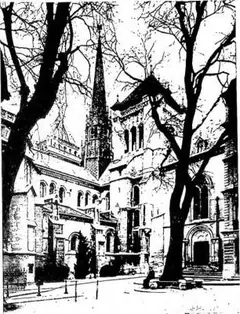
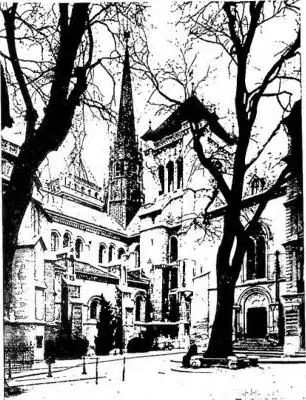
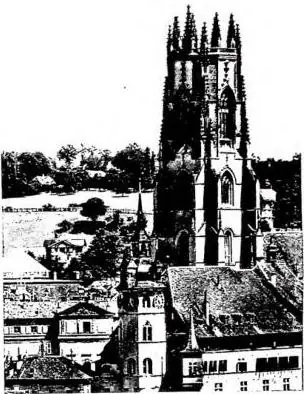
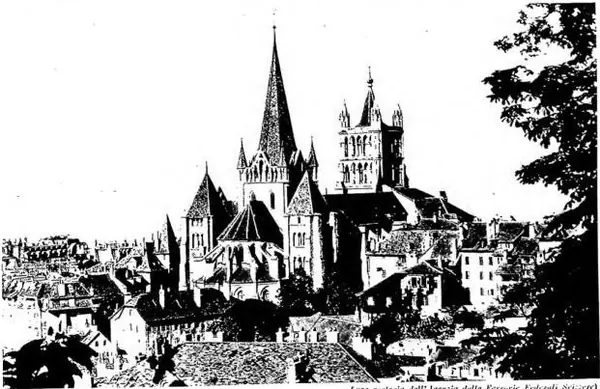
In Geneva, the cathedral of St. Peter (today Protestant), built in the 12th century on the site where a small church of the 4th century stood, replaced by a larger one in 515, enlarged in the 10th century. In Lausanne, the Cathedral (also today Protestant), the most beautiful Gothic building in all of Switzerland, built between 1170 and the end of the 13th century, on the ruins of an ancient Romanesque church of the 9th century. It was consecrated, in 1275, by Pope Gregory X, in the presence of Rudolf of Habsburg. In Fribourg, the Cathedral, begun toward the end of the 13th century, on the site of a Romanesque church, consecrated in 1182. Among the ancient abbey churches, those of Hauterive (Cistercians), 7 km from Fribourg (Cottineau, I, col. 1375), and, in the canton of Vaud, those of Romainmôtier (ibid., II, coll. 2497-98) and of Payerne (ibid., coll. 2239-40), once Cluniac monasteries (the first is today a Protestant temple, and the second has been deconsecrated).
Fribourg has a Catholic University, founded in 1889; the new, modern buildings of the three Faculties of theology, law and letters were inaugurated in 1941. - See plate CIX.
Bibliography7 works
Luigi Waeber