
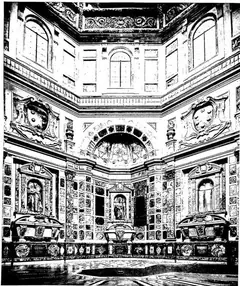
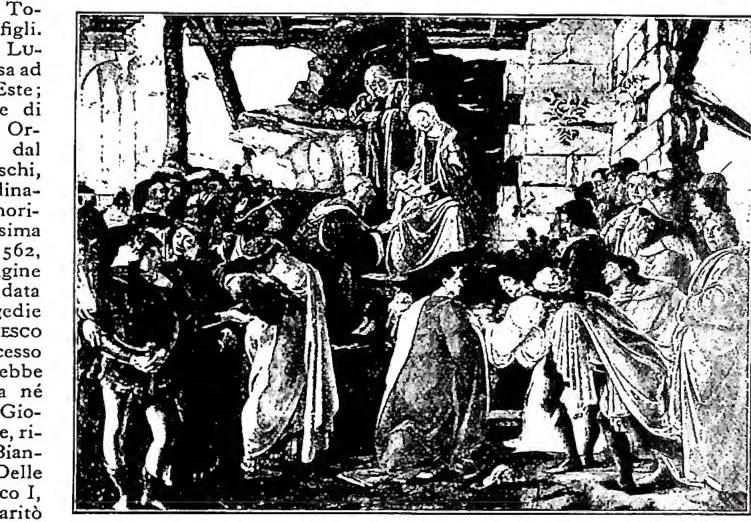
MEDICI, FAMILY. - Enriched by commerce and banking, the M.[Medici] acquired, in the 15th century in Florence, political supremacy, in the form of a disguised lordship. After 1530 this was transformed into an absolute monarchy that governed Tuscany, with dynastic succession, for two centuries. The M.[Medici] gave the Roman Church many bishops and cardinals, and three popes: Leo X, Clement VII, Leo XI. Pius IV too was a Medici, of the M.[Medici] of Marignano; but the origins of this family, to which the mother of St. Charles Borromeo belonged, are obscure, and there is a lack of positive evidence to prove its descent from the same stock as that of the Florentine M.[Medici].
The oldest of the M. of whom mention is found in documents is BONAGIUNTA, a witness in an act of 1221. In public life the M. appear toward the end of the thirteenth century with ARDINGO, prior in 1291 and gonfaloniere di giustizia in 1296. In the same period COSTANTINO was bishop of Orvieto, MATTEO of Chiusi. The M. sided with the Blacks and with Corso Donati. GIOVANNI was among those executed by the duke of Athens. Meanwhile the Medici Bank was widening the circle of its business, expanding its branches in Italy and abroad, and successfully weathering the crisis that swept away industries and banks in the early decades of the fourteenth century. Although by their social and economic condition they belonged to the popolo grasso, the M. aimed to build up a political clientele among the popolo minuto. SALVESTRO (1331-88) was among the organizers of the tumult of the Ciompi, while VIERI DI CAMBIO exercised a moderating influence in 1393.
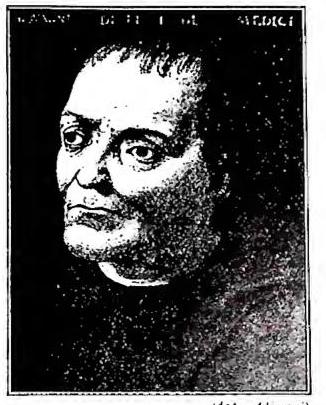
For the M. cited thus far there is no certain genealogy. This begins only with the branch known as that of Cafaggiuolo (from the name of one of their estates in the Mugello), whose recognized founder is AVERARDO, called Bicci. His son GIOVANNI DI BICCI (1360-1429), one of the richest bankers in Italy, won popular sympathy through his liberality. He built the church of S. Lorenzo and the Ospedale degli Innocenti; he had Donatello and Michelozzo erect a tomb for John XXIII in the Baptistery. He had two sons: Cosimo and Lorenzo.
COSIMO, called the Elder (1389-1464), took political supremacy away from the Albizzi and established a lordship, concealed by the formal survival of the republican institutions. Politics did not lead him to neglect business, and at his death he left the Bank in a most flourishing condition. Although of scant culture, he protected men of letters and artists, gave impetus to the Studio fiorentino, built villas, palaces, convents, churches. Relatives of Cosimo were DONATO, bishop of Pistoia, and FILIPPO, bishop of Arezzo and then of Pisa. By Contessina de' Bardi Cosimo had GIOVANNI, who predeceased him, and PIERO, called the Gouty, who inherited his father's rank, but because of his weak character and precarious health placed the family's authority in grave danger. A natural son of Cosimo, CARLO (d. 1492), held the provostship of Prato. From Piero and from Lucrezia Tornabuoni, a woman whose austere morals and deep religiosity are celebrated, were born GIULIANO, who was killed in 1478, and LORENZO, called the Magnificent (v.). Giuliano left a son, GIULIO, who was Pope Clement VII (v.). During Lorenzo's rule the Bank was liquidated, and an attempt was made to save the family patrimony through investments in land. Lorenzo had seven children by Clarice Orsini. Of the females, LUCREZIA, married to Iacopo Salviati, bore MARIA, who married Giovanni delle Bande Nere; MADDALENA had by Franceschetto Cybo INNOCENZO, cardinal, minister of Alexander, then of Cosimo I, and LORENZO, founder of the Cybo-Malaspina line. Of the males, GIOVANNI was cardinal and then Pope Leo X (v.); GIULIANO, duke of Nemours, held with Giovanni the government of Florence after the restoration of 1512, and left a natural son, IPPOLITO, who was named cardinal; PIERO, who succeeded his father in the lordship, was driven out in 1494 and, after vain attempts at recovery, died in the battle of the Garigliano (1503). Children of Piero and of Alfonsina Orsini were CLARICE, who married Filippo Strozzi, and LORENZO, for whom Leo X procured the Duchy of Urbino. Lorenzo had by Maddalena de la Tour d'Auvergne CATERINA (v.), who married Henry of Valois and was queen of France. It is believed that ALESSANDRO was a natural son of Lorenzo; he, having been named duke of Penne, received the government of Florence in 1530, married a natural daughter of Charles V and was killed in 1537 by his cousin Lorenzino. With Alessandro the direct line of Cosimo the Elder died out.
The brother of Cosimo the Elder, LORENZO, who was treasurer of the Apostolic Chamber, had a son, PIERFRANCESCO, from whom were born LORENZO and GIOVANNI. These, after the death of the Magnificent, declared themselves adversaries of Piero and were banished by him; having returned in 1494, they changed their coat of arms and took the name of Popolani. From Giovanni and Caterina Sforza was born GIOVANNI DELLE BANDE NERE (d. 1526), who had by Maria Salviati a son, who was Cosimo I. COSIMO I (1519-74), after the killing of Alessandro, seized power, gradually removed from it those Florentine magnates who were attempting to reconstitute an oligarchic government, and with the support of Charles V established a regime of rigid absolutism. He freed himself from every possible rival, having Lorenzino killed, arranging for the latter's brother, GIULIANO, to emigrate to France (where he held ecclesiastical offices), and giving GIULIO, natural son of Alessandro, a high military rank. Co-
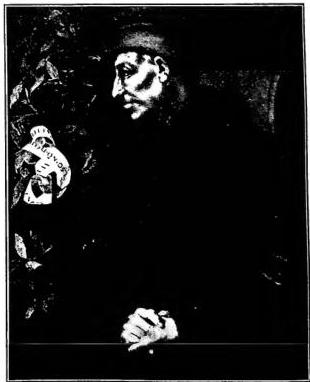
Cosimo I unified the territory with the conquest of Siena, created a fleet that took part in the battle of Lepanto, and instituted the Order of the Knights of St. Stephen, which for over a century gloriously held its own in the Mediterranean against the Barbary corsairs. Although bound to Spain, Cosimo succeeded through his energy in preserving the greatest autonomy that the conditions of Italy could allow him. In 1569 he received the grand ducal title from Pius V.
Cosimo I had twelve children by Eleanor of Toledo. Of the females, LUCREZIA was married to Alfonso II d'Este; ISABELLA, wife of Paolo Giordano Orsini, was killed by her husband. Of the males, GIOVANNI, a cardinal, and GARZIA died within a very short time of each other, in 1562, which gave rise to an unfounded legend of family tragedies; FRANCESCO I (1541-87), who succeeded his father, had neither his intelligence nor his energy. He married Joanna of Austria and, having been widowed, Bianca Cappello. Of the daughters of Francesco I, ELEONORA married Vincenzo Gonzaga, duke of Mantua, MARIA (v.) married Henry IV of France.
Francesco I was succeeded by another son of Cosimo I, FERDINANDO I (1551-1609). He, who abandoned the cardinal's dignity in order to marry Christina of Lorraine, restored the prestige of the Grand Duchy. He was on friendly terms with Henry IV and played a notable part in his conversion. He built the port of Livorno, and protected men of letters and scientists. Of the daughters of Ferdinando I, CATERINA was married to Ferdinando Gonzaga, CLAUDIA to Federico Ubaldo della Rovere and, in a second marriage, to Leopold of Austria. One son, CARLO, was a cardinal; the other son, COSIMO II (1590-1621), succeeded his father. Cosimo II devoted much care to the navy and to the port of Livorno; he protected Galileo; but with him begins the decline of the Grand Duchy. From Cosimo II and Maria Maddalena of Austria were born GIOVANNI CARLO, who was a cardinal; MATTIAS, who took part in the Thirty Years' War and in the war of Castro; LEOPOLDO, also a cardinal, who favored scientific studies and founded the Accademia del Cimento; FERDINANDO II (1610-70), who supported the activity of his brother Leopoldo, and sought to revive the depressed economy of the country by stimulating its commercial exchanges. The son of Ferdinando II and Vittoria della Rovere was COSIMO III (1642-1723).
In the last years of the government of Cosimo III, while the wars of succession were preparing radical changes in the political map of Europe, the foreign Chancelleries, foreseeing the imminent extinction of the house of M., began to consider the Grand Duchy as a commodity of exchange in the diplomatic game. The firstborn son whom Cosimo III had by Marguerite Louise d'Orléans, FERDINANDO, predeceased his father. Cosimo's brother, FRANCESCO MARIA, had renounced the purple in order to marry Eleonora Gonzaga, but the marriage remained childless. Thus the Grand Duchy passed to Cosimo's other son, GIANGASTONE (1671-1737), a man of notable intellect, but of indolent character and corrupt morals. Since Giangastone had no children, Cosimo had thought of securing the succession for his daughter ANNA MARIA LUISA, widow of Giovanni
Guglielmo, elector palatine; but the powers, even before the death of Giangastone, assigned the Grand Duchy to Charles of Bourbon, then to Francis Stephen of Lorraine. After the installation of the Lorrainers, Anna Maria lived in Florence until 1743, respected by all, but without any political authority. In 1737, ceding the family properties to the Lorrainer, she stipulated that the Medici collections could never be taken outside the city.
Other branches of the M. are traced back to a certain GIOVENCO (d. in the first half of the 14th century), who would have been the brother of Bicci's father. From one of these descended OTTAVIANO (1482-1546), who married Francesca Salviati, niece of Leo X. Their son, ALESSANDRO, was archbishop of Florence and pope Leo XI (1605); from the other son BERNARDETTO, who in 1567 acquired the fief of Ottaiano, derived the princes of Ottaiano and dukes of Sarno. To their lineage belonged that LUIGI M. who was minister of Ferdinand IV of Bourbon.
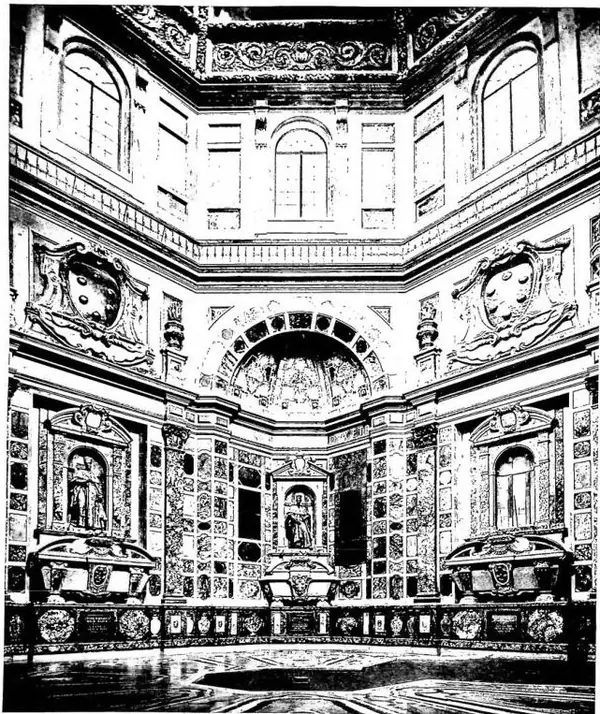
To yet another branch finally belonged the b. FILIPPA (d. in 1488); GULDO, who was archbishop and castellan of Castel S. Angelo during the sack of Rome; GIULIANO, bishop of Pisa (d. in 1636); RAFFAELE (d. in 1628), who was admiral of the Knights of St. Stephen. This branch, called that of the marquises della Castellina, a title they already possessed in 1629, still exists and is held by agnation to be the legitimate heir of the house. - See plate XXXIV.
Bibliography5 works
Roberto Palmarocchi