
ORPHIC MYSTERIES. - Orphism is the greatest religious phenomenon of a mystical character to appear in the history of Greece in the 6th century B.C. It can be considered as the theological transposition of the mysteries of Dionysus (v.), a god of Thracian origin, adopted by the Greeks thanks to their wisely receptive and nimbly creative psyche. He is a god of wild nature, ruler of a region rich in wooded mountains and deep valleys, where the whistling of the wind howling through the mountain gorges appears as the living presence of the god who takes delight in unbridled running and loves to be worshipped in the same exalted form in which he makes himself present.
The adherents of his cult are above all women (μαινάδες), who form the god's retinue. Dressed in a fawn's skin and sometimes a fox's, crowned with ivy, brandishing the thyrsus, during the great festivals, which took place every two years, they ran through the mountains clasping to their breast a fawn or a kid, an embodiment of the god, to the deafening sound of cymbals, timpani and flutes. This noisy nocturnal running excited the maenads to the point of paroxysm, so that they ended up biting raw the flesh of the animal they clasped to their breast ("σοπάρια" from ὠμός = raw and φαγείν = to eat). This rite, despite despite its savage appearance, was susceptible of a religious elevation, parallel to the development of the social environment, because in the omophagic incorporation of the god there was enclosed in germ the mystical union with him through the sacrifice of the sacred animal; and in the originally vegetable character of the god, with his twofold aspect of death and resurrection, in conformity with the perennial vicissitude of nature, there was contained the prospect of a similar resurrection for the faithful, provided that he had assimilated himself to him through the initiatory rite. This religious sublimation of the cult of Dionysus was accomplished in the 6th century by Orphism.
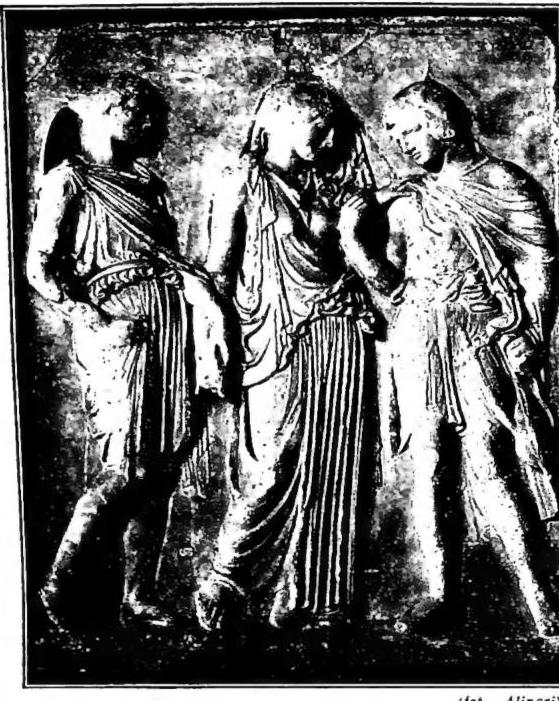
The 6th century is for Greece an epoch of profound social transformation. It marks the end of the so-called Greek Middle Ages, which lies between the collapse of the ancient monarchies mirrored by the poems of Homer and the rise of the democratic States of which Athens is the most illustrious example. In this troubled epoch Orphism represents the yearning for liberation from a regime of oppression and violence, the refuge of the best spirits, where comfort in the present and freedom in the future are promised to the adepts. For this reason among the Orphics there is a lively horror of blood, a powerful desire for justice (Δίκη) and for law (Νόμος). Therefore Dionysus is adopted as the central god of Orphism, the god characteristic for his sufferings and his unjust death, the foreign and popular god who came from Thrace, instead of the Olympian gods who had made the glory of the old warrior aristocracies sung by Homer.
I. ORPHEUS
He is the legendary Thracian singer capable of attracting not only animals but all of nature with the sound of his lyre (Euripides, Bacch., 560).
His mythical figure contains within itself so many elements, a reflection of the religious system ascribed to him, that it is no longer possible to delineate his original figure. He is in fact a native of Thrace like Dionysus, and he dies a Dionysian death because he is torn apart by the bacchants (Aeschylus, Bassarai, in Trag. Graec. Fragm., Fr. 113 Nauck); his head and his lyre are carried by the sea to Lesbos, the island of singers; he is placed in relation with Hades, where he goes to bring back his dead wife Eurydice, granted to him by Persephone in recompense for his song, but from whom he must be separated for having transgressed the command of the goddess, who had imposed on him not to turn back before he had emerged from the Underworld (Virgil, Georg., IV, 454; Ovid, Met., x, 10); he takes part in the enterprise of the Argonauts; he is the inventor of the alphabet; he is the presumed author of hymns, oracles, cathartic formulas, the baggage of Orphism and later Neoplatonism. The etymology of his name is also uncertain, which would come from ὄρρανός in the sense of solitary (Kern); from the root ὄρρ in the sense of dark, as an inhabitant of Hades (G. Curtius); from the fish ὄρρος in the sense of fisherman (Eisler). Whatever one must think of his historical figure, it is certain that at the origins of the Orphic movement there must have been an Orpheus, that is, a man of profound theological genius and of profound religious inspiration who sublimated the pre-existing Dionysian mystery by framing it within a philosophical cosmogony (myth of Zagreus) and developing its moral prescriptions in view of the higher destiny reserved for the initiates.
II. THE MYTH OF ZAGREUS
Dionysus, son of Zeus and of Persephone, the last figure of the divine generations, receives in Orphism the particular name of Zagreus (Ζα + ἀγρεύς) in the sense of great hunter (of souls), with which he is linked in a wholly special way to the underworld.
He received from his father the scepter of the world. But the Titans, sons of Earth, incited by the jealous Hera, plot against his existence, and while Zagreus, a naive child, amuses himself in the fields, they lure him into a trap with various objects (which correspond to the secondary instruments of the Orphic ritual), among which the most important is a mirror (Clement of Alexandria, Protr., 2, 17, 2; Arnobius, 5, 19; Nonnus, Dionys., 6, 197-210). He tries to escape their grasp by changing form, but the Titans manage to capture him precisely when he has assumed that of a bull; they tear him to pieces and devour him raw. But Athena saves the heart of Dionysus and brings it to Zeus, who swallows it and then begets from Semele a new Dionysus, a glorious resurrection of the old one (Nonnus, Dionys., 6, 165 ff.; Macrobius, In somn. Scip., I, 12, 12). The Titans, for their impiety, are struck by the thunderbolt of Zeus, and from their ashes the human race is formed, in which therefore the two elements are united, evil and good, the Titanic and the Dionysiac, fused together ever since the Titans devoured the divine body of Zagreus. The whole Orphic discipline consists precisely in the liberation of the luminous, celestial, Dionysiac element, which is the soul, from the dark, material, Titanic element, which is the body. In this reconstruction of the myth of Zagreus, laboriously but definitively carried out by the most erudite Lobeck, all the fundamental elements of the ancient Dionysiac sacrifice are found again: Dionysus under the name of Zagreus, the sacrificial bull, the tearing apart (σπαραγμός) of the victim, the meal of raw flesh (omophagy). These elements still ritually produce all their religious power because the rite always draws from its own entrails the efficacy of its action, independently of the orientations of the myth. But while in the Dionysiac concept the sacrifice had the value of an ecstatic communion with the god, renewed each time, in Orphic theology the sacrifice is the memorial of a primeval immolation that is a crime, a deicide, from which derives the sad position of man on earth, his dark imprisonment, from which liberation is long and difficult.
III. ESCHATOLOGY
Orphic morality and eschatology rest upon the destiny of the soul and the means of attaining it: a morality and an eschatology of the very highest significance, which have offered to later speculation the richest sources of inspiration and to devout souls the sweetest raptures and the most consoling certainties. For the Orphics, then, the soul is of divine origin and the body is a tomb (σῶμα, σῆμα) into which it has fallen as the result of a primordial guilt. And the distance that separates the dark prison of the body from the blessed abode to which the soul yearns to ascend can be shortened and abolished only at the price of a purifying expiation, of a catharsis (κάθαρσις).
This expiation can be accomplished by treading two paths. The first is that of rebirths, since a single life is not enough to accomplish the expiation, and the soul is condemned to transmigrate from body to body, in a succession of lives that returns upon itself like a circle: the circle of generation (ὁ κύκλος τῆς γενέσεως) which turns inexorably like a wheel, the wheel of destiny (ὁ τῆς μοίρας τροχός). The second path is that of purification in Hades, a place of terrors and delights, where the soul descends after death, but where it does not in any case find its joy, even in the most joyous of situations, because its only joy is to be reunited with its principle, which is Zagreus.
In order to attain its final goal, which is to be reunited with the divinity, the Orphic imposes upon himself a life of purity, of asceticism, of ceremonial purifications, whose merits were applicable also to the dead, and whose prescriptions were contained in special rituals and were carried out by Orphic priests for the benefit of individuals and cities. External signs too distinguish those who lead such a life: a white garment; horror of everything that implies contact with the dead, such as: a) the proximity of tombs; b) eating legumes, which are the chief offering made to the dead; c) wearing wool, even in the tomb, because wool was the coat of an animal; d) tasting eggs and meat, because these too are in contact with the souls wandering through the various cycles of metempsychosis; to flee the generation of mortals (γένεσις βροτῶν) in the very widespread sense of avoiding the pollution connected with childbirth (cf. Euripides, Cret., fragm. 145 Nauck).
For one who has led a pure existence, beyond the tomb there opens a prospect that has made generation after generation of Orphics throb with hope and has dictated to Pindar a winged description (Ol., 2, 62). In the Orphic Hades reign Eubouleus (the "well-counselled"), which is an epithet of infernal Dionysus, Hades also called Eukles (the "well-named") and above all Persephone, who predominates in the popular Orphic conception. There are two main paths that branch off from the entrance, to the right and to the left, in the shape of a Y, and they lead to the flowering meadows of the good and to the Tartarus that punishes the wicked. There flows Lethe, or the river of oblivion, proper to the Hades where there is no remembrance of life, a concept dear to the Orphics who have abandoned the dark life of the world in order to draw from Zagreus the source of divine life. As soon as he has entered Hades, the Orphic must take not the left, the ill-omened path of evil spirits, marked by a white poplar, but the right, which guides him to the spring of Mnemosyne, from which special guardians keep away anyone who has not had the privilege of initiation. He gives the password that declares him a son of Uranus and Gaia, of Heaven and Earth, that is, a participant in the Dionysian and Titanic compound in accordance with the cosmogonic myth of the sect, and he asks the queen of the Underworld, Persephone, to judge him (this is a new concept, purely Orphic) and to destine him to the sweet spring of her fields in expectation of the final return into the one Zagreus.
IV. THE LAMINETTE
All this eschatology is set forth by one or another of the gold tablets found in Orphic tombs in Magna Graecia, in Rome, in Crete. These tablets, a few centimetres long, folded several times like little pieces of paper, have been found hung at the neck or within reach of the hand of the deceased as a guide and reminder and amulet together for his journey to the other world. They contain brief formulas (and for two of them incomprehensible) of Orphic apocalyptic poems in which the devotional life of the adherents was poured forth and where their faith was affirmed and their hope exalted. They are now in the Museum of Naples (five), in the British Museum (two) and in that of Crete (three). Of these tablets, the one found near present-day Strongoli in Calabria (ancient Petelia) is the most important for knowing the topography of the Orphic Hades.
Of the four found at Terranova di Sibari (ancient Thurii) the first affirms liberation from the iron law of the transmigration of souls thanks to the Orphic discipline; the other three are notable: 1st for the affirmation of the purity that distinguishes the Orphic adherent, who calls himself the pure one who lives in a company of pure ones: « I pure among the pure come to you etc. »; 2nd for the affirmation, in b and c, of that injustice, of that original guilt (which is the deicide of Zagreus) of which all souls have paid the penalty by undergoing the fulguration of Zeus in the persons of the Titans and by suffering in the body that imprisons them a thirst that parches them; 3rd, by the impulse with which the soul breaks the bonds of its imprisonment and flies to reach the longed-for crown, an impulse compared with an effective simile to the flight (ἐξέπτων) of a bird freed from the nets. Three other lamellae, all identical, now kept in the Museum of Athens, were found in 1803 near Eleutherna in Crete, where the cult of Zagreus was, as has been mentioned, widely diffused. In them the initiates cry out in three verses the thirst that consumes them, the desire to slake it at the perennial fount, and proclaim their heavenly origin. The thirst that consumes the soul is no longer the material aridity that all primitive peoples attribute to the dead and for which they provide by furnishing the corpse with little jars of water and praying for its refreshing or cooling, but it is the thirst for blessed immortality.
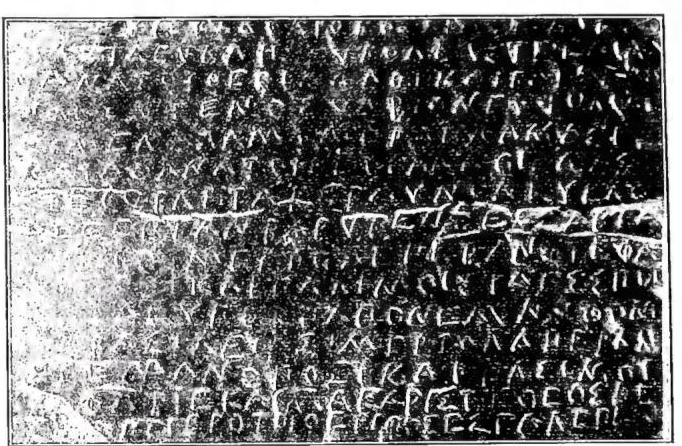
The last lamella (2nd century AD), found in Rome on the Via Ostiense, belongs to the matron Caecilia Secundina (it is the only case in which the deceased is mentioned), who declares her prerogative of being "pure among the pure," that is, an Orphic, boasts her divine lineage, and affirms that she has attained blessedness because she always lived according to the Law.
V. ORPHIC LITERATURE
The gold lamellae contain the most direct and genuine formulation of Orphic eschatology. Nevertheless, under the name of an Orpheus, who appears in them as poet and magician, there unfolded an entire mystical literature during the Alexandrian era, devoted to subjects of theogony, cosmogony, eschatology, etc. The Ὄρσος (hymns, 88 in number, in hexameters, of liturgical content, arranged according to the affinity of their mythological subject, the work of various authors, deriving very probably from Asia Minor, as may be inferred from the name of certain divinities mentioned: Antaia, Cybele, Hipta, Sabazius) gained prominence during the Renaissance.
This Orphic literature is generally devoid of a unified conception, because there existed no school that controlled and kept firm the heritage of Orphic beliefs, which were sustained above all by virtue of their eschatological vision, which was the one to which the spirit religious spirit of the time yearned for and which was reinforced by the philosophical-religious tradition of Egypt, Chaldea, and Persia, whose sages were said to have transmitted to the Greek-Roman West the elements that are summed up in the concept of saving gnosis.
And indeed, if one considers that often unbalanced ferment of ideas which at the dawn of Christianity spread through the East under the complex name of Gnosticism, one will find there still, having arrived there by means of the great Neoplatonic current, albeit reinforced by Iranian dualist elements and by Babylonian astral speculations, which would later culminate in the strange Manichaean religion, that which is the central thought of Orphism: man is a mixture of good and evil; the soul is a ray of divine light immersed in the darkness of matter; the whole duty of man consists in procuring for himself gnosis, the doctrine that teaches him at once the reality of his situation and points out to him the way of liberation.
VI. ORPHISM AND CHRISTIANITY
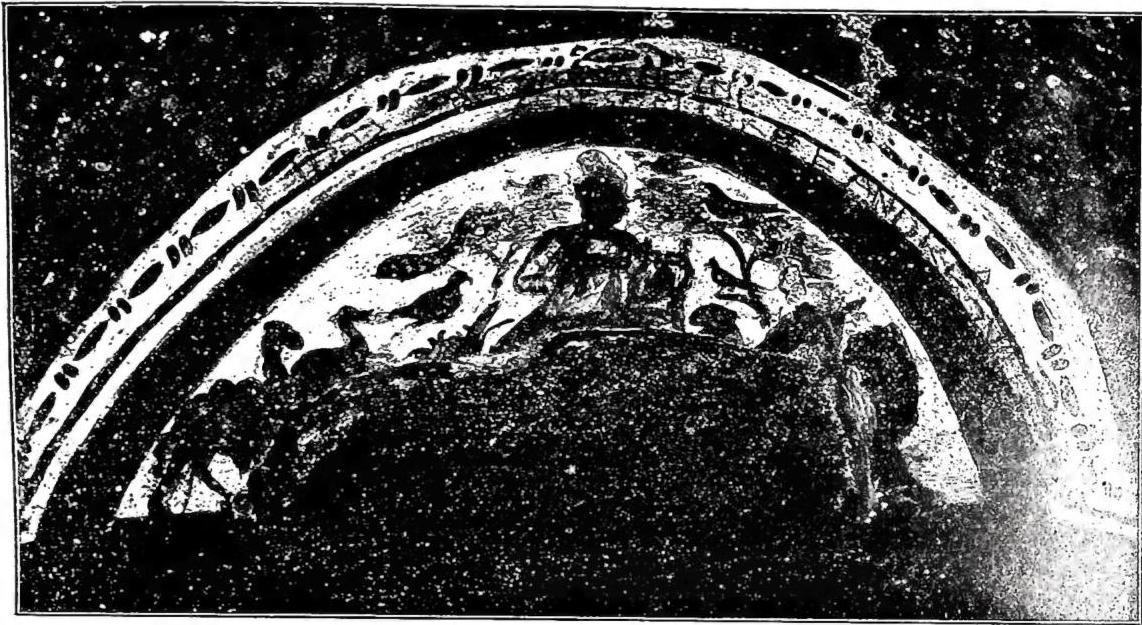
Among the various depictions that Orpheus has had in pagan art — singer accompanying himself with the lyre; attacked and killed by the maenads; near Eurydice; seated in the midst of the wild beasts that he tames with the sound of the lyre — the latter was the only one that Christianity accepted and reproduced in the catacomb paintings (cf. Wilpert, Pitture, p. 223 ff.): in the cemetery of Domitilla the most faithful in reproducing the elements of the pagan design (id., ibid., pl. 229); in the cemetery of Callistus, where Orpheus is a figure of the Good Shepherd with sheep and doves (id., ibid., pl. 37); in the cemetery of Sts. Marcellinus and Peter with Orpheus and six rams (id., ibid., pl. 98); in the cemetery of Priscilla with Orpheus in the midst of the flock (cf. G. B. De Rossi, Bull. arch. crist., 4th series, 5 [1887], pl. 6; see also the entry GESÙ CRISTO, VII. Iconography).
This preference is due not to a specific dependence of Christianity on the Orphic mysteries but to the symbolism suggested by the divine and irresistible efficacy of Jesus' teaching, capable of drawing all men to follow him. Whatever Orphism one has wished to find in Christianity belongs in reality to the religious ideas current in the Hellenistic age, namely: a fundamental dualism between soul and body, an otherworldly sanction of actions performed in life, a yearning for moral purity, respect for the figure of a founder and homage for his doctrine. While it is a doctrine specific to Christianity: faith in the voluntary and expiatory death (not by another's violence, as in Zagreus) of Christ, and in his resurrection, a faith that is not due to the theological elaboration of St. Paul, but was found by him alive and operative at the dawn of the new religion; the baptismal rite understood as a renewal of the inner man, whereas in later Orphism, or neo-Orphism, which is the one in vogue in the Hellenistic era, salvation is brought about through rites and formulas that have a flavor of magic.
BIBLI.: oltre alle opere generali citate sotto la voce MISTERI, v.: E. Maas, Orpheus, Monaco 1895; J. Harrison, Prolegomena to the study of Greek Religion, 1ª ed., Oxford 1903; 2ª ed., ivi 1921, sulla liturgia orfica; D. Comparetti, Laminette orfiche, Firenze 1910; V. Macchioro, Zagreus, 1ª ed., Bari 1920, 2ª ed. aumentata, Firenze 1930; O. Kern, Orpheus, Berlino 1920; id., Orphicorum fragmenta, ivi 1922; A. Boulanger, Orphée, Parigi 1925; M.-J. Lagrange, Les mystères: l'Orphisme (Introd. à l'étude du N. Test., IV. Critique historique, I, Parigi 1937); G. Faggin, Inni orfici, Firenze 1949, sulla letteratura orfica seriore.
Nicola Turchi