
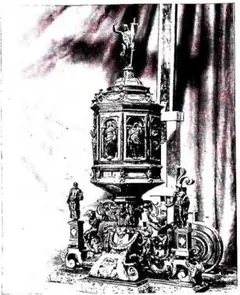
TABERNACLE (Tabernaculum). - From the Latin taberna (= hut built with wooden planks), it denotes the field tent of the Roman army; it corresponds to a small house with a double-pitched roof closed with curtains (cf. the sculptures on the columns of Trajan and Aurelius), and to the tent of Roman magistrates on mission.
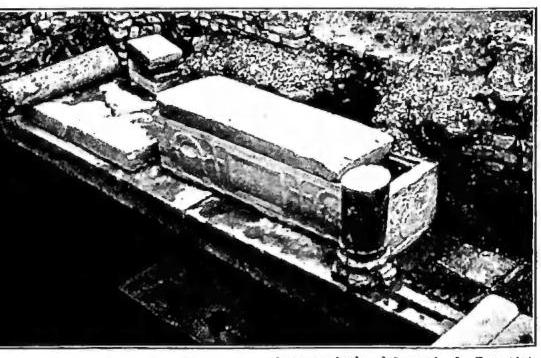
In late Latin t. also means a sacred aedicula in the form of a house, and from there it came to signify a precise form of tomb; it must not have been dissimilar from the tettegulae teg(u)latae (whence it is explained how tombs are found sub teglata) a kind of ciborium with a roof covered in tiles. As an inscription of the 5th century (excavations 1950) from Concordia Sagittaria (Venice) says, the term t. also denotes a shrine, a funerary chapel, a small rectangular chamber, with cells, whose opening was framed by small columns like a pronaos and niches, three by three, aligned on the background with a rectangular outer perimeter; this burial enclosure, with a vaulted roof, was provided with an altar with relics, placed before the tomb of Faustiniana, famula Christi, who commends herself and her burial «Christi tabernaculo ac sanctorum memoriae». In this sense t. also occurs at Tipasa; indeed next to the martyrium church of St. Salsa, an inscription says that this oratory, in relation to the cult paid to the Saint, was the initial memoria, the breve tabernaculum, where, according to the Passio, the body of the Saint had rested.
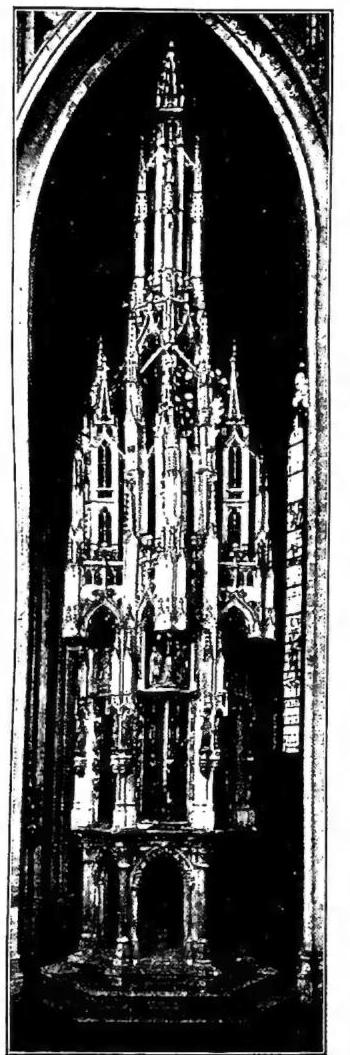
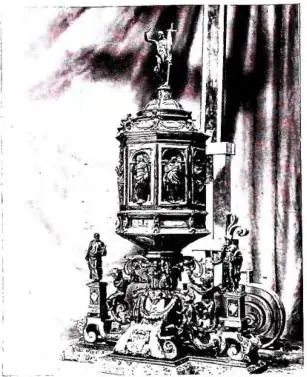
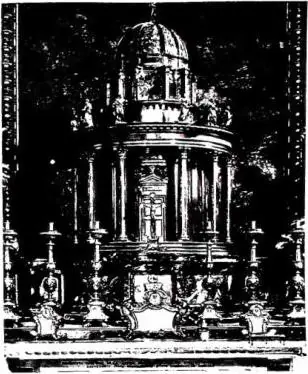
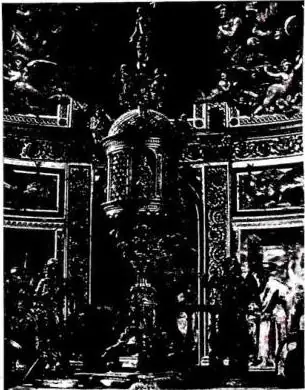
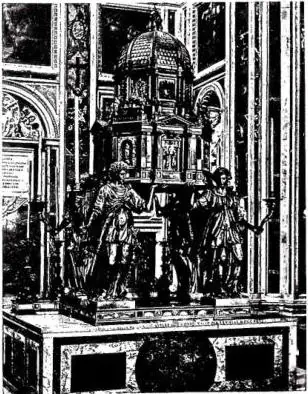
In the Catholic liturgy the t. is a closed and elevated aedicule, placed in the center of the altar where the Most Holy Eucharist is kept. Anciently the sacred Species were kept in the conditorium (cupboard) in special niches in the form of an aedicule, in the sacristy, or beneath the altar table, in the wall of the apse; in the 11th century they began to be kept on the altar (cf. Admonitio synodalis [PL 96, 1375] and Regino of Prüm, De synodalibus causis [PL 132, 87]), and thus the eucharistic doves suspended beneath the tegurium or ciborium entered liturgical use, which still recalls the original meaning of t., while conditorium recalls the concept of the tomb. In the 12th century the term takes on the name and function of t., as an aedicule set against the walls of the altar; the Gothic eucharistic towers are also noteworthy. In the 15th century we have the true and proper t. The first was the bishop of Verona; G. Matteo Giberti (1524-43), who built in his Cathedral the high altar with a eucharistic t. in the middle. Thus it soon becomes the center of eucharistic worship with a permanent character, that is, also outside of Mass; and art enriches it with the most elegant constructive and decorative schemes. The primitive aedicule takes the forms of small rectangular, octagonal, round temples, with columns, statues, marbles, bronzes, etc. Above the small temple is placed the Cross and in the center opens a door, almost always chased and often enriched with precious stones and sacred figurations. Classical or Baroque artistic schemes create a varied iconography of the t., which, in miniature, reproduces the schemes of grand architecture. In the Byzantine rite the artophorion corresponds to the t. of the Latin rite » (C. Costantini).
Among the most notable t. for artistic value, elegant structure and balanced decoration, mention should be made of the t. by Orcagna in Orsanmichele in Florence, by Mino da Fiesole in the Medici chapel of the church of S. Croce in Florence, by I. Sansovino in the National Museum of Florence, by the Vecchietta on the high altar of the cathedral of Siena, by A. Riccio in the chapel of the Most Holy Sacrament of the basilica of S. Maria Maggiore in Rome, by G. L. Bernini in the chapel of the Most Holy Sacrament in the basilica of St. Peter in Rome (see also EUCHARIST in the LITURGY, V, coll. 775-79).
Bibliography6 works
Paolo Lino Zovatto
LITURGICAL NORMS
The practice, introduced by the bishop of Verona, was supported by the Popes, and in 1614 Paul V, in the edition of the Rituale romanum, made it obligatory for all of Rome and recommended its use to other dioceses as well. Outside Italy it was slow to be introduced, despite the fact that the provincial Synod of Toulouse of 1590 had imposed it. The provincial Synod of Constance of 1609, on the other hand, left freedom for the reservation of the Most Holy Eucharist "vel in ipso altari secundum morem romanum vel in latere sinistro chori prope altare" (F. Raible, Der Tabernakel einst u. jetzt, Freiburg im Br. 1908, p. 422). This continued until 21 Aug. 1863, when the Sacred Congregation of Rites imposed the adoption of the tabernacle on the altar, forbidding every other form of reservation of the Most Holy Eucharist. The obligation was reaffirmed by can. 1269 of the CIC. The Congregation of the Sacraments, moreover, on 26 May 1938 issued an Instruction that gives precise norms on the matter (AAS 30 [1938], pp. 198-207). In the current discipline of the Church the Most Holy Eucharist must therefore be reserved solely in the fixed and immovable tabernacle placed in the middle of the altar. It is obligatory for all cathedral and parish churches. In cathedrals and collegiate churches, by reason of the choral office, the tabernacle must not stand on the high altar but on another side altar or in a chapel destined expressly for this purpose. In parish churches, on the other hand, the tabernacle must stand on the high altar; nothing, however, forbids that it may stand on another suitably adorned altar. The Eucharist may be reserved in only one tabernacle (Sacred Congregation of Rites, decr. 3449, ad 1).
There are no norms regarding the form of the tabernacle: it is left to the genius of the artist; but it is
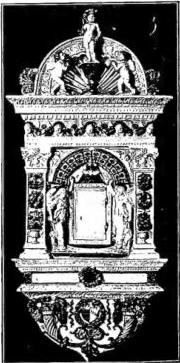
(phot. Alinari)
TABERNACLE - T. by Giovanni della Robbia - Florence, Museo nazionale.
it is always necessary that it have a single opening and that the gaze not penetrate its interior. It is forbidden to place electric light bulbs inside it. The interior must be gilded or at least covered with white silk (S. Congr. of Rites, decrr. 3150, 3254, 3709, 4035). The t. must not serve as a base for statues, images or relics (decr. 2613, 2740); the Cross for Mass may be placed upon it, when no other provision can be made (decr. 4136). The throne for exposition may be placed there only during the solemn exposition of the Blessed Sacrament. Besides the Blessed Eucharist, nothing else may be kept in the t., which must always be covered by a conopaeum of white cloth or of the liturgical colors of the day. The use of the conopaeum is mandatory (decr. 3520, 4137), but in the case of grand or artistic t., the legitimate authority may dispense from the conopaeum. The key of the t. must be of gold or silver, and, if of iron, silvered or gilded, and must be jealously guarded by the parish priest or by a person assigned to the church who enjoys his full trust. Before the t. there must burn day and night at least one lamp fueled with oil or beeswax, or, failing that, on the opinion of the local Ordinary, with other vegetable oils (can. 1271). - See plate CXIX.
Bibliography6 works
Silverio Mattei