

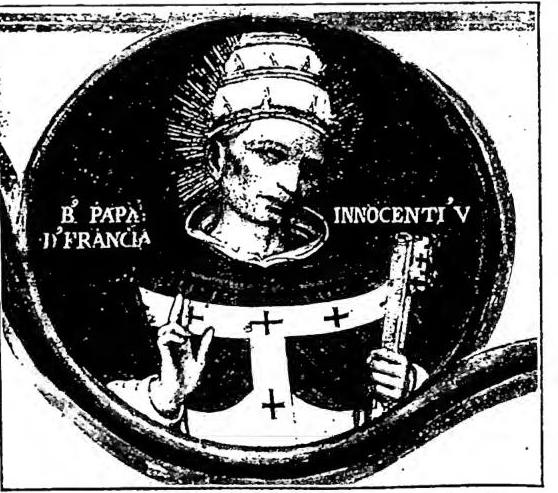
INNOCENT V, Pope, Blessed. - Dominican religious, known under the name of Fr. Petrus de Tarantasia, b. in Tarantasia proper (upper Isère Valley and not in the Aosta Valley or in the small and little-known Lyonnais Tarantasia) ca. 1224, d. in Rome on 22 June 1276.
He took the Dominican habit in the Convent of Lyon ca. 1240; in the summer of 1255 he went to the Studium of Paris and there obtained the degree of master in theology. As such he took part in the work (1 June 1259) of the extra-chapter commission of the five masters, among whom were St. Albert the Great and St. Thomas Aquinas, charged by the General Chapter of Valenciennes with preparing the ratio studiorum of the Order. He occupied the chair of the "French" at the University of Paris from 1259 to 1264. In 1260 he received the title of preacher general. Immediately after the election of the new general of the Order, John of Vercelli (1264), 108 propositions extracted from the first two books of his commentary on the Sentences of Peter Lombard were denounced to the General, who had to relieve him of the chair. The confreres of the province of France then chose him as their provincial (1264-67). Meanwhile St. Thomas, at the behest of John of Vercelli, set about examining the anonymous libel of denunciation, pronouncing himself clearly in favor of the accused (cf. Explanatio dictorum de dictis cuiusdam a Patre Thoma, ed. of the opuscules, III, Paris 1927, p. 211 ff.), for which reason the General Chapter of Bologna (1267) released Peter of Tarantasia from his office of provincial in order to entrust to him once again the Parisian chair, which he held from Sept. 1267 to May 1269, when he was re-elected provincial of the province of France. At the will of Clement IV, Peter busied himself actively with the preaching of the Crusade. The excellent qualities of administrator, of which the already brilliant Parisian professor gave proof, induced Gregory X, who knew him personally, to elect him archbishop of Lyon and primate of the Gauls (6 June 1272). The primatial see of the Gauls, to which comital rights were annexed, found itself at a particularly critical moment, both because of the long vacancy (from 1267 and practically from 1245, because the predecessor Philip of Savoy had never had himself consecrated) and because of the annexationist aims of Philip the Bold and of the internal struggles that bloodied the city for the attainment of certain communal rights and for the administration of justice. The elect, aware of the needs and difficulties of the diocese of Lyon, had to restore the discipline of the clergy, reclaim usurped rights and pacify minds. Already before Oct. 1272, Peter had taken possession of his see, provoking the protests of King Philip the Bold; but, once his attitude was clarified, the King withdrew his agents from Lyon, recognizing the archbishop's full right to the administration of justice, a first step toward obtaining the easing of tensions. Meanwhile Gregory X, with a shrewd political move, chose Lyon as the seat of the general Council that was to open on 1 May 1274 to treat of the Crusade and of the Union with the Greek Church, and created the archbishop cardinal bishop of Ostia (28 May 1273). Peter, consecrated between May and Aug. 1273, continued to hold the administration of the see of Lyon until the eve of the Council, which he prepared with care and in which he then took a very active part. He indeed delivered there the opening addresses of the third and fourth session and the funeral eulogy of St. Bonaventure (7 June, 6 and 15 July 1274); on 16 July he administered Baptism to three members of the mission of the Ilkhan of Persia, Abāqā; and he dealt with the long-standing question of the Mendicant Orders. Toward the end of the year he went to the court of Philip the Bold, to whom he also communicated Gregory X's plans for the marriage of a son of the King with Joan of Navarre. Elected major penitentiary, he accompanied Gregory X to Beaucaire (21 Apr. 1275) and to Lausanne (6 Oct.).
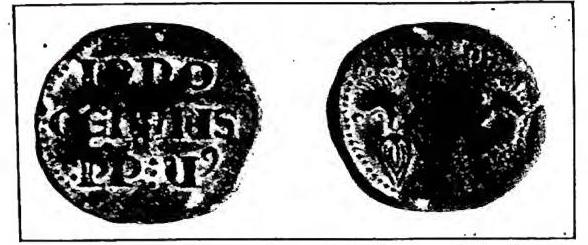
On the death of the Pontiff, which occurred at Arezzo on 10 Jan. 1276, Cardinal Peter, present at the Conclave, was chosen as his successor (21 Jan.) and assumed the name of I. V; then on 22 Febr. in Rome he was enthroned and crowned. The few months of his pontificate were intensely occupied with the preparation of the Crusade, which political difficulties rendered unrealizable, with the pacification of Genoa with Charles of Anjou and with the cessation of hostilities between Ghibelline Pisa and the Guelph Tuscan League. The months of March and April were particularly devoted to the Eastern problems of the Crusade and of the Union, sanctioned by the Council of 1274, which treated with the envoys of Michael VIII Palaiologos, George the Metochites, archdeacon of Constantinople, and the grand intendant, Theodore. Unfortunately in the course of these delicate negotiations I. was excessively subject to the influence of Charles of Anjou and of Philip of Courtenay, Latin emperor of Constantinople, as is evident from the tone of the instructions given to the general of the Minors, Jerome of Ascoli, head of the mission that was to conclude with the Palaiologos the negotiations in progress. The mission was then interrupted by the death of the Pontiff. I.'s all too evident sympathies for Charles of Anjou placed the Pope in serious difficulties with the elected Roman emperor, Rudolf of Habsburg. I. also took an interest in the canonization process of Margaret of Hungary. As for his hostile attitude toward the Order of the Servites, it is established that this is a rumor with a legendary basis. His cult was confirmed by Leo XIII on 14 March 1898. Feast on 22 June.
WORKS
Peter of Tarentaise occupies a distinguished place among the scholastics of the 13th century, and his writings enjoyed a notable diffusion not only in the university milieu but also in the principal cultural centers of Europe, as is evident from the approximately 280 manuscripts (13th-16th centuries; the list is susceptible of further additions), found in the libraries of the continent, and from the monumental 17th-century edition of the commentary on the Sentences. He belongs to the period of transition of the Dominican school which passed from an Augustinianism tinged with Neoplatonism to Christian Aristotelianism with the two great masters, his contemporaries and friends, St. Albert the Great and St. Thomas Aquinas. Peter's works represent the fruit of his university teaching, but unfortunately their analysis proves most laborious because the majority of them are still in manuscript. Peter was not only a polished compendiator, as is evident principally from the commentary on the Sentences, but a true thinker capable of supporting his solutions with originality and firmness. His scholarly production comprises, as indeed does that of the great scholastics of the 13th century, commentaries on Scripture and on the Sentences and particular theological questions in which the peculiarity of his thought is grasped.
To his first teaching belong: 1) In IV
libros Sententiarum Commentaria, composed between 1257 and 1259, but published between 1259 and 1264 (cf. the edition of T. Turco and Giov. Battista de Marinis, 4 vols. in-fol., Toulouse 1649-52). The author made use of the parallel commentaries of Sts. Bonaventure and Thomas: the latter had to analyze the work on the commission of John of Vercelli, to whom he then addressed the Explanatio dubiorum already mentioned. 2) The A redaction of the postil Dedi te in lucem gentium on the Epistles of St. Paul, earlier than 1264. Of this postil there exists a B redaction due to an anonymous author, in the past often attributed to the Dominican Nicholas de Gorran and several times printed under this name (Cologne 1478, etc.). Of particular theological interest are the "distinctiones" and the "dubitationes" that interrupt the literal commentary.
To the second teaching must be attributed: 1) the Quodlibet containing 37 questions (cf. ed. P. Glorieux, in Recherches de théol. ancienne et médiévale, 9 [1937], pp. 237-80). Question 36 on salvation in the state of innocence was refuted by St. Thomas in Quodlibet V, q. 5, a. 8). 2) The questions De lege et praeceptis (more than 50), definitively reclaimed for Peter. The first question on the existence of the eternal Law was published in full (cf. ed. O. Lottin, in Ephemerides theologicae Lovanienses, 14 [1937], pp. 295-97). The solutions given to the questions of a dogmatic and moral character treated there and in the Quodlibet allow one to grasp the most original aspects of our author's thought. There are also 13 certainly authentic sermons by Peter. His postils on the Pentateuch and on St. Luke have not yet been rediscovered.
Bibliography6 works
A. Pietro Frutaz