
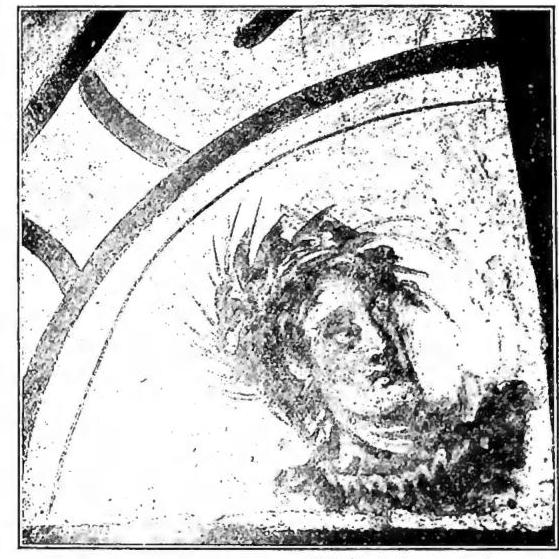
PERSONIFICATIONS. - Early Christian art generally continued to make use of the personifications created by classical art.
For example, the personifications of the four seasons as they were found in the 16th century in a ceiling of a Roman house on the Caelian (Wilpert, Pitture, p. 35, fig. 2), and in a columbarium of the burial ground of the Isola Sacra (G. Calza, Il sepolcreto dell'Isola Sacra,
Rome 1939), occur sometimes in Christian funerary monuments, thus in the cubiculum known as the "chapel of the Greek woman" in Priscilla, where the bust of Summer remains (J. Wilpert, Fractio panis, Paris 1896, pl. 5); later in the cemetery "inter duas lauros" (Wilpert, Pitture, pl. 100; J. P. Kirsch, Un gruppo di cripte dipinte inedite del cimitero dei SS. Pietro e Marcellino, in Riv. arch. crist., 7 [1930], pp. 231-34, figs. 18-21); in the so-called cemetery of Marcellinus and Peter (Wilpert, Pitture, pl. 245, 1). Spring alone appears in a cubiculum of Pamphilus (E. Josi, Il cimitero di Panfilo, in Riv. di arch. christ., 1 [1924], p. 141, fig. 52); in Praetextatus one finds: Spring in the guise of maidens weaving garlands of flowers (Wilpert, Pitture, pl. 32, 1); Summer with harvesting putti (id., ibid., pl. 32, 2); Autumn with grape-harvesting putti (id., ibid., pl. 33); Winter with putti gathering olives (id., ibid., pl. 34); putti personifying the seasons are also found in Domitilla in the cubiculum known as that of the bakers (R. Garrucci, Storia dell'arte cristiana, Prato 1876-81, pl. 21, 2) and in Pontianus (J. Wilpert, Die Katakombengemälde und ihre alte Kopien, Freiburg im Br. 1891, p. 69, pl. 28).
In cemetery painting, but with a purely decorative meaning, there is also the personification of Oceanus in the cemetery of Callixtus (Wilpert, Pitture, pp. 30-31 and pl. 134, 1); while the river Tigris is represented (bearded, naked, reclining) beside Tobias who takes the fish there in a fresco of the cemetery believed to be that of Thraso (id., ibid., p. 31 and pl. 212). The sun in the form of a human head from which rays go out toward Jonah is found in a painting of the cemetery of Domitilla (id., ibid., pl. 56). Personifications of the sea and of the lands, as in the sarcophagus of Annos Catos, formerly in Callixtus, now in the Christian Museum of the Lateran (Wilpert, Sarcofagi, pp. 183-328, pl. 193, 1), or of the sea in the crossing of the Red Sea (id., ibid., p. 183, pl. 211, 2); of the caelus (id., ibid., p. 176), of the storm or of the wind (id., ibid., pp. 15, 162, 184, 202); of the river Jordan, in a Vatican sarcophagus, in one in the Louvre and in the Lateran 119 (id., ibid., pp. 182, 268 and fig. 106), which will later be found in the mosaics of the two Ravenna baptisteries and again in the "Hortus deliciarum" (Wilpert, Mosaiken, p. 779, fig. 349). Still later, in the 9th-century Greek Psalter of the National Library of Paris, one finds the personifications of Melody listening, of the Mountain of Bethlehem, of the nymph Echo, of Night, of Dawn, of Strength, of Power, of Humility, of Repentance, of the Mountain, of the Desert, of Night, of the Abyss, etc. (L. Bréhier, L'art byzantin, Paris 1924, pls. 22-25).
In the 11th century other personifications are found in the Greek Vatican Psalter 381; among these are remembered David between Wisdom and Prophecy (P. Franchi de' Cavalieri, Miniature del Cod. Vat. Reg. gr. 1 e del Salterio del Cod. Vat. gr. 381, Milan 1905, pl. 7).
The Lord with his power appears, in general, simply represented by the divine hand emerging among the clouds that stays the arm of Abraham ready to sacrifice Isaac or delivers the Law to Moses, or crowns the Martyrs of Christ, or in bust form on high among the clouds, as in the mosaics of St. Mary Major (for example, in the sacrifice of Melchizedek, or when he speaks to Moses [Wilpert, Mosaiken, pls. 8 and 19, 1]).
The personification of the "Sol Salutis" under the well-known aspect of Helios on a biga or quadriga is found in Domitilla, "inter duas lauros" (Wilpert, Pitture, pl. 160, 1) and, in mosaic, in the vault of a Christian mausoleum in the Vatican (B. M. Apollon-Ghetti, A. Ferrua, E. Josi, E. Kirschbaum, Esplorazioni sotto la Confessione di S. Pietro in Vaticano, I, Vatican City 1951, p. 123, pl. D). In Christian sarcophagi there sometimes continue the well-known personifications of the radiate Sun, of the waxing Moon, as in the Sarcophagus of Manosque (Wilpert, Sarcofagi, p. 328, pl. 192, 6). The personification of the Roman Church was in the apse mosaic of the Vatican Basilica, restored by Innocent III (Wilpert, Mosaiken, p. 362, fig. 114); in the Exultet of Montecassino (cod. Barb. lat. 592, 11th century) it is represented in prayer with the inscription Mater Ecclesia (Enc. Catt., III, cols. 1517-18). Of an absolutely Christian character are the two female figures personifying Charity and Peace (Agape and Irene), in frescoes of the cemetery "inter duas lauros" (Wilpert, Pitture, pp. 31, 433 ff.; pls. 133, 2; 157; 184). Personifications of Rome, of Constantinople, of Alexandria and of Trier were reproduced in the codex containing the Chronographer of 354, known through the drawings of Peiresc published by J. Strzygowski (Die Kalenderbilder des Chronographen vom J. 354, Berlin 1888, pls. 4-7); a capsella found in Croatia represents in the center Rome, having on the right Constantinople and Carthage and on the left Nicomedia and Siscia (CIL, III, 3969); the personification of Rome is also found in a fresco of a building discovered near the Lateran in 1655 (Wilpert, Mosaiken, p. 127 ff. and pl. 1); she is queen, as Prudentius had called her (Contra Symmachum, I, 464: PL 60, 157).