INTARSIO

INLAY: V. TARSIA.

(from F. Maden, *Mediaeval Palaeography*, Oxford 1907, pl. 15)

Article illustration
INSULAR, SCRIPT AND MINIATURE — Anglo-Saxon minuscule script. Helvas Bradford grants land in Oxford to William son of Robert of Norhamt (c. 1180) — Oxford, University Archives, ms. CLXVII.

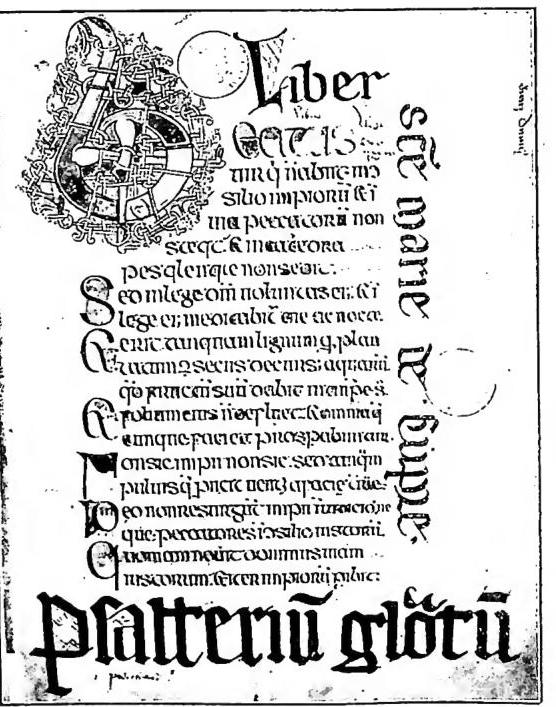
This influence extended to Ireland, particularly in miniature art. This is especially true of decoration, which predominates widely in Insular manuscripts and manifests itself in complex interlacings, geometric borders around and within initial letters, and red dots outlining the first element of each paragraph. The ornamental element is often composite, distributed across the entire page with patient study of patterns and proportions; even the crude depiction of animated figures (human or animal) assumes a fantastic, grotesque aspect and remains limited to a purely decorative function. The color is generally somber, especially in Irish texts; in Anglo-Saxon ones, the page is sometimes enlivened with gold. These characteristics exerted varying influence in some continental centers as well. However, in the 9th century, Carolingian art began to penetrate English schools, particularly from Reims; the new direction found its fullest expression in the monastery of Winchester.

Among the most notable products of Insular miniature art are the Lindisfarne Gospels, the Codex Aureus of Stockholm, and the Book of Kells. — See pl. VIII.

BIBL.: E. M. Thompson, *The history of English handwriting, A. D. 700–1400* (Transactions of the Bibliographical Society, 5), London 1901; F. Steffens, *Lateinische Paläographie*, III, Freiburg 1903, pp. XIV–XVI (with indication of the most important collections of facsimiles); W. M. Lindsay, *Early Irish Minimaute script*, Oxford 1910; id., *Early Welsh script*, 1912; L. Schiaparelli, *Intorno all’origine e ad alcuni caratteri della scrittura e del sistema abbreviativo irlandese*, in *Archivio storico italiano* 74, 11 (1916), pp. 3–126; E. A. Lowe, *Codices latini antiquiores*, II, Oxford 1935, pp. v–XII. Important observations also in L. Traube, *Perrona Scottorum. Ein Beitrag zur Überlieferungsgeschichte und zur Paläographie des Mittelalters* (Sitzungsber. d. kl. bayer. Akad. d. Wissensch. Philol.-histor. Klasse, 4), Munich 1910, reprinted in *Vorlesungen und Abhandlungen*, III, Munich 1920, pp. 95–119. Fundamental is the overview by L. Bieler, *Insular palaeography*, in *Scriptorium*, 3 (1949), pp. 267–89. On miniature art: E. H. Zimmermann, *Vorkarolingische Miniatur*, III and IV, Berlin 1916; E. G. Millar, *La miniature anglaise du Xe au XIIIe siècle*, translated from English, Paris 1926; K. Pfister, *Irische Buchmalerei*, Potsdam 1927; O. E. Saunders, *English illumination*, I, Florence 1928; F. Masai, *Essai sur les origines de la miniature dite irlandaise*, Brussels-Antwerp [1947]; C. Nordenfalk, *Before the Book of Durrow*, in *Acta archaeologica*, 18 (1947), Alessandro Pratesi, pp. 141–74.

Article illustration
INSULAR, SCRIPT AND MINIATURE — Gallican Psalter from the abbey of Coupar Angus in Scotland (12th–13th century). Vatican Library, cod. Palat. lat. 65, f. 1r.

In tablature, *si bemolle* is indicated; the second ninth is *si naturale*. Signs derived from common mensural notation are added (the cipher system introduced in France by a contemporary of Mersenne had followers). Entirely different is the concept underlying notation for the lute or guitar. Here the intention was not to indicate the note but the point of finger pressure on the string, i.e., the fret. The two staff lines represent the strings, and thus there are as many lines as there are strings on the instrument. The divergence between the Italian and French systems is complete: in the latter, the upper line of the staff corresponds to the highest string, whereas in the Italian system the lower line does. The French apply letters to the staff, the Italians numbers. The Germans omit the staff while maintaining an ideal alignment of the alphabetic notation. Among the earliest theorists treating of tablature is K. Paumann, with his *Fundamentum organizandi* (1452; ed. Berlin 1925).

Tablatures transmitted and preserved much music from the 15th, 16th, and 17th centuries. Lute tablatures are particularly useful not only for understanding the technique of the instrument but also because they resolve doubtful points in those polyphonic-choral works that were transcribed into tablature.

In the 15th and 16th centuries, the Meistersingers referred to tablatures as *Tablatur* (a set of rules for setting a poetic text to music).

Bibl.: J. Wolf, *Handbuch der Notationskunst*, I, 1, Leipzig 1919. Edgardo Carducci Agustin