
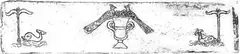
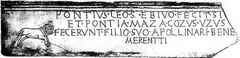
EPIGRAPHY, CHRISTIAN LATIN AND GREEK. - Epigraphy may rightly be called the eye of archaeology. How difficult it is to make a monument speak when no trace of writing is found on it. And even then the information drawn from it will always be faint and uncertain. It is a privilege of Christian antiquity to be illustrated by a very great number of inscriptions. More or less approximate figures have often been given, and continual discoveries see to it that they become less exact from year to year. More than twenty thousand are the texts that the Roman catacombs have so far restored to us; about a thousand those of Syracuse; an almost countless dust of the most varied fragments has been collected in the cemeteries of ancient Christian Carthage.
And then it is not always easy to judge whether an inscription is Christian or pagan, that is, the work of Christians or not. In practice, Christian epigraphy properly so called takes into consideration only those inscriptions that bear a mark of Christianity, since its task is principally to gather from the tombstones the testimonies of ancient Christian life as such. Nor should one fear that this method, for the age in which Christianity was the religion of the great majority, such as the 5th and 6th centuries, would logically leave us to consider as pagan a great number of inscriptions that are really the work of Christians; since for the ancients, and in particular for the men of those centuries, the class of purely civil and secular inscriptions hardly existed; their profound religious sentiment found a way to express itself on every occasion, and it is rare to find an epigraphic text that does not display some manifestation of it.
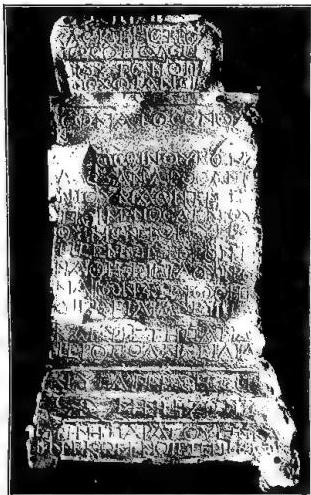
(from L. Duchesse, L'epigrafe d'Aucrius, in Mélanges d'archéologie et d'histoire, 18 (1888), pp. 111-112, inv. 1)
Ancient Christian epigraphy begins to appear at the end of the 2nd century, almost simultaneously in Rome and in Phrygia; but its testimonies remain scanty throughout the first half of the 3rd; thereafter they become frequent, even before the Constantinian peace, at least in the Roman catacombs and in certain localities of Asia Minor. But the vast majority of the texts (which are for the most part epitaphs, or funerary inscriptions) belong to the 4th and 5th centuries; for the first half of the 4th century they are still almost confined to Rome, Chiusi and western Asia Minor; then rapidly in all the regions of the Empire there is a flowering of texts which within the space of little more than a century yield the great mass of the paleochristian inscriptions known thus far.
In the sad centuries that followed, it seems that the ignorance and misery of the times greatly restricted the use of epigraphy, or at least practiced it mostly on materials so fragile that the texts have not survived to our day. Indeed, from the 6th and 7th centuries there is a good number of monumental inscriptions, but dense groups of epitaphs only in certain countries such as Gaul, Spain, Egypt and Cilicia.
Epigraphy has a notable part in the study of Christian antiquity in general. For what it contributes to a better knowledge of dogmas and religious conceptions, v. DOGMATIC INSCRIPTIONS. But to an even wider extent it helps to form a more precise idea of the general life of the ancient Christians; of their customs and usages, both religious and civil, and of ecclesiastical institutions. The exploration of the ancient cemeteries makes known their funerary rites and many curious particulars of daily life, for example, the secrets of individual onomastics and its transformations; from the ancient churches one learns more concretely how official worship was conducted, under what material conditions, with what instruments; civil and private epigraphy, in particular that of the multiform instrumentum domesticum, shows to what degree the Christian religious spirit had penetrated souls and expressed itself in even the most unexpected manifestations and sometimes in veritable deviations of superstition. The rich iconographic heritage of figured monuments, which has revealed a whole world, often curious and unexpected, of artistic ideas and symbolic elaborations, receives from the inscriptions that sometimes accompany them fixed points for a positive interpretation of otherwise insoluble problems and for some sort of chronological arrangement and historical vision of the whole body of facts. Philology, which once believed only the pages of the great authors composed in the official language worthy of its study and disdained the humble testimonies of unpretentious texts, often incorrect and barbarizing and full of vulgarisms, has now learned the interest there is in occupying itself with rough but spontaneous and genuine documents of the real language, and in them successfully studies the evolution of Latin and Greek, which both in pronunciation and in forms and in the lexical part move ever more decisively toward giving life to the modern languages.
Yet history too, in the more properly intended sense, that is, the great history of events and of the men deemed important, often finds in epigraphy a precious aid, mostly regarding individual facts that are known from inscriptions alone or receive from them an unexpected and decisive illustration, sometimes even in questions of a more general nature. By now, to give a few examples, it is admitted that a history of the primitive diffusion of Christianity (and therefore the geography of the orbis christianae antiquus) can no longer be written without the valuable contribution of epigraphy, and Harnack has given a good example of this; how many lights hagiography, especially Roman and African, can draw from inscriptions has been shown repeatedly by Delehaye and Monceaux; the stelae of Aricanda (v.) cast an instructive light upon the persecution of Maximinus, and the famous question of the census of Quirinus is keenly illuminated by a slab, unfortunately mutilated, from Tivoli, just as in another discovery recently made at Nazareth there is perhaps an echo of the rumors spread artfully by the Jews about the disappearance of Jesus' body (Mt. 28, 13). What would we know of popes like Eusebius and Marcellus without the inscriptions dedicated by Pope Damasus? What would be known of St. Abercius and St. Eutychius without their funeral eulogies? Even literary history now finds in epigraphy texts worthy of its consideration, such as not a few metrical compositions, and at other times providential sources of documentation such as the catalogue of the books of St. Hippolytus engraved on the back of his chair or that letter of St. Athanasius to the monks, whose original text was found written on the door of a monastic cell near Thebes in Upper Egypt.
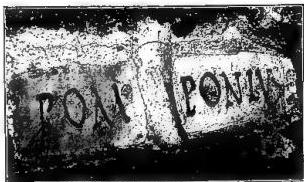
Semitic epigraphy and that of ancient Egypt have brought innumerable contributions to a better understanding of the historical setting and of certain facts and personages of the Old Testament, as Vigouroux showed at length; but the New Testament too, and in particular the Acts of the Apostles, received new light on many points from epigraphic discoveries. However, the usefulness that the student of the Bible can derive from ancient inscriptions concerns more generally the text and the language. An innumerable series of Greek and Latin biblical quotations scattered over epigraphs could, if collected systematically and studied as a whole, teach many things about the local varieties of the texts, about the diffusion of particular recensions, about the use of the different translations, about the familiarity
VALERIAE NICE FLAVIAE FILIAE
VALERIVS' FVNDAMVMPAT' E R
[Int. Rec. Cert.]
CHRISTIAN EPIGRAPHY - Sepulchral inscription of Valeria Nice Flavia (3rd century). Cast in the Museo Cristiano Lateranense. The original is in the cemetery of Praetextatus - Rome.
that the Christian people had with the various sacred books, on the credit attributed to several apocrypha.
No lesser fruit has been derived from epigraphy for the exact understanding of certain idioms of the New Testament and, more generally, for the correct evaluation of the language in which it is written. Without entirely denying that more or less Semitizing background left by the culture proper to its authors and the nature of its sources, it is now agreed that the greatest part of its lexical, morphological and syntactical peculiarities are those common to the current Greek language then on the lips of the people, in which precisely those books were written. This demonstration has been made principally on the basis of inscriptions, ostraca and papyri.
The paleochristian inscriptions have come down to us for the most part on slabs of marble or of some less noble stone; relatively few are those incised on metal or on the clay of objects of domestic use, few those painted with a brush; on the other hand, quite numerous are those scratched with a hard point on plaster. The ancients had the same faults as the moderns; thanks to them certain walls on which every passer-by and every idler left some record of himself have become for us precious palimpsests, on which one reads, stratified, sentiments and notices of the highest interest. Suffice it to recall the graffito of the Palatine with the scene of the mockery of the worshippers of Jesus and the wall found still covered with graffiti of the devout on the tomb of St. Peter, or the far better known ones of the catacombs of St. Sebastian.
The script is the capital (v.) quadrata or rustica, in its current forms, rather irregular and asymmetrical, often truly very ugly, of the 4th and 5th centuries. The tormented cursive forms (v.) are almost exclusively reserved for graffiti. The often not slight difficulty of reading these inscriptions derives from the fact that many abound in errors, lack punctuation between word and word or have it wrong, present mixtures of sibylline abbreviations, strangely deformed letters, or else a phonetics and a grammar very far from the regular one. He who incises the inscription often does not know how to read and materially copies a text he does not understand; at other times the very man who dictates the inscription is illiterate and expresses himself as the common people of the lowest quarters speak.
The pronunciation of Latin and Greek in the 4th and 5th centuries was by then profoundly altered, and if a man of the age of Pericles or of Caesar had passed again through the streets of his city he would have struggled to recognize it as his own and to make himself understood. The poor authors of the Christian epigraphs, who write as they speak, continually exchange B for V (Vitalis and Bitalis), DI + vowel for Z (diaconus and zucunus, baptizatus and baptidiatus), C K and Q among themselves (quiesces and ceopres, Quirius and Cyrius), X with C S and S (cinit, vicis, cinit, Xystus and Sustus), IE with GE and ZE (femarius and Genarus and Zenaria, Aloiosus and Alagiosus, Genesis and Ieneia, Manis and Magias), TJ with Z and S (Genitane and Geuans), Y with E (Hypatius and Epatia), V with O and E with I especially in the Gauls (christiani and crestiani, titidans and tetidans), not to speak of the diphthongs, of the double consonants and of the aspirates where too often they cannot make head or tail of it, and of the final consonants often omitted in writing as in pronunciation (bocata so = vocata sum). Worse still when, through misunderstood learning, they etymologize backwards (Heliodorus for Heliodorus, believing it derived from Aelius).
Those who write in Greek add to most of these a great number of errors proper to their pronunciation, and exchange AI with E (αἰτῶν for ἀτῶν, ξήσος for ξήσιος), OI with Y (ὄνθος for ἀνόξαι, κόμησις for κόμησις), α with O and OY (διόξω for δρόνου, Ζώσιμος for Ζώσιμος, Ὀνόριος for Ὀνόριος), H and EI with I (κίτε for καῖται, ἐστρανίς for ἐστρανίς, κόμιος for κόμησις), they thin out the endings IΩΣ and ION into IΣ and IN (λοῦσις for λοῦσιος, πεδὶν for παθόν), they prefix a euphonic I before the initial impure Σ, as the Latins also did (Ἰωρῆς and Ἰερᾶς for Spas), the subjunctive tends to eliminate the optative, weak forms take the place of strong ones especially in verbs, the phenomena of heteroclisis and metaplasm multiply.
Lexical and grammatical degeneration does not usually cause much trouble in short inscriptions, of stereotyped formulary, such as those in prose usually are. But it often creates great difficulties for the correct understanding of metrical inscriptions. These are ordinarily composed of pure hexameters or of dactylics, and only rarely are they in iambic verses. Very few are metrically correct; some allow themselves so many liberties as to be able to be reckoned rather rhythmic verses, regulated, that is, by the tonic accent rather than by the quantity of the syllables. But it is not for this that those poems are difficult to understand, but rather for the vagueness of the expressions and the awkwardness of the constructions, in which is manifest the unskillfulness of one who must put those words into verse and takes the quarry at its least bad, doing violence now to grammar, now to meter, now to the thought itself, disguising it in commonplaces that say nothing. Even the carmina of a man like the pope Damasus (v.) turn out for this reason often incredibly obscure.
Often the improvised poet tries to extricate himself by resorting to models of poems that he plunders as much as he can, even of whole verses. For the thoughts to be expressed, particularly in an epitaph, are generally always the same. And the Damasan compositions, which must have been much relished, were subject to this fate in a special way. Indeed it is thought by some that the stonecutters had for their use veritable manuals of epigraphic metrical phraseology, from which they drew each time, as from models, what served their purpose. Thus it is explained that two eulogies of the bishop Alexander of Tipesa reappear almost entire for the bishop Cresconius and Cuicui (E. Diehl, Inscriptiones Latinae Christianae veteres, Berlin 1924-31, nos. 1103, 1825 and p. 511); the dedication of St. Peter in Chains in Rome reappears in part at Tebessa and then in the 6th century in a baptistery of Ravenna (Diehl, ibid., nos. 977 and 1840 a CIL, VIII, 10707-10708). This method was so much in honor that the very oldest metrical epitaphs already appear composed in this way. Thus the oldest dated Greek epitaph, the carmen of Alexander of Hierapolis of 216, was composed by literally plundering the metrical eulogy of St. Abercius (v.), who, in his turn, had already made use of older carmina, as the first and last verses reveal, defective precisely for that reason. In truth the fascination of poetic composition for its own sake was such that it easily made one overlook all defects of style, of meter, of language, and even of inspiration.
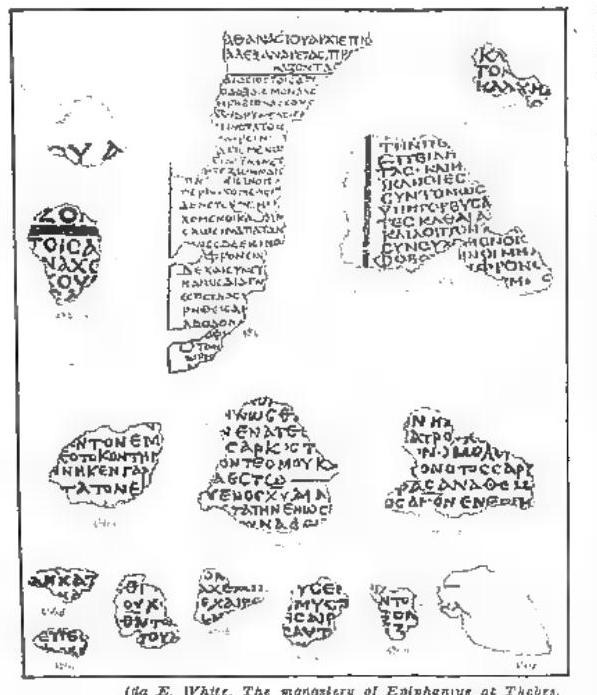
Defects of phonetics and morphology tend to be much more serious and more frequent in proper names, in which they then generate much greater difficulties for correct reading and understanding. For the onomastics of paleochristian inscriptions is by now very different from that known from the classics. The use of the tria nomina, still frequent in the 3rd century, later becomes very rare, and even the presence of gentilicia becomes ever sparser in the course of the 4th. A great disorder is also introduced in the titulature of important persons, for whom gentilicia often become cognomina (and even serve as praenomina), while true cognomina take on endings with the function of a gentilicium. The only constant element, even for people of good standing, is the presence of the cognomen, and those who wish to give themselves airs take more than one. The personal proper names of modern languages descend in a direct line from the cognomina as they were already in use in the 4th and 5th centuries.
Many have raised the question of typically Christian names, that is, coined by Christians, and they have gone very far along this road. It is a difficult and thorny path to travel and full of pitfalls. All things considered, it is not even true that, at least for the 4th and 5th centuries, the names put into use by Christians were numerous. There are certain biblical names such as Petrus, Ioannes, Susanna; others derived from Christian concepts such as Anastasius, Paschasius, Agape, Athanasius, Adeodatus; or certain compounds especially dear to Africans (Deogratias, Quodovildeus, Habeides, Deusdedit, etc.); sometimes names already used by pagans became very common and almost proper to Christians because of their fame or their meaning; such as Paulus, Maria, Stephanus, Redemptus, Cyriacus, Bonifatius, Dominicus, Elpis. The so-called names of humiliation are often counted among these, such as Proiectus, Stercorius, Kampusovis, Calumniosus, Contumeliosus, Importunus, Alogius; but these are rather to be attributed to a fashion peculiar to the time than to a sentiment of Christian virtue. Moreover, the same names occur that are also found in the pagan inscriptions of the same period, even those of pure idolatrous stamp, such as Mercurius, Venerius, Isidorus, Diodorus, Apollodorus, Diogenes, Saturninus, Palladius, Aphrodisius, etc. No one paid any attention to it.
However, these names are very often no longer used in the forms proper to the good classical period, but adapted to current taste with new suffixes such as -ius, -antius, -entius, -omius, -osus, -ensis, -io, -as. Thus rather than Eutychus and Εὐαεβίς one says Eutychius and Εὐαεβίς, Tyrannio and Dominio instead of Tyrannus and Dominus, Bousius and Leonius instead of Bousus and Leo, and likewise Asterius, Adelphius, Agapius, Venantius, Vincentius, Mortensis, Calendio, Trophimius, Ἐπαρχάς, etc. Their declension too appears profoundly altered by a series of phenomena that can be reduced to two heads: the invasion of Greek endings upon the Latin ones and the prevalence of weak forms over strong. Juliane-es, like Agape-es, Menas-a become normal forms, and alongside Hague-es one has Hague-es or Hague-es-ets, and likewise Seman-ets or ens. Spes-ens, Eutychus-ets, Hedys-ets, and similar, down to Vitalis-ets, Menas-ets, Epictesis-ets, Attilus-ets.
There is no need to be surprised if all this onomastics is also etymologically more Greek than Latin. Many think they can infer the nationality of persons from the quality of the names, but the study of inscriptions shows that, at least for the 3rd-5th centuries, this is an illusion. Latin names are at that time very common among Orientals, just as Greek names are among Westerners. No attention was paid to it, or if some element had an influence, it was only fashion for a certain taste for exoticism.
It is instructive, on the other hand, to examine in epigraphy the fluctuation in the use of Greek in the West. Until the time of Constantine, from a third to a quarter of the inscriptions are Greek. Afterwards they diminish rapidly, so that from the middle of the 4th century onward, with the exception of some artificial poetic composition, only the inscriptions of Orientals are Greek, and these almost always declare themselves as such.
The age of these inscriptions is recognized by various indications, but above all by paleography, by the formulary and by the date sometimes marked on them, more rarely by allusions to known persons or events. The paleographic argument, and in part also that drawn from the formulary, is easy to handle in a fairly numerous and homogeneous body of inscriptions, but very difficult and delicate when single inscriptions are involved. Then caution is never excessive.
The date on inscriptions (that is, the year in which they were written) is usually marked according to the consular era, official for the Roman State, or according to other local or regional eras. Until Constantine this was done very rarely; from about the middle of the 4th century to the middle of the 6th, dated inscriptions become very numerous. Their usefulness is evident, and for this reason special collections of them have also been made. They are like milestones marking the path of the development of epigraphy and helping to fix chronological canons also for the mass of undated inscriptions. Throughout the West the consular date is in normal use, that is, indicated by the consuls who were in office that year; only in western Spain and in Mauretania are eras particular to those regions used. This use, on the other hand, becomes universal in the East, where the multitude of particular eras, often not well known, especially in Asia Minor, Syria and Palestine, tends to create notable difficulties. And let us not speak of the indiction (v.) often indicated in later inscriptions, but which for practical chronological value is almost negligible.
A problem no less difficult than the chronological one is often, at least for the more ancient inscriptions, whether the texts are pagan or Christian. Even granting the principle that an inscription is to be considered pagan until its Christian character is demonstrated, there nevertheless always remains a broad zone for hypotheses and conjectures of various kinds. And all the more so because inscriptions are often still found in place on Christian tombs, for example in the catacomb, which bear rather signs of paganism than of Christianity, for example the invocation of atrocious vengeance against violators of the tomb, the dedication to the gods Manes, the mention of Hades, of Tartarus and other pagan divinities, certain expressions of disconsolate pessimism. Conversely, even manifestations of a noble religious, monotheistic or eschatological thought must sometimes not deceive, since they can also be found on the lips of adherents of special philosophical currents or mystery cults, as is the case of the cippus of C. Clodius Fabatus of Rignano Flaminio (Diehl, loc. cit., n. 3443). And sometimes today the question is further complicated by the hypothesis of belonging to heretical sects or Jewish communities. Thus an important inscription such as that of Regina (Diehl, loc. cit., n. 4933) is disputed between Christians and Jews, and the other no less notable one of Probina (Diehl, loc. cit., n. 3330) among Jews, pagans and Christians.
For the more ancient ages, a search has been made for cryptochristian formulas, but the path is extremely difficult and dangerous, nor has it yielded appreciable results. Thus, although Wilhelm succeeded in demonstrating the Christian character of a formula neutral in itself such as ἕστα σὺν πρὸς τὸν Θεόν (a threat against violators of the tomb), the disputes over the "angels" of the stelae of Thera have not yet ceased, nor can anything certain be said of a group of inscriptions from Arles with the pax tecum (CIL, XII, 84).
Often the Christian character of an inscription also emerges from the figurations that accompany it, almost always of a symbolic nature. For they are very rare on pagan tombstones and, according to the various regions, of a well-defined character; as a rule of a type much more secular than religious. Here too, however, a certain prudence is necessary, since palms and crowns also occur not infrequently to adorn pagan epitaphs, indeed sometimes even fish, mostly dolphins. And for Phrygia, where a rich series of representations of a particular character appears (buildings, arch-tectonic [representations], objects of domestic use, stars, swastikas, vines), Calder went somewhat too far in wanting to determine a certain number of them as properly belonging to Christians.
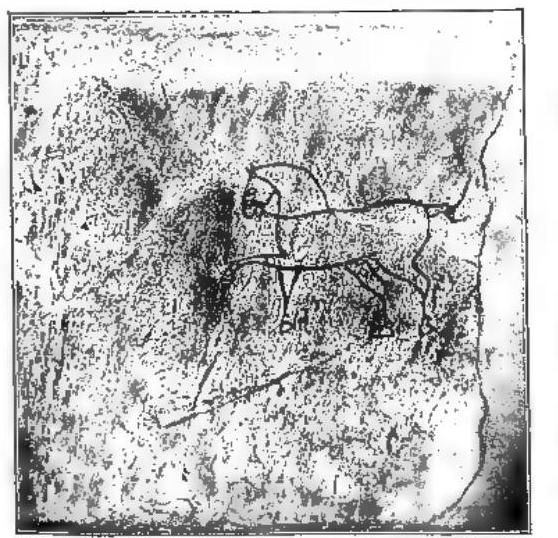
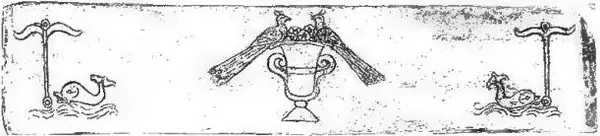
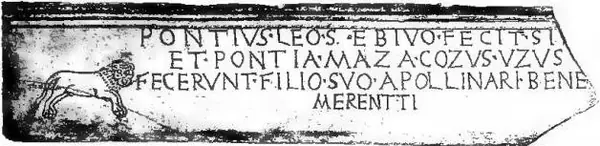
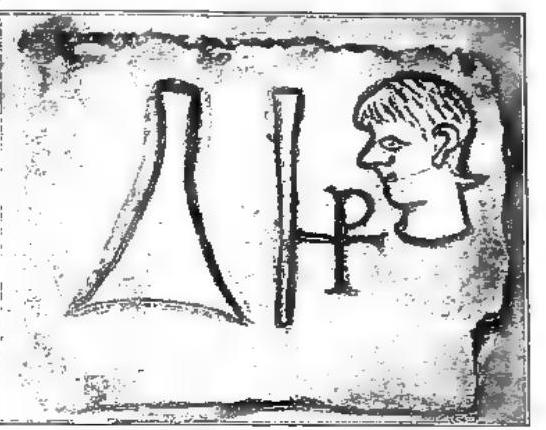
The most common figurations are the Good Shepherd and the sheep, the orant, Noah's dove, birds of several species (particularly doves and peacocks) either alone or facing a vase, the phoenix, the dolphin or other fish, the anchor, crowns and palm branches, decussate monograms or monogrammatic crosses, alone or accompanied by the apocalyptic letters A and Ω and also by doves, vine branches, measures of grain, tools of trades (especially those of the stonecutter), scenes of private civil life and sometimes also of religious initiation, also some biblical scene, horses in race, a little ship that... often figured representations from the name of the deceased in the manner of coats of arms (the figure of a sheep on the tombstone of a certain Prebatus, because sheep in Greek is called πρῶτον; the peacock, bird of the sun called in Greek ἥλιος, on the tombstone of a certain Aelia, and so on).
The greatest part of early Christian inscriptions are of a funerary character, either in prose or in poetry. They have as their own the general concern of marking the date of the death and burial of the deceased, a thing which, as of ill omen, was studiously avoided by the pagans. Moreover the titles of civil condition yield as a rule their place to those that signify the position of the deceased in the Christian community. The frequency with which Christians express their religious sentiments finds only very scant comparisons on the pagan epitaphs of the same time. More or less the same is true for what concerns the care of the inviolability of the tomb. All this derives from that faith which, as it has given a new form to life, so also confers a new aspect upon death, radically changing the vision of their respective values.
Of the other classes of inscriptions, those to be noted are the monumental ones, that is, affixed to buildings, not only for their number and for their historical importance, but above all for their new character. The pagan ones are wont to highlight the author of the building and his work; the Christian ones aim instead at the purpose of the work, that is, the interest of the community and of divine worship. Those, for example, to whom a temple is dedicated remained formerly in the background as if in shadow; now he passes to the foreground, to the center of the subject. And in general it must be observed that all Christian epigraphy presents, in comparison with the pagan, a more spiritual air, that is, more intimately religious. Faith and religious sentiment yield as a rule in the latter to a stereotyped formalism; here instead they assert themselves fully outside of all ritualism. This is perhaps the most profound and universal value of early Christian epigraphy, superior even to its properly historical and documentary value. - See plates XXXIII-XXXIV.
Bibliography5 works
The inscriptions of Rome were not included in vol. VI of the CIL, since they had to be published separately. De Rossi gave 2 vols.: I. Epitaphia certam temporis natam eublamia, Rome 1857-61; II, part 1, Series codicum in quibus veteres inscriptiones Christianae descriptus sunt aere succ. XVI, ibid. 1888; afterwards A. Silvagni gave two more, no longer arranged by subject matter, but inoprofattico: Nova series, I: Inscriptiones incertae originis, ibid. 1922; II: Cementeria in suis Cornelia, Aurelia, Fortunata et Ostiana, ibid. 1932. Useful collections of a particular kind were given by Fr. Bücheler, Carmina epigraphica, 2 vols., Leipzig 1893-97, which also includes all the Christian texts, with supplements by E. Eneströ, ibid. 1912 and E. Lommatzsch, ibid. 1926; P. Monceaux, Enquête sur l'épigraphie chrétienne d'Afrique, 60 articles in the Revue archéol, 4th series, 1-8 (1903-1906); continued in Ménolier de l'Arcé, des Ines et belles lettres, 12 (1907), 1, pp. 161-239; A. Ferrus, Epigrammata Damianae, Rome 1942. A very full sylloge of all the Latin Christian inscriptions with copious and most useful indexes was given by E. Diehl, Inscriptiones Latinae Christianae veteres, 3 vols., Berlin 1924-31.
The Greek inscriptions were first collected in the CIC-IV, nos. 8608-9026 by A. Kirchhoff (Berlin 1859) with indexes by H. Rochl (ibid. 1877). In the new ed. of the Corpus, Inscriptiones Graecae, ibid. 1870 ff., the Christian inscriptions enter only in part and in different ways in the individual volumes: worthy of special mention is vol. XIV, Inscriptiones Graecae Siciliae et Italiae, additis graecae Galliae, Hispaniae, Britanniae, Germaniae interstitiuntiae, ed. G. Knibel, Berlin 1890. Other general collections do not exist, but only partial ones such as A. Bayet, De titulis Atticae christianis antiquissimis, Paris 1898 (completed by J. S. Creaghan and A. E. Raubischek, Early christian epitaph from althen, I&sporia, 40, Woodstock 1947); Fr. Cumont, Les inscriptions chrétiennes de l'Asie mineure, in Mélanges d'archéologie et d'histoire, 15 (1895), pp. 245-90 (eicnchi, indici, libivi); V. Strassella, Inscriptionem Christianarum qua ein Syracuseis catacombis repertae sunt corpusculum, Palermo 1897; V. V. Laryère, Iscrizioni greche critiquee della Russia meridionale, St. Petersburg 1897 (in Russian); G. Miltet, J. Pargoire, L. Petit, Recueil des inscriptions grecques chrétiennes du Mont-Athe, Paris 1904; G. Lefebvre, Recueil des inscriptions grecques chrétiennes d'Égypte, Cairo 1907; W. M. Ramsay, The cities and bishoprics of Phrygia, 2 vols., Oxford 1895-97; id., Studies in the history and art of the Eastern provinces of the Roman Empire, Aberdeen 1906; Fr. Cumont, I. G. L. Anderson, H. Grégoire, Studia Pontica, III, Recueil des inscriptions grecques et latines du Pont et de l'Aradène, Brussels 1910; H. Grégoire, Recueil des inscriptions grecques chrétiennes d'Asie mineure, Paris 1922 (only the islands and the western shore); C. Wessel, Inscriptiones Graecae Christianae veteres occidentis, Halle 1936 (first fascicle whose continuation was interrupted by the war); J. Gietzmann and G. Soteriu, Corpus der griechisch-christlichen Inschriften von Hellas, I: Isthmos-Karinthos, edited by R. Bees, Berlin 1941. The Jewish inscriptions (for the most part Greek) of present-day Europe were collected by G. B. Frey, Corpus inscriptionum Iudaicorum, I: Europe, Rome 1936.
Regional collections worthy of mention for the great number of Christian inscriptions they contain are, for Africa, St. Gell, Inscriptiones Latines de l'Algérie, I: Inscriptiones de la Procaudaire, Paris 1922; L. Châtelain, Inscriptiones latines du Maroc, ibid. 1942; A. Metlin, Inscriptiones latines de la Tunisie, ibid. 1944. Even more useful for the Greek inscriptions, given the lack of a recent Corpus, are Ph. Le Bas, H.-W. Waddington, Voyage archéologique en Grèce et en Asie mineure pendant 1821 et 1841, part 2: Inscriptiones grecques et latines, III: Asie mineure, Syrie proprement dite, ibid. 1870 (indexes by J. B. Chabot, in Revue archéologique, 28 [1896], p. 213 ff.); G. Perrot, E. Guillaume-J. Delbot, Explanation archéologique de la Galatie, de la Bithynie, de la Phrygie, de la Mysia, Paris 1862-72; B. Laryère, Inscriptiones antiquae orae septentrionalis Ponti Euxini Graecae et Latinae, 3 vols. plus supplements, St. Petersburg 1883-1901; W. K. Prentice, American archeological expedition to Syria in 1889-1900, part 3: Greek and latin inscriptions, New York 1908; Syria (Publications of the Princeton University archeological expedition to Syria in 1901-1905), Division III: Greek and latin inscriptions, A. Southern Syrian, edited by D. Miane and R. Stuart, Leiden 1907-21; B. Northern Syria, edited by W. K. Prentice and E. Lattmann, ibid. 1908-22; L. Jalabert, R. Mouterde, Inscriptiones greques et latines de la Syrie, Paris 1920 and 1919 (two fascicles); Nonumata Aisio Minneri antiqua, 6 vols., London 1928-March 1930, all devoted to Fama, except vols. II and III to Cilicia. For the study, however, what are obviously most useful are F. Grossi Gondi, Trattato di e. e. latina e greca del mondo romano occidentale, Rome 1920, analytical, and C. M. Kaufmann, Handbuch der alt-christlichen Epigraphik, Freiburg im Br. 1917, more list-like (but with various inaccuracies). Older and of much lesser value are E. Le Blant, Manuel d'épigraphie chrétienne d'après les marbres de la Gaule, Paris 1896; id., L'épigraphie chrétienne en Gaule et dans l'Afrique romaine, ibid. 1869; Systua (Sisio Scapile), Notiones archeologicae christianae disciplinis theologicis condimnae, II, part 1: Epigraphia, Rome 1909; G. Marucchi, Epigraphia cristiana, Milan 1910. Successful and well done are the two long articles by L. Jalabert, Epigraphie, in DFC, I, coll. 1904-27, and L. Jalabert and R. Mouterde, Inscriptiones grecques chrétiennes, in DACL, VII, coll. 623-94; Elmenzère R. Agram, Manuel d'épigraphie chrétienne, I: Inscriptiones Latines, Paris 1912; II, Inscriptiones greques, ibid. 1913 (annotated examples); A. Silvagni, Monumenta epigraphica christiana succ. XII antiquorum quae in Italiae Iudae aduae exstant, Rome 1944 (I, Rome; II: 1, Mediolumne; 2, Comma; 3, Papia; III, 1, Luca, IV, 1, Neopolis; 2, Beneventum), large plates for paleographic study. The new texts are reported in full in the appropriate regional rubrics by J. J. E. Hondius, Supplementum epigraphicum Graecum, Leiden 1922 ff., and in their content in the analytical bulletin of Epigraphia, Milan 1939 ff. For Christian epigraphic studies in general one should consult rubric 8, Epigraphia, of the bibliographical bulletin in the Rivista di archeologia cristiana, Rome 1929 ff.
A. Antonio Ferrus