
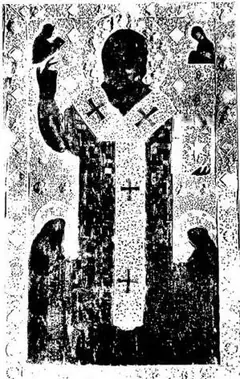
NICHOLAS, Bishop of Myra, Saint. - Born at Patara, in Lycia, he was bishop of Myra around the middle of the 4th century. He is one of the most popular saints of both the Greek and the Latin Church; but no positive data exist concerning his life. Hagiographers have woven a biography of St. Nicholas of Myra by attributing to him a large part of the life of another Nicholas, called the Sionite, who in the 6th century founded a monastery at Sion near Myra and later became bishop of Pinara in Lycia (d. 12 December 564).
In the "Praxis de Stratelate" it is related that the Saint freed three officials from mortal danger in the time of Constantine; this narrative was disseminated under Justinian. In Rome his image at the beginning of the 8th century is reproduced on the wall of the left nave of S. Maria Antiqua; he is haloed, of aged appearance, white tunic, black paenula, sacred pallium, and the inscription O ALTOC NIKOAAOC (Wilpert, Mosaiken, p. 708), and he stands between St. Athanasius and St. Erasmus. In Rome there are as many as 26 churches dedicated in his honor and a hospital (C. Huelsen, Le Chiese di Roma, Florence 1927, pp. 389-408). At the Lateran Pope Nicholas I (858-67) erected a basilica to the Saint of Myra; Callistus II, after Worms, rebuilt it and gave orders to fresco it; the image of the Saint was placed in the apse, with a book in his right hand and a pastoral staff in his left (Wilpert, Mosaiken, p. 163, fig. 43; G. B. De Rossi, Esame storico ed archeologico dell'immagine di Urbano II papa e delle altre antiche pitture nell'oratorio di S. Nicola entro il Palazzo Lateranense, in Studi in Italia, 1881, pp. 1-61). The chapel was destroyed in the time of Benedict XIV. Furthermore, in the time of Leo IV (847-55) two oratories dedicated to St. Nicholas are known, one near the basilica of S. Lorenzo in Agro Verano (Lib. Pont., II, p. 112) and the other near the titulus of the SS. Quattro Coro-
nati on the Caelian (ibid., p. 116); a third oratory was erected by Nicholas I (858-67) near the deaconry of S. Maria in Cosmedin (ibid., p. 161). In the restoration of the oratory of S. Lorenzo at the "Sancta Sanctorum" of the Lateran, carried out by order of Honorius III (1216-27), there is the mosaic image of St. Nicholas, again of aged appearance, bearded and with the mitre (Wilpert, Mosaiken, pp. 179-80 and fig. 56). At Constantinople the church at the Blachernae was erected by Justinian (Procopius, De aedificiis, I, 6); an oratory in the imperial palace was built by Basil the Macedonian; his birthday was celebrated in Constantinople with great solemnity (Synax. Constantinopol., Brussels 1900, p. 284). Between France and Germany no fewer than 2000 churches dedicated in his honor can be counted; England has about 400; Iceland about 40. In the East his mosaic image was in the church of St. Luke in Phocis (11th century). His iconography developed still further after the translation of his relics to Bari (through the agency of some merchants, on 9 May 1087), where a sumptuous basilica was erected in his honor and St. Nicholas became the patron of the city. It is found, for example, in the grotto of S. Stefano at Vasto near Otranto (12th century). Devotion to St. Nicholas manifested itself in every way, not only through liturgical celebrations, but by choosing him as patron for confraternities of young people, of schoolboys, of bakers, of boatmen; he is even the patron of prisoners; he is preferred as a baptismal name, etc. The enormous devotion aroused in Apulia, after the translation of 1087, was the cause of the jealousy of Benevento which, having a church dedicated to St. Nicholas, would have wished pilgrims to prefer it; they went so far as to write an "adventus S. Nicolai in Beneventum" (BHL 6206) to extol the merits of this city against the inhospitality of Bari. The iconography is oriented toward the representation of the legends of the three maidens saved from dishonor, of the three youths killed and resurrected; the account of the miracle of the precious vessel (BHL 6172) is nothing but the adaptation of a miracle attributed to St. Menna in a Greek text (BHG 1258). The oldest legend relating to St. Nicholas in the West is represented by an 11th-century manuscript of the Library of Karlsruhe (BHL 6119). A portable mosaic image attributed to the 13th century was stolen in the Museum of Vich (Roulin, Tableau byzantin inédit, in Monuments Piot, VII, 1900). Russian art has often represented St. Nicholas also with episodes from his life: in the Vatican Pinacoteca there are some examples from the 16th-17th centuries. In Germany, Switzerland and Holland popular imagination has made Nicholas the munificent old man with the white beard who on the day of his feast (6 December) brings his gifts to children. In North America he has been identified with the popular Santa Claus (from St. Nicolaus) who brings his gifts on Christmas night.
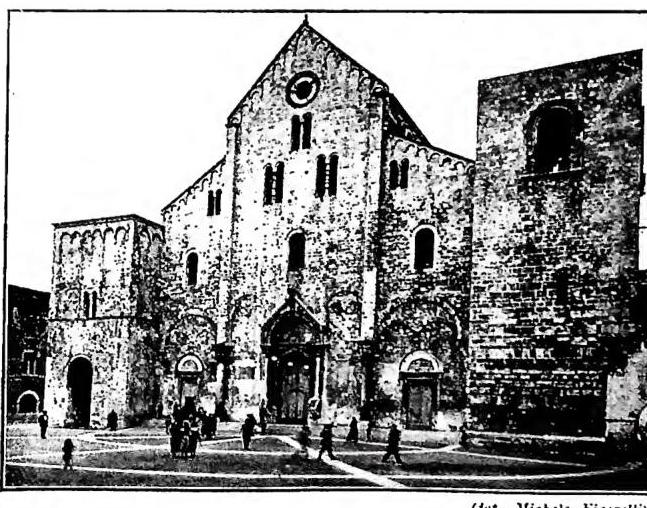
The Roman Martyrology, besides the feast of 6 December, commemorates his translation on 9 May. Even today at the tomb of the Saint an oily liquid is collected, called "manna of St. Nicholas," which is said to emanate from his bones and to which a miraculous power is attributed.
Bibliography7 works
Art. - In Byzantine art, the figure of the Saint is reproduced on talismans, appears in the iconostases of churches: there is also found, in a chapel of 1560, on Mount Athos, a complete cycle dedicated to his legend, in conformity with the precepts of the Book of the Painter.
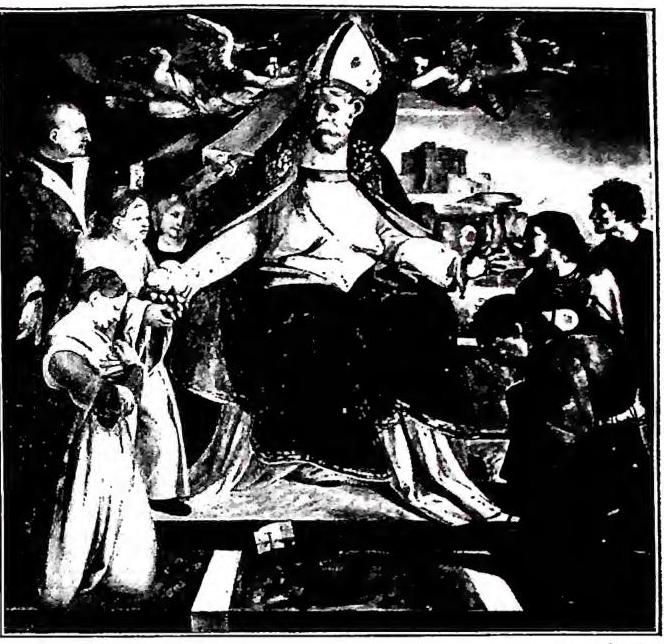
Among the greatest pictorial representations of the Saint is that in the altarpiece by Bernardo Daddi at the Uffizi, a sculpture in the style of Jacopo della Quercia in the cathedral of Siena, another in the chapel of the Saint at Siest. The German wooden sculptures representing the Saint with the attribute of the golden balls on the book are very numerous.
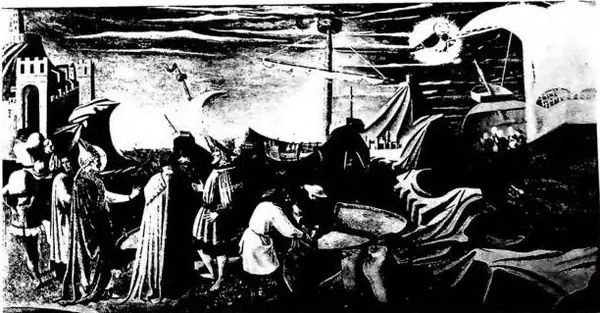
Scenes of episodes taken from his legend were already frescoed in the 13th century in the chapel of the Sancta Sanctorum in Rome and in S. Cuniberto at Cologne, or were included in a Flemish altar of the Museum of Dublin. In St. Paul in Carinthia a Romanesque pulpit with 29 carved scenes is preserved; in the great cathedrals entire stained-glass windows are dedicated to the story of the Saint, at Bourges, at Civray, Chartres, Tours, Le Mans in France and at Freiburg. The story of the Saint also finds wide use in contemporary cycles of frescoes. Five scenes are represented at Cologne, in St. Mary of the Lily, others in the Chapel of the Sacrament in St. Croix in Florence and in the Lower Basilica of Assisi. Mention should also be made of the frescoes of the greater cloister of Zurich, of the 14th century, of a chapel near Bonaduz, and above all the romantic narrative that an anonymous master depicted in 12 scenes in the chapel once dedicated to the Saint in the cloister of Constance. Altarpieces reproducing the image are also very numerous, while individual episodes find a place in the predellas or in the side compartments. Italian art possesses in this field outstanding masterpieces, such as the four small panels by Ambrogio Lorenzetti, at the Academy of Florence, dated 1332, and three panels of the Buonarroti Gallery, from the beginning of the 15th century; furthermore various predellas, such as the one by pupils of Masaccio in the Museum of Berlin. St. Nicholas frees three knights in a panel by Mariotto di Nardo (15th century) in the Vatican Picture Gallery, where he is likewise found together with St. Paul in a panel by Niccolò Buonaccorsi, and with other saints in another by the Sienese Paolo di Giovanni Fei. Gentile da Fabriano painted a polyptych for the Quaratesi chapel in St. Nicholas in Florence, of which one part is in the Uffizi in the same city; while the central panel is in Buckingham Palace in London; and four paintings of the predella with the scenes of the birth and of three miracles of the Saint are in the Vatican Picture Gallery. Angelico repeated the theme several times, and among his works particularly notable is an altarpiece for the chapel of St. Nicholas in St. Dominic in Perugia, today in the Picture Gallery of that city, whose predella with episodes of the life of the Saint is preserved in the Vatican Picture Gallery. Other examples can also be found in the German-speaking countries, e.g., in St. Nicholas in Rostock and in St. Mary in Danzig. Rarer are the representations of the various events of the life of the Saint carried out in relief in marble or wood: from the Romanesque age are two baptismal fonts at Zedelghem (in Holland) and at Winchester (in England), an archiepiscopal chair at Troyes, tympana and portals at Colmar, Chartres, etc. - See plate CXVII.
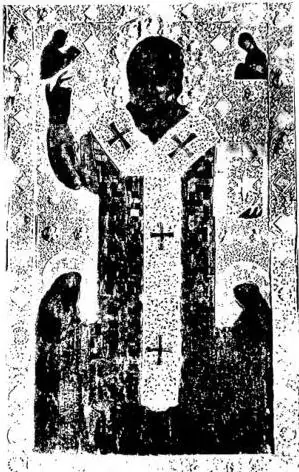
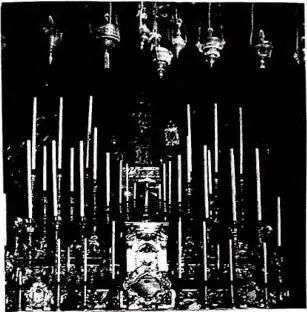
Bibliography
Eugenio Battisti