

GREGORY VII (Hildebrand), Pope, Saint. -
I. LIFE OF HILDEBRAND BEFORE HIS PONTIFICATE
The tradition concerning G.'s family, place and year of birth is not unanimous. G. Marchetti-Longhi sought to maintain the thesis that he was born of a family of high Roman nobility, perhaps of the Hildebrand-Stefaneschi, basing himself very probably on G.'s baptismal name, Hildebrand. But according to the primitive tradition Hildebrand was born at Soana (Sorano) in the Tuscan Maremma ca. 1020, the son of Bonizo, a blacksmith, and of «Berta, maggiore suburbana». For instruction in the liberal sciences and for moral discipline he was entrusted by his parents to his uncle, abbot of S. Maria in Aventino (of the priory of the Knights of Malta). Of his early youth spent in Rome, Hildebrand himself gives precise information four times in his pontifical letters, according to which he was received into the Lateran Palace and had two famous teachers, Lorenzo di Amalfi and the archpriest Giovanni Graziano, later Pope Gregory VI, with whom, after the deposition made by King Henry III of Germany at the Synod of Sutri (1046), he went reluctantly into exile near Cologne, as his chaplain. Probably there he took the Benedictine habit. The controversy among historians as to whether Hildebrand was a monk or not has been decided in the affirmative (cf. G. B. Borino, Quando e dove si fece monaco Ildebrando, in Miscellanea G. Mercati, I, Città del Vaticano 1946, pp. 218-62).
With Pope Leo IX he returned to Rome, even more unwillingly. By the same Pontiff, Hildebrand the monk was ordained subdeacon and became prior and steward at S. Paolo fuori le mura. There he reformed monastic discipline and restored the Basilica.
By Pope Leo IX and his successors, Victor II and Stephen IX, Hildebrand was employed in various diplomatic missions in France (e.g., against Berengar of Tours) and in Germany. Pope Stephen IX ordained him deacon and appointed him archdeacon of the Holy Roman Church. After his premature death, Hildebrand with great skill prepared the fall of Benedict X, elected uncanonically by the party of the Tusculani, and the election of Pope Nicholas II (1059-61). By his successor, Pope Alexander II (1061-73), his friend in reform, he was created cardinal and chancellor of the Holy Roman Church; after the death of Card. Humbert of Silva Candida (1061), he became, together with St. Peter Damian, the Pope's right hand in the struggle for ecclesiastical reform.
II. THE ELECTION OF HILDEBRAND (22 Apr. 1073)
Immediately after the burial of Alexander II Hildebrand was acclaimed pope by the people in the Lateran Basilica and shortly afterwards elected by the cardinals at S. Pietro in Vincoli and took the name of G. Doubts about the canonicity of the election arose much later, at the beginning of the struggle with King Henry IV of Germany. The young king seems to have confirmed the election of Hildebrand: it was the last time that the German Emperor performed that act.
III. THE PERSONALITY AND CHARACTER OF GREGORY VII
Hildebrand-G. was fifty years old when he attained the supreme pontificate. He was of extraordinarily small stature, with a pale face, but of incomparable strength of will and spirit. What he conceived, he carried out. He preferred images and similes drawn from the language of war. St. Peter Damian sometimes compared him to the north wind, at other times called him a "holy Satan." Fervent apologists and raging contemporary adversaries do not give an impartial judgment of his character and of his great soul that shines forth from the letters written in his own hand, to faithful friends such as Countess Matilda of Tuscany, Hugh abbot of Cluny, Hermann bishop of Metz. The predominant particularity of his spiritual attitude was an ardent faith enlightened by a mystical piety toward the person of Jesus. Justice was the leitmotiv of his thinking and acting.
IV. HIS REFORM PROGRAM
Hildebrand-Gregory, who had already worked for the reform of the Church for more than twenty years before his pontificate, began from the very first year of his pontificate to carry out his reform program with every effort. Conscious of the fullness of power of the successor of Peter, he set about uprooting the vices most deeply rooted in the clergy: simony and clerical marriage. For this reforming work he desired agreement between the spiritual and secular power, between the priesthood and the Empire. In the Lenten Synod of 1074 he issued decrees against simony and Nicolaitism, and at the same time encouraged the people no longer to attend the liturgical functions of married priests. The opposition of the bishops and clerics in Germany, Italy, France and England was great, but Gregory continued the work with growing fervor and energy. In the Synod of 1075, besides renewing the previous decrees, he issued another against the lay investiture of bishops and abbots, and called for freedom in their canonical election, without the intervention of the king or the civil power. Against this decree there arose the unanimous resistance of the feudal lords, especially on the part of the king of Germany. Therefore the rupture between the Papacy and the Empire was inevitable. From the same time dates the so-called Dictatus Papae, 27 brief propositions dictated by Gregory VII and inserted in his original register [between ep. 55 and 56 of book II]. Among the various hypotheses concerning its character, perhaps the most probable is that of G. Borino, according to whom the Dictatus Papae would be the index of a canonical collection. In its content the Dictatus Papae represents the expression of the primacy of the Roman Pontiff instituted by Jesus Christ and transferred to St. Peter. From him comes the position of primacy of the Church of Rome and of its bishop with titles of honor, privileges and real rights. From this derives his supreme power in legislation, administration and jurisdiction over the universal Church and over the individual churches. To the Dictatus Papae is also annexed Gregory VII's concept of the relations between the Church and the State: a much-discussed conception, which can chiefly be gathered from his letters to Herman, bishop of Metz (1076-81). At the foundation of his concept stands the unlimited power of binding and loosing given by Jesus Christ to St. Peter, and the evident superiority of the sacerdotal power over the royal power. The apostolic and royal powers are destined by God to direct the world, and the concord of both powers was the goal that Gregory VII set himself in his actions for the salvation of Christendom. He considered the work of the devil to be not the State in itself, but the bad government of tyrants and enemies of the Church in the civitas terrena, in the sense of St. Augustine.
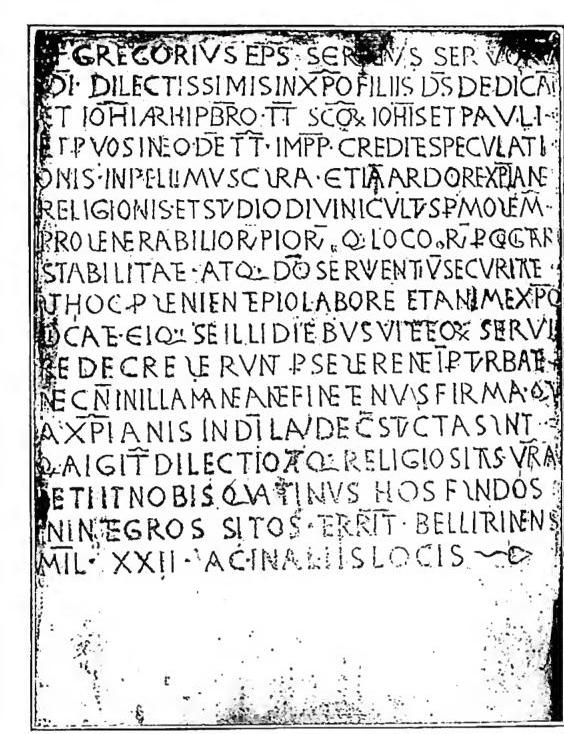
(from A. Silvagni, Monumenta epigraphica, Vatican City III) (no. 29, 6)
V. THE STRUGGLE BETWEEN THE PRIESTHOOD AND THE EMPIRE UNDER GREGORY VII AND KING HENRY IV
This immense and tragic struggle between the two powers can be divided into three periods.
1. The period of preparation (1073-75). From G. VII's first papal letters there stands out his benevolence toward King Henry IV. But the latter, a young man of high intelligence but weak character, soon made himself hateful, by his religious and political action, to the papal legates whom G. sent in 1074 to his court to reconcile the rebellious Saxons with the king, to settle ecclesiastical affairs and to promulgate the reform decrees: the reconciled king promised his help.
2. The period of transition (1075-80)
But in fact Henry IV, despite the decree against investitures, continued to institute the bishops of Germany and also of Italy, and especially of Milan, and dismissed dissatisfied the pontifical legates whom G. sent to him at the end of 1075. Shortly after, on 24 Jan. 1076, Henry IV at the Synod of Worms declared the Pope deposed. G.'s response to this deposition was the Roman Synod of 1076, in which he solemnly excommunicated the king and released his subjects from the oath of fidelity. The effects of the excommunication promised to be disastrous for Henry IV. The Saxons rebelled anew, many bishops who had been forced to sign G.'s deposition submitted again to the Pope, and the princes of Germany threatened him with deposition if he did not obtain absolution within a year. To obtain reconciliation, Henry IV came down into Italy in the winter of 1076-77 and found G. on his way to Germany, to go to the diet of Augsburg, in the castle of Canossa near Countess Matilda of Tuscany. Henry IV, in the garb of a penitent, implored for three days absolution from the excommunication. G. yielded to his prayers and absolved him. The dramatic event of Canossa is judged variously by historians. But today the majority agrees in recognizing that G. VII in that circumstance sacrificed the statesman to the priest, and Henry IV won back his crown.
3. The concluding period of the struggle (1080-85). In the Roman Synod of 1080 G. VII decided the case between Henry IV and his rival Rudolf of Swabia in favor of Rudolf and declared Henry deposed and excommunicated, because he was unfaithful to his promises. After the Synod of Bressanone (1080), in which Henry IV elected the archbishop of Ravenna Guibert as antipope (he called himself Clement III), the king undertook a military expedition against G. VII. But only in 1084 was Henry able to conquer the Leonine City with St. Peter's, where he enthroned the antipope Clement III and had himself crowned emperor. Robert Guiscard, with the army of the Normans, freed G. VII from the Castel Sant'Angelo and led him to the Lateran Palace: but because of the sack of the city carried out by the Normans, G. VII departed with his federates. At Salerno he again excommunicated, in a Synod of Nov. 1084, Henry IV and all his accomplices, and wrote an encyclical that was like his testament, in which he gave the synthesis of his reforming work and expressed his confidence in the future of the reform. On 25 May 1085 he died at Salerno with the famous words on his lips: "I have loved justice and hated iniquity, therefore I die in exile." He was buried in the cathedral of Salerno, where he still rests today.
VI. THE RELATIONS OF GREGORY VII WITH THE OTHER NATIONS OF EUROPE AND WITH THE EAST
Although his struggle with Henry IV, King of Germany, had occupied his entire pontificate, he nevertheless had relations with the other nations of Europe; thus with William the Conqueror of England, generally a friend of the reform; with King Philip I Augustus of France, an enemy of the reform; with Spain, with the Kingdoms of Denmark, Norway, Sweden, Ireland, with Poland, Bohemia, Hungary, Croatia and Dalmatia. The union between the Christian West and East also lay very much at his heart.
VII. JUDGMENT ON GREGORY VII
Although a great many studies have been made on G. VII, his personality still oscillates between the admiration and the hatred of opposing factions. In the grand history of the popes, perhaps no other of the Roman pontiffs was so excellently endowed by nature and by divine grace to fight that gigantic battle which he engaged in to free the Church from so many earthly ties and political entanglements. His more than human greatness and his inflexible firmness prepared for his successors the way to dominion not only spiritual, but also temporal, over the world of the Middle Ages. Pope Paul V inscribed him in the catalogue of the holy Roman pontiffs as a most zealous champion of the rights of the Church. Feast on May 25. - See plate LXXXII.
Bibliography14 works
Lucchesio Spalding