
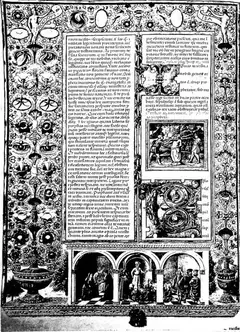
ISAIAS (HEB. JĒŠA-JĀH[Ā] "SALVATION [IS] YAHWEH", SEPTUAGINT 'HESAIAU). - The major of the writing prophets of the Old Testament (8th century B.C.).
I. THE PROPHET
Isaiah's activity is intimately connected with the history of the rulers who were his contemporaries, according to the indications of individual biblical passages and the general datum of Is. 1:1: "In the days of Uzziah, Jotham, Ahaz, and Hezekiah, kings of Judah." Their reigns together occupy the advanced 8th century, for some seventy years: a difficult period from the political standpoint and one of decadence from the religious-moral standpoint, but flourishing as regards Israelite society, which enjoyed progress in civilization because of frequent exchanges with neighboring countries, especially with the Aramean countries (to the north), with Assyria and Egypt.
Jerusalem was at this time a beautiful city, with perfected public services (Is. 7:3; 22:8-11; etc.), great palaces and much traffic, always an object of concern on the part of the kings for its defense (Is. 22:8; etc.). The kings of Isaiah's time, from the moral and religious point of view by which the prophets judged them, were either mediocre or far from embodying the theocratic ideal. Uzziah (or Azariah, ca. 769-737), who died in the very year in which the prophet had begun his ministry, had had a long reign, in which Israel enjoyed a certain well-being: in substance a good king, who had pursued a policy perhaps a little small in comparison with that of his northern colleague Jeroboam II, but fruitful especially for the future, by reason of its peaceful and popular character. His successor Jotham reigned only a couple of years, or little more (737-34). Ahaz (734-720) was instead the type of the "lay" king, insofar as this expression is applicable to a Semite of that era: a shrewd political schemer, a calculator, an exploiter of situations. In the summarizing judgment of the author of the Book of Kings he is one of the rulers of Judah who did "what is displeasing to Yahweh"; he was an "impious" man and as such punished (II Kings 16:2-20). An excellent king was instead the great Hezekiah (721-693), even if in his life there is no lack of grave errors, especially in his policy toward Assyria. In the time of Ahaz the Syro-Ephraimite war had occurred (736-735); moreover the first attempts at Assyrian penetration into Palestine with Tiglath-Pileser III (745-727) and especially with Shalmaneser V (727-722). But Hezekiah had to stand up to Sargon (721-705) and to Sennacherib (705-681) and endure the disastrous invasion of his territories: in compensation he was more fortunate in diplomatic relations with distant countries, Babylon, Ethiopia, other small states of Syria and Arabia, and in small wars with the Philistines and other neighboring populations.
In Isaiah's Jerusalem the forms usual to a courtly environment predominated: ambition and corruption, according to circumstances cynical or hypocritical, in which women participated with luxury, vanity and coquetry. Religious life, or rather ritual life, was extremely intense. This world of officials, courtiers, merchants, women, Levites, talked a great deal about public affairs, about "politics": they were passing through difficult moments, and everyone felt the need to declare himself for Egypt or Assyria, not to mention the positions taken for or against Samaria, Damascus, etc.
In such an environment Isaiah was born and lived, the most personal writer of the Old Testament and one of the most profound spokesmen of God in the entire religious history of humanity. Son of Amoz (not to be confused with the prophet of the same name), he was born in all probability in Jerusalem, which was the theater of his activity (Is. 7:3 ff.; 8:2; 22:15 ff.; 37:2 ff.). The data of the book do not confirm the Talmudic tradition that Isaiah was of royal stock, but they show in him an aristocrat, who was familiar with the court (cf. especially chs. 7 and 36-39), well informed about the backstage of politics (a symptomatic case: ibid. 29:15 ff.). The date of birth would fall around 767 B.C., if one supposes that at the time of his "vocation" in 737 he was about thirty. By this date Isaiah must already have been married (cf. ibid. 7:3), to a woman whose name is not known, who is called a "prophetess" (ibid. 8:3), because of the religious vision that Isaiah had of his marriage, not expressed in so explicit a manner as in Hosea (v.), but nonetheless evident in the symbolic names of the children (cf. ibid. 7:3 and 8:3).
Shortly before Isaiah had been Amos. Hosea was in full activity (ca. 745-735), when Isaiah would have been about twenty; Micah (v.) must have been his contemporary, who in turn suffered and, to a lesser degree, exercised an influence on Isaiah.
Like other prophets before and after him, Isaiah felt himself invested with his sovereign mission in a divine manifestation of a sudden character, the "vocation," described by himself (ibid. 6), which occurred ca. 737 B.C. Isaiah was in the Temple, probably alone, in prayer, when in a grandly solemn vision he was able to contemplate Yahweh seated on a throne "high and exalted," while Seraphim poised in the air in two ranks on either side, in alternating choirs, cried out the invocation "Holy, Holy, Holy!" Isaiah observed, accompanied by a feeling of profound fear at the consciousness of his personal unworthiness to witness such a spectacle, beyond the memory of the moral misery of his sinful people, with whom he felt co-responsible. But behold, one of the Seraphim took a burning stone from the altar and with it purified the prophet's lips. Then Yahweh himself communicated to him his mission: the charge to accelerate with his word the action of God's judgment, already in act, against the transgressing people, until it should have become like a tree stump, from which a new "seed" was to sprout, the messianic people (ibid. 6:13). The mystery of that fascinating hour impressed itself indelibly on the memory of the man, now become a prophet. The soul of the seer felt itself absorbed forever in the mission that God, proclaimed three times "Holy," had wished to give him. Conscious of his belonging to Yahweh, from then on he lived and worked as the envoy of the "Holy One of Israel" (as Isaiah very often calls God) to his people and even to the pagans. With intrepid courage, for over thirty years he fulfilled the mission of restoring to religion its monotheistic and moral purity, of inculcating justice in relations between men, especially of the rich toward the poor, and of reawakening in public life the sense of Israel's election and of its belonging to God. These are the three main lines of Isaiah's message. Political and commercial relations with Arameans, Assyrians, Egyptians favored the infiltration into Israel also of pagan ideas and practices; thus to the ancient transgressions against religion were added new ones: astral cults, magic, divination, all with the character of the refinement of living in foreign fashion. Of the traditional religious forms there remained the external manifestations, great sacrifices, sumptuous ceremonies, empty of sincere religiosity and divorced from morality. For both attitudes, immoral paganism and empty ritualism, the prophet has the harshest words of reproach, derision, contempt, which do not spare the most venerated cultic places and allude many times to the priestly class, or to prominent citizens, responsible for bad example.
Isaiah also fought for social morality. From Amos (v.) and from him come the most impressive figurations of transgressions against justice: the rich man who commits oppression to the harm of the common people and enriches himself at their expense (Is. 5:8, 14-15; etc.); unjust sentences in cases brought before magistrates; oppression of the orphan and widow (ibid. 23; etc.). There is also talk of personal violence, extending even to murder: the prophet speaks of "scarlet sins" (ibid. 18); God covers His face before the gesture of prayer (stretching out the hands to heaven), because they are hands full of blood (ibid. 15). The perversion lies in the very moral conception itself: evil is called good and good evil (ibid. 3, 20). The denunciation of the most disgusting moral defects completes the rejection of external religiosity, with which it is often associated, in strident contrast with the most urgent demands of divine holiness.
A characteristic of I.'s thought was the recalling of public activity and of politics itself to the principles of the faith and morality of the Yahwistic religion. Israel is the people of God: it has a law and God demands of it a manner of life; its public life, like its private life, therefore cannot be that of any one of the gentile peoples. Its kings cannot place themselves in the current that drags all sovereigns and peoples toward a policy of pure and simple utilitarianism. Moreover, Israel, as Yahweh's property, must defend its spiritual heritage from every pagan degeneration: it cannot therefore, not even for occasional reasons, make common cause with idolatrous peoples. Hence the harsh opposition that I., before and more than any other prophet, showed with regard to political and military alliances with pagan peoples. In the contest for hegemony that is fought among the neighboring powers — Samaria, Syria, Assyria to the north, Egypt to the south — Israel must not take a position on one side or the other: it must place the hope of its salvation solely in trust in Yahweh, by whom it will be saved. Faith must be the norm of its policy. The opposite practice is first of all an offense against the holiness of Yahweh and would result in Israel's being abandoned by him. Thus I. taught Ahaz on the occasion of the threat of invasion by the allied kingdoms of Samaria and Damascus (Is. 7), and later in the time of Hezekiah, on the occasion of the Assyrian-Egyptian hostilities (ibid. 28-30); and he repeated this on other occasions. A utopian policy, it would seem at first sight, and such was the judgment passed on I.'s position. But the test of facts proved the "utopian" right; "realism" did not save Ahaz from the disastrous invasion that he was so eager to avoid; in the terrible trial of 701
B.C., which revealed the greatness of soul of the prophet, but also brought into focus the "utopian" character of his religio-political views with the most "impolitic" of his proposals (refusal of the offer of negotiations with the pagan king Sennacherib, who found himself in a moment of difficulty, but had always passed from victory to victory), if King Hezekiah had not followed the counsels of the old prophet he would have been swept away and with him Jerusalem itself. In the midst of the stormy sea of events, I. pointed to the unshakable rock of trust in the Lord, to which the King and the people had to cling: through trust in the Lord Jerusalem was saved by I.
In consequence of this, like all men of God, he knew opposition. His words were not always heard with deference and respect: interests struck, vices denounced sought revenge in calumny, in hatred, in mockery (Is. 28:9-10), in contempt for his word (ibid. 30:12), and at alternating periods they procured for him fortunate influences and unpopularity and disfavor at court. To a moment of this kind an uncontrollable Jewish tradition, preserved in late documentation, links the end of I., about which the biblical text is silent, and which would have made the prophet a martyr.
Indeed the Ascension of Isaiah (5:1 ff.) recounts that the prophet died sawn with a wooden saw (cf. Heb. 11:37) by order of the impious Manasseh (cf. II Kings 21:16), whom he had reproached for idolatry.
II. THE BOOK OF ISAIAH
The book presents a very clear division into two parts, which is accepted identically by all scholars.
1. First part (chaps. 1-35) and historical appendix (chaps. 36-39)
The first part has a content that reflects the characteristic prophetic mentality of the 8th-7th centuries B.C., as it is known from the other similar writings of that age, in this case accompanied by power of thought and perfection of expression. The prophetic theme is essentially a grandiose divine judgment on life and contemporary history: not only the pagans and not only the schismatic northern kingdom, but also Judah (Jerusalem) for its religious infidelities and moral corruption will be subjected to "judgment": the instrument of punishment will be Assyria, moved by Yahweh. The people will be swept away along with the reigning dynasty; from the disaster only a small "remnant" will be saved, which will be the seed of the messianic people. From the Davidic stock a shoot will sprout: the Emmanuel (v.), the Messiah, who will reign eternally and universally in Zion.
Reasons especially of content lead to further distinguishing minor collections of Isaian oracles (1st collection: chaps. 1-12; 2nd: chaps. 13-27; 3rd: chaps. 28-35, in which it is sometimes possible to distinguish even subtler stratifications), which may have had an independent existence for a certain time, and then were incorporated into the present work, which, because of this slow formation, perhaps through successive accretion, is not ordered according to a single criterion. Among the "minor" collections, the two concerning Babylon (chaps. 13-14 and the first part of chap. 21) stand out, as does the one of singular content called the "apocalypse of Isaiah" (chaps. 24-27), whose authenticity is seriously called into question for reasons (set forth, e.g., by the Catholic J. Fischer [v. bibl.], I, pp. 110, 148) of historical setting (the Neo-Babylonian power asserts itself at least a century after Isaiah) and of form.
The historical appendix (chaps. 36-39) has a common origin with the passage II Kings 18:17-20:19, of which it is essentially a duplicate: there are reasons for holding that it is the work of Isaiah (cf. II Chron. 32:32), used by the author of the Book of Kings, and also that it is the work of the author of that book, from which it would have been extracted and inserted into Isaiah, because of the important part the prophet had in the events narrated.
2. Second part (chaps. 40-66)
Notable differences of content and form have raised, since the end of the 18th century (Döderlein, 1775; Eichhorn, 1824), strong doubts about the authenticity of the second part, whose author, without prejudice to the critical question and provisionally, as the grave problem persists, is almost universally designated by the name of "Deutero-Isaiah."
Some scholars then accept a further division of this part, proposed by Duhm (1892), into two collections by different authors, called "Deutero-Isaiah" (chaps. 40-55), from which are kept distinct the poems on the "Servant of Yahweh," inserted at four different points (in chaps. 42, 49-50, 52-53), and "Trito-Isaiah" (chaps. 56-66). Other, more minute and daring divisions, devised by isolated "critics," do not merit consideration.
The author, with the mentality, aspirations, and preoccupations of a Jew living at the end of the Babylonian exile, speaks for the most part of the imminent liberation of Israel, of its return to the Holy Land, and of the inauguration of the "kingdom of God." Formally, there are poems, true literary "compositions," some of them long, according to a technique that disposes of advanced and sometimes refined means. This brief note is sufficient to indicate the distant origin of the hypothesis that this "second part," to be considered a biblical book in its own right, should be attributed not to Isaiah but to an anonymous writer of the 6th century B.C., possibly a student of Isaiah. One must affirm the eminently historical-critical character of the question, despite its rationalistic origin.
For Catholics the (religious) value of the messianic oracles contained in Is. II would remain almost entirely intact if, instead of to the Isaiah of the 8th century B.C., they were attributed to an author of the 6th century B.C. (cf. H. Höpfl - A. Miller - A. Metzinger, Introd. in Vet. Test., Rome 1946, p. 418), that is, they would remain true prophecies; the same can be said of the oracles concerning the liberation of Israel from its exile. Already a well-known response of the Pontifical Biblical Commission of June 28, 1908 (Ench. Bibl., nos. 287-91), without taking decisive positions, limits the doctrinal-theological aspect of the question in affirming (in this followed concordantly by all Catholics) the character of true prophecy that the oracles of the second part of Isaiah have (Resp. I-III), while for the problem of authenticity, on the critical ground, it affirms only that the arguments that up to that time had been brought forward to deny Isaian authenticity are not sufficient to permit abandoning the attribution peacefully accepted by all Jewish and Christian tradition (Resp. IV-V). Catholics have not ceased, with the consent of ecclesiastical authority, to consider the possibility that the "Deutero-Isaiah" does not in fact go back beyond the 6th century and to study the arguments for and against this opinion, which even at a distance of almost half a century from the response cannot be said to be demonstrated, although it has gained adherents. A useful orientation on the more advanced position of Catholic thought is in J. Coppens, Histoire critique des livres de l'Ancien Text., Louvain 1942, pp. 182-83, 187-88. On the other hand, it is not of little interest to note that even very recent non-Catholic scholars have pronounced against the "Deutero-Isaiah" hypothesis and in favor of the unity of the book (see the list of H. Höpfl-A. Miller-A. Metzinger, op. cit., p. 415, note 6).
Arguments in favor of the traditional unity are, especially, that the author of the second part of the book lived not in Babylon, to which very scanty references are made, interpretable also as not from direct vision, but in Palestine, whose civil conditions are also well portrayed (Is. 56 ff.); the fact that this would be the only example of an anonymous prophetic book, a notable and strange fact, certainly not in conformity with Israelite religious-literary mentality; Jewish and Christian tradition; and other considerations of thought and form. On the contrary, the following are urged: the description of the exile as a present situation, not a future one (Cyrus is a person supposed to be known and even designated by his name); many particularities of language and also of general theological conceptions (divine majesty; wisdom; omnipotence; transcendence), proper to this book; the literary character of the whole, the work of a poet, rather than of a nabhī'.
3. The oracles of Isaiah
Among the Isaian oracles of particular importance are to be noted: a) chap. 1, used as a general introduction to the book, but perhaps composed after the Syrian war of 732: a vivid and moving representation, in most beautiful images, of the painful conditions of that moment, in their religious, moral, and economic aspect. - b) The introductory vision of chap. 6, which contains at least in germ all the characteristic themes of the prophet's doctrine. - c) The oracle of the Emmanuel (v.) in chap. 7, with developments in a long series of subsequent oracles ("Book of the Emmanuel," chaps. 17-12). - d) The poems of the "Servant of Yahweh" (42:1-7; 49:1-9; 50:4-11; 52:13-53:12), with prophecies of the messianic passion and redemption. - e) The description of the new messianic Jerusalem (chaps. 60-62).
But the sublime power of the writer and his religious and prophetic value could be known only through a direct reading of his prophecies. The "forms" that he uses (part 1) are those fixed by the prophetic tradition: oracles of threat and promise concerning the future, and of reproach concerning the present. His most lofty theology, the violent passion that sweeps over him at times, the pathetic warmth of his appeals to faith and to abandonment in God, the plastic power of an expression continually enlivened by images, some of which would today even seem too bold, or hurled with a vigor explained only by the depth of conception and by creative immediacy, make him the greatest Hebrew poet and one of the supreme geniuses of ancient Semitic civilization.
Bibliography9 works
Commenti patriatici: Origene (PG 13); s. Basilio (PG 30); s. Cirillo Alessandrino (PG 70); s. Girolamo (PL 24).
Commenti cattolici: B. Neteler, Münster 1876; A. Condamin, Parigi 1905; S. Minocchi, Bologna 1907; J. Knabenbauer-F. Zorell, 2 voll., Parigi 1922-23; F. Feldmann, 2 voll., Münster 1925-26; J. Fischer, 2 voll., Bonn 1937-39; G. Girotti, Torino 1942.
Non cattolici: S. D. Luzzatto, Padova 1855-67; B. Duhm, Gottinga 1892 (4ª ed., ivi 1922); K. Marti, Tubinga 1900; H. W. Hertzberg, 2 voll., Lipsia 1936-39.
Giovanni Rinaldi
III. SCROLLS OF ISAIAH
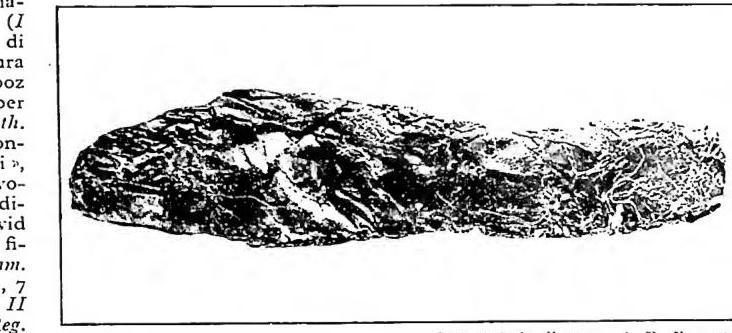
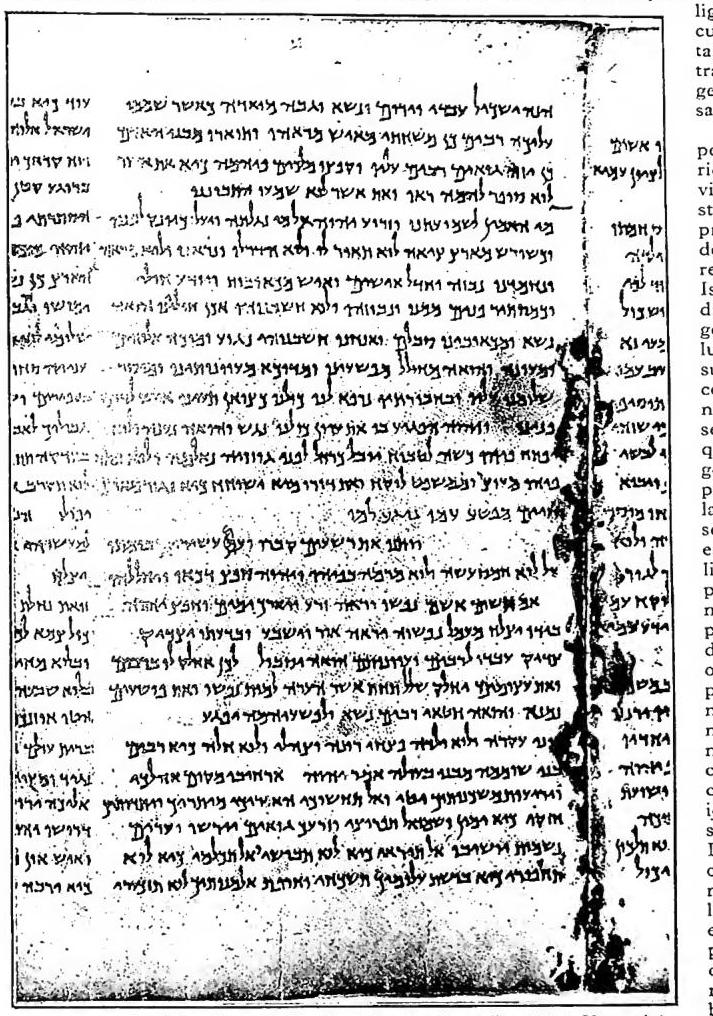
A scroll of the entire book of Isaiah was discovered in the autumn of 1947 in a cave 2 km west of the Dead Sea, 4 km from the springs of 'Ajn el-Feshah; it was purchased by the Syro-Jacobite metropolitan of St. Mark in Jerusalem. It is 7.24 m long, 26 cm high, made up of 17 sheets of leather (from 25 to 63 cm wide) sewn with linen threads. The sacred text is arranged there in 54 columns (of 29 lines on average); it was written with care in the 2nd or 1st century B.C. (J. Trever dates it: 125-100 B.C.). In mid-February 1948 it was photographed by John C. Trever (E. L. Sukenik then copied and published chapters 42-43 from it, Jerusalem 1948), and in 1950 the American School of Oriental Research issued the phototypic edition of it (in 61 double plates), edited by Millar Burrows.
The text is substantially in conformity with the Masoretic recension, but it has many bizarre, redundant spellings (scriptiones plenae); it belongs to the "popular" type of transmission, distinct from the "official" text determined by the sōphērîm, who toward the beginning of the Christian era eliminated the "popular" texts by throwing them into the gēnlzāh. The orthography of proper names is interesting (J. T. Milik [v. bibl.], p. 217 ff.); in theophoric names the ending -jāhō is almost regularly replaced by -jāh. From ch. 34 the masculine and feminine pronouns of the 3rd person singular take an elongated form (huvā, hā') and other forms (kāh, mī', -hāh) are lengthened with a mater lectionis. A text independent of the tradition codified by the sōphērîm is observed in 19, 18; 49, 5. 24-25; etc.
In Is. 41-53 there are notable messianic variants. In 51, 14 (mafahṭī "I have anointed" instead of miḥath "destruction") the Messiah appears as high priest, founder of a universal covenant; in 53, 11 is added (as also in the manuscript of the Hebrew University) 'ôr "light"; 42, 1: "his justice" ("his" is omitted in the Masoretic text); 51, 5: "In Him (Messiah), the distant lands hope... the mighty deeds of his arm," etc. (in the Masoretic text: "In Me (God)," etc.).
The Hebrew University of Jerusalem possesses another scroll of I. (acquired by E. L. Sukenik) in a fragmentary state. It contains parts of chs. 17, 22 and 23, and the last third of the book (chs. 44-66), all in very poor condition. This text is being brought back to life with infrared photography. It is most faithful to the "official" recension; Sukenik considers it to be of the 3rd or 2nd century B.C.
Bibliography6 works
Antonino Romeo
IV. ICONOGRAPHY
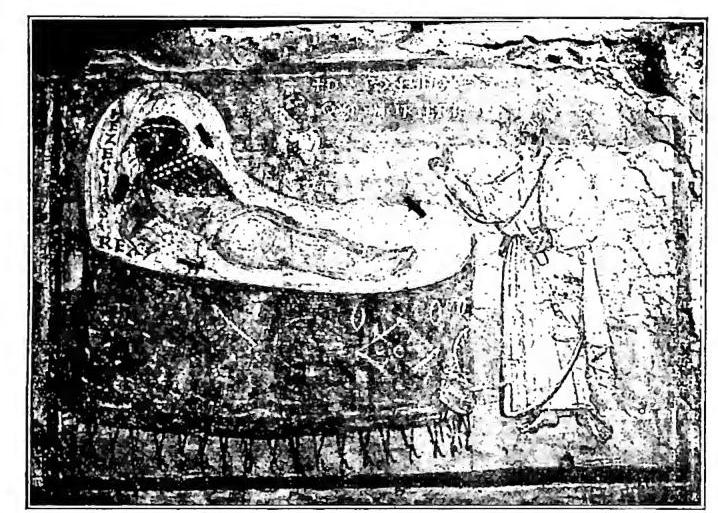
A fresco located in the sand-quarry of the cemetery of Priscilla depicts the Madonna pressing the Child to her breast; on the left a figure in tunic and pallium holds a book in his left hand and with his right points to the star painted (now faded) above the Madonna's head. G. B. De Rossi, who first published the fresco, identified the figure with I., who wrote: "Ecce Virgo concipiet et pariet Filium" (Is. 7:14); in the star De Rossi saw the true light, symbol of Christ, foretold by the same prophet: "Surge illuminare Ierusalem, quia venit lumen tuum et gloria Domini super te orta est" (ibid. 60:1-6). Garrucci, on the other hand, proposed identifying the figure as the prophet Balaam, who foretold the star: "Orietur stella ex Iacob" (Num. 24:17). Wilpert maintained De Rossi's opinion and gave a color reproduction of the image that is very important because today the star is no longer recognizable (Pitture, pl. 22); the same author wrongly believed he could identify another similar scene in a badly damaged fresco of the cemetery of Domitilla (ibid., p. 175, fig. 14). Recently Fr. E. Kirschbaum revived Garrucci's thesis, while L. De Bruyne emphasized I.'s allusions to light (Conferenze della Società dei cultori di archeologia cristiana, in Riv. di arch. crist., 21 [1945], p. 243).
Worthy of note is the passage of Justin which attributes to I. (Apol., I, 32: PG 6, 380) what in fact belongs to Balaam.
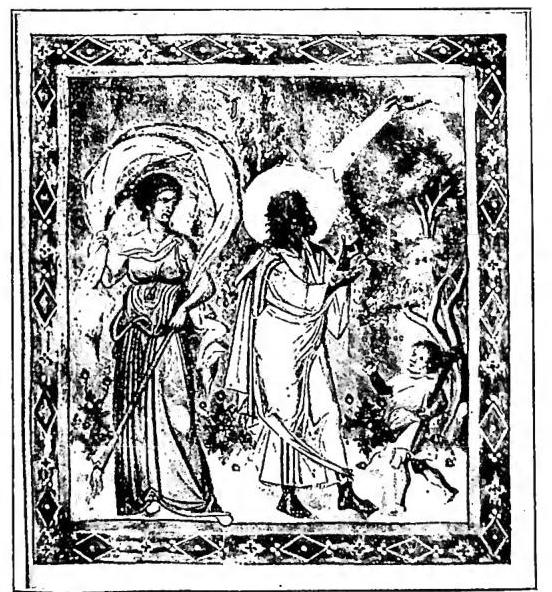
In the Christian topography of Cosmas Indicopleustes a miniature depicts the vision of I.; in the center is the Redeemer enthroned between two seraphim acclaiming "Agios, agios!", while in the right corner the prophet is approached by an angel who purifies his lips with a burning coal (a similar scene is also at the beginning of the book of I. in the Bible of Charles the Bald in the National Library of Paris). In the Greek Psalter no. 139 of the National Library of Paris a miniature depicts another vision of I.; from the divine hand a ray bursts forth from on high and strikes the nimbed head of the prophet standing between personified Dawn and Night.
A fresco of S. Maria Antiqua depicts the prophet I. foretelling to Hezekiah his imminent death (Is. 38:1). In the chapel of al-Baqawāt in Egypt the martyrdom of the prophet was depicted. A miniature with the vision of I. is in fol. 67 of the manuscript containing the Sermons of St. Gregory of Nazianzus in the National Library of Paris (Cod. Parisius 510).
Bibliography2 works
Enrico Josi
V. ASCENSION OF ISAIAH
Old Testament apocryphon of a narrative and prophetic character, having as its protagonist the prophet Isaiah. The composite character of the work is unanimously recognized. Regarding the identification of the sources, or independent earlier writings, and of the editorial or later additions, scholars advance various hypotheses, which agree substantially in recognizing a Martyrdom of Isaiah (chapters 1-3, or 2-3 up to verse 12, and the first half of chapter 5); an apocalyptic writing called by Charles the Testament of Hezekiah (chapter 3 from verse 13 and chapter 4); a Vision of Isaiah (from chapter 6 to chapter 10 and part of chapter 11).
The first document narrates that I., accused of having made himself superior to Moses, for having said "I saw the Lord" (Is. 6:1), was had cut in two with a wooden saw by the impious king Manasseh: this writing, already known to Origen (In Is. hom. 1,5), and according to some also to Heb. 11:37, which among the kinds of martyrdom recalls "being sawn" (but it might draw only on parallel traditions), is Jewish and from the end, or middle, of the 1st century B.C.
The second document recounts the resentments provoked in an adversary of the prophet by his great messianic prophecies: the Incarnation, Passion and Death of Christ, the election of the Apostles, etc. It is of Christian origin, perhaps from the 2nd century A.D.
The third document narrates a journey of I. through the seven heavens, where he learns the most hidden mysteries, also of a Christian character: perhaps this too is from the 2nd century A.D.
The final compilation dates from the end of the 2nd century A.D., or the beginning of the 3rd. The original text was Greek, only partially preserved (2:4 - 4:4); we have the complete Ethiopic version (5th century) and fragments of three Latin versions, of one Slavonic and one Coptic.
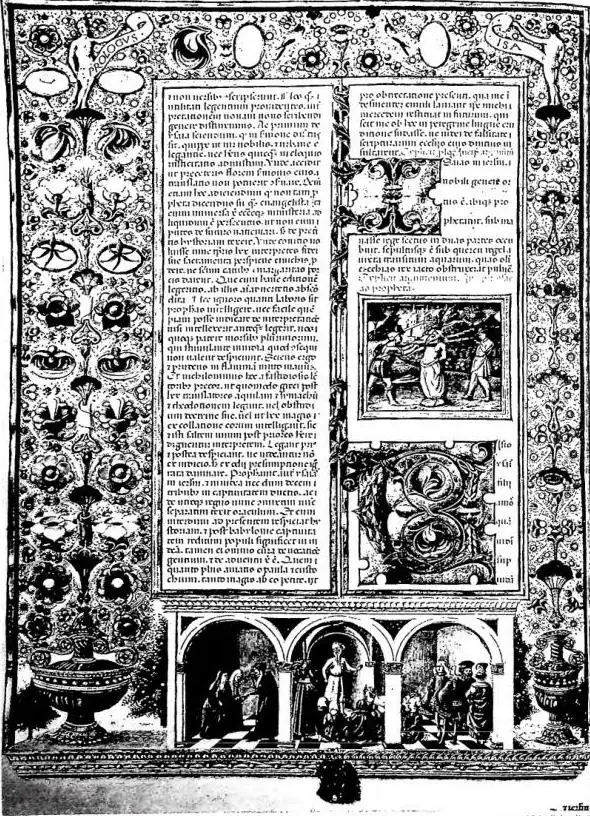
The account of I.'s death enjoyed a certain popularity among the Fathers (E. Tisserant [v. bibl.], pp. 62-74) and in Jewish writings; the book was held in esteem by certain Gnostic sects. - See plate XVI.
Bibliography7 works
Studi : V. Burch, The literary unity of the book of the Ascension of I., in Journ. of theol. studies, 20 (1918-19), pp. 17-23; J. Felten, Storia dei tempi del Nuovo Testamento, II, Torino 1932, p. 350 sgg.
Giovanni Rinaldi