

CLEMENT I, Pope, Saint. - Pope from 92 to 101, according to Eusebius; author of an epistle to the Corinthians.
I. LIFE
According to Irenaeus (Adv. Haer., III, 3, 3, in Eusebius, Hist. eccl., V, 6, 1-3), he was the third successor of St. Peter after Linus and Anacletus; other testimonies, less reliable (Tertullian, De praesv. haeret., 32; Jerome, De vir. ill., 15; Adv. Iovinianum, I, 12; Comm. in Isai., 52, 14), make him the immediate successor of St. Peter; others, later still (Eusebius, Hist. eccl., III, 4, 8-9; Constit. Apost., VII, 46; Liberian Catalogue; Optatus of Milevis, De schismate Donatist., II, 3; Augustine, Epist., 53, 2), give this order: Peter, Linus, C. The period of his pontificate is indicated by Eusebius both in the Hist. eccl., III, 15, 34, and in the Chron. ad a. Abr. 2110. From the letter he appears to have been educated in Hellenistic Judaism. He was in personal contact with Peter and Paul (Irenaeus, loc. cit.) and according to the ancients he should be identified with the C. of Phil. 4, 3. On the other hand, the identification, proposed by some, with the consul Titus Flavius C., cousin of Domitian martyred in 95, rests only on the testimony of the Clementine apocrypha, which make him a member of the imperial house of the Flavians, and is in conflict with reliable information. A tradition, documented only from the 4th century, makes him a martyr. Feast 23 Nov.
II. THE EPISTLE
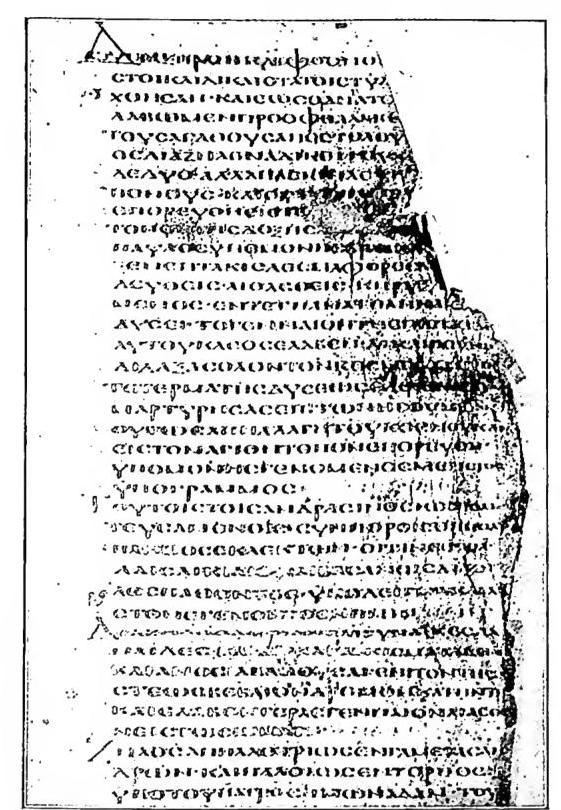
The biblical codex Alexandrinus (5th cent.) and the Greek codex 54 of the patriarchal library of Jerusalem (11th cent.) have transmitted to us a letter from the Church of Rome to the Church of Corinth, which has also come down to us in ancient versions: Syriac and Latin. It is anonymous, but it is attributed to C.: by Hermas (Pastor, Vis. II, 4, 3); by Hegesippus (in Eusebius, Hist. eccl., IV, 22, 1); by Dionysius of Corinth (ibid., IV, 23, 11); by Clement of Alexandria (Stromata, I, 7, p. 339 ed. G. Potter; IV, 17, p. 609; 18, p. 613; VI, 8, p. 173); by Origen (De principiis, II, 3, 6; In Ezech., 8, 3; 51, 1; In Iohann., VI, 54 [36]); by Eusebius (Hist. eccl., III, 16, 38). The allusion to a persecution that had ceased (1, 1), which must be that of Domitian, places the epistle under the reign of Nerva (18 Sept. 96-25 Jan. 98). Its occasion was a sedition stirred up by a few factions against the leaders of the Church of Corinth (1, 1; 3; 21, 5; 47; etc.). In the first part (1-36), of a general character (cf. 62), C., having described the wretched state of that Church once flourishing (1-3), indicates its cause in envy (5-6), and the remedies in the virtues of penance, obedience, hospitality, piety, humility (7-19); he recalls the benefits of God, which the creatures obey, the exhortations of Scripture, the resurrection, divine omniscience, the reward promised by God (20-36). In the second part (37-61), more closely tied to the occasion of the letter, he sets forth the hierarchical order of the Church established by Jesus Christ, which requires order and discipline in the liturgy and in government (37-44); he reproves the seditious, exhorting them to penance, praises and recommends charity (45-58), prays for the Church and for the public authorities (59-61). Finally, having summarized his exhortations, he mentions the legates sent by him to Corinth, whom he hopes may soon return with good news (62-65).
The epistle of C., as appears from the authors cited above and from other sources, enjoyed very great fortune; it was read publicly in many Churches and received into some biblical codices immediately after the New Testament. Historically important are the attestations it gives us of the persecution of Nero, in which Peter and Paul suffered martyrdom, of the seven prisons and of the latter's journey to Spain (ch. 5); of the sedition of Corinth; of the liturgical prayer, of which the one reported there may be considered a model; of the relations with the imperial power, for which prayer is there made. The dogmatic content is also noteworthy. As for Trinitarian and Christological doctrine, it reproduces the data of the New Testament; the ecclesiology is particularly developed: the Church is the body of Christ (46, 7), in which the various members have distinct functions (ch. 37); whence the hierarchy, of divine institution (ch. 42), composed of bishops, also called presbyters, and of deacons (42; 44, 1-2). The Roman primacy emerges luminously, whether Rome's intervention was solicited by the Corinthians, or whether, as is more probable, C. took the initiative himself. He is conscious of fulfilling a duty (1, 1), speaks with authority, demands obedience and threatens the disobedient (59, 1-2; 63, 2-4; 65, 1); the result (Eusebius, Hist. eccl., IV, 23, 11) shows that this authority was fully recognized.
Bibliography16 works
The discourse addresses the "new people" that had by now become more numerous than the old (2, 3), but the formulation of the admonitions has a Jewish-Christian flavor. Its religious ideal is "righteousness" (v. Mt. 7, 21 in 4, 2 [non-canonical formulation?]; 11, 7; 12, 1; 18, 2; 19, 3), but perhaps in the sense of an ascetic surpassing of common "righteousness." The author invites Christians to leave this world, this flesh (5, 1; 5, 5), because the great promise of Christ is rest in the future kingdom of eternal Life (5, 6).
The two worlds, the present one and the future one, are two enemies (6, 3). This world inclines to adultery, corruption, love of money and deceit. One must renounce all this (6, 4), one must preserve Baptism, the pure seal (6, 9; 7, 6) and do penance while we are on earth (8, 1; 2). We must keep the flesh chaste, if we wish to keep the seal without stain (8, 4 and 6), we must guard the flesh as a temple for its resurrection (9, 1 and 3). One must renounce every equivocation and perform acts of righteousness in order to be able to enter the Kingdom of God (11, 5; 7) awaiting its arrival from hour to hour (12, 1). Doing so we shall be members of the first church that was built before the sun and the moon (14, 1) and if God created according to Gen. 1, 24 man male and female, we must think of Christ and the primitive church (14, 2), which were spiritual. When the Spirit took up dwelling in the flesh of Christ, the Church also appeared (14, 3). We must in our flesh reproduce the relation between the flesh of Christ and the Spirit, thus we shall be members of the primitive Church (14, 3, 4). The consequence is the "counsel" of abstinence (ἐγκράτεια). Furthermore, almsgiving, fasting and prayer are recommended (16, 4). After having suffered for a short time in the present world, we shall reap the immortal fruit of the resurrection. With "the fathers" we shall rise again and enjoy a happy world (19, 4).
The spirituality of the work is very archaic. In its general traits it has affinities with the Shepherd of Hermas, the pseudo-Clementine literature and the Acts of Paul (on the last point cf. C. Schmidt, Acta Pauli, Leipzig 1905, pp. 190-92). It is an ascetic spirituality (apotaxis) based on the eschatological contrast of the two worlds. It seems that a virginal life is recommended to Christians, both because such a demand is already deduced from Baptism, and because of the virginal birth of Christ. The Jewish-Christian speculation on Adam was perhaps not unknown to the author when he alludes to the christological problem. The author knows apocryphal writings, almost certainly the so-called gospel according to the Egyptians (ch. 12), which however he does not interpret in the sense of the Encratites, and probably another apocryphal gospel (5, 2; 3, 4 and perhaps 4, 2); furthermore he knows an apocryphal prophetic book (11, 2-4) which is also known from the First Epistle of C.
(23, 3-4): perhaps Eldad and Modad. The country of origin of our writing is perhaps Syria, the time of composition probably the first half of the 2nd century.
Bibliography3 works
2. Letters to the Virgins
A Syriac codex of the New Testament contains after the epistle of Jude two epistles of "C. apostle of Peter"; Epiphanius (Panan., 30, 15, 2, ed. K. Holl [CB, XXV], Leipzig 1915, p. 352 ff.) knows "encyclical letters" of C. that were read in the churches and opposes them to the Περσβοί of Peter attributed to C., that is, to the pseudo-Clementine literature.
The fact that these epistles were read in the religious service in the East explains their presence in a New Testament codex, but the notice of Epiphanius also proves the existence of more than one letter, and the public reading is understandable given the quasi-apostolic authority of C. The same letters are also known to Jerome (Adv. Ioan., 1, 12), who holds that they were addressed to the "eunuchs who have made themselves eunuchs for the Kingdom of heaven" (Mt. 19, 12). This destination, which does not appear from the Syriac translation, returns instead in the Coptic translation of the text. The Coptic text published in fragments by Th. Lefort (in Le Muséon, 40 [1927], p. 254 ff. and ibid., 1929, p. 265 ff.) nevertheless attributes the epistles not to C. but to St. Athanasius. Greek fragments (in part abridged) of the text have been found in the Pandects of Holy Scripture of the Palestinian monk Antiochus (ca. 620). The public reading of the epistles in the churches favors the attribution to Pseudo-C.; while the attribution to Athanasius is explained by the fact that he too had written epistles to virgins. The asceticism of these letters is still primitive. The sacred virgins live in their parents' house but have made a vow (profession, ἀμολογία [Coptic text]) of chastity. The custom of the cohabitation of men and women consecrated to the Lord (virgines subintraductae) is combated. Interesting is the survival of the charisms in these groups and the lack of stabilitas loci. The ancient hypothesis remains all the more plausible, that the epistles are works of a Syrian or a Palestinian of the 3rd century.
Bibliography3 works
3. Liturgy of C
In book VIII of the Apostolic Constitutions the liturgy there named is called that of St. Clement, because their compiler wrongly attributed his work to C.
Another question is whether the epistle of C., in its liturgical passages, survived in later liturgical texts. Thus, for example, in Constit. Ap., VIII, 22, 3 (p. 526, 12 ff. ed. F. Funk) phrases from the First Epist. of C. return - almost verbatim: 60, 1 and 59, 1; and also in the liturgical fragment of a papyrus of the 3rd century (cf. U. Wilcken, Mitteilungen aus der Würzburger Papyrussammlung [in Abhandlungen der Preussischen Akademie der Wissenschaften, 6], Berlin 1934, n. 3, p. 33 ff.) coincidences with the text of C. are found. Probably the coincidences are explained by admitting that both C. and the liturgical texts depend on Jewish liturgical texts. From the so-called liturgy of C. in book VIII of the Apostolic Constitutions, Syriac liturgies that go under the name of C. are to be distinguished.
Bibliography3 works
Erik Peterson
4. Clementine
This name (Κινημέτεια) is given to a group of writings once attributed to St. Clement of Rome, which constitute one of the most complex problems of ancient Christian literature.
a) Current state. - There remain: 20 Homiliae, 10 books of Recognitiones, a Syriac Epitome compiled from the two preceding works, two Greek Epitomes, or extracts from the homilies and from other writings, two Arabic Epitomes, likewise extracted from the Homilies and the Recognitions. The Homilies in Greek are preceded by two letters, one attributed to St. Peter, a "Contestation" (δινακρυσμία) of James and his presbyters, and a letter in which C. declares to James the content of the work, which is at the same time his autobiography and the summary of the sermons delivered by Peter during the journeys on which C. accompanied him. Accordingly, in the Homilies, the narrative, novelistic element is interwoven with the didactic one and serves it as a pretext; the conflict and the disputes with Simon Magus constitute in a certain sense its center. The doctrine is a mixture of Jewish, Christian and Gnostic elements, not fused into a homogeneous corpus: the conceptions of the sect of the Elkesaites (v.) predominate: Christ is not the Savior, but one of the prophets.
The Recognitiones too, which have come down to us only in Rufinus's Latin translation, present themselves as an autobiography of C. addressed to James, with some variations in the narrative and with a doctrine that, departing from Judaism, conforms to Catholic orthodoxy; this is certainly due to the translator. The title (ἀναγνωρίσιοι) comes from the "recognitions," after many vicissitudes, of C. and his relatives, which take place in the Homilies.
b) The relations and sources of the two writings have been explained in different ways. Once the attribution to C. was excluded, as irreconcilable with the doctrinal element, the Homilies were at first made to depend on the Recognitions (Hilgenfeld), then the relationship was inverted (Uhlhorn); others thought of a mutual influence, distinguishing in the two works parts of different ages (Uhlhorn, Lehmann, de Lagarde). Today the existence of one or more common sources is generally admitted, which scholars seek to identify with the Acts and Preachings of Peter (Waitz, Harnack), or with the Περσβοί of Clement mentioned by Origen (Schwartz). The date is likewise uncertain: some fix it in the earliest times of Ebionism, others place it no earlier than 221 or 260, others in the post-Nicene period, dating the writings that have come down to us to the second half of the 4th century.
Bibliography14 works
Michele Pellegrino
IV. TITLE OF ST. CLEMENT I - It lies in the hollow between the last remnants of the Esquiline and the Caelian (Caelian and Oppian) in an area close to the Flavian Amphitheatre. Excavations have established that the basilica was first adapted within a large building of massive tufa blocks with a course of travertine, dating roughly to the Augustan age and raised at a later period (late 2nd century - early 3rd) with a brick curtain wall. Beside it was a house of the Flavian age which in the 3rd century underwent some remodellings, including the insertion of an important centre of Mithraic worship.
The conversion of the public building into a Christian basilica could not have taken place before the peace of the Church. But as early as the 1st century a Christian group could have gathered in the aforementioned house. And it is not improbable that this was precisely the community directed by Pope C. and that the house was the property of Titus Flavius Clemens, since the tradition of the place recalls the two figures. In the 4th century St. Jerome (De viris ill., 15) declares: «nominis eius [Clementis papae] memoriam usque hodie Romae extructa ecclesia custodit». A slave's collar of the 4th century bears an inscription that speaks of the dominicum Clementis. The word dominicum may suggest a notable dignity of the site, perhaps even on account of the memory of an original seat of the Domus ecclesiae.
The basilica received the care of many popes of the early Middle Ages, beginning with Siricius (384-99). In 417 a Council presided over by Pope Zosimus was held there. Major works were carried out under Hormisdas (514-
32) and John II (533-35): the monogram of the latter is in the plutei of the presbyterial enclosure, later readapted in the upper basilica. Adrian II (867-72) placed there the relics of St. C. brought by Sts. Cyril and Methodius. In 869 also St. Cyril, who died in Rome, was buried by the Pope in St. C.
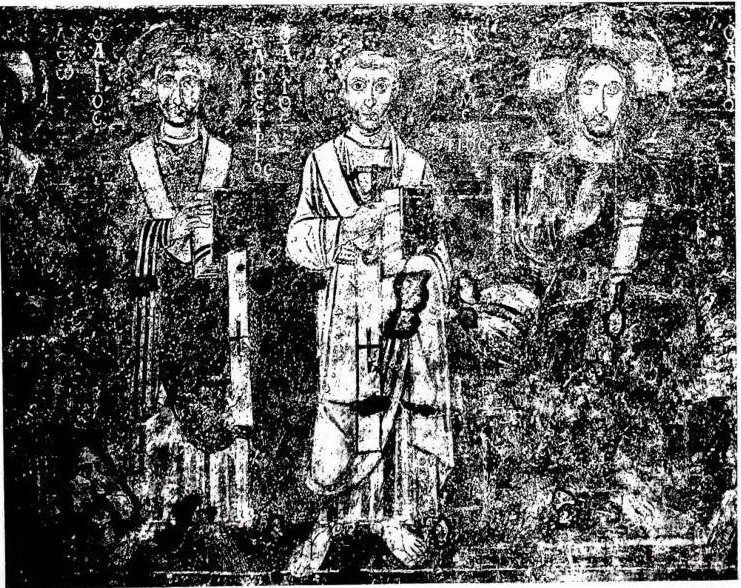
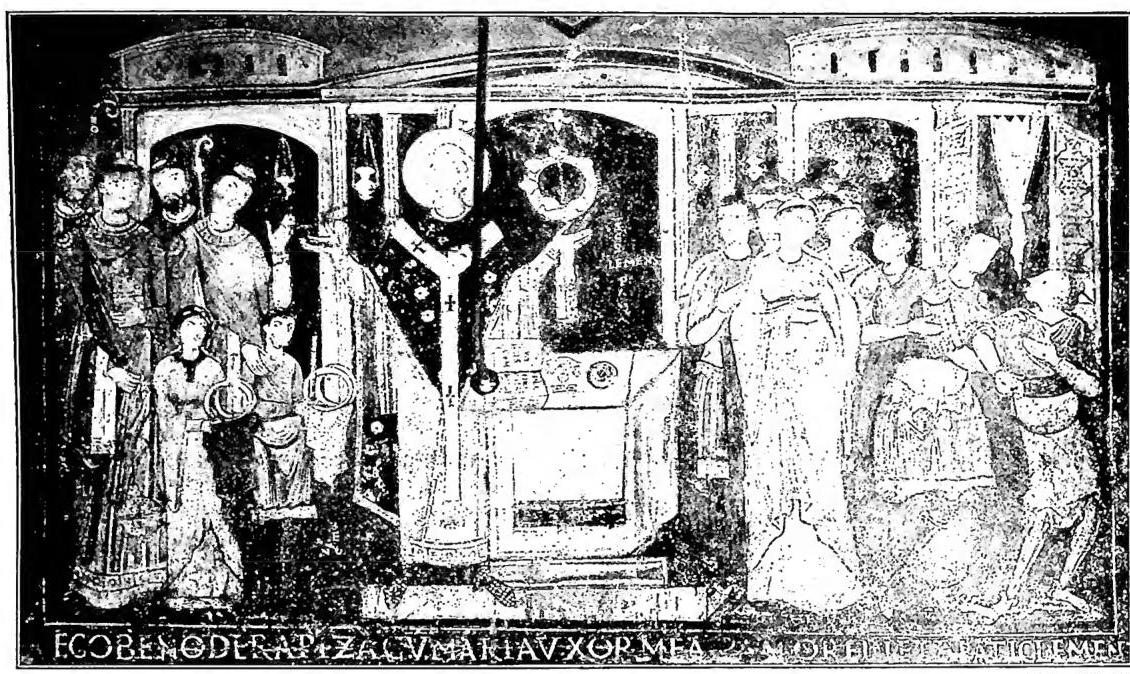
After the ruins wrought by the sack of Guiscard (1084) the basilica, which had had an important pictorial decoration in the early Middle Ages (among which a votive picture from the times of Leo IV, in which is the portrait of the Pope) was further decorated with scenes alluding to St. C., to St. Alexis, etc.; but shortly afterwards it had to be rebuilt at a higher level (age of Paschal II, 1099-1118). It was rededicated in 1128.
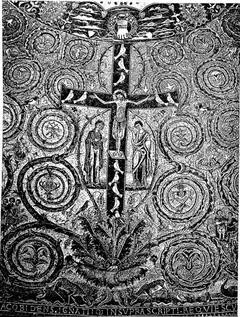
The mosaics of the apse, most beautiful (dominating them is the Crucifix in the midst of a broad burgeoning of floral volutes) are of this time. The new basilica, narrower than the old one, had a new atrium; it was enriched with a schola cantorum and a ciborium of Cosmatesque art. Other works of art were added later, among which notable is the 15th-century chapel of St. Catherine with the paintings of Masolino da Panicale. - See PLATES CXIII-CXIV.