
ITINERARIES. - From iter, they are practical indicators of the road to be traveled in order to move from one place to another: sometimes, especially in the less ancient ones, the nature of the terrain is noted, the distances, the mutationes of the horses, the stationes, where the traveler could find rest or refreshment. They serve purposes of-
extremely varied, military, commercial, utilitarian. They develop and are perfected with the expansion of a nation. The conquests of Alexander, those of the Romans bind to future generations a whole network of roads, first traveled by phalanxes and legions, then by merchants, traders, emigrants, pilgrims, driven by the greed for gain, by the pressure of other peoples, by religious feeling or otherwise. The road from Babylon to Pontus was well known after the anabasis and katabasis of the soldiers led by Xenophon, just as the Roman conquests marked the certain knowledge of the passability of the routes, of the nature of the paths, of the measurement of distances. It was then that locomotion services were organized, whence the travel indicators that have come down to us.
I. THE ROMAN ITINERARIA
These are itineraria inscribed on silver vessels, like those of Vicarello, or recorded on the marble of milestones, like those of Tongeren or Autun, or reproduced on clay tablets, as on any other writing material. From the examination of these itineraria one may infer that at a certain time they became stereotyped, for the use of any purchaser: a total indication of the distance in miles from the station of departure to that of arrival (Cadiz-Rome; Santiago de Compostela-Rome), then follow, in order of spatial succession, the intermediate mutationes and stationes, indicated with their respective distances.
Among the numerous itineraria handed down to us from the Latin world are the two Itineraria Antonini Augusti; one of the provinces, the other of the landing places and ports of call, for navigators. In each the distances are measured in miles; and anyone with experience of manuscripts will not be surprised that the figures indicated must be taken with great distrust. The itineraria reported follow one another without order, and the whole document, far from representing an official compilation, seems drawn up by a private patchworker on the basis of a mappa mundi, with the aim of bringing together around one center of radiation the lesser itineraria connected with it.
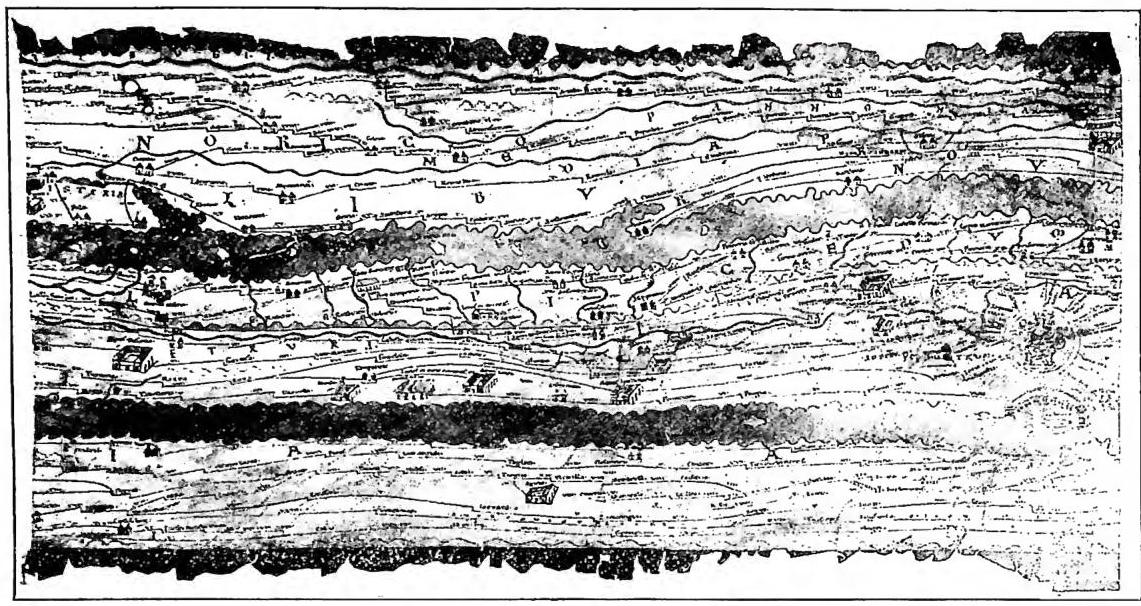
Reference has been made to the Mappae mundi. It is known that during the Empire, when few corners of the world did not feel Roman hegemony, the Romans displayed in porticoes colored geographical maps, reproducing the Empire and indicating locorum situs, spatia, intervalla. From these colored mappae descend the itineraria of the tabula Peutingeriana type, the itineraria of the Anonymous of Ravenna and the Geographica of Guido da Pisa.
The first, which takes its name from its owner, C. Peutinger, consists of a parchment roll, today in the Library of Vienna, where it has been divided into the eleven skins composing it. It seems that it may go back to a copy of the 3rd century. Prominent, marked in red, is a road map, with the spatial indications proper to all itineraria; but here the draughtsman, in order to indicate cities or other notices, uses symbols.
The Anonymous of Ravenna compiled his Cosmographia around the 8th century, having before his eyes as many maps, drawn by different cosmographers. He is a monk, who describes the world to a fellow brother, and, since he found the maps discordant among themselves, he relies on the better-informed cartographers, giving precedence to the natives of the region depicted. Of each region are recorded the cities, the rivers, the lakes; there follows a list of islands, arranged according to the continents to which they belong. He warns his brother not to be surprised if civitates vel flumina nuper aliter appellentur, because of the migrations of peoples that have occurred; whence it results that the source maps had been compiled before the barbarian invasions.
Guido Pisano, going back to the 12th century, when geographical studies were recognized as having a social importance, writes in humanae vitae communione, so that man may know how to live not for himself alone, but for others. He dwells by preference on Italy and the Mediterranean regions, as far as the western borders of Spain and the northern borders of England.
II. THE ITINERARIES OF THE HOLY LAND
From the very first Christian generations there was a desire to visit the places that witnessed the biblical and especially the evangelical events. The Ecclesiastical History of Eusebius (PG 20, 396 and 542) presents various pilgrims, such as Melito of Sardis (ca. 170) and St. Alexander the Cappadocian (3rd century), who came to Palestine already during the period of the persecutions. The pilgrimage movement intensified, naturally, with the Edict of Toleration, and has always remained alive, even if at certain times it was hindered by the Arabs. The pilgrims made known in Europe the existence of the Sanctuaries and the state in which they were found, brought back relics of them, strove to reproduce them in their own countries, and contributed to the development of certain devotions such as the Way of the Cross (v.). The writings of the pilgrims, called itineraries, are often of no small importance for knowing the biblical (v. BIBLICAL ARCHAEOLOGY) and Christian traditions and the state of the Sanctuaries, because many times they are the only testimonies on the matter. The number of surviving itineraries is very great, so that it is possible to enumerate only a few among the principal ones.
In the 4th century the Itinerarium Burdigalense has particular importance, held to be a common guide for a Bordeaux-Jerusalem journey, compiled by or for a merchant, or pilgrim, Jewish or Christian, around 333. The indications are those of a normal itinerary, but here a historical memory is linked to the name of a city, and these notations intensify when one arrives in Palestine. At this point the Christian material becomes abundant, and the itinerary changes into a summary description of the Holy Places. Around 390 St. Jerome translated into Latin a pamphlet of Eusebius of Caesarea, Hebraicorum nominum, which had wide success. The same Jerome in a letter to Eustochium marveled that Palestine did not arouse greater interest in Christian hearts, rather than the Tarpeian rock; and he invited the noble Marcella to the East to see the places where our religion was born (Ep. ad Paulam et Eustochium).
The first account of a journey in the East is linked to the name of Etheria or rather Egeria (v.), a colorful and lively narrative through Palestine, Egypt and Mesopotamia.
Almost negligible, on the other hand, is the letter attributed to Eucherius of Lyon and addressed to the priest Faustus: a patchwork from St. Jerome and Hegesippus. The author lacks a direct vision of the places described. Nor does the De situ Terrae Sanctae compiled by a North African, Theodosius, around 530, seem to deserve better esteem. While very important, even if it welcomes popular narratives and legends, is the itinerary falsely attributed to St. Antoninus, martyr of Piacenza. The writing is crammed with important information, owed to one of the martyr's travel companions. The account, dictated on direct impressions, was written around 570.
Exactly a century later Adamnan of Hy (623-704) wrote the De Locis Sanctis libri tres based on the oral accounts of the Frankish bishop Arculf, a shrewd connoisseur and scrupulous narrator of what he had seen during a nine-month pilgrimage. Adamnan is a diligent and scrupulous collector, and his account arouses warm interest. Bede is a simple compiler from Adamnan, from Pseudo-Eucherius and from others. St. Willibrord, between 727 and 720, set before a nun of Heidenheim, who collected them, the impressions of a journey he had made many years earlier. Any imprecision in the account must be attributed, rather than to negligence on the part of the woman reporting it, to the speaker's faded memory. The nun participates so vividly in the account that, in evoking it, feeling herself almost a protagonist, she passes unwittingly from the third to the first person: the text constitutes a notable complement to the Arculf-Adamnan narrative.
In the Commemoratorium de casis Dei there is nothing but a notable statistical survey of the churches, monasteries, and priests officiating in the various temples of the Holy Land, in an age prior to the Crusades.
The itinerary of Epiphanius Hagiopolites, on the other hand, achieves a notable informative purpose; his account proceeds from direct impressions, "and whoever writes otherwise - these are his words - deceives himself, being ignorant of the truth." Around 867 a French monk, Bernard, having asked the assent of Nicholas I, set out in the company of an Italian and a Spaniard for the Holy Places. Having visited Palestine, the three returned by sea to Rome, stopping at the Lateran, and closing the pilgrimage at the sanctuary of St. Michael, at Gargano.
In the itineraries examined, mention is made several times of vexations suffered by pilgrims at the hands of those in charge of crossings or border offices; from the 11th century these journeys, undertaken individually, became risky: to be more certain of arriving, one had to organize in groups and, if necessary, be well armed. From such pilgrimages, however, does not proceed the Liber de Locis Sanctis of Peter the Deacon, dedicated to the abbot Wibald of Montecassino. It is a compilation put together around 1137 from the homonymous treatise of Bede and from the Peregrinatio Aetheriae, which can be supplied, in its missing initial part, precisely with these extracts, reported by Peter the Deacon.
John of Würzburg, around 1165, sets out to describe the state of Jerusalem as it appeared to him after the destructions it had recently suffered. He reports the metrical and prose inscriptions displayed in the various monuments. Another who keeps his eye on the real state of the Holy City is John Phocas, who left a description of it in Greek in 1177.
A brief mention is deserved by the itinerary of Benjamin of Tudela, a Jew from Navarre, who visited the whole East as far as the frontiers of China, during a journey lasting 13 years. His account, translated into various languages, constitutes a conspicuous source for the Jewish history of the 12th century.
In the post-Crusade period, note is taken of the itineraries of Burchard (v.) with good geographical notions, Riccoldo of S. Croce, Pipino and P. Faber (1480-83), Dominicans; of Giacomo da Verona (1335), Augustinian, of A. De Reboldi (1327 and 1330), Niccolò da Poggibonsi (v.), the first, as far as is known, to write in Italian, F. Suriano (v.), Bonifacio da Ragusa and above all F. Quaresmio (v.) of the Franciscans. Since Father Quaresmio made a thorough study of the traditions, the subsequent itineraries, in this respect, do nothing but link themselves to him.
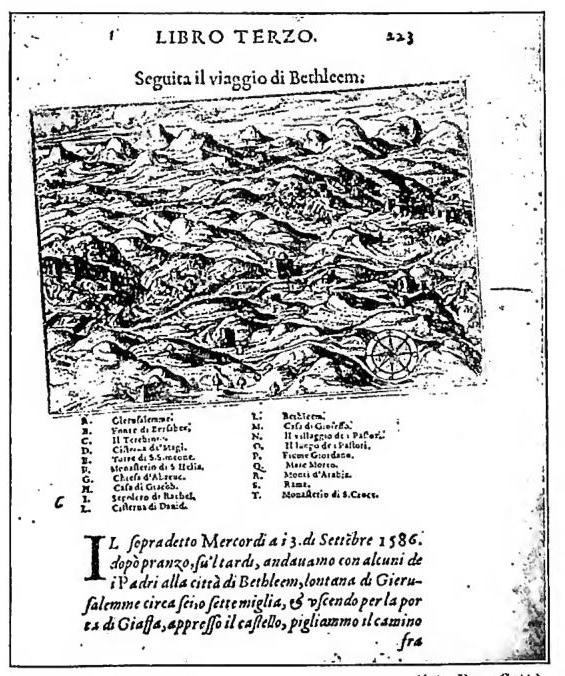
From the literary and historical point of view, those of Mariti (1767), Chateaubriand (1806), Bassi (1846), Cassini da Perinaldo (1846), Matilde Serao (1893), E. Battaglia (1906) and the recent ones of G. Venturini, S. D'Amico, C. Angelini and M. Sticco are to be remembered. From the illustrative point of view, the woodcuts of the itinerary of von Breitenbach (1483), the freehand drawings of Zuallardo (1586), those to scale of B. Amico (v.) and the beautiful views of C. Le Bruyn (1714) deserve to be noted.
III. THE ITINERARIES OF THE CITY OF ROME
The cult of the apostles Peter and Paul, as of the martyrs, intensified and grew stronger with the persecutions: after the conversion to Christianity of the various European peoples, the vivere peregrinando came to be considered one of the most meritorious means of acquiring indulgences; hence a greater frequency ad limina Apostolorum.
Once the pilgrimage to Rome had been undertaken, the vastness of the City and the dispersion of the Christian monuments obliged the visitor, who had to perform his acts of devotion, to furnish himself with guides, almost with internal itineraries, that would point out to him the places to visit.
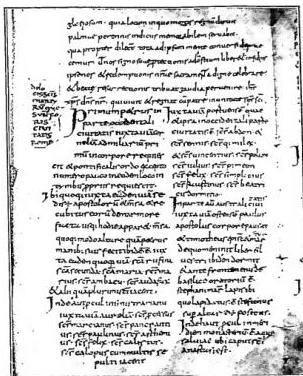
At one time the pre-Constantinian Notitia and Curiosum were considered itineraries of this type. But if those documents are seen stripped of the additions introduced into them by centuries of elaboration and by anonymous collaboration, which, having lost knowledge of their original purpose, sought to reduce them to guides for pilgrims, and if they are restored to their primitive scheme, one will easily recognize in them nothing other than a spatial delimitation of the duties of the 48 vicomagistri who in each of the XIV regions regulated the life of the city, protecting and safeguarding the interests of the public. But in the first half of the 7th century, according to others in the second half of the 8th, a true Roman itinerary for pilgrims is found formulated: the Notitia ecclesiarum urbis Romae. The pilgrim sets out from the basilica of Sts. John and Paul, the only urban church that preserved the bodies of martyrs; from there he passes to the Flaminia, then one traverses the Salaria Vecchia and Nuova, the Nomentana, the Latina, the Appia, the Ardeatina, the Ostiense, the Aurelia, the Portuense, the Cornelia, as far as the tomb of St. Peter. The main roads are at times abandoned in order to follow side paths; but everywhere the basilicas and the positions of the various hagiographic groups are exactly indicated. The booklet closes with a detailed description of the Vatican-Constantinian basilica. For De Rossi, the itinerary is earlier than 650. According to Sickel, this itinerary would have been written in 799 by an unknown person who accompanied Bishop Arno of Salzburg to Rome.
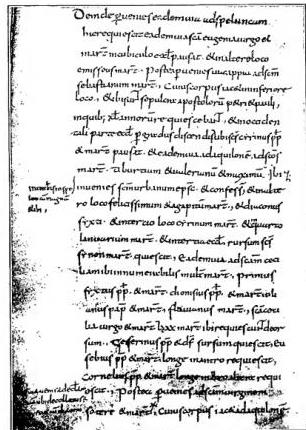
Slightly later appears another itinerary, the Liber de locis sacris martyrum. Unlike the preceding one, here one begins from St. Peter and traverses the Cornelia, the Aurelia, the Portuense, the Ostiense, the Ardeatina, the Appia, the Latina, the Labicana, the Prenestina, the Tiburtina, the Nomentana, the Salaria Nuova and Vecchia, to end at the church of St. Valentine on the Via Flaminia.
To be precise, more than an itinerary one has here a notice of the churches and tombs situated along each road, to which the determinations of nearness or distance, like every other spatial indication, are referable. The exposition is not always orderly, nor always perspicuous, the Liber being a probable epitome of a memoria of martyrs and saints. For what purpose a list of the intramural churches was placed at the end of this itinerary, and by what criterion it was ordered, is not easy to understand. As it presents itself, the itinerary may be assigned to the first thirty years of the 7th century.
Another kind of itinerary, perhaps slightly later, is the one inserted by William of Malmesbury in his Gesta regum Anglorum, with some variation of a nature not clearly indicable, but referable only to the wording. Like the De locis, here too one sets out from the Vatican to continue, according to the right, in the same direction as the Notitia. There is no lack of references to the tombs of the saints within Rome.
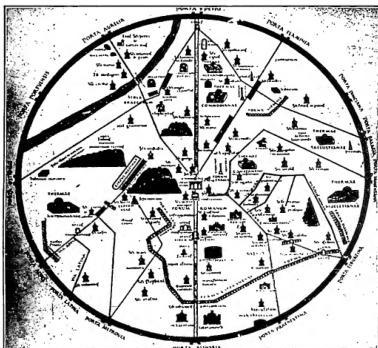
Much more important is the Einsiedeln Itinerary, to be assigned to the Carolingian age. The author has traced II itineraries, venturing even outside the city. The text is informed by this concept: to give the pilgrim a clear representation of the relations of spatial relativity among the individual entries. The compiler had in mind to point out to the pilgrim, with the most realistic precision and tangible evidence, where he would find the monuments to visit. Having set him on a road, with this kind of indicator in hand, the author points out to him the places on the right and on the left, and not only that, but the distance between individual entries is brought out by the position occupied by the names of the individual monuments. This skilful arrangement of the original, once the awareness of whoever had devised it was lost, went on disintegrating with the loss of knowledge of these initial informative criteria, so that the later copies, in the most fortunate case, were reduced to lists of names placed without any relation of relativity, to the right or left of a given route. Despite the wholly arbitrary conjectures of the critics, who increasingly altered its nature, this precious document always represents a witness of the surviving pagan Rome and of the Christian Rome that arose beside it, down to the Carolingian age.
The II itineraries are: from St. Peter to St. Paul, from Porta S. Pietro to S. Lucia in Orfea; from Porta S. Pietro to the Salaria, from Porta Nomentana to the Roman Forum, from Porta Flaminia to the Via Lateranense, from Porta Tiburtina to the Suburra, from the Via Tiburtina to S. Vito, from Porta Aurelia to the Prenestina, from Porta S. Pietro to the Asinaria, from the 7 roads as far as Porta Metronia, from Porta Appia to the Schola graeca and then, by a portico, as far as the aqueduct and along the 7 roads.
The evidence of the distances could be brought out by the placement of the entries and by the distance that separated them on the page. All these itineraries are traced with such exactness as to make it very possible to believe that the author knew the places de visu and had taken most careful note of them; a conjecture confirmed by the collection of inscriptions, profane and Christian, found precisely in the same Einsiedeln Codex. The toponyms of the Roman roads and monuments still (8th century) subsisted in their classical appellation. Nor did the compiler obtain this information in any place other than Rome; their extraordinary diffusion is to be considered proportional to the influx of pilgrims.
Last, in the chronological series, must be considered the itinerary that the archbishop of Canterbury, Sigeric, has left of his journey to Rome, made in 990. It consists of two parts: the first gives the list of the stations (mansiones) of the overland journey from England to Rome; the second is a list of Roman churches visited on different days by Sigeric and his retinue, important for the toponymy of the aforesaid churches.
After the year 1000 the itineraries take the form of descriptions of the monuments with the annexed poetic legends, approaching in a certain way certain descriptions of the monuments of the Holy Land mentioned above. Their compilation goes under the name of Mirabilia, Indulgentiae ecclesiarum urbis Romae. There will come later, after 1500, the treatises of scientific topography.
Bibliography13 works
Roberto Valentini