
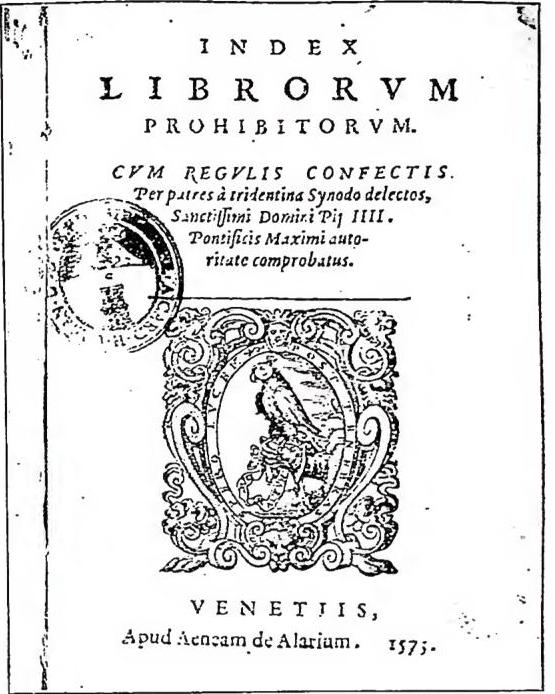
INDEX OF FORBIDDEN BOOKS. - By the expression "forbidden books" are designated the books whose reading is forbidden to the faithful by positive ecclesiastical law, general or particular, or by a decree issued by the competent authority, ordinarily the Sacred Congregation of the Holy Office or the local Ordinary.
The faithful, however, must abstain from reading not only books proscribed by law or by decree, but every writing that exposes them to the danger of losing the faith or of depraving morals. This is a moral obligation, imposed by the natural law, which admits of no exemption or dispensation. The gravity of this obligation is proportional to the danger to which the soul is exposed.
But since the simple faithful would rarely be in a position to discern the danger they incur, it is natural that the Church, with timely warnings and prohibitions, should keep them away from bad reading.
I. The I. of f. b. (Index librorum prohibitorum) is the catalogue of the books that the Holy See has forbidden as bad or dangerous for the integrity of faith and morals and that the faithful, without a special license, may neither read nor keep. The Church has always fulfilled her duty of vigilance over books, but until the invention of printing she did not feel the need to draw up a catalogue of forbidden books, because writings held to be dangerous were burned.
The Council of Nicaea (325) forbade the book Thalia of Arius; Pope Anastasius condemned the works of Origen, because they were more harmful to the ignorant than useful to the wise; St. Leo the Great reproved in Rome the writings of the Manichaeans and enjoined the Spanish bishops to rise up against the books of the Priscillianists. From the earliest centuries the question of the pagan classics (v.) was agitated. The danger grew with the spread of printed books, and then the intervention of the Church became more frequent. First she intervened with the obligation of prior censorship (v.) and of the Imprimatur (v.), preceded in this by the civil authority, as by Henry VIII in England and Charles V in the Netherlands, and by the Sorbonne in France.
But despite this, numerous heretical books were published, and Paul III, to stem the danger, entrusted the proscription of books infected with heresy to the cardinal inquisitors general. Paul IV was the first to order them, in 1557, to compile an I. (or catalogue) of f. b., which was published in 1559. It comprised three lists: of authors, of book titles, of the anonymous ones. Pius IV then, accepting a petition of the Council of Trent, had the index revised and updated, which he published with the constitution Dominici gregis of 24 March 1564. It consisted of two parts: the first contained ten rules, which then appeared in all subsequent editions up to 1929, by which the categories of books prohibited by natural law or by general law were fixed; the second gave, in alphabetical order, the catalogue of books proscribed by special decree. But not even the periodic compilation of a catalogue of prohibited books was any longer sufficient to check the spread of an evil, fed by the new heresies and favored by the diffusion of printing. Therefore Pius V instituted, in 1571, the Sacred Congregation of the Index (v. CONGREGAZIONI ROMANE, SACRE).
The following editions of the I. of l. p. have been published, besides that of Paul IV already mentioned: 1590, 1593, 1596, 1632, 1665, 1681, 1704, 1711, 1716, 1744, 1758, 1786, 1787, 1819, 1835, 1841, 1877, 1881, 1887, 1900, 1901, 1907, 1911, 1917, 1922, 1924, 1929, 1930 (in Italian and in French), 1938, 1940, 1948. To these must be added certain unofficial editions: 1580 (Parma), 1610 (Lyons), 1766 (Venice), 1783 (Parma), 1852 (Monreale), 1899 (Turin). Leo XIII, with the Officiorum ac munerum of 25 January 1897, promulgated a true and proper consolidated text of the laws on the matter, which then passed into the CIC (tit. XXIII of book III).
Not even these norms, however, are a sufficient guide for the faithful, and in concrete cases they give rise to doubts and uncertainties, because they lack that determinacy (the conceptual fixity of the philosophers of law) which is one of the characteristics of law. Therefore the Church sometimes intervenes and prohibits with specific decrees certain books, which in themselves would be prohibited ipso iure, inserting them from time to time in the I. of l. p. Therefore the CIC obliges all the faithful, and in particular clerics, especially if constituted in ecclesiastical dignity or eminent for culture, to denounce pernicious books to the Ordinaries of the places or to the Holy Office (can. 1397 § 1). To the Ordinaries it then recalls the duty of watching, directly or through suitable priests, over the books that are printed or sold in their dioceses (can. 1397 § 4). Residential bishops, individually or assembled in council, have the right and the duty to condemn bad books (can. 1395 § 1); but they must refer to the Holy See publications that require a difficult examination or that, by reason of their importance and diffusion, can be effectively proscribed only by the supreme ecclesiastical authority (can. 1397 § 5).
Books condemned by the Holy See are prohibited everywhere and for all the faithful (cann. 1396 and 1401), even if they are clerics, except cardinals, bishops and the other Ordinaries mentioned in can. 198 § 1.
The categories of books whose reading is forbidden by natural law or by general law (can. 1399) are:
1) The editions of the original texts of Sacred Scripture prepared by non-Catholics and every translation prepared and published by them; - 2) All books that champion heresy, schism, or that in any way strive to demolish the foundations of religion; - 3) Books in which good morals or religion are deliberately attacked; - 4) The books of all non-Catholics who deliberately treat religious subjects, unless it is established that they contain nothing against the Catholic faith; - 5) Books printed without the prescribed ecclesiastical censorship, when they are books of Sacred Scripture or related notes and commentaries or its translations into the vernacular (can. 1391), books on theological subjects, books or pamphlets of piety, etc., or that report new apparitions, revelations, visions, prophecies, miracles or introduce new devotions; - 6) Books that combat or ridicule any Catholic dogma, defend errors condemned by the Holy See, discredit divine worship, strive to undermine ecclesiastical discipline, or deliberately sling mud at the ecclesiastical hierarchy or at the clerical or religious state, always without prejudice to the task of conscientious and serious historians; - 7) All books of whatever kind that teach or recommend superstition, magic, sorcery, divination, spiritism and the like; - 8) Books that teach as lawful dueling, suicide or divorce, that treat of Masonic sects or similar secret societies representing them as useful or as not dangerous to the Church and the State; - 9) Books that openly treat, recount or teach lascivious or obscene things. Books of medicine or works of moral theology that deal with such things for a serious purpose do not fall under this prohibition; - 10) Liturgical books in which changes are introduced, so that they do not agree with the authentic editions approved by the Holy See; - 11) Books that publish indulgences that are apocryphal or proscribed or revoked by the Holy See; - 12) All images of Our Lord Jesus Christ, of the Most Blessed Virgin, of the angels and saints or other servants of God, printed in any manner, contrary to the sense and the prescriptions of the Church.
It may be held, however, that the proscription of books does not bind non-Catholics, born in schism or heresy, at least insofar as it is a positive ecclesiastical law.
The Ordinaries of places can forbid the reading of bad books only to their own subjects (can. 1395). Canonists and moralists commonly teach that exempt religious are not bound to observe diocesan laws on the matter. But it seems more exact to affirm the contrary, if the expressions used in cann. 1395-1405 are carefully observed. It is true that can. 1395 § 1 speaks of subjects, and exempt religious are not subjects of the bishop, but it does so solely to warn that the prohibition of the Ordinary of the place does not extend beyond the boundaries of his territory, as is deduced from the comparison of can. 1395 § 1 with can. 1396. Moreover it must be borne in mind that the proscription of books, by the motu proprio Alloquentes (25 March 1917), has been entrusted to the Holy Office. Now no religious is exempt from the jurisdiction of the Ordinary of the place in matters within the competence of the Holy Office. Can. 1386 § 1 then expressly subjects all religious to the jurisdiction of bishops in this matter. A confirmation of what has been asserted is found in can. 1395 § 3: the legislator felt the need to attribute expressly also to regular Ordinaries a power concerning the prohibition of books for their own subjects, precisely because can. 501 § 2 severely forbids them to meddle in causes within the competence of the Holy Office. Finally it is useful to note the different expression used in §§ 1 and 3 of can. 1395: ius et officium in the first, potest in the third. Now if the jurisdiction in the matter of regular Ordinaries over their own subjects were exclusive, even in § 3 one would have to read officium.
A prohibited book cannot be published, read, possessed or held, sold or bought, translated, communicated to others, without a special permission, under pain of mortal sin.
The publishers of the books of apostates, heretics or schismatics who champion apostasy, heresy or schism incur the excommunication reserved speciali modo to the Holy See, if the work is published. The same penalty is incurred by the faithful who defend or knowingly keep or read, without the due permission, the aforesaid books and those that have been condemned by apostolic letters, which are not to be confused with the decrees of condemnation issued by the Holy Office. Authors, moreover, and publishers who, without the required license, have books of Sacred Scripture, notes or commentaries on it printed, incur excommunication not reserved (can. 2318).
A prohibited book may not be republished unless the necessary corrections have been made to it and permission has been obtained from the one who condemned it, from his successor, or from the competent superior (can. 1398 § 2).
Besides the Supreme Pontiff, only the Holy Office can grant permission to read or keep prohibited books that are prohibited ipso iure or by a decree issued by the Holy See. Ordinaries may grant such permission only to their own subjects, in urgent cases and for individual books (can. 1402 § 1). Ordinaries, on the other hand, have broad powers, limited only by natural law and by any intervention of the Holy Office, with regard to books prohibited by themselves or by their predecessors: not even a general license granted by the Holy See authorizes the reading of books prohibited by Ordinaries, unless the apostolic indult expressly states that they may read or keep books condemned by anyone whomever (can. 1403 § 1). Evidently the license obtained does not exempt any person from the prohibition, by natural law, of reading books that expose him to a proximate spiritual danger. Permission to read books that deliberately treat of obscene matters is not customarily granted; and it is forbidden for booksellers to keep them in stock, sell them, or lend them out. Local Ordinaries and parish priests must warn the faithful of the danger they incur and of the harm they will suffer from reading immoral books.
The Holy Office for its part, by an instruction circulated on 3 May 1927 (AAS, 19 [1927], pp. 186-89), exhorted local Ordinaries to keep watch over all writings that are printed or published in their dioceses, and to point out to the faithful the books prohibited ipso iure, whose reading is forbidden under pain of mortal sin, and reminded them of the provision of can. 1395 § 1: they have not only the right but also the duty to proscribe books deserving of condemnation. The Holy Office has had to return to the subject several times (the most recent intervention is that of 17 Apr. 1947, in which the obligation laid down in can. 1397 is recalled).
Finally, to the flood of immoral books there has lately been added Marxist printed matter (books, reviews, newspapers), which attempts to undermine the foundations of the Christian religion. The Holy Office therefore, by a decree issued on 28 June 1949, declared such writings prohibited ipso iure, in accordance with can. 1399, and imposed the excommunication latae sententiae, reserved speciali modo to the Holy See, on those who profess, defend, or spread the materialist and anti-Christian doctrine of communism (AAS, 41 [1949], p. 334).
Bibliography24 works
Arturo De Iorio