
TERRACINA, PRIVERNO AND SEZZE, DIOCESE OF. - In Lazio, in the province of Latina, immediately subject to the Holy See.
T. has an area of 200 sq km with a population of 39,037 inhabitants, all Catholics, distributed in 11 parishes, served by 18 diocesan priests and 20 regulars; it has 3 male religious communities and 10 female. P. has an area of 160 sq km with a population of 30,000 inhabitants, all Catholics, distributed in 11 parishes, served by 16 secular priests and 12 regulars; it has 3 male religious communities and 8 female. S. has an area of over 244 sq km with a population of 29,448 inhabitants, of whom 29,000 are Catholics, distributed in 10 parishes, served by 21 diocesan priests and 8 regulars; it has 2 male religious communities and 8 female (Ann. Pont. 1953, p. 421).
The minor seminary is in S. and the major one in Anagni, shared with the other dioceses of lower Lazio. The episcopal residence is in T.
I. TERRACINA
It is the Volscian Auxur, which was situated on the slope of the hill toward the inland side of the present-day city. After various vicissitudes it became the Roman T., which prospered considerably, thanks to its position on the sea and along the Via Appia. From the pontificate of Adrian I it belonged to the Papal State. In 1000 Sylvester II ceded it to Count Daiferio, and in 1071 Alexander II ceded it to the famous abbot Desiderius of Montecassino, until in 1150 Eugene III redeemed it. The origins of Christianity in T. go back to the 1st century. The Greek apocryphal acts of St. Peter and St. Paul, composed in the 9th century, narrate the coming of the two Apostles from Baia to Gaeta and from Gaeta to T., while they were traveling to Rome. This fantastic account perhaps gave local historians grounds to conclude that St. Paul had preached in T. and St. Peter had erected the diocese. There remains, instead, only the probability that St. Paul spent the night in T. during his first journey to Rome.
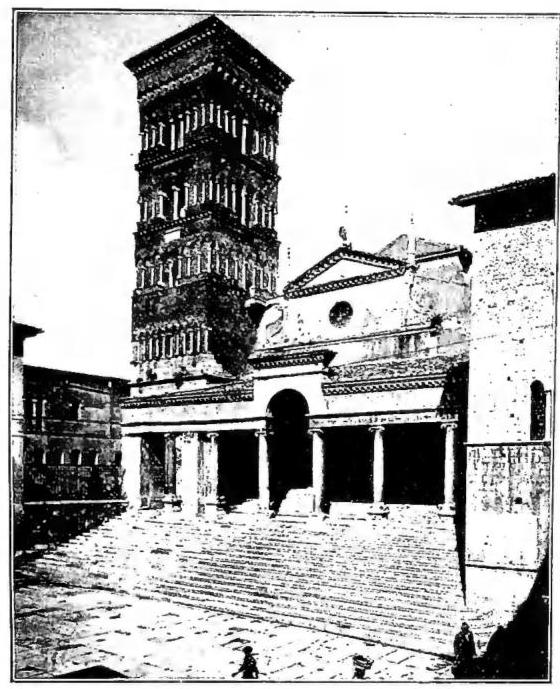
It is known that at the time of the emperor Domitian (81-96) Flavia Domitilla, wife of the consul Flavius Clemens, was exiled to the island of Ventotene (Dio Cassius, Hist. Rom., 67, 14) and Flavia Domitilla, granddaughter of the same, to Ponza (Eusebius, Hist. eccl., III, 18, 4). Both were Christians. The Acts of Sts. Nereus and Achilleus (BHL, 6058-6067), from the second half of the 5th century approximately, claim that the second Flavia Domitilla died and was buried in T.; as well as that two Roman virgins, companions of the same, Euphrosyne and Theodora, had been martyred and buried there under Trajan (98-117) by a holy deacon named Caesarius. The anonymous author of the aforementioned Acts undoubtedly intended, with the deacon Caesarius, to honor the namesake martyr of T., who appears in the Hieronymian Martyrology on November 1 and April 21. The Passio (BHL, 1511-16), composed between the 5th and 6th centuries, says he was martyred under Nero in T. and buried along the Via Appia, a little before arriving at T. coming from Rome. But the Acts of Sts. Nereus and Achilleus and the Passio of St. Caesarius, with regard to the time, have no probative value. It is certain, instead, that on the tomb of the martyr, which belongs to the time of the persecutions, a basilica was erected that was also the primitive cathedral of T., rebuilt in the 11th-13th centuries and remodeled in the 17th century. On the hill of T. was the famous monastery of S. Stefano al Monte, founded by St. Benedict himself, as appears from the Dialogues of St. Gregory the Great (II, 22). In the 17th century it was already in ruins.
At Paola, below the Circeo and in the Pontine Islands which belonged to T., Christian inscriptions have been found, one of which is from 345 (CIL, X, I, 6419-21; X, II, 8412-13).
Analda, a local historian, opened the series of bishops of T. with Epaphroditus of the Epistle to the Philippians (II, 25), without adducing reasons. As P. Gams (Series episc., Ratisbon 1873, p. 731) inserts into it the martyrs Quartus and Quintus, the first of whom, according to the Passio of St. Caesarius, would have been the burier of the supposed martyr Eusebius. The first bishop of T. certainly known to us is Sabinus, in 313.
In the 11th century - it is not possible to determine more exactly - the dioceses of P. and of S. were united to T., as appears from the bull of confirmation issued by Honorius III on January 18, 1217.
II. PRIVERNO
It corresponds to the ancient Privernum, which was later colonized by the Romans and, after being destroyed in the Middle Ages, was rebuilt under the name Piperno, until in 1028 it resumed its ancient name. The diocese of P. appears for the first time in a document of 769, but L. Duchesne believes it to be earlier than the 7th century and to have been transferred in 1039 to S., unlike P. F. Kehr, who considers them two distinct dioceses. The reading of three names of martyrs, made by G. B. De Rossi on a very damaged inscription from P., has not been accepted.
In the diocese of P. is the famous abbey of Fossanova, at the point where the Valley of the Amaseno opens into the Pontine plain. Some have believed that it was the monastery of S. Stefano di Mileto, founded by St. Benedict and flourishing until the time of Innocent II, who in 1135 would have granted it to the Cistercians under the name of S. Pudentiana, later of S. Maria; P. F. Kehr believes it to be distinct from that one and founded in 1027. The construction of the church consecrated by Innocent III on 19 June 1208 constitutes the first example of the Cistercian style, which had formed in Burgundy as an evolution of the Lombard style. The fame of the abbey is due, however, principally to the death there of St. Thomas Aquinas. The church of S. Maria, formerly the cathedral, then a collegiate church, was restored as cathedral by Benedict XIV on 10 Sept. 1724, with the same rights as that of T.
III. SEZZE
It is the ancient Setia or Suessa of the Volsci. It rises on the top of a hill from which the view extends over the Agro Pontino and the Lepini Mountains. It was a Roman colony, then from the 8th century onward it formed part of the Papal State. The diocese of S. appears for the first time in a document of 1036, but, like P., L. Duchesne believes it to be earlier than the 7th century.
S. and P. in the 11th century were united with T. The church of S. Maria, a Romanesque construction rebuilt in 1347, was a cathedral, then a collegiate church and again, on 29 April 1724, was erected as a cathedral by Benedict XIV with the same rights as that of T. and of P. In the diocese of S. flourished the monastery of S. Cecilia, founded by St. Lindanus in the 11th century.
The dioceses of T., P. and S. have their court of appeal at the vicariate of Rome. - See plate CXLII.
Bibliography8 works
Benedetto Pesci