
UNION OF SOVIET SOCIALIST REPUBLICS (U.S.S.R.). - The use of the abbreviation U.S.S.R. dates back to 30 Dec. 1926 (in Russian S.S.S.R., or, in Cyrillic characters, C.C.C.P., that is "Sojuz Sozialist-česciich Sovietskich Respublik"). It designates the vast political unity that inherited, following the Revolution of Feb. 1917, the Empire of the Tsars, transformed into a State with a communist structure and constituted (nominally) as a federation of several units gravitating with differing ties around the federal power. The abbreviation tends to replace the old name Russia, which nevertheless is still retained both for the whole of the U.S.S.R. and for its European part, and, not infrequently, for the R.S.F.S.R. (Russian Soviet Federated Socialist Republic), which is the only one in every respect pre-eminent within the Federation.
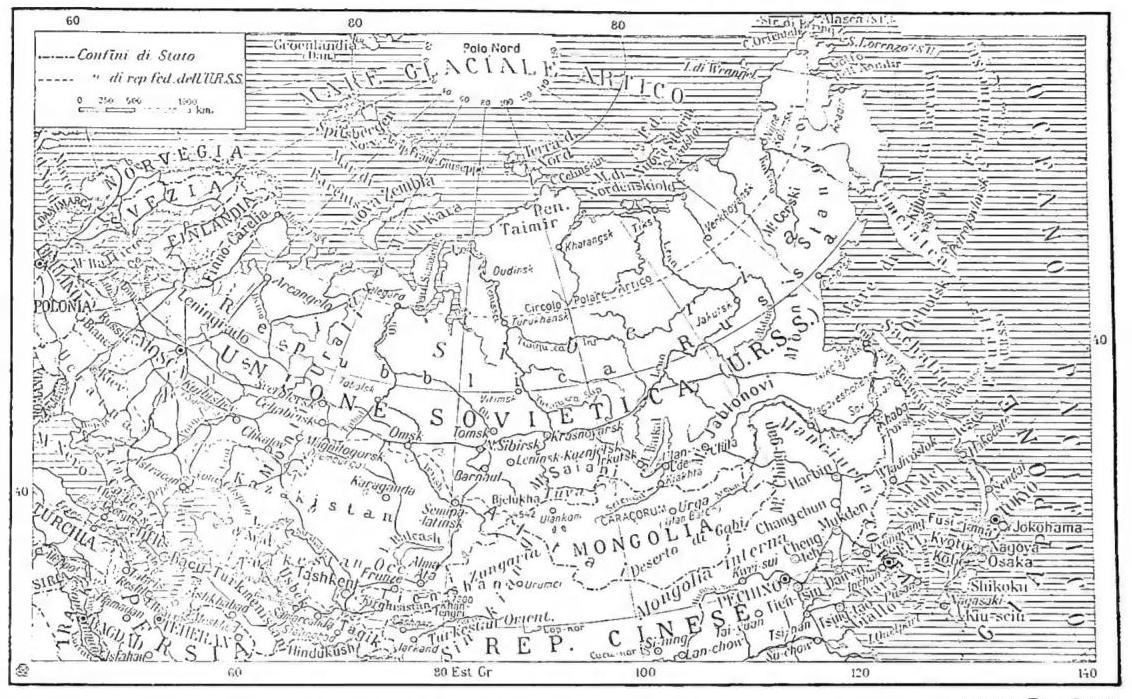
The territory of the U.S.S.R. is the most vast on Earth, insofar as it is considered as a single contiguous whole: before the last world war it extended over 21.2 million sq km, of which more than 4/5 in Asia (of which it occupied 37%) and 1/4 in Europe (43% of it), thus representing 14.3% of the emerged lands; with the annexations carried out between 1939 and 1945 (690,000 sq km; and of these fully 478,000 in Europe) its surface rose to 22.8 million sq km (of which 5.1 in Europe), which means slightly less than 1/6 of all the continents and 2/3 of the Eurasian mass. The territory of the U.S.S.R. is bounded for about 2/3 of its perimeter (45,000 km) by seas, almost all of them closed or blocked by ice for a more or less long period of the year, and therefore not always favorable to navigation. The land frontiers (25,000 km) properly touch 11 States: 4 of the 6 European ones (Poland, Czechoslovakia, Hungary, Romania) and 2 of the 5 Asian ones (China and North Korea) concern political units concretely functioning as satellite organisms. In any case, even more than for its geographical position and for its dimensions (greater than those of an entire continent) the U.S.S.R. is involved in all the great problems of world politics because of its decided and tenacious will for
UNION OF SOVIET SOCIALIST REPUBLICS
Republics and Autonomous Provinces in the U.S.S.R.
| Federated Repub. comprising | No. of oblasti | RA-Autonomous Republics PA-Autonomous Provinces | Surface in sq km (1000) | Pop. in 1000 | Capital and population 1000 inhab. |
|---|---|---|---|---|---|
| Russia | 53 | RA Bashkirs | 143.5 | 3000 | Ufa (300) |
| » Buryat-Mongols | 351.4 | 600 | Ulan Ude (150) | ||
| » Dagestan | 38.1 | 900 | Mahačkala (87) | ||
| » Yakutia | 3061.8 | 450 | Jakustk (23) | ||
| » Kabardia | 11.9 | 300 | Nalčik (27) | ||
| » Komi | 404.5 | 450 | Sytkyvkar (17) | ||
| » Mari | 23.0 | 600 | Joskar Ola (9) | ||
| » Mordvins | 26.2 | 1200 | Saransk (200) | ||
| » North Ossetia | 9.1 | 450 | Dzandžikau (128) | ||
| » Tatars | 67.6 | 2850 | Kazan (500) | ||
| » Chuvash | 18.4 | 1050 | Čeboskari (16) | ||
| » Tannu Tuva | 171.2 | 150 | Kyzyj (10) | ||
| » Udmurts | 42.0 | 1200 | Iževsk (200) | ||
| PA Adighezia | 4.4 | 300 | Maikop (67) | ||
| » Jews | 35.7 | 108 | Birobidžan (7) | ||
| » Khakassia | 62.2 | 300 | Abakan (13) | ||
| » High Altai | 93.0 | 150 | Gorno Altajsk (12) | ||
| » Circassia | 4.0 | 100 | Čerkessk (23) | ||
| Ukraine | 25 | ||||
| Belorussia | 12 | ||||
| Georgia | RA Abkhazia | 8.5 | 330 | Suhumi (36) | |
| » Adžaristan | 2.8 | 195 | Batumi (90) | ||
| PA South Ossetia | 3.9 | 120 | Stalinir (8) | ||
| RA Nakhichevan | 5.4 | 160 | Nakhichevan (12) | ||
| Azerbaijan | PA Nagorno Karabakh | 2.8 | 130 | Stepanakert (5) | |
| Kazakhstan | 16 | ||||
| Kirghizistan | |||||
| Uzbekistan | 9 | RA Karakalpaks | 159.5 | 435 | Nukus (11) |
| Tajikistan | 6 | PA Gorno Badakhshan | 61.1 | 45 | Horog (1) |
| Turkmenistan | 6 |
an ideological function: the spread of communism throughout the world; in Europe, moreover, it controls, by means of a military occupation that has now continued for over 8 years, a large portion of Germany (107,000 sq km, 30% of the entire State, and 25% of its population) and of Austria (23,500 sq km, 31% of the State and 34% of the population), not excluding their respective capitals. Particularly notable is the position of predominance it has assumed, after 1940, in the Baltic, with the annexations of Estonia, Latvia and Lithuania: the entire southern basin of that sea, taking into account the occupation still in progress in eastern Germany, is practically under Soviet dominion.
The U.S.S.R. extends from 35° 48' (Afghan frontier) to 77° 37' N. (C. Čeljuskin) and from 19° 32' (Frische Nehrung) to 169° 50' E. Greenwich (C. Dejnev on the Bering Strait); which is to say for about 9,700 km from W. to E. and for at least 4,000 from S. to N. There follows, evidently, a great variety of natural conditions and aptitudes, and likewise of climatic environments. From the depressions that surround the Caspian (whose level is 26 m lower than the common sea level) and from the crypto-depressions of Baikal (which, with its 1,280 m below that same common sea level, is the deepest on earth) one rises to 7,600 m on Stalin Peak in the Trans Alai (the highest summit of the Federation); and thus from the frosts of the extreme north-eastern Asian regions — where the "pole of cold" is localized, at Oimekon, on the Indigirka (absolute minima of — 70°!) — one passes to the tropical heats of central Asia, where summer temperatures sometimes approach 70°. The differences in precipitation are also notable: to maxima of over 2 m as in western Transcaucasia there is opposed the aridity of great deserts E. of the Caspian (Kara and Kizil Kum), where, over expanses as large as or larger than continental Italy, not a drop of water falls for summers and for years.
With all this, the immense domain does not lack a peculiar geographical unity of its own. In the appearance of the landscape, because of the absolute prevalence of tablelands, or rather of high plateaus, and therefore of vast flat or barely sloping surfaces, over the corrugated regions, which occupy almost all peripheral sectors; in the relative arrangement of the different natural units, which follow one another from N. to S. according to a gradual and on the whole regular climatic differentiation; and finally in the climate itself, because of the character of continentality that dominates over all, one may say, of the territory of the U.S.S.R., even where this is close to the peripheral seas, owing to the substantial uniformity of the thermal and rainfall regimes over vast surfaces. To the much greater extension of this from W. to E. there corresponds the arrangement in the direction of latitude of the typical zones of the landscape of the U.S.S.R.: the arctic tundra, in the sector nearest the Arctic Ocean; the broad forest belt (the Siberian taigá) that follows it, at first (to the N.) entirely of conifers, then increasingly mixed (to the S.) with broad-leaved trees, with large patches of moor or peat bog; the cereal lands (černozem) that replace the original steppe vegetation in Ukraine and in west-central Siberia; and finally the arid and saline steppes, which pass little by little into true desert (central Asia). In the peripheral sectors, as has been said, but sometimes also interfering with the zones just named, the reliefs, themselves varied from sector to sector: the high and compact Caucasian wall, to the SW.; the interlocking mountain enclosures from central Asia (from the Alai to the Sajani) and eastern Asia (in part still rather imperfectly known) and the Urals, which, although extending from N. to S. for over 2,000 km, in reality form only a modest swelling between flat sectors that are entirely similar.
The natural regions of the U.S.S.R. therefore generally assume considerable dimensions; over broad areas local differences, though not absent, appear almost negligible. On the whole one may distinguish: a) the great Eurasian plain, made up of two vast tabular blocks on either side of the Urals: the general flatness is barely disturbed, here and there, by small hilly alignments
The 16 Federated Republics of the U.S.S.R.
| Republic | Area in sq. km. (1000) | Population 1950 (in millions of inhab.) | Density per sq. km. | Capitals (pop. in 1000 inhab.) |
|---|---|---|---|---|
| Russia | 16,922.0 | 116.4 | 7 | Moscow (4500) |
| Ukraine | 576.6 | 40.8 | 71 | Kiev (900) |
| Belorussia | 207.6 | 9.3 | 45 | Minsk (230) |
| Estonia | 45.1 | 1.2 | 27 | Tallinn (196) |
| Latvia | 64.5 | 2.1 | 33 | Riga (390) |
| Lithuania | 65.2 | 3.0 | 46 | Vilna (163) |
| Moldavia | 33.8 | 2.7 | 80 | Kishinev (110) |
| Karelo-Finnish | 178.5 | 0.6 | 3 | Petrozavodsk (70) |
| Armenia | 29.8 | 1.5 | 50 | Erevan (255) |
| Georgia | 76.2 | 3.6 | 47 | Tiflis (540) |
| Azerbaijan | 85.7 | 3.3 | 39 | Baku (800) |
| Kazakhstan | 2,753.8 | 6.6 | 2 | Alma Ata (300) |
| Kirghizia | 196.9 | 1.5 | 8 | Frunze (440) |
| Uzbekistan | 407.5 | 6.0 | 15 | Tashkent (600) |
| Tajikistan | 142.6 | 1.5 | 11 | Stalinabad (110) |
| Turkmenistan | 484.8 | 1.2 | 2 | Ashkhabad (120) |
| U.S.S.R. | 22,270.6 | 201.3 | 9 |
(along the Volga, the Don, the Dnieper), which barely exceed, at most, 250-300 m. in height, while only in the N., on the Kola peninsula, are 1000 m. reached. The Urals by no means represent a barrier, except in the N.: railways and roads cross them everywhere in open country. This is a region extending about 4000 km. from W. to E. and at least 2000 from S. to N.; in it is gathered almost 85% of the population of the U.S.S.R.; b) the plateaus of central Siberia, beyond the Yenisei; elevated from 500 to 800 m. over an area of more than 2,000,000 sq. km. Toward the south the plateau gives way to a series of reliefs more than 2000 m. high (Yablonovy, Stanovoy), which dominate more or less depressed troughs, the largest of which, that occupied by Baikal, is more than 1600 m. deep. It is a rugged country, with a harsh climate and manifold altitudes, but still in the process of development; c) the territories of the Far East, delimited on the W., approximately, by the 125th meridian E. Greenwich and extending to the Pacific. Great mountain arcs (Khingan, Sikhote-Alin, Chersky, Verkhoyansk) with their concavity facing N. rise to beyond 4000 m., towering, in the interval between one and another, over internal basins, the most important of which, from the economic point of view, are the southernmost ones (50° N.) of Blagoveshchensk and Khabarovsk, joined by the broad valley of the Amur. It is a region still very sparsely populated, even along its cold and humid maritime edge, with the exception of the thin border zone near Korea; d) central Asia, that is, the flat or depressed strip that opens to the east of the Caspian; an arid and partly desert territory, but one which several belts of high or very high (from 4000 to over 7000 m.) reliefs (Alai, Ala-Tau, Tien Shan, Pamirs), which frame it from the S. to the SE., benefit with their waters. It is one of the districts in which the economic transformation wrought by the Soviet regime has been most decisive: the original nomadism and the persistent seasonal migrations gradually give way to the formation of a stable settlement, favored by the development of industries; e) the Caucasian sector, which comprises a broad complex of peaks, extending from the Black Sea to the Caspian for more than a thousand km. and rising to more than 5500 m. in Elbrus. On both sides of the axial line the mountains open into mazes of valleys, which have given rise to a complicated ethnic-political mosaic, of a strongly conservative character in the N. (Ciscaucasia), while in the S. (Transcaucasia) the contrast remains alive between the humid Colchis (Georgia), which faces the Euxine, and the bare, thirsty plain of the Kura (Azerbaijan), both closed toward Iran by the Armenian plateau, a wild complex of mountains, basins and plateaus, not however devoid of resources.
Such a combination of environmental conditions could not fail to give rise to anthropic and economic differentiations, even apart from the particular historical evolution that the various countries have experienced: nor is it surprising that the Slavic expansion, which set out from the 16th century to conquer the immense domain, has not yet succeeded in bringing about everywhere conditions of civilization comparable with what has been achieved in other regions of even less ancient colonization. An index of this same fact is the low overall density of settlement, although the figure that expresses it (less than 10 inhab.) must also be related to the large portion (about 1/3) of the area of the U.S.S.R. that is occupied by frozen (tundra) and desert (central Asia) lands. Moreover, regional densities vary within rather wide limits: while almost the entire Asiatic sector N. of the 50th parallel has indices lower than or close to 1 inhab. per sq. km. (but with vast tracts in which, in concrete terms, there is in truth no more than 1 inhab. every 10, every 50 or even every 100 sq. km.), in the regions near Moscow or the industrial centers of the Ukraine more than 100 or 200 inhab. per sq. km. are exceeded, albeit over modest areas. But, in order to understand well the noted mobility of the Soviet population, one should take into account the great number of nomads and semi-nomads who live in central and northern Asia, the ever-lively rhythm of internal migrations and the production crises (famines) that have determined, until yesterday, mass exoduses or phenomena of adjustment unknown to our countries. Considerably different from ours, moreover, are the Russian cities themselves, at least the traditional ones, insofar as they have escaped, to a greater or lesser degree, the leveling action that the social-economic transformation carried out by communist classism has exercised and exercises. Among the most powerful results of the revolution must be placed the increased number of urban centers and their increased demographic importance: in 1950 the Union counted more than a hundred large cities (that is, each having a population of more than 100,000 inhab.), of which two exceeded 3,000,000 inhab. (Moscow, with more than 5, and Leningrad), about a dozen half a million (Kiev, Baku, Kharkov, Gorky, Novosibirsk, Sverdlovsk, Tashkent, Tiflis, Odessa, Dnepropetrovsk, Rostov-on-Don and Stalino), and at least 16 a quarter of a million.
Characteristic of the population of the U.S.S.R. is its great ethnic heterogeneity: at least 170 distinct groups, belonging to about ten different stocks. Although Indo-Europeans still prevail in an absolute manner, the Russians (or rather, the Great Russians) today form less than half of the total inhabitants of the U.S.S.R. (100,000,000 souls in 1951), whereas they constituted 53% before the last great world war; there follow, by numerical consistency, the Ukrainians (36,000,000), the Belorussians (10,000,000), and 14 other groups each having more than 1,000,000 individuals. After the Indo-Europeans, the peoples of Turkic-Tatar stock constitute the most numerous nucleus (15% of the total), headed by the Uzbeks (5,000,000), the Tatars (4.3) and the Kazakhs (3.1), and they are spread not only in Asia but also in the European regions. At least 17 other groups consist of masses each numbering fewer than 1,000,000 and more than 100,000 souls, and roughly a dozen of smaller quantities. The consequence is a babelsome linguistic confusion, which the Soviet regime has, for its part, stimulated, encouraging the preservation and development of the local idioms, insofar as they are peculiar to the political-administrative units within which they live; but at the same time decreeing the predominance of Russian (which, with its 220,000,000 speakers, has passed to second place in the world, immediately after English), which is the official language of the U.S.S.R.
As for number of inhabitants, on the eve of the world war the U.S.S.R. held third place in the world among sovereign States; of its population, almost exactly two-thirds belonged to the European sector. In this way, the Soviet Union, while it gathered 8% of the population of the Earth, absorbed by itself a little less than one-fourth of that of the European continent, and in this it far surpassed any other State. With the conclusion of the Second World War, this situation became even more clear-cut. Within the Soviet domain there is now gathered 8.7% (1948) of the world population; the share belonging to the European sector represents in Europe 26% of the total number of inhabitants, but surpassing far more decisively the share relating to all the other States.
Despite its recent, grandiose industrial development, and the tendency to shift ever more toward the East the center of gravity of its economic life, in order to turn to ever greater account the immense resources of every kind with which the Asian sector is rich, the U.S.S.R. still remains an essentially agricultural country (57% of its population is rural) and one that draws the incomparably most conspicuous part of its production from the European sector. In the field of agrarian activity, such a consequence appears all the more evident, in that over four-fifths of the territory brought under cultivation still lies to the west of the Urals. The new regime has, however, not only given impetus to the development of all those productions permitted by the peculiar natural environments of the extra-European regions (and it suffices to recall the growing production of cotton-growing and fruit-growing in Central Asia), but has pushed much further the exploitation of the soil in the traditionally agricultural zones themselves, and above all in Ukraine, both by renewing the organization of labor (in the state, or soviet, farms, and in the collective ones, or kolkhozes) and by an ever broader mechanization (machine and tractor stations, tractors), and by regulating the distribution of the various crops according to plans that take into account the specific properties of the soils and the needs of the community. In cereal production (wheat, rye, oats, barley) the U.S.S.R. has therefore strengthened its world primacy, without managing to resume its role as the greatest exporter, because of increased internal consumption and the increased competition of the other producers. It is not easy to provide entirely reliable figures on the agricultural production — and the warning applies equally to what concerns the other statistical data — of the U.S.S.R.: with reasonable approximation, one can affirm that the agricultural surface there represents 16% of the world's, and the percentages, again of world production, of the principal agricultural harvests hover around the following values (the first figure refers to the cultivated surface, the second to the harvest): wheat 13-14.5 (450,000,000 quintals in 1950); rye 68.5-62.5 (162 million quintals in 1950, against 255 in 1935-38); oats 28-23; barley 18-14; potatoes 40-36. As can be seen, the figure relating to production is generally lower than that of the cultivated surface; which indicates that unit yields are rather low (that of wheat, for example, is about half of the corresponding Italian one).
In the face of the almost absolute predominance of cereals over the other crops characteristic of the tsarist period, the tendency today toward the development of specialized crops is clear, among which predominate the oil-bearing plants (sunflower, castor, flax, hemp), cotton (from Ukraine to Transcaucasia; taking into account the other regions in which the same crop is widespread, it follows that the U.S.S.R. participates in world production with barely 6%) and sugar beet. In the framework of Soviet agriculture one must not forget the care with which the problem of artificial irrigation has been undertaken, which has allowed, and will allow still more in the future, new land to be gained for human labor (it is calculated, for example, that the surface won from the desert can be brought from 400,000 to 1.3 million hectares). On the other hand, the production of hydroelectric energy (two-thirds of the available power is located in Europe) is still far from its possibilities, despite the great power stations built (Dneproges, once the largest in the world) or under construction. The zootechnical patrimony is enormous: sheep (100,000,000 head) and cattle (60,000,000) are in the first ranks, especially the regions of Central Asia and southern Siberia lend themselves to their breeding. And equally enormous are the products of fishing: for those of fresh water, very active in the numerous rivers, the U.S.S.R. has no rivals (production of caviar). Nor are the forest resources any less grandiose (23% of the productive areas of the world, 21.5% of those accessible; which in turn are half of the forest area of the U.S.S.R.); at least 1.5 of the territorial surface is considered today accessible and exploitable, and places the U.S.S.R., in the export of the related products, in one of the first places in the world.
Of no different order of magnitude is the abundance of mineral resources. To ascertain their localization and consistency, the new regime has set to work on an intense and methodical exploration of the entire territory of the U.S.S.R., whose reserves grow from year to year with the perfecting of the geological survey of the many regions still unknown or little known. The results achieved so far prove that the immense domain possesses conspicuous quantities of almost all minerals, the necessary basis for a great economic power. The Soviet Union has reserves of iron in a proportion of at least over one-fifth of the world total; of petroleum for a little less, of coal for 10-15%, and for varying but always conspicuous shares of copper, zinc, lead, manganese, gold, platinum, nickel, asbestos, chromium, potassium, bauxite, mercury, magnesite (over one-third), etc.: even if calculated with some optimism, these resources are in any case such as to assure the Soviet Union in this regard a substantial autarky, but also an industrial expansion that certainly does not find its limits in the deficiency or scarcity of the raw materials necessary to feed it. It is therefore understandable that precisely the field of extractive industry has been the one on which, from 1917 to today, the effort of economic transformation willed by the communist regime has been exercised with the greatest commitment; until the First World War, Russian industry, however much it might dispose of such a base, had remained far too inferior to the expansion required, more than by its policy, by the very needs of its growing population.
The already noted defect of such recent statistics on Soviet extractive industry does not prevent one from perceiving the progress achieved and the average targets; the production of crude iron has increased tenfold in the last twenty years (from 2.1 to 21 million tons between 1928 and 1950), that of steel has increased sixfold (from 4.3 to 27.6 million tons), that of coal has grown 8.9 times between 1913 and 1950 (from 29 to 250 million tons); that of petroleum has risen from 1.5 to 37.6 million tons in the same period. It should be borne in mind, however, that the increase in production falling to the Soviet share of the world total is not to be identified outright with the figures indicated above (other nations have progressed as well); thus, for example, the proportion falling to iron has passed from 3 to 12.5% between 1927 and 1939; that of steel from 3.5 to 13%, that of manganese from 17 to 45%, that of chromite from 4.5 to 15%, and so on. In any case, even more than the volume of production now attained, which places the
U.S.S.R., in almost every branch of industry, but above all in the metallurgical, iron and steel, mechanical, chemical and textile industries, in second place in the world, immediately after and in evident competition with the U.S.A., what matters is to note the gigantic effort of such vast proportions, in a country in which almost all the prerequisites for such a task were lacking or were wholly inadequate (skilled labor, references, means of communication, foreign trade, etc.).
Setting aside also the relationship that exists between this effort and the sacrifices that it has imposed and imposes on the mass of the population, it is evident that Soviet production is still far from having reached the optimum of its possibilities: a clear and balanced vision of this economy is moreover made difficult, without consideration of the objectives, immediate or distant, of a policy that aims to assert itself, beyond the widest frontiers of this domain, as an expression of universal values. To this same order of ideas must be referred the complicated political and administrative structure of the U.S.S.R., in which the federal autonomies, although recently strengthened, are subject to a state and ideological unity that practically nullifies them. Confining ourselves to the external lines of this structure, it will suffice to note here that the U.S.S.R. consists of 16 Federated Republics, within which, with a decreasing degree of autonomy, Autonomous Republics, Autonomous Provinces, National Districts, and oblasti (the latter indicating divisions of a merely administrative character) find a place, according to the appended tables.
For history, literature, rite and art, in the Soviet European territory, improperly called Russia, v. RUTENI; RUSSIA; SLAVI; SLAVORITIA; UCRAINA. See also ARMENIA; BIEGRASSIA; ESTONIA; GEORGIA; LETTONIA; LITUANIA.
Bibliography35 works
II. LEGAL STATUS OF THE CHURCH
The Russian Empire (v. RUSSIA, III. Juridical condition of the Church) regulated its relations with the Catholic Church according to the law on foreign confessions (Svod Zakonov, vol. XI, 1: Code of Ecclesiastical Affairs of Foreign Confessions). The Soviet Union too is not without an ecclesiastical-state legislation; however, this differs from the legislations of all other States, even of those that proclaim the separation of Church and State.
The fundamental documents, still in force today, are: 1) the decree of 23 Jan. 1918 "On the Separation of Church and State" (13 articles), on the basis of which the 1918 Constitution of the R.S.F.S.R. in art. 13 (from 1925 art. 4) guarantees: "Citizens are permitted without distinction religious and anti-religious propaganda." 2) The decree of 18 Apr. 1929: "On Religious Associations" (68 articles), on the basis of which art. 4 of the Constitution is changed to: "Freedom of religious profession and anti-religious freedom are recognized for all citizens." 3) Art. 124 of the Stalin Constitution (1936). The aforementioned article, in force until now, based on previous decrees, restricts freedom of conscience even further: "Freedom to practice religious cults and freedom of anti-religious propaganda are recognized for all citizens." Art. 124 represents a phase, albeit a long-term one, on the path toward the liquidation of the Church. Its starting point is materialistic ideology. Therefore, before Soviet law the Catholic Church exists, but only "de facto," not "de iure."
1) The Roman Pontiff, as head of the Catholic Church, is not considered a sovereign person, nor even a juridical one; expressions such as Holy See, bishops, deacons, etc. do not occur. The Church counts as a religious community and association, but has no rights, not even over professional and cultural organizations.
2) The Church, even as a collectivity, is deprived of ecclesiastical property and is incapable of possessing movable and immovable property: buildings of worship (churches and chapels), rectories, seminaries, utensils etc. Everything is "the patrimony of the people." Once registration is made, the community of believers may conclude an agreement with the civil power and receive permission to use the building of worship, but must pay taxes and repairs; the taxes in question, today better regulated, are so high that the closing of churches is inevitable. Moreover, following registration there is greater surveillance and dependence on the civil power.
3) The law places a halt to the spread of the faith and provides for its progressive liquidation: religion is banned from all schools, no religious activity is permitted for the youth; the Church lives, but without press, without radio, without film, without printing houses, without paper, without libraries etc. The expenses of worship are covered by the offerings of the faithful.
4) The implementation of the ecclesiastical-state legislation is not carried out through the judicial channel, but the administrative one, that is, through the organs of the Ministry of the Interior and through the police: trials with a predetermined outcome, convictions without trials, arrests without indication of reasons, deportation and forced labor.
5) Catholic life unfolds in a hostile, atheistic, anti-religious environment, whose exponents have at their disposal all means of dissemination: press, radio, film, school, subsidies, etc.
After 1945 the dissident patriarchal Russian Church is almost on the point of becoming a juridical person by reason of the tasks in favor of the Soviet State, which they should fulfill. The Catholic Church, on the other hand, will never have hope of similar favors and privileges; deprived of rights, its hierarchical organization in the U.S.S.R. is by now liquidated; the number of the faithful greatly reduced: however, its potential (number, quality, heroism) in the years of communism has remained more or less as before.
There exists no religious statistics of the U.S.S.R. The Government in the census of 1937 posed the question of religion. Such was the number of citizens declaring themselves believers that the result was not published. It is certain that the generations raised under Bolshevism are in large part atheistic. It is impossible to give even approximately the number of the baptized in the U.S.S.R. The Government in its Encyclopedia (vol. on the Soviet Union, Moscow 1948), coll. 1788-90, lists the religions existing in the U.S.S.R. without, however, giving their statistics. According to these notices the largest religious group is that of the "Russian Orthodox Church," whose faithful perhaps oscillate between 20 and 30 million. They were, in 1918, 98 million (including the Old Believers). On the Catholic Church it is said: "The
Roman Catholic Church is scattered mainly in the west of the U.S.S.R. while in the east it has only a few communities. Its hierarchy consists of the metropolitan Antonio Springovics, one archbishop, two bishops and a great number of prelates and canons. Within the boundaries of the U.S.S.R. as they were in 1939, before the war, there lived ca. half a million Catholics. For them there exists in fact no ecclesiastical organization — that instituted in 1926 is annihilated — and as far as is known only one church remains open for worship, that of St. Louis in Moscow, of the French embassy. In Moscow alone there are 15-20,000 Catholics. The new religious policy of the Soviet Government reopened various churches for the dissidents, but none for the Catholics.
After the war, in 1945, vast regions with numerous Catholics were incorporated into the U.S.S.R.: the eastern and southeastern part (Galicia) of Poland, Lithuania, the so-called Subcarpathia, Latvia and Estonia (with few Catholics). Thus the number of Catholics rose to ca. 8 million. The Greek-Catholic ecclesiastical province of Lviv was officially suppressed in 1946. The same was done in 1949 with the diocese of Mukachevo in Subcarpathia (formerly Czechoslovakia). From eastern Poland the Polish Catholics were in very large part deported. In Lithuania and Latvia the struggle against the Catholic Church is ongoing. In Lithuania only one bishop remains at liberty, that of Panevėžys, in Latvia the archbishop of Riga, Antonio Springovics. The apostolic administrator of Estonia, Msgr. Edoardo Profitlich S.I., was deported as early as 1940.
The Soviet Encyclopedia recalls the following Christian confessions existing in the U.S.S.R.: the Church of the Old Believers divided into three branches, the Georgian "Orthodox" Church with its own patriarch-catholicos residing in Tiflis and the Armenian Church with its patriarch-catholicos residing in Etchmiadzin, head of all the dissident Armenians. There also figure the Protestant sects of the Baptists and the Lutherans and still others. The number of Protestants is estimated between 2 and 3 million. Numerous too in the U.S.S.R. are the Jews and the Muslims.
Even in the period of the "New Religious Policy" (from 1943) the anti-religious legislation remains in force; every religion must die, is to be liquidated. In the neighboring (Catholic) countries recently annexed a violent persecution still rages, while in the interior of the U.S.S.R. the ideological struggle prevails. Literature with anti-religious ideas is disseminated in millions of copies; however, the masses read it little and prefer the classics, because they feel the emptiness of materialist ideology. As a pledge that religious life in general and ecclesiastical life in particular in the U.S.S.R. is not yet extinguished, there serves the fact that in the dissident Russian Church there are still as many as 3 million Easter communions. The number of believers, it is true, was greatly decimated and is sometimes masked, but is compensated by heroism. Therefore the potential of the religious life of the U.S.S.R. is not much inferior to that of before the revolution. V. BOLSCEVISMO; COMUNISMO; MOSCA, patriarcato di. - Vedi tavv. LXXIX-LXXX.
Bibliography9 works
Giuseppe M. Schweigl