
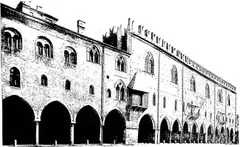
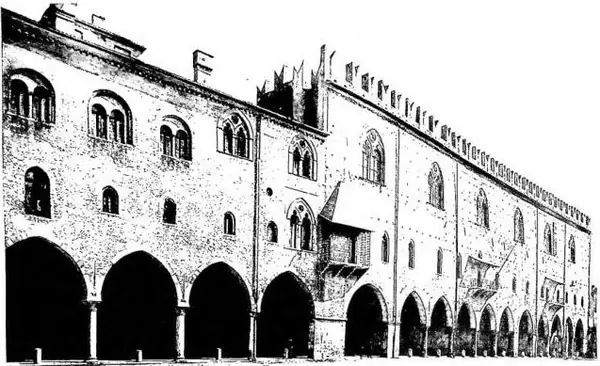
GONZAGA, FAMILY. - The asserted Germanic descent of the Gonzaga and also their supposed kinship with the Ottonians is entirely legendary. As to their origin, it is still debated whether they were milites of Countess Matilda of Canossa or, from very ancient times, minor vassals of the monastery of St. Benedict in Polirone (the feudal bond with this monastery still existed toward the end of the fourteenth century). In the second half of the twelfth century the Gonzaga settled in the city of Mantua and continually expanded their possessions around it and toward Reggio Emilia. In the thirteenth century they were banished from Reggio and their goods in the Mantuan territory confiscated, but the protection of the Bonacolsi allowed them to rise again, and toward the end of that century they had attained great economic power: their territories extended widely through the Veneto and reached as far as Ivrea.
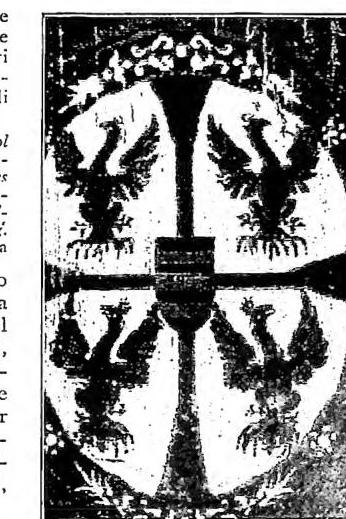
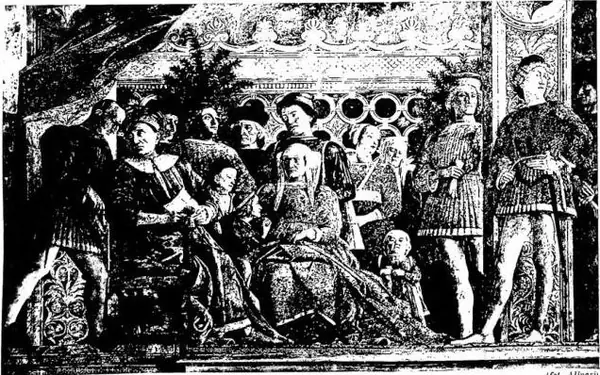
In 1328 Luigi Gonzaga overthrew the lordship of the Bonacolsi and was proclaimed captain general of Mantua, with the right to designate his successor. From Louis the Bavarian he received the title of imperial vicar. He took part in the league against John of Bohemia, then in that against the Scaligeri; but in 1358 he had to acknowledge the high sovereignty of the Visconti. He died in 1360. He was succeeded in the office of captain general by GUIDO (1360-69), LUDOVICO (1369-82), FRANCESCO (1382-1407). Francesco sought to escape Visconti predominance by relying on Venice. The feudal bond that tied the Gonzaga to the monastery of St. Benedict was annulled by Boniface IX, who erected Mantua into a fief directly dependent on the Holy See, exempting the Gonzaga from any tribute, even a merely formal one. Francesco reformed the Bonacolsi statutes and, concentrating power in his own hands, laid the foundations of the principality. In 1403 the emperor Wenceslaus gave him the title of marquis, but Francesco did not make use of it. His successor GIANFRANCESCO (1407-1444) refused the same title in 1413, but then bought it in 1433 from Sigismund, when he judged that the latter had consolidated himself on the imperial throne: he thus acquired the right to add to his coat of arms four eagles with open wings. Gianfrancesco found himself in difficult circumstances, caught between the Duchy of Milan and the Republic of Venice at war with each other. In 1438 he abandoned the Venetian alliance for the Milanese one, and the Peace of Cremona forced him to a notable cession of territories to Venice. During his government the school of Vittorino da Feltre flourished in Mantua. At his death Gianfrancesco divided the State among his four sons, but the death of two of them and the rebellion of a third, CARLO, allowed the other son, LUDOVICO (1444-1478), to remain sole lord. In 1450 Ludovico allied himself with Francesco Sforza, to whom he gave valuable aid for the conquest of the Duchy of Milan; but the Peace of Lodi confirmed for Mantua the loss of the territories previously ceded to Venice. During his government Ludovico greatly increased the prestige of the marquisate, especially through his activity in civil works. He donated reclaimed lands to cultivators, devoted particular care to the water regime, had two churches built on designs by Leon Battista Alberti and the famous tower with the clock regulated by Bartolomeo Manfredi. A passionate reader of the classics, he was lavish with subsidies to men of letters and artists. Ludovico too arranged that after his death the State should be divided among various heirs, thus causing a dispersal of power and wealth. While, of his sons, FRANCESCO was the first to wear the cardinal's purple (in 1461): for him Poliziano wrote the Orfeo, and LUDOVICO held the bishopric of Mantua, to GIANFRANCESCO was assigned the lordship of Sabbioneta, Bozzolo, etc., and to RODOLFO, who died in the battle of Fornovo, that of Castiglione delle Stiviere, Solferino, etc.
Of the branch of Gianfrancesco, mention should be made of SCIPIONE, son of Carlo, b. in 1542, who studied at Padua, in 1565 went to the court of Maximilian and obtained for himself and his descendants the title of prince of the Empire, was created patriarch of Jerusalem by Sixtus V in 1585 and appointed cardinal in 1588; in 1590 he received from Vincenzo I the government of Montferrat and died in 1593. Scipione founded in 1564 the Accademia degli Eterei, which welcomed Tasso among its members, and was one of the revisers chosen by the poet for the Gerusalemme. To the same branch belonged GIULIA, daughter of Ludovico, b. in 1513, married to Vespasiano Colonna, who by her personal charm attracted to herself scholars and poets, was celebrated by Ariosto and other men of letters, and portrayed by Sebastiano del Piombo and by Titian. Giulia took part in the movement of the «reform» and was in correspondence with Carnesecchi. She died in 1566. Of the branch of Castiglione delle Stiviere, St. LUIGI (v.), great-grandson of Rodolfo, and LUIGI (1745-1819), scholar and adventurer, are to be noted. He posed in France as a Jacobin, then in Austria ceded to Maria Theresa every right of sovereignty in exchange for a life annuity.
On the throne of Mantua Ludovico was succeeded by FEDERICO (1478-84), who for some time commanded the militias of the Sforza in the war between Florence and Sixtus IV. With FRANCESCO (fourth marquis of Mantua, 1484-1519), the marquisate was involved in the great political and military struggles of the time. While his wife, Isabella d'Este, made Mantua a great cultural center, Francesco, placed in 1495 at the head of the Italian League, maintained an ambiguous conduct, so that, when in 1500 French dominion was re-established in Milan, he barely avoided having his territories partitioned between France and Venice. His successor FEDERICO (1519-40), although from 1521 he held the office of captain general of the Church, sought the favor of Charles V, and during the war of the League of Cognac, in agreement with Alfonso d'Este, opened the way for the Landsknechts. From this moment he remained faithful to imperial policy, but his hope of recovering the lands ceded to Venice and his aspiration to the Duchy of Milan were disappointed. The only compensations for his activity as an agent of the Emperor were the erection of Mantua into a duchy (1530) and the gift of that Montferrat which was to be the cause of so many disasters for the Gonzaga. At Federico's death the regency for his young nephew FRANCESCO was held by ERCOLE (b. in 1505, d. in 1563), who abandoned it during the brief government of Francesco, and then resumed it until 1550. Ercole was named bishop in 1521, then went to the Studio of Bologna and in 1526 received the cardinal's purple. During his regency Ercole restored the economy of the State by curbing the luxury of the court, appointed Giulio Romano prefect of the waters and buildings, renovated the Cathedral by calling Veronese to decorate it, and gave commissions for paintings to Titian. In 1561 he was one of the five pontifical legates at the Council of Trent, of which the presidency was entrusted to him, which he held until his death.
FERRANTE (1507-57) was a brother of Ercole; in 1527 he took part in the campaign of Rome with the imperial forces, and in 1530, after the death of Orange, he commanded the army at the siege of Florence, then took part in the expedition to Tunis and in the war of Provence. In 1539 he acquired Guastalla. In 1546 he was appointed governor of Milan. But after the conspiracy against Pier Luigi Farnese and the unhappy outcome of the war of Parma of 1551-53, he was recalled to Brussels, and Milan was given to the Duke of Alba. The lordship of Guastalla, on the death of Ferrante, passed to his firstborn son CESARE. A grandson of Ercole, the third-born son of Federico, LUDOVICO, was taken as a youth to France in 1549, where he gathered the inheritance of his maternal grandmother, Anne d'Alençon. He became an influential figure at the court of Henry II, was a listened-to counselor of Catherine de' Medici and a support of the Catholic party. Marrying Henriette of Cleves, he obtained the titles and estates of Rethel and Nevers. Another Gonzaga, CURZIO (1536-99), was sent by Cardinal Ercole to Charles V as delegate for the Peace of Cateau-Cambrésis. He then moved to Rome, where he was admitted to the Academy of the Vatican Nights founded by Cardinal Borromeo; he wrote Rime and a chivalric poem.
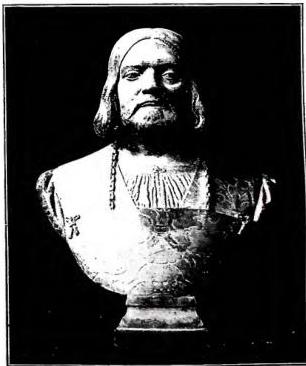
The power of the Gonzagas reached its height with another grandson of Ercole, GUGLIELMO (1550-87), who married his daughter ANNA to Ferdinand of Austria and his daughter MARGHERITA to Alfonso II d'Este, and obtained that Monferrato be erected into a duchy. His successor VINCENZO I (1587-1612), with the immoderate luxury of the court and the mad expenses to enrich his gallery (he donated a fief in exchange for a Madonna by Raphael), dealt a very grave blow to the finances of the State. He attempted to resolve the problem of Monferrato with the marriage of his firstborn son FRANCESCO and of Margherita, daughter of Charles Emmanuel I, but Francesco died a short time after his father, leaving only a daughter, MARIA. The throne fell to Francesco's brother, FERDINANDO, sixth duke of Mantua (1612-26), who renounced the cardinal's purple to marry Catherine de' Medici, but had no children. In 1625 Ferdinando established a university Studio in Mantua, which he entrusted to the Jesuits. The marriage of Ferdinando's brother and successor, VINCENZO II (1626-27), also remained sterile. As the extinction of the main branch of the family appeared imminent, in 1625 Ferdinando had summoned Charles of Rethel to Mantua. The latter, b. in 1580, was the son of Ludovico Gonzaga Nevers and had lived until then in France, where he had taken part in the struggles of the princes during the regency of Marie de' Medici. The succession of Mantua belonged to Charles, but to legitimize his rights even more in the face of the foreseeable reactions of Spain and the Empire, Vincenzo II, on the eve of his death, consented to his marriage with MARIA Gonzaga; CARLO I (1627-37) found the treasury exhausted by the mad prodigalities of Vincenzo I, of Ferdinando and of Vincenzo II. There were added the assault and invasion of an imperial army, which savagely devastated and plundered the whole country. The son of Carlo I, CARLO, predeceased his father, while a daughter, ANNA (1616-84), who remained in France, exercised notable activity during the Fronde and was superintendent of the queen's household until 1660. On the throne of Mantua there ascended in 1637 the grandson of Carlo I, CARLO II (1637-55), under the tutelage of his mother MARIA until 1647. Maria devoted herself with all her energies to the reconstruction of the country, and her activity seemed to bear good fruit; but the government of the unwarlike Carlo II, and then that of FERDINANDO CARLO (1655-1708) drew upon Mantua new wars, new Franco-Spanish and imperial invasions and new devastations. On 30 June 1708 Ferdinando Carlo was declared guilty of felony, and the Diet of Regensburg revoked the Duchy of Mantua to direct imperial authority. Two years later Guastalla too passed to form part of the hereditary States of the House of Austria. Mantua nevertheless preserved the ducal title until 1815, when its territory was annexed to the Kingdom of Lombardy-Venetia. - See pl. LXIV.
Bibliography8 works
Roberto Palmarocchi