
PERSONALISM. - persona (v.), the term dates back to the nineteenth century (Schleiermacher, Feuerbach, Grote, Teichmüller), having pantheism (v.) or to the conception of an impersonal divinity, spiritualism (v.). This meaning is still retained, especially in American culture, where the doctrine of J. Royce (v.), M. Calkins, and W. E. Hocking is termed “absolutistic personalism” (cf. D. S. Robinson, La philosophie religieuse américaine au XXe siècle, in the collaborative work L'activité philos. contemp. en France et aux Etats-Unis, I, Paris 1950, p. 321 ff.). Today the term, in the sense clearly defined by the works of Ch. Renouvier and B. P. Bowne (v.), generally denotes doctrines founded upon the value of the human person.
These doctrines individual (v.) and person, inherited from Kantianism and idealism, and tend to establish how the individual human subject passes from the egoistic individual state to the fullness of personal human values.
1. Naturalistic personalism regards the transition from individuality to personhood as the effect of the determinism of natural laws. Its first formulation is based upon biologism, especially in the evolutionary form of Spencer and in the energetic form of Ward and Waxweller (cf. E. Waxweller, Esquisse d'une sociologie, Brussels 1906, p. 62). American neo-materialism fundamentally adheres to it (cf. R. W. Sellars, The philosophy of physical realism, New York 1932). psychologism (v.) and finds its chief psychoanalysis (v.) (cf. R. Bloch, Les tendances et la vie morale, Paris 1948). At present, however, both formulations are absorbed by sociologism, which sees in “social pressure” the fundamental instrument indispensable for the formation of personality (cf. G. Gurvitch, Le contrôle social, in La sociologie au XXe siècle, by several authors, I, ibid. 1947, p. 122 ff.). E. Durkheim (cf. Les formes élémentaires de la vie religieuse, ibid. 1912, p. 387, L'éducation morale, posthumous, ibid. 1925) was the first to raise the problem of the reality of social consciousness and regarded it as the means determining the personality of individuals in all its expressions. In the United States, social “behavior” (v.) and the “theory of attitudes” (W. J. Thomas, F. Znaniecki, L. L. Bernard, R. Young) emphasize the social conditioning of individual responses to different situations; but it is above all “psychodynamic personality analysis” that brings out not only the action of the social group in the formation of the normal person, but also the pathological deviations of personality caused by social disorders. Its initiator was G. H. Mead (cf. Mind, Self and Society, posthumous, Chicago 1934); he was followed by K. Horney (The neurotic personality of our time, New York 1937), R. Linton (The study of man, ibid. 1936; The cultural background of personality, ibid.-London 1945), and A. Kardiner (The individual and his society, New York 1939; The psychological frontiers of society, ibid. 1945). The pedagogical doctrine of quite a few modern thinkers moves on the plane of naturalistic personalism, considering education either as the free vital expansion of instincts, or as the psychological sublimation of tendencies, or as active participation in social life: the Dewey theory of education is connected with this latter form (v. STRUMENTALISMO).
Naturalistic personalism shares the positivist error of compromising the freedom of the individual person through the determinism of natural laws. Nevertheless, its investigations constitute an important contribution to the scientific study of the psychophysiological and social conditioning of free spiritual activity (cf. L. Sturzo, Del metodo sociologico, Bergamo 1950, pp. 15-16).
2. Spiritualist personalism, in opposition to naturalism, defends the absolute freedom of the human spirit and its inward commitment to self-perfection, in the full realization of its values. Its first formulation is based on vitalism and on dynamic monadism, elaborated under the influence of Kant’s Critique of Practical Reason (v.) pluralism (v.) Lotze (v.). P. Janet may be regarded as its initiator: he contrasts egocentric individuality with personality as “conscience de l'impersonnel” (La morale, Paris 1874, p. 593), that is, consciousness of those absolute values, adherence to which causes the absolute dignity of the person to arise from the sacrifice of the individual ego. Janet would have wished to call his tendency personalism, as Dauriac attests (Bulletin de la Soc. franç. de philos., Feb. 1904, p. 40); but it was Ch. Renouvier who first gave the system this designation (Le personnalisme, 1903), introducing into it his own conception of the spirit as pure freedom, of the primacy of good will, capable of reconstructing the whole universe according to the kingdom of ends, that is, centered upon the absolute value of the person. In England this personalism developed along the lines of the morality of “self-realization” and “self-sacrifice,” monism (v.) individualism (v.): T. H. Green, B. Bosanquet, F. H. Bradley (cf., for the latter, Appearance and reality, 9th ed., Oxford 1930, pp. 365-70). In the United States it is customary to distinguish within spiritualism: a) the position of absolute personalism: it sees in the personal absoluteness of God the foundation of all disinterested values, the pursuit of which enables the individual to transcend himself (cf. J. Royce, The philosophy of loyalty, New York 1908). W. E. Hocking adds to this an appeal to the experience of reality, particularly to religious experience, drawing inspiration from James: “The object of certain knowledge has this threefold structure: the Self, Nature, the Other Consciousness; and God, the proper object of ontological proof, includes all three” (The meaning of God in human experience, New Haven 1912, p. 315). b) The position of pluralistic personalism, which makes personality the primary category of reality: by rising to it, individuals recognize the absolute value of their own person, can communicate with other human persons, and above all recognize God as a personal being by essence. Initiated by Howinson, this pluralistic personalism was elaborated by B. P. Bowne (Personalism, Boston 1908); at present, with evident influences of Thomistic thought, it has been developed by many authors (R. T. Fleweling, E. S. Brightman, A. C. Knudson, F. J. McConnell, L. R. Ward) and defended by the journal The Personalist, founded in Los Angeles by Fleweling in 1919. The thought of the Australian A. C. Garnett may be connected with II.
The second formulation of spiritualist personalism is due to the influence of the theory of values (v.) phenomenology (v.): critical personalism. In the analysis of consciousness, the empirical ego finds itself opposed to the ego of value, which, by its absoluteness and categorical character, commands its respect and impels it to perpetual self-transcendence. Whereas the “relativist” position makes the very ego of value the creator of its values (cf. R. Polin, La création des valeurs, Paris 1944), the metaphysical or “absolutistic” position gives values an absolute significance in themselves and seeks to attain the personal divine transcendent as their ultimate foundation (cf. R. Le Senne, Le devoir, 2nd ed., Paris 1950; Obstacle et valeur, ibid. 1934; L. Lavelle, Traité des valeurs, ibid. 1951).
Critical personalism becomes axiological personalism when personality is understood no longer as «consciousness of the impersonal» but, through the dialectic of the I–Thou relationship and through the «reciprocity of consciousnesses», as «consciousness of the personal». SCHELER, MAX (v.) is its initiator; but in him values are still an impersonal absolute, even though they are present in the hierarchy of persons (individual and collective), and fundamentally in the divine person (cf. Der Formalismus in der Ethik und die materiale Wertethik, 3rd ed., Halle 1927, p. 94), and even though they operate emotionally in the formation of human personality through interpersonal imitation (cf. Wesen und Formen der Sympathie, Bonn 1923).
W. Stern is responsible for identifying value with person (cf. Die menschliche Persönlichkeit, Leipzig 1918; Person und Sache. System des kritischen Personalismus, III, Wertphilosophie, ibid. 1924). There is a hierarchical scale of values corresponding to the hierarchical scale of persons. Every I is an absolute center in the personal world of values. The initial I must pass to the ideal I, that is, to its own personal value, representing its vocation («Berufung», cf. Wertphilos., cited work, p. 449). But one cannot attain one’s own value except by positing it as the center of all the other person-values and seeking to make them one’s own through Introzeption; the categorical imperative thus becomes: introzipiere (ibid., p. 353, p. 89). To realize one’s person means inner enrichment through an ever higher religious and social commitment.
Spiritualist personalism, in the various forms indicated, does not succeed in overcoming the immanence of subjective consciousness, nor in defining the foundation of human values, inner freedom, and moral obligation. The many reservations concerning the equivocal nature of the term personalism therefore have serious grounds (cf. M. Blondel, L'action, II, Paris 1937, pp. 483–484). Nevertheless, despite its heterogeneity and equivocality, this contemporary personalist tendency expresses the increasingly felt need to reconstruct social life upon the dignity of the human person, overcoming the egoistic optimism of empirical and rationalistic individualism, the deterministic enslavement of positivism, and the moral slavery of statist totalitarianism and Marxist collectivism. It refers back to the inner drama introduced into modern thought by Pascal (v.) existentialism (v.); but it seeks to resolve it through confidence in the energies of the spirit, through aspiration
to a transcendent absolute that may fill the individual’s insufficiency, and above all through the power of love, which unites individuals in the communion of an active personal life. Personalism thus presents itself as a «philosophy of salvation»—individual and social. Its profound investigations into human values and its careful phenomenological analysis of consciousness represent a highly positive contribution to the deepening of the problems of the human person and of all his activity.
Christian thought lays claim to the designation personalism in its authentic meaning. Indeed, it was Christianity that revealed and defended the full value of the natural and supernatural dignity of the human person (cf. A. Tommasini, Il cristianesimo e la personalità umana, Rome 1940; E. Zeller, La filosofia dei Greci nel suo sviluppo storico, Italian trans., I, Florence 1932, p. 318), and founded upon it its work of moral and social renewal (cf. I. Giordani, Il messaggio sociale di Gesù, 2 vols., Milan 1947). Christian personalism may be defined as communitarian theocentric humanism. Contemporary Christian thinkers see in anthropocentric humanism, which inspires the entire development of the modern world, the true cause of the ills of present-day society. They oppose to it a systematic elaboration of Christian personalism that may serve as the principle of a new social order, in which the natural and supernatural rights of the person are safeguarded, all the pluralistic demands of human nature are fulfilled, and which therefore represents the suitable means for the integral historical perfection of the person in relation to his eternal end.
Christian personalism presents itself in two fundamental attitudes: one connected with the Augustinian approach, with more or less evident adherence to the various contemporary personalist formulations; the other with Thomistic doctrine, of which it represents an organic elaboration (cf. C. Bortolaso, Incontro di filosofi cristiani, in Civ. catt., 1951, III, pp. 51–58).
a) Christian spiritualist personalism encompasses very diverse tendencies, ranging from the existentialist to the phenomenological and axiological, and reaching a true and proper realism that considers the person as «incarnate spirit» in material and social concreteness. In France, the existentialist position (cf. E. Gilson, L'existentialisme chrétien, Paris 1947) is represented principally by G. Marcel and N. Berdiaeff. G. Marcel sees the affirmation of the I not through the objective opposition of the impersonal, proper to science and philosophy, but through the relationship of communication with the «Thou», determined by faith: God is the «Thou» par excellence, irreducible to objectification and therefore to rational inquiry (cf. Journal métaphysique, ibid. 1928, pp. 137–38, 155, 254). In De la destination de l'homme (ibid. 1935), N. Berdiaeff rejects legalistic individualism in favor of a mystical morality of redemption, through which the person realizes his personal value by the love of God identified with love of neighbor; and in Cinq méditations sur l'existence (ibid. 1936) he studies the dynamism of the person in social life (cf. especially the 3rd and 5th meditations: «Le moi, la solitude et la société»; «La personne, la société et la communion»). The phenomenological position is represented especially by M. Nédoncelle (La réciprocité des consciences, ibid. 1942; La personne humaine et la nature, ibid. 1943; Vers une philosophie de l'amour, ibid. 1946). He sees the formation of the person in the reciprocity of consciousnesses, opposing monadism with dyadism: it is therefore love that brings about that spiritual act through which the ideal I opposes the natural non-I and becomes the higher form and source of psychological reality. E. Mounier (v.), on the other hand, bases himself on a realistic position (cf. especially: Rivoluzione personalistica e rivoluzione comunitaria, Italian trans., Milan 1949; Che cosa è il p., Italian trans., Turin 1948): the person reaches perfection by opposing every form of egoistic individualism and enslaving totalitarianism that violate his absolute personal autonomy, and by becoming a radiating force of love in the concreteness of social life. Only from this personalist revolution can arise that communitarian revolution which transforms a society based on unitarism into a true society of persons, or community, based on mutual love and the love of God. In Italy the principal representatives are L. Stefanini (Metafisica della persona, Padua 1950; P. sociale, Rome 1952), who moves from the person’s present psychological consciousness to establish its metaphysical meaning; G. Bozzetti (Il valore della persona, in Filosofi II. contemporanei, by various authors, 2nd ed., Milan 1946, p. 195 ff.), ROSMINIANI (v.); and A. Agazi (Saggio sulla natura del fatto educativo in ordine alla filosofia della persona e dei valori, Brescia 1951). Mention should also be made of the formulation of historicist personalism contained in the works of L. Sturzo (La società, sua natura e sue leggi, Bergamo 1949; Del metodo sociologico, ibid. 1950), which may be related to the thought of G. B. Vico (iv.) cf. G. Marchello, Storicismo e spiritualismo, in Riv. intern. di scienze sociali, 22 (1950), pp. 61–67).
b) Neo-Scholastic p. begins from the metaphysical value of the person, the principle of its inner dynamism toward the fullness of values, in order to ground upon it the entire moral and social order. “It is only when our self is not phenomenalized and depersonalized that value as an end can be attributed to it” (F. Olgiati, I fondamenti della filosofia classica, Milan 1950, p. 269). The person, in fact, is perfectly in itself and for itself, both really and intentionally. “Sola intellectualitas natura est propter se quaesita in universo, alia autem omnia propter ipsam” (C. Gent., III, chap. 112). The created person can fully realize God’s creative purpose only by realizing its personal end, which consists in the eternal possession of the Good in the full plenitude of its entitative value, that is, in the vision and love of God. It is this coincidence between the ultimate internal end and the ultimate universal end, this intentional capacity of the person to bear within its unity the fullness of being, that makes the person itself an absolute and an end, which God Himself recognizes, never reducing it to an instrument of His governing action (cf. Sum. Theol., 1ª-2ª, q. 1, a. 2).
The definition of Christian p. included a third term: communitarian theocentric humanism. The person, in fact, is a good for itself and for others. As a good for itself, it entails individuality and unity, openness to the appropriation of all values; as a good for others, it entails the communication of its own good: “bonum est diffusivum sui.” Since the person can never be reduced to the utilitarian instrument of another person, the associative bond between persons can only be the bond of mutual love: society, therefore, as an expression of friendship, that is, community. Supernatural elevation gives persons the possibility of the communion of Saints (v.), based on charity. The human person, through its essential composition of spirit and matter, entails an associative necessity for the progressive attainment of useful goods, proportionate to the objective pluralism of the needs of its nature: the individual, therefore, dynamically expresses personal life in the family, in the profession, in the national and international community, in the State and, on the supernatural plane, in the Church. The law of love and charity allows the person to sacrifice particular and temporal interests for the sake of the common good, but excludes renunciation of its absolute values.
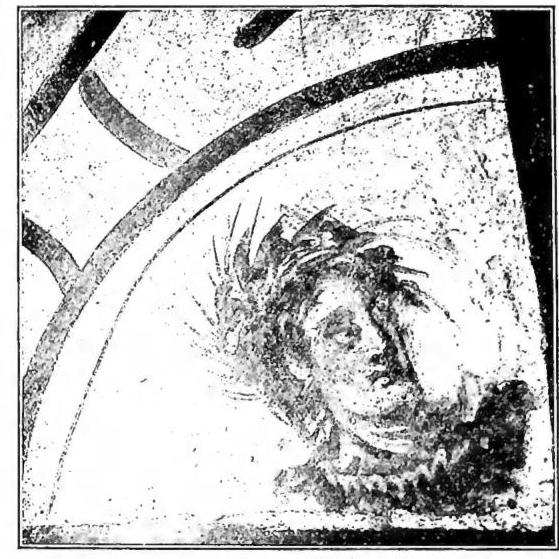
(photo Pont, Comm. arch. sacra)
PERSONIFICATIONS — P. of Summer. Fourth-century fresco in a cubicle of the cemetery Inter duas lauros — Rome.
the contemporary Christian social movement is founded, aiming at the realization of a social order conforming to the natural and supernatural rights of the human person. Its inspirers, through their encyclicals and directives, have been the supreme pontiffs, from Leone XIII to Pio XII. Eminent scholars have contributed to it, Ketteler (v.) Toniolo (v.) down to contemporaries, who through writings, study weeks, social institutes, and journals have explored more deeply the principles of natural law and the psychophysiological and historical-social laws conditioning human activity. From these studies the social activity of Catholics draws inspiration, both through CATTOLICITÀ (v.) and through direct political, professional, and educational action.