
PILATE, PONTIUS. - I. LIFE. - Roman procurator of Judea, at the time of Jesus.
A descendant of the family of the Pontii, of Samnite origin, already famous in the earliest times of the Roman Republic, P. is called a "knight" and must have been personally valiant, as the surname of P. seems to indicate, deriving in all probability from pilum, javelin. He was honored with the title of "friend of Caesar" (Jn. 19:12), a mark of his nobility.
P. was the fifth Roman procurator of Judea. He succeeded Valerius Gratus in 26 A.D. and remained in office until 36. Elected by Tiberius in the time of Sejanus, a sworn enemy of the Jews, he always showed great contempt for his subjects. Herod Agrippa I in a letter to Caligula calls him "implacable, without regard and obstinate." Such indeed he shows himself to be in the few episodes that history preserves of him, handed down by Philo and by Josephus. His downfall was due to the Samaritans, who denounced him to Vitellius, governor of Syria, following an act of cruelty committed against them. Vitellius deposed P. and sent him to Rome to answer for his conduct before the Emperor. P. arrived in Rome at the beginning of 37, Tiberius already being dead: from then on he disappears from history.
Apart from the narrative of the trial of Jesus Christ, in which P. plays so great a part, he is named six times in the New Testament, three times with his full name, in Lk. 3:1; Acts 4:27; 1 Tim. 6:13; and three other times with only the surname of P.: Lk. 13:1; Acts 3:13; 13:28. In passing, St. Luke (13:1) alludes to an episode of cruelty in which P. had a group of Galileans killed in the Temple, while they were offering sacrifices.
What made P. sadly famous was the trial and condemnation of Jesus Christ. Throughout the whole course of the trial, P. maintained an uncertain conduct. Toward Jesus Christ he showed himself respectful and almost favorable: he repeatedly declared his innocence (Mt. 27:23; Mk. 15:14; Lk. 23:4, 14, 22; Jn. 18:38; 19:4, 6), for which reason he long refused to receive the request for condemnation presented by the Sanhedrists, and even sought to free him: he sent him to Herod (Lk. 23:6-15); he proposed to inflict a punishment on him to appease the people (ibid. 23:16); he sought to use the right of pardon in his favor (Mt. 27:15-21; Jn. 18:39 ff.); he showed him to the people crowned with thorns, to move them to compassion (Jn. 19:4-6). Nevertheless, in addition to the scourging inflicted on him, in the end he pronounced the death sentence of crucifixion, just as the Sanhedrists demanded, to whom he did not want to yield. He had realized from the beginning that they had brought Jesus to him moved by envy of him (Mt. 27:18), and then he accommodated himself to the change of accusation, which from religious became political, and condemned the innocent man. St. John (18 and 19) reveals the character of P.: cynical, and yet with the innate sense of justice of the Romans; insensible to higher principles and superstitious; an enemy of the Jews and extremely sensitive to his own advantage, for which he went so far as to sacrifice the life of a man. He resolved indeed to pronounce the condemnation when he heard the cry: "If you release him, you are not a friend of Caesar!" (Jn. 19:12).
Legend gives particulars about the end of P. After his arrival in Rome, history is silent about him. The legend, however, is so varied that it ranges from making him a suicide to proclaiming him a saint. According to Eusebius (Hist. eccl., II, 7: PG 20, 155) he was exiled to Vienne, in Gaul, where he committed suicide; according to Malalas (Chronographia, 10: PG 97, 390) he was beheaded by Nero. A violent death seems probably to have been the wretched end of P.
Bibliography8 works
II. APOCRYPHA OF PILATE
A body of apocryphal writings that complement one another, made up of primitive parts and later additions. The primitive core seems to have consisted of Christian writings of the 2nd century, narrating the Passion, death, descent into limbo and Resurrection of Jesus, gathered under a general title of Acta Salvatoris or, as it is preserved by the Greek recension of the present Acta Pilati, Ἑκονήματα τοῦ Κυρίου ἡμῶν Ἰησοῦ Χριστοῦ πραχθέντα ἐπὶ Ποντίου Πλάτου. Later other writings were added, containing the notification made by Pilate of what had happened regarding Jesus, and the punishment inflicted on him and on the Jews for the condemnation of the divine innocent. Seven works of this collection can be distinguished.
1. Acts of Pilate
A writing that has come down to us in two Greek recensions, very different from each other (A and B), one Syriac, one Coptic, one Armenian, two Latin (A and B). It seems to have already been known to St. Justin (Ap., I, 35 and 48: PG 6, 384 and 400) and to Tertullian (Apol., 21: PL 1, 461). It is composed of two parts, both completed later, containing: the first, the trial of the Redeemer before Pilate; the second, the burial by Joseph of Arimathea. The primitive part seems to have been written, shortly after the events, by a Jewish-Christian; it was completed shortly afterwards. The original language was Aramaic. In 425 the apocryphon was found by a certain Aenia, translated by him into Greek and published, with a preface: to that time dates the recension from which the others known today derived. It has a plainly apologetic purpose. The author, if he was not himself a witness of the events, used the Gospel narrative as a background, adding to it a good deal of his own, drawn from testimonies transmitted orally and well known to his contemporaries.
It narrates the trial of Jesus held before Pilate, with the related accusations and defenses. The procurator repeatedly acknowledges the innocence of Jesus, but condemns him; Jesus is crucified and dies. The Jews reproach Nicodemus for the part he took in favor of Jesus and imprison, for the same reason, Joseph of Arimathea, who during the night is miraculously freed. In the morning the soldiers placed to guard the tomb of Jesus come to announce the Resurrection, and others, arriving from Galilee, assure that they have seen the Master conversing with the disciples. To the unbelieving Jews, Nicodemus proposes that Jesus be sought for: he is not found, but they discover that Joseph is at his house. Invited to the council, he narrates his own liberation. Then comes the news of the Ascension of the Savior: then faith in him makes its way into those hearts.
2. Descent of Christ into hell
This apocryphon is often found, especially in the Latin versions, following the preceding one; in the Greek codices it is for the most part missing, as also in the Coptic version. It is preserved in a single Greek recension, while for it too the Latin ones are two. It was also written by a Jewish-Christian. Nevertheless it forms a distinct and independent work, only later added to the Acts of Pilate, of which it is a confirmation and complement. C. Tischendorf dates it to the beginning of the 2nd century or even to the end of the 1st century A.D.; L. Darley affirms that it is from the first years after the events narrated.
It contains the narration of the descent of Christ into limbo and of what happened there, written by the two sons of the old Simeon, Leucius and Carinus, raised by the risen Jesus.
Jesus takes Satan prisoner, brings out the righteous, entrusts Adam to Michael the Archangel who carries him to the Earthly Paradise, where Enoch, Elijah and the good thief are found. At the end of the booklet many codices place a Letter of Pilate to Claudius, in which he narrates what happened during his governorship: accusations of the Jews against Jesus, his credulity toward their words, condemnation of Jesus. He however rises again, but since the Jews sought to corrupt the witnesses, Pilate wishes to put the Emperor on guard against their lies.
3. Letter of Pilate
It is preserved by some Latin codices, none Greek; of uncertain author and date. Also known as the Second letter of Pilate, addressed to Tiberius. It presupposes the first. In the codices it follows the account of the Descent into hell, and seems to date to not many decades after the disgrace of Pilate and his return to Rome.
In it Pilate excuses himself for having had to condemn Jesus, a most pious man, saying that he was forced to do so by the Jews, all united in wanting his death, which was then accompanied by prodigies never seen before. He also affirms that he wished to avoid seditions and to save the authority of the Emperor.
4. Gospel of Nicodemus
It is not a new apocryphal book, but the union of the Acts of Pilate with The descent of Christ into hell.
The first codex that testifies to their union is that of Einsiedeln, of the 10th century: it is not known, however, when and by whom they were first united. There is no notice of such a union in the Greek codices. The title is very recent, perhaps of the 16th century.
5. Anaphora Pilati
Also known under the name of Epistle of Pilate to Caesar, it is nevertheless completely different from the letter to Claudius. It is a report that Pilate makes to the emperor Tiberius of what happened in Palestine regarding Jesus. It too very ancient, it is preserved in two Greek recensions, fairly similar to each other. It is not found in Latin codices.
Pilate writes that the Jews handed Jesus over to him, accusing him especially of having violated the Sabbath. Jesus, on the other hand, had always shown himself good and had benefited many, even with miracles. Induced by the tumults, he first had Jesus scourged, then condemned him to death. The Jews crucified him. When he was on the Cross, the sun darkened, the earth trembled and opened, and many dead rose again. In the night after the Sabbath, Jesus himself rose again and called back to life all those who were in Limbo. Many Jews hostile to Jesus were swallowed by the earth, and all the synagogues of Jerusalem were destroyed.
6. Paradosis Pilati
It is like the continuation or, better, the consequence of the Anaphora: easily by the same unknown author. Preserved only in a few Greek codices.
Having received the report of Pilate, the Emperor became furious, and sent to imprison him. Arrived in Rome, he was subjected to a solemn trial and condemned to death. The Jews too were punished, in part with death, in part with slavery.
7. Vindicta Salvatoris
It too concerns the relations of the Romans with the Savior. Preserved only in some Latin codices, of unknown author.
It must date to the times of Claudius, at least in the primitive recension, quite short, which constituted the primitive core of the long one. The Latin recension, as it has come down to us, is certainly composed of several writings, as the repetitions found in it attest. In the primitive part is narrated the punishment of Pilate and of the Jews, inflicted by Titus and Vespasian. To this part was later added the narration of a mission of Velusian, who here is made to be summoned by Titus and Vespasian: he goes to Palestine, seeks a likeness of Jesus; finds the handkerchief of Veronica, carries it to Rome, where it is adored by Tiberius, who by that act merits healing from his ailments and has himself baptized.
In conclusion: besides the Acts of Pilate and the Descent of Christ into hell, it seems that the various Letters of Pilate and the Vindicta Salvatoris, preserved in Latin, correspond to the Anaphora and the Paradosis Pilati of the Greek codices: they have the same purposes, but are independent of one another. Both, however, derive from a common, official source, and seek to complete the cycle of the Acta Salvatoris. Later studies may clarify several points still obscure.
Bibliography6 works
Fedele Pasquero
III. ARCHAEOLOGY
The figure of P. in the Lord's judgment also entered into the representations of ancient Christian art, especially in the sarcophagi. Garrucci, Le Blant and others have published nineteen examples of sculpture; Wilpert another nine, though fragmentary. The sarcophagi, which derive from a Roman prototype, are, except for nine, of the type of those whose front is divided by columns: in these, generally, the scene of P.'s judgment is on the right; the tribunal is indicated by the suggestus with the chair for the judge, the hourglass for determining the time allotted to the conduct of the trial, the assessors or counselors of the judge, the soldiers who accompany the accused, P. near whom is the servant who is preparing to wash his hands. The most notable sarcophagi are: the Lateran 55, called that of the "two brothers," the Lateran 174, now in the Vatican Grottoes, like that of Junius
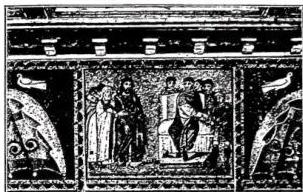
Bassus. The scene is also found in one of the front columns of the ciborium of the high altar of St. Mark's in Venice (6th century); in the lid of the lipsanotheca of the Civic Museum of Brescia (4th century); there Christ is held by two soldiers, while P. washes his hands; in the ivory diptych of the Treasury of the cathedral of Milan (5th century), where P. washes his hands, while J. Christ is led away by a soldier, as in the ivory of the British Museum in London (early 5th century) and in the bronze door of the cathedral of Salerno (13th century). Of singular interest is the same episode in the mosaics (early 6th century) in St. Apollinaris in Ravenna: Christ, accompanied by a soldier, is to the right of P. who, seated on a chair, flanked by some figures, washes his hands.
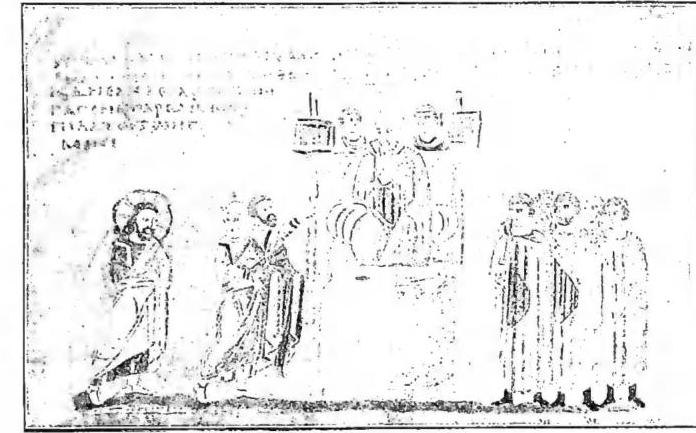
In the field of painting, the miniature of the Codex purpureus Rossanensis (6th century) is of extraordinary importance: P. is on a chair with a high square back with a cushion, placed above the suggestus: to his left five figures, to his right two, and, somewhat apart from these, J. Christ. Another miniature is the one mentioned by Peirce and Tylor, in which the Jews are observed demanding from P. the release of Barabbas. The scene also occurs in the Syriac Evangelary of Rábula of the year 586 (f. 12). The subject was also treated in St. Maria Antiqua in the Roman Forum, where, beside the painting that represents J. Christ on the way to Calvary, one wishes to see, in the smallest remains, the Lord before P. In St. Maria in Pallara or St. Sebastian on the Palatine, among the frescoes of the 10th century and later, destroyed (except those of the apse) but known in the copy made in 1630 (Vatican Library, Barberini fund), the scene of P. was depicted, preserved instead in the series of frescoes (11th century) in St. Urban at the Caffarella. According to G. Wilpert, in P.'s judgment there could not be missing, because as a rule in the hall of the tribunal, the images of the emperors: sacri vultus, sacrae imagines: these are found only in the Evangelary of Rossano, in the column of the ciborium of St. Mark's in the form of small pictures, placed at the sides of P., and in the Lateran sarcophagus 174, in which the symbolic figure of the emperor (headless) is carried by the servant imaginifer (εἰκονόφορος). However, it is to be observed that this particular has no correspondence with historical reality, because, among the many privileges granted to the Jewish nation, the Roman soldiers could not carry the standards of the Emperor into that territory. P. for the first time brought Roman soldiers with such insignia into Jerusalem, which he was then forced to have removed, as later he had orders from Tiberius to remove from the Palace of Herod some golden shields with the name of the Emperor, which he had placed there.
Lastly, one may recall the so-called "basin of P.," which is found in the courtyard of the same name, in the midst of those buildings: churches, oratories, that constitute the basilica of St. Stephen in Bologna. It is a small marble basin, of archaic workmanship, a gift of the Lombard kings Liutprand and Ilprand. Found in an excavation it was held to be the one in which P. washed his hands: it was placed on a base by Cardinal Giovanni de' Medici, later Leo X.
Bibliography16 works
Carlo Carletti
IV. ART
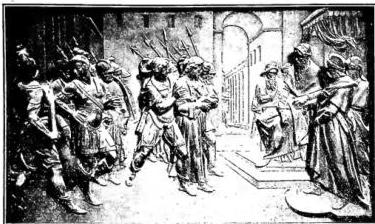
Painting and sculpture from the Romanesque age onward have very frequently represented P. seated on a throne in the act of washing his hands, in all the figurative cycles of the New Testament. Prototypes of this are found in the work of Duccio (Siena, Museo dell'Opera), of a 14th-century Riminese painter (Venice, Accademia) and of Pietro Cavallini (Naples, S. Maria Donnaregina). Spinello Aretino repeats those schemes in Florence in the frescoes in S. Croce, and with variations Ghiberti does so in the reliefs of the door of the Baptistery, where in one and the same composition the flagellated Christ and P. washing his hands are seen. Almost in the same span of years Donatello, alone in a terracotta relief in the Bargello in Florence, and in collaboration with Bertoldo in the bronze ones in the pulpit of S. Lorenzo, took up the theme again, depicting in the same scene Christ before Herod and P. Among the 16th-century representations, memorable are that of Tintoretto in the scuola of S. Rocco in Venice, that of Pontormo in the frescoes of the Certosa del Galluzzo near Florence, and that of Giambologna in the bronze reliefs of the altar of the chapel of the Soccorso in the S.ma Annunziata, also in Florence, where in the Galleria di arte moderna, in the famous painting by Antonio Ciseri entitled Ecce Homo, is the most realistic representation of the scene offered us by 19th-century art.
Emilio Lavagnino