

PIUS II, Pope. - Born at Corsignano in the Sienese territory on 18 Oct. 1405, died at Ancona on 15 Aug. 1464.
I. THE YOUNG HUMANIST
Enea Silvio Piccolomini, from a decayed and banished family of Sienese nobles, devoted himself in his youth to the study of jurisprudence; but far more did he love to enrich himself with a very vast humanistic culture. In 1432 he went to the Council of Basel in the retinue of Cardinal Domenico Capranica; having entered, after various vicissitudes, the service of the pious and learned Cardinal Albergati, he traveled with him throughout Western Europe and was sent to Scotland, acquiring direct knowledge of the most varied countries. A writer and abbreviator of the Council (1436), he took an active part in the opposition to Eugene IV; he was secretary of the antipope Felix V; in a Libellus he defended the authority of the Council. Having entered, however, the imperial chancery, he followed and encouraged the policy of Frederick III, of neutrality between the Pope and the Council. Up to this point he had been widely esteemed for learning and eloquence, he loved to call himself a poet, having received the laurel from Frederick (27 July 1442); he displayed and almost flaunted a lightness of morals—the comedy Chrisis and the all-too-famous De duobus amantibus historia (1444) date from this time. But the presentiment of a not-distant old age, reflection on the grave problems of Christendom and of Europe, perhaps new and higher ambitions, produced in him a radical change; already from Oct. 1444 he declares that he wishes henceforth to serve God alone. Humanism itself, of which he continues to be a fervent follower and of which he makes himself an apostle in Germany, now acquires for him a deeper content and turns him toward papal Rome.
II. THE MAN OF THE CHURCH
Aeneas Silvius then perceives more clearly the danger that, by following the path on which the Council had set out, the universal Church would break apart into national Churches; and he feels the necessity that the desired reform be promoted by a strengthened papacy. As ambassador of Frederick III at Rome, he is reconciled with the Pope; he receives the sacred Orders (priest on 4 March 1447), which he had previously refused so as not to bind himself to chastity; he works to win the German nation over to Henry IV; and he has a great part in that "concordat of the princes" (Feb. 1447), which, though favorable to the latter, was nevertheless a decisive step for the reunion of the Church around the Pontiff. Bishop first of Trieste (19 Apr. 1447), then of his own Siena (23 Sept. 1450), he confesses the error of having adhered to the Council, affirming that where the Pope is, there is the Council. He works for the recognition of Nicholas V by the Germans, while continuing also to serve the house of Austria, for which he procured the marriage of Frederick III with Eleanor of Portugal, niece of Alfonso king of Aragon and Naples, and conducted the difficult negotiations for the imperial coronation.
A month after the coronation, on 25 Apr. 1452, in a speech before the Pope and the Emperor, he proposes the task that now presses upon Christendom, the war against the infidels. As legate in the transalpine countries, he urges the Pope, the Emperor, the German diets, to avert the danger that threatens Christian civilization and that the fall of Constantinople has revealed in all its gravity. But he already perceives the painful reality; the papacy and Empire are by now empty names; Christians are, through inertia and discord, "procurators of the Turks." And yet, created cardinal by Callistus III (17 Dec. 1456) and having become his counselor, while he demonstrates his ability in various affairs, he insists above all on the plan of the crusade, encouraging the already fervent Pontiff in it.
In the Conclave of 1458, with a not disinterested defense of the independence of the Papacy and of Italy from the ultramontane nations, and in particular from France, he succeeds in keeping the Frenchman Estouteville away from the tiara; and, with the support of the envoys of Milan and Naples, he is elected pontiff (19 Aug.): the new name of P. is a somewhat pedantic reminder of the Virgilian pius Aeneas.
III. THE PONTIFF IN HIS CULTURAL AND POLITICAL ACTIVITY
Aged prematurely, tormented by illnesses, P. displayed varied and magnificent activity. He continued his work as a writer, in an agile, limpid, most elegant Latin, rich in acute observations, in portraits full of life, in savory anecdotes, in descriptions animated by a vivid sense of natural beauty. If the many letters, quite varied in subject and length, most of the orations, the Cosmographia, treatises on the most varied subjects (Historia bohemica, Historia rerum Friderici III imperatoris, De viris aetate sua claris, De liberorum educatione, De curialium miseriis), belong to the years preceding the pontificate, to this belong the Commentarii, which, after having summarized in the first book the life of Enea before the papal election, narrate in the other twelve the deeds of him as Pope and of Italy and, as far as he knew, of the world in the years of the pontificate up to the first months of 1464; a work of great literary value and, even in its inevitable subjectivity, of high historical value.
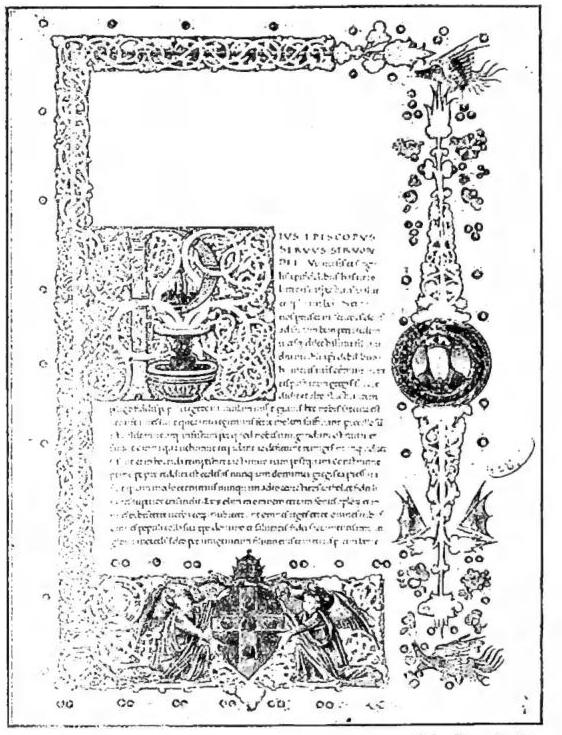
He was a protector of humanistic culture, both because of his own character as a most learned and refined humanist, and because it seemed to him that he could make use of it for the benefit of the pontificate; he held dear illustrious humanists, such as Biondo Flavio, who dedicated to him the Roma triumphans, and Campano; he gave impetus to Italian and foreign universities. But he disappointed the hopes of many, both because of the very refinement of his taste, which made him distinguish tinsel from gold, and because it was repugnant to him to enrich, at the expense of the Church, men who had little or nothing of the ecclesiastical about them. More munificent in matters of art, he had a loggia and two palaces built in Siena and transformed his small Corsignano, erected as a city and bishopric of Pienza, into a jewel.
He gave no small effort to politics: he broke the Roman agitations; he reorganized the Papal State; he waged a harsh war against Sigismondo Pandolfo Malatesta, from whom he took
Fano and Senigallia, leaving him Rimini, he validly supported Ferrante of Aragon, securing for him the Kingdom of Naples against the plots of the barons and the invasion of Giovanni d'Angiò. Although it is not possible to exonerate him entirely from the reproach of nepotism and of excessive concern for earthly interests, it must be recognized that he wished to strengthen the pontificate also temporally, in order to enable it to attend with greater efficacy to its spiritual mission; and in Italy, which he protested with moved words that he wished to defend against the shame and harm of foreign dominations, he saw a bulwark for the freedom of the Church, especially in the face of French interference, whose danger the exile of Avignon had demonstrated.
IV. THE ASSERTOR OF PAPAL AUTHORITY
In the more strictly spiritual field he was an energetic assertor of the supreme authority of the pontiff. Even before making amends with the bulla retractationis (April 26, 1463) for his old anti-papal doctrines, he had condemned with the bull Esecrabilis, which was dated Mantua, January 18, 1460, as an execrable abuse the appealing from the pope to a council. He obtained, after difficult negotiations, that Louis XI of France abrogate the Pragmatic Sanction (November 27, 1461) and render solemn obedience to the Pontiff (March 16, 1462): the fact was celebrated, as it truly was, as a triumph of the pontificate, although the King, disappointed in the twofold hope of seeing the Pope's attitude changed in the question of Naples and of drawing into his own hands the most important benefices of France, rendered the abrogation practically null by a series of ordinances.
In the German lands, where tendencies hostile to Rome were very much alive, he excommunicated and declared heretical Duke Sigismund of Tyrol for the acts of violence committed to prevent Cardinal Cusanus from carrying out ecclesiastical reforms in his diocese of Bressanone; the duke appealed to a council with a most violent writing by his counselor Gregory of Heimburg, one of the fiercest enemies of Rome; and the conflict was not settled until after the Pope's death. The latter was able, on the other hand, to obtain that Diether von Isenburg, archbishop of Mainz, head of the anti-papal movement, whom he had excommunicated and deposed, was forced to submission. In Bohemia he contributed at first to consolidating the authority of the national king George of Poděbrady; but, despite the latter's insistences, he declared the Compacts of Basel null (March 31, 1462); and since the King, after long ambiguity, had declared himself favorable to Utraquism, he initiated a trial against him, which remained suspended because of the Pope's death. If the designs of Cusanus and of the bishop of Torcello, Domenichi, for a radical reform of the Church were not carried out because of the difficulty of the times, P. removed abuses, re-established monastic discipline in several places, promoted the reform of religious Orders; favored the missions; supported, as a defense against usury, the institution of the Monti di pietà; the solemn canonization of Catherine of Siena (June 29, 1461) was an homage by P. not only to the virtues of the great fellow citizen, but to her courageous work for the purification of morals.
V. THE HERALD OF HOLY WAR
But P. wished his pontificate to be directed above all to the grave task of gathering the forces of Christendom for holy war: it was at once a necessity of defense against the Turkish threat and a means of restoring to the respublica christianorum the sense of unity that was being lost. And since, of the two heads of the Christian world, one was, both because of the decadence of the imperial institution and because of the insignificance of the man invested with it, unsuited to the great enterprise, P., accentuating a tendency already revealed under some of his predecessors and anticipating the future, wished that, above the variety of now-independent nations, all Christians should gather for religious interests around the pontiff. With the bull Vocavit nos of 13 Oct. 1458 he convoked the representatives of the Christian states to a diet, which was to be presided over by himself; and overcoming opposition and difficulties, he opened it at Mantua on 1 June 1459. Only on 26 Sept. did the negotiations begin; several months were consumed in trying to extract some promise from the Christian powers, divided, concerned only with their own interest, incredulous of the tremendous common danger; Venice, the most threatened and at the same time the most warmly urged, hesitated out of the not unjustified fear of being left alone before the enemy. In the end, even before obtaining universal consent, P., on 14 Jan. 1460, proclaimed the crusade for three years, granting indulgences and imposing a tithe on the revenues of the clergy, a thirtieth on those of the laity, a twentieth on the property of the Jews. And the Diet dissolved (18 Jan.), having concluded nothing.
The Pontiff, whom religious conflicts, political intrigues, and the coldness of the Christian states deprived of the hope of undertaking the enterprise for the time being, dreamed of seeing in Mehmed II a new Constantine turned Christian and seated with papal consecration on the throne of the East; and he addressed to him a long letter, which is almost a dogmatic treatise, to induce him to conversion. But the dream, not unlike that which had already been entertained with regard to the Tartars, was short-lived.
VI. THE CRUSADER POPE
P. returned to his old plan when Venice was dragged by the Turks themselves into war and the Hungary of Matthias Corvinus, likewise threatened, seemed disposed to fight effectively at his side, and, of the princes of the West, at least one, the chivalrous Duke of Burgundy, announced his participation in the Crusade. But he thought that example was worth more than speeches, however eloquent; that the Vicar of Christ, by making himself the Godfrey of the new Crusade, might draw the world to follow him. Having again proclaimed holy war (Oct. 22, 1463), he set out, old and infirm, for Ancona. But the troops gathered there on false hopes had dispersed, the Venetian galleys were slow in coming; P. was barely able to see them from the hill of Ancona before he passed away with a death that moves one like that of a martyr. He was buried in Rome, first in St. Peter's, then transferred to Sant'Andrea della Valle.
Not immune from doctrinal and moral faults in his youth, nor ever from ambition and vanity, at times almost childlike, too fond of his own kin, too prone to enthusiasms not always restrained by a vigilant sense of reality, Pius II was nevertheless, by intellect, culture and industry, one of the greatest men of his age; by his piety, charity, simplicity of life, and complete dedication to his duty as head and defender of Christendom, he was among the noblest figures of pontiffs.
Bibliography24 works
Giovanni Battista Picotti