
GOOD SHEPHERD. - The people of Israel were eminently agricultural, and in the Old Testament the expression "shepherd" is often used. Moses says that the people of the Lord need a leader so that they may not be like a flock without a shepherd (Num. 27:17). The whole of Psalm 22 refers to the shepherd and the flock, which also recurs in Psalms 95 and 100. Isaiah assures that the Lord will send shepherds (3:15, and even more so in 40:11); Jeremiah recalls the shepherds (3:15), and rails against the shepherds
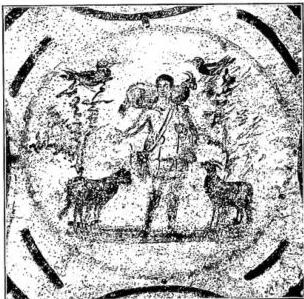
Savior, who by his sacrifice gave men redemption and eternal salvation (Enc. Catt., Gesù Cristo, VI, col. 254 ff.). Homer called Agamemnon shepherd of the peoples. In the Old Testament the Lord is with much greater reason called "Shepherd of the Peoples." Indeed St. Peter calls the Lord "the chief Shepherd" (1 Pt. 5, 4). In the Martyrium s. Polycarpi Jesus Christ is called "Shepherd of the Catholic Church over all the earth" (F. X. Funk, Opera Patrum apost., I, p. 304). Abercius (v.), bishop of Hierapolis in Phrygia, in his sepulchral poem declares himself "a disciple of the chaste shepherd who has great eyes that look from on high in every direction" (A. Ferrua, Nuove osservazioni sull'epitaffio di Abercia, in Riv. arch. crist., 20 [1943], p. 296). In the hymn in honor of the Savior, Clement of Alexandria calls him "shepherd of the royal flock" (PG 8, 681). St. Augustine calls the Lord Pastor pastorum (serm. 138, 5: PL 38, 765). The image of the Good Shepherd is the most represented in the ancient Christian cemeteries of Rome, whether in painting or on sarcophagi or in epitaphs. P. Styger in 1927 indicates that the Good Shepherd is depicted in the Christian cemeteries of Rome in no fewer than 120 paintings and 150 sculptures (Die altchristliche Grabeskunst, Munich 1927, p. 7). It appears either in isolation, with the sheep on his shoulders, as in Pretestato (Wilpert, Pitture, pl. 17), symbolizing the soul of the deceased carried by the Savior among the elect, or, in most cases, together with the flock, that is, with the elect in a garden (Paradise), represented by trees with birds; the flock consists more often of only two sheep, or even of more. The Shepherd may be with the orant, as in Callisto (id., Pitture, pl. 25) or as in the Lateran sarcophagus of Juliana (id., Sarcofagi, pl. 57, 5) or in the fresco of Domitilla (id., Pitture, pls. 190 and 198). He may be represented pasturing the flock, that is, the community of the faithful (id., Pitture, pl. 63, 2, and in the well-known Lateran sarcophagus). There is also the scene of the Shepherd defending the flock, as in Pretestato (Wilpert, Pitture, pl. 51, ref. to v. ASINO); or in the slab of Veratius Nicator of the Lateran (O. Marucchi, Monumenti del Museo Cristiano Lateranense, Milan 1910, pl. 57, 8). In mosaic it appears in the tomb of a certain "Lollianus" at Thabarca (R. de la Blanchère, Tombes en mosaïque de Thabarca, Paris 1897, p. 21, pl. 2 and fig. 12). The Good Shepherd also appears as a graffito on many sepulchral slabs in the Roman cemeteries (G. B. De Rossi, Roma sotterranea, II, Rome 1867, pls. 39-40, no. 38; 49-50, no. 17; III, ibid. 1887, pl. 30, no. 45; G. Wilpert, Fractio Panis, Paris 1896, pl. 5; O. Marucchi, Monumenti del Museo Cristiano Lateranense, Milan 1910, who scatter and destroy the flock of the Lord (23, 1-4; 50, 6), and Ezekiel develops these concepts even further (34).
The metaphor of the shepherd and the flock also occurs often in the New Testament (Mt. 9, 36, 10, 6; 15, 24; Lk. 12, 32; Jn. 21, 16-17). The flock of the Lord is entrusted to the presbyters and bishops (Acts 20, 28). One understands therefore how the parable of the Good Shepherd (Jn. 5, 1-18) came to have a great iconographic development. Already in the entry Gesù Cristo L. Kollwitz has illustrated how ancient in Christian iconography is the image of Christ as the Good Shepherd, symbol of the pl. 7, nos. 4, 6, 13). As early as 1934 J. Quasten had called attention to psalm 22 relating to the Good Shepherd in worship and in the baptismal liturgy. L. De Bruyne has the merit, since the Fourth International Congress of Christian Archaeology in 1938, of having brought out that the image of the Good Shepherd was prevalent in the iconography of the most ancient Christian baptisteries of Dura Europos ([v.] first half of the 3rd century), of Damasus (366-84) in the Vatican Basilica (Prudentius, Peristephanon, XII, 43 ff.), of Naples ([v.] ca. 400; Wilpert, Mosaiken, pls. 36-38); of the Lateran (ibid., pp. 256-257, figs. 72-73; L. De Bruyne, La decorazione degli edifici sacri di Roma, in Atti del IV Congr. intern. di arch. crist., II, Vatican City 1948, p. 119). Immediately afterward the idea was developed by J. Quasten, who added to it the contribution of literature both in the East and in the West (J. Quasten, Das Bilde des Guten Hirten in den altchristlichen Baptisterien und in den Fünfturgien des Ostens und Westens. Das Siegel des Gottesherde, in Pisciculi, F. J. Dölger dargeboten, Münster 1939, pp. 220-44; id., The painting of the Good Shepherd at Dura Europos, in Mediaeval studies, 9 [1947], pp. 1-18). On a terracotta lamp the Good Shepherd is surrounded by seven stars and planets. On sarcophagi the Good Shepherd is found at Rome, at Tolentino (Wilpert, Sarcofagi, pl. 72), at Pisa perhaps coming from Ostia (id., ibid., pl. 75, 4), at Lucca (R. Garrucci, Storia dell'arte cristiana, V, Prato 1879, pl. 400, 1), in Gaul, as at Dijon (Wilpert, Sarcofagi, pl. 65, 2-3), in Spain at Gerona, in Africa at Tipasa and at Philippeville.
It is also frequent on terracotta lamps (G. B. De Rossi, in Bull. arch. crist., 2nd series, 1 [1870], pl. 1, nos. 1-2; O. Wulff, Altchristliche Bildwerbe, Berlin 1918, p. 244, no. 1224, p. 250, no. 1263). At Istanbul, on a pulpit, the Good Shepherd is depicted on one side with the sheep on his shoulders and on the other pasturing the flock represented by a single sheep (G. Mendel, Musées impériaux ottomans, Musée de Constantinople, II, Constantinople 1914, pp. 409-410). There are also examples of the depiction of the Good Shepherd in floor mosaics. Thus at Aquileia (La basilica di Aquileia, Bologna 1933, pl. 30). At Rusguniae in Mauretania Caesariensis, today Matifou in Algeria, on the floor of a basilica the Good Shepherd is portrayed in the center, while two other shepherds watch the flock.
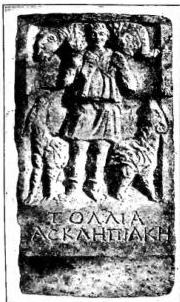
There are also statues of the Good Shepherd. From the very well-known one of the Lateran Museum (Wilpert, Sarcofagi, p. 71, fig. 29 and pl. 52, 1), to another in the same Museum (ibid., pl. 52, 5), to that of the Museo delle Terme (ibid., p. 72, fig. 33 and tav. 52, 8), or outside Rome, in the museums of Istanbul (ibid., p. 73, tav. 52, 7 and 9) and of Athens (ibid., tav. 52, 6). In the cemetery "inter duas lauros" there are two small "hermulae" with the Good Shepherd that served as altar bases (ibid., figs. 34 and 35). In the cemetery of Bassilia a sepulchral stele of Tollia Asclepiaca (ibid., p. 74 and fig. 36). At Ravenna the cippus of Antiphon. Numerous too are the images of the Good Shepherd on gilded glass (R. Garrucci, Storia dell'arte cristiana, nei primi otto secoli della Chiesa, IV, Prato 1879, pp. 169-77). It is also frequent on terracotta lamps (id., loc. cit.). Tertullian attests that the Good Shepherd was depicted on drinking cups in common use (De pudicitia, 7, 10); just as it is also found on rings as a gem (G. B. De Rossi, in Bull. arch. crist., 3rd series, 3 [1881], p. 113; O. Marucchi, Roma sotterranea, new series, Rome 1914, p. 137, fig. 27; A. De Waal, Der Gute Hirt, in Römische Quartalschrift, 29 [1915], p. 111); on medallions (R. Garrucci, Storia dell'arte cristiana, VI, Prato 1881, tav. 585, no. 6). Still in a later period, in the fresco of the oratory of the Benedictine abbey built over the basilica of St. Hermes in the cemetery of Bassilia, in the open book held by the Redeemer is repeated: ego sum pastor bonus et cognosco oves meas (E. Josi, Scoperta di un altare e di pitture nella basilica di S. Ermete, in Riv. arch. crist., 17 [1940], p. 199, fig. 5). Even today in the hymn of Matins for Low Sunday is sung "Qui Pastor aeternus gregem / aquam lavas baptismatis". The catechumens of Baptism become the "agni novelli" of the flock of Christ the shepherd. In the ordo commendationis animae one reads: "Constituat te Christus filius Dei vivi intra Paradisi amoena vireta et inter oves suas te verus ille Pastor agnoscat".
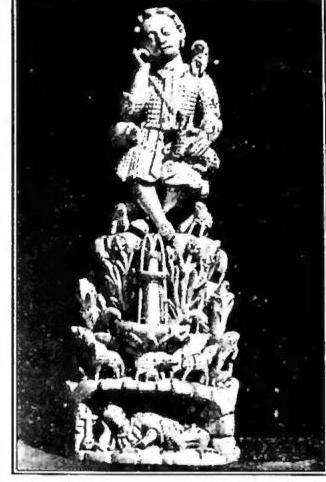
Representations of the Good Shepherd in medieval art and especially in modern art are rare. One may recall, for example, the 16th-century ivory sculpture of Indian workmanship in the Oriental Room of the Sacred Museum of the Vatican Library and the image of the Good Shepherd painted by C. Mezzana (20th century) in a chapel in the upper level of the cemetery of Callistus.
In ancient Christian epigraphy the idea of the shepherd and the flock still sometimes recurs. Thus Damasus, extolling the heroism of Sixtus II, writes "pastoris meritum numerum gregis ipse tuetur" (A. Ferrua, Epigrammata Damasiana, Vatican City 1942, p. 124); thus in the inscription of Spoleto that commemorates the bishop Achilles, founder of the Basilica in honor of the prince of the Apostles (G. B. De Rossi, Bull. arch. crist., 2 [1871], p. 118). It also returns in an inscription of the bishop John of Ravenna (578-95; CIL, XI, 301) and in Vercelli (ibid., V, 6725) the inscription of the bishop of Vercelli Celsus "custos gregis ovium Christi".
Bibliography4 works
Hirt. Ursprung und Denbung einer altchristl. Symbolgestalt, Rome 1942; L. De Bruyne, La décoration des baptisières paléochrétiens, in Misc. liturg. in honorem L. C. Mohlberg, I, Rome 1948, pp. 189-220; Wilpert, Sarcofagi, I, pp. 63-100.
Enrico Josi