
MASOLINO da PANICALE. - Painter, born to a certain Cristofano Fini in 1383 at Panicale di Valdelsa near Empoli (Florence) or at Valdarno near S. Giovanni (Arezzo); he appears in the register of deaths of S. Maria del Fiore in Florence on 18 Oct. 1440 or 1447. In 1403 and 1407 he is among Ghiberti's assistants on the second door of the baptistery, and on 18 Jan. 1423 he is enrolled in the Arte dei medici e speziali.
In 1424 (2 Nov.) he receives a payment for the frescoes of the chapel of S. Elena in S. Stefano at Empoli; on 8 July 1425 he is recorded in Florence for a modest task for the Compagnia di S. Agnese delle Laudi; he then departs in the service of Pippo Spano for Hungary, where he is still to be found in 1427 after the death of the Florentine condottiere; on 1 Nov. 1432 he is paid at Todi for a fresco in S. Fortunato; in 1435 he executes the frescoes of the baptistery of Castiglione Olona, where, in an unspecified year, he left his name in a Nativity, or rather in an Adoration of the Child (« MASOLINUS DE FLORENTIA PINEIT »), part of a cycle in the vault of the collegiate church, which is the starting point for the reconstruction of M.'s personality.
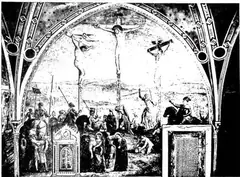
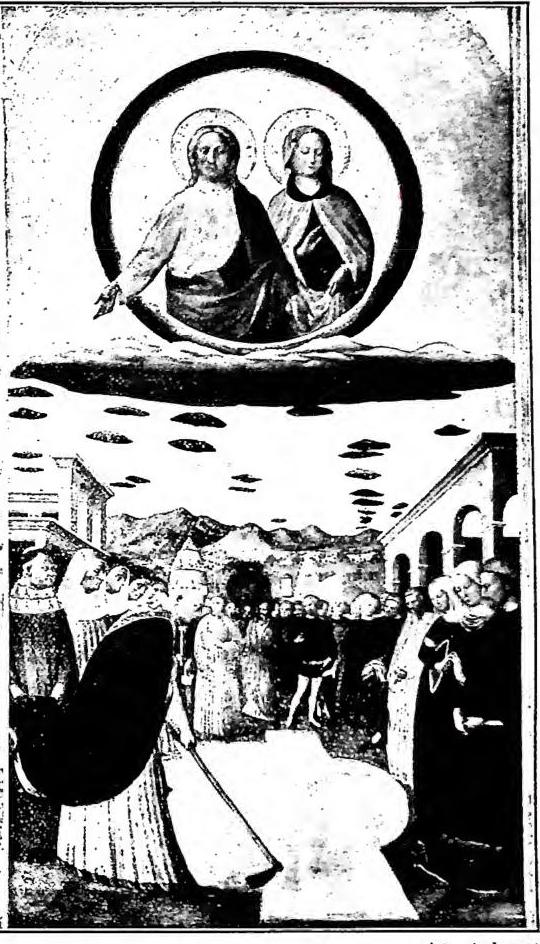
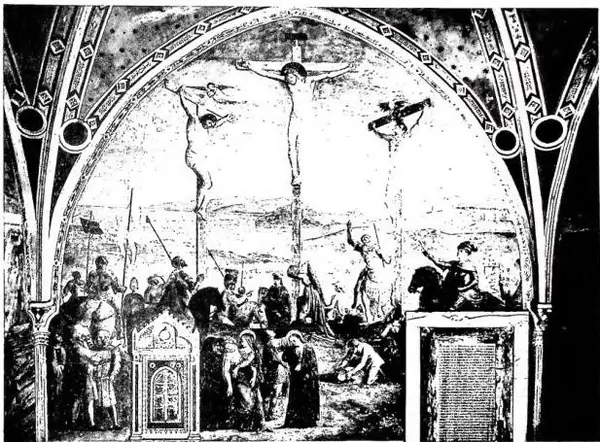
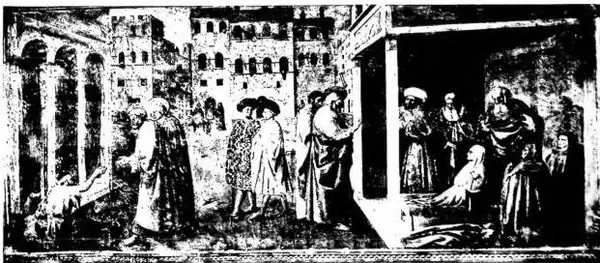
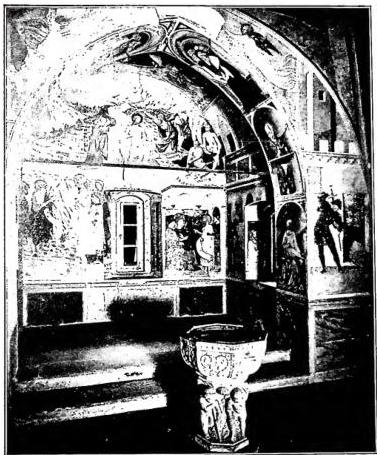
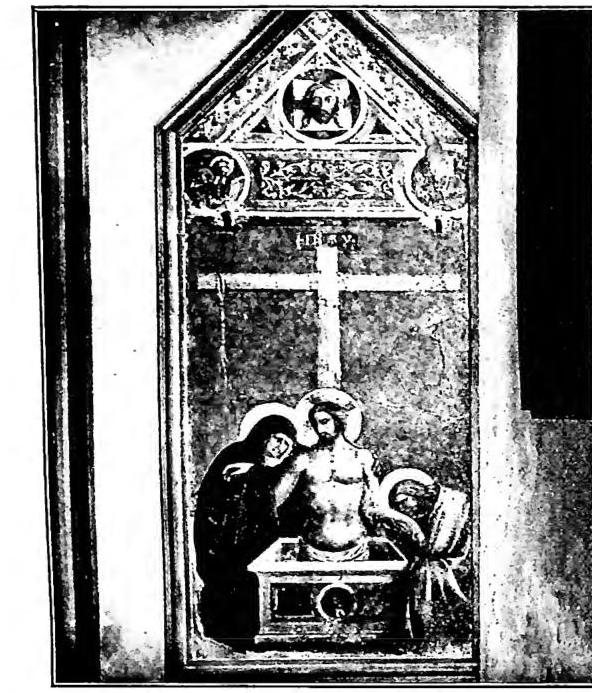
Trained in sculpture in the current of idealized medieval classicism and, perhaps at a later time, initiated into painting by Starnina (Vasari), in his earliest surviving work — the Madonna of Humility in the Kunsthalle in Bremen (1423) — he reveals himself as a late Gothic artist, yet a creator of delicate figures full of graceful human warmth, far removed from the wooden and transcendent ones of a Lorenzo Monaco, with a soft chiaroscuro of diffused luminosity. And he appears congenial to Gentile da Fabriano and above all to Arcangelo di Cola da Camerino (with whom M.'s works suggest sure contacts), both of them in Florence at the beginning of the third decade of the century. The same tendencies, with a more developed formalism, return in the Madonna of the Milk in the Pinacoteca in Munich, and at S. Stefano in Empoli in the fragmentary frescoes of the chapel of the Cross, in those of the transept as well as in the lunette with the Virgin and the Child between two angels. Of surer modelling and more profound expressive value is the noble Pietà in the collegiate church, again at Empoli (datable between the end of 1424 and the beginning of 1425), through the influence of the genius of Masaccio, of whom perhaps M. had been an occasional master in Florence and who, in any case, was then his companion in the pictorial decoration of the Brancacci chapel. Perhaps in the same year 1423 or at the beginning of 1424, on his own, he decorated the webs of the vault of the Brancacci chapel with the four Evangelists (lost in 1746 in the remaking of it, in which V. Meucci painted the Blessed Simone Stock receiving the scapular from the Madonna), by which perhaps Francesco d'Antonio was inspired in the organ shutters of Orsanmichele (1429), today in the Galleria dell'Accademia in Florence. In the two large lunettes of the side walls M. executed the Calling of Andrew and Peter, of which an eighteenth-century copy was in the Giovannelli collection in Venice, and the Shipwreck of the Apostles, derived from Giotto's Navicella in St. Peter's in the Vatican in Rome, though with variants probably preserved in a fresco by Mezastris and one of his collaborators in S. Maria in Campis at Foligno (after 1452). In the lunette at the end, beside the large window (transformed into a window in 1746), M. painted Peter Denying Jesus; but beside him Masaccio appeared in the scene with the Saint Raising the Dead, demonstrating a collaboration that had already been established, with a secondary part for M., in Masaccio's panel in the Uffizi, with St. Anne, the Madonna, the Child and five angels. In those early frescoes (destroyed in the 18th century and then replaced by the architectural ornaments painted by C. Sacconi), it is to be presumed that an accentuated spatiality and the concreteness of the lighting already alluded to the influence of Masaccio. However, the separation between the two personalities is visible in the surviving frescoes of the Chapel. M.'s Tempted Ancestors proclaim his persistence in the late Gothic: they are insubstantial figures with rosy flesh that remain in a generic grace, devoid of personality compared with the tragic and springing ones of the Expulsion, so charged with ethos, painted by Masaccio on the opposite pier. Even the figures who assist kneeling at the Sermon of St. Peter, in a mountainous landscape, in contrast with Masaccio's Baptism of the Neophytes, lack individual characteristics, are of an amiable superficiality clothed in beautiful colours, even if the standing burghers and Carmelites emulate, without attaining it, the constructiveness proper to the young companion. In the Raising of Tabitha and in the Miracle of the Cripple, a typical large composition by M., divided by the figures of two elegant young men passing through a Florentine square, the distance from the "classical" texture of the Tribute Money, which faces it, is profound. It seems that Masaccio (v.) may have intervened in the details, that is, in the cripple, in the buildings and in three small figures in the background, while the other, weaker ones, of an outward descriptivism, belong to M., so ungainly moreover in the disproportionate architectures that close the scene on both sides. The superficial but amiable and receptive painter of Valdelsa must have felt at ease in the profane international Gothic climate of Hungary. Before leaving he must have painted, for the Carnesecchi altar in S. Maria Maggiore, a triptych of which three conspicuous pieces were rediscovered (a Madonna with a sturdy Child, formerly at Novoli, later stolen; a St. Julian as a knight, formerly in the parish church at Settimo, now in the Uffizi; a story of the same Saint in the Museum of Montauban). Nothing is known of M.'s activity in Hungarian territory; however, after his return (around 1427) he is found in Rome, when Masaccio also came there, to fresco for Cardinal Branda da Castiglione, a diplomat and humanist known to M. in Hungary, the chapel of St. Catherine in S. Clemente. When work was begun on the project, for which a collaboration might perhaps have been repeated, M. was perhaps still alive, and the echoes of his figurative manners through his drawings surface in the restored Evangelists and in the Doctors of the Church which, paired, decorate the four the vault webs (especially in John, Matthew, Luke and Jerome), in some Apostles of the sub-arch, in various passages of the spectacular, spacious Crucifixion on the back wall (foreshortened views of horsemen, holy women, a young man bent and kneeling, near the Crucifix on the right), but disconnected, incoherent, at times crowded and descriptive in its display of costumes echoing Pisanello, and on the whole tied to the Po Valley taste that M. knew. But if the Masaccism is of vague descent, one suspects that alongside M., meticulous and indeed micrographic in the Jerusalem of the background, there intervenes an assistant who lends greater vigour to certain Masaccesque recollections, such as Arcangelo di Cola, whose style had been growing stronger precisely through the influence of Masaccio. In the five Stories of St. Ambrose on the right wall and in the corresponding Deeds of the Saint of Alexandria on the opposite side, M. returned to telling stories ingenuously and joyfully with his poetic imagination turned to the episodic and the descriptive in the beautiful costumes of the northern courts, with his enchanting, clear colours, but always abstract and devoid of atmospheric sense when they wander among the buildings of fabulous cities, incapable of movement (Miracle of the Wheel) but always a suggestive narrator, as when among the placid hills of Latium he raises an improbable Alpine crag (Death and Burial of St. Catherine). And M.'s amiable language is still revealed, in spite of the restorations it has undergone, also in the gigantic St. Christopher at the entrance and in the Annunciation on the triumphal arch of the Chapel, where the ambitious, complicated perspectival scheme, with too dry a succession of planes, is not, but would like to be, Renaissance, because of the persistence in the parallelism of the ceiling lines in an always Gothic empiricism. Of a triptych in S. Maria Maggiore, once wrongly ascribed by Vasari to Masaccio, painted on two sides, there remain in the National Museum of Naples the two middle panels, one of which, with the Foundation of the Liberian Basilica, matches in style the stories of St. Ambrose, while the other, with the Assumption and its motley angelic court, preludes aspects that will be found in the two cycles of Castiglione Olona. And there also remain, in two panels of the Johnson collection in Philadelphia, the four noble figures of saints arranged two by two that flanked one of them; as there also remain the other two compartments, recently rediscovered and acquired by the National Gallery of London. M., having executed the Annunciation now Goldmann in New York, whose perspectival structure develops that of the fresco in the church of S. Clemente, and the Announcing Archangel and the Annunciate in the National Gallery of Washington (Kress collection), left at Todi (1432) a most pure Madonna and a milky Child between two gentle angels in prayer, in the Franciscan church of S. Fortunato; then he crossed the Apennines again to paint, in the service of Card. Branda, in the latter's native village, raised above the narrow but pleasant valley of the Olona (Varese). M. first decorated the six long webs of the vault (wrongly supposed by others to date from c. 1423), then the entire baptistery (the date 1435 is repainted but correct). In the former (they represent, without following the order of the legend, the Annunciation, the Marriage, the Nativity of the Child, the Adoration of the Magi, the Assumption, the Coronation; on the walls, then, Paolo Schiavo, in part a pupil of M., and Vecchietta set out the Stories of St. Stephen and St. Lawrence), in order to adapt to the shape of the webs, and perhaps also because he found himself in a late Gothic environment, M. returned to elegant formal archaisms, though rich in Roman reminiscences and in stylistic parallels with the paintings of the baptistery; hence of firm modelling and matured experience, which are also found in the highly stylized and refined Madonna of Humility, formerly Contini Bonacossi, which has migrated to Germany. In the baptistery, whose façade preserves the remains of an ethereal Annunciation, M. frescoed the Evangelists in the webs of a vault and painted Prophets and Doctors of the Church on the intrados of the arch dividing the bipartite space. The rest, even the splays of the windows, the loquacious painter covered with Stories of the Baptist. And, in narrating with a plain, calm and somewhat timid language, he finally expressed himself, evoking, as a receptive artist, the past, representing the Eternal City in a faithful, attentive view, showing in his poetic backgrounds (Baptism of Christ; Feast of Herod and Presentation of the head of John to Herodias) a sensitivity to space in a commingling of Gothic and Renaissance, but remaining, in the exaltation of colour and in the slender, idealized figures of scant plastic consistency, always tied to tradition. Thus in the three essential stages of his art, Florence, Rome, Castiglione Olona, in noting the external aspects of life with his own cheerful, wavering language, strengthened first by the proximity of Masaccio, through new influences and resonances, instead of proceeding toward the new order, M. withdraws into the fascinating whirlpools of the International Gothic. Belonging to the great Florentine stock, he could seem in Lombardy a constructive and even plastic artist; in Venice he was understood in his most poetic quality: in the clear, luminous colour, whether plain or glowing, that captivated Antonio Vivarini; in Florence he was only a limited episode, of which two minor figures, in substance belated, partly profited: Francesco d'Antonio and Paolo Schiavo. - See pl. XXIII.
Bibliography5 works
Mario Salmi