
PELAGIUS,
saint and martyr. —
He is commemorated in the Roman Martyrology and in the Greek Synaxaria on 9 June, but his true “dies natalis” is 8 October, as attested by the Syriac Martyrology.
He suffered martyrdom at Antioch during the persecution of Diocletian; on his
sandria, where he probably died around 427. Nothing authorizes the belief that he ever returned to Britain.
A remarkable writer, a generous and at the same time severe moralist, P. lacked both a sense of tradition and an intuition of supernatural realities (Orosius, Apol., 29). Without perhaps ever having intended to found a dissident sect, driven solely by the desire to raise the general level of Christian morality, he was led by the logic of overly elementary principles and by the impulse of unenlightened zeal to construct and defend a heterodox doctrine, which exercised immense seduction.
P.’s literary output was vast; lost works include a treatise in three books on the Trinity (C. Martini, Quatuor fragmenta Pelagio restituendo, in Antonianum, 13 [1938], pp. 293–334); the Book of Testimonies (collections of scriptural citations); a treatise On Nature; a treatise On Free Will; two letters on Grace to the bishops Constantius and Paulinus of Nola; and a commentary on the Song of Songs.
Works that remain (under the name of St Jerome) include: an important exegetical work, the Expositions of the Epistles of St Paul (ed. A. Souter, in Texts and Studies, IX, Cambridge 1926); a notable moral work, remarkable for its unity and literary style, the Letter to Demetrias (PL 30, 15–45); a treatise On the Christian Life, long attributed to St Augustine or to Pastidius (PL 40, 1031–46); many letters of exhortation, among them the Letter to Celantia (CSEL, LVI, 329–56); a panegyric On Virginity (PL 30, 163–75); a treatise On Chastity (ed. C. P. Caspari, Christiania 1890, pp. 122–67); and various fragments of letters to Livania. Two polemical treatises also survive: On Riches and on Evil Teachers and On the Works of Faith (ed. C. P. Caspari, ibid. 1890, pp. 25–113).
II. THE DOCTRINE
1. Early manifestations
At the outset, PELAGIUS’s teaching, prompted by moral concerns, presented itself in essentially practical guise: a doctrine rich in enthusiastic and intransigent asceticism, aimed above all at criticizing the use of wealth and reducing the evangelical counsels of poverty and chastity to absolute precepts. The rigorism of PELAGIUS(Int. Enc. CML.)
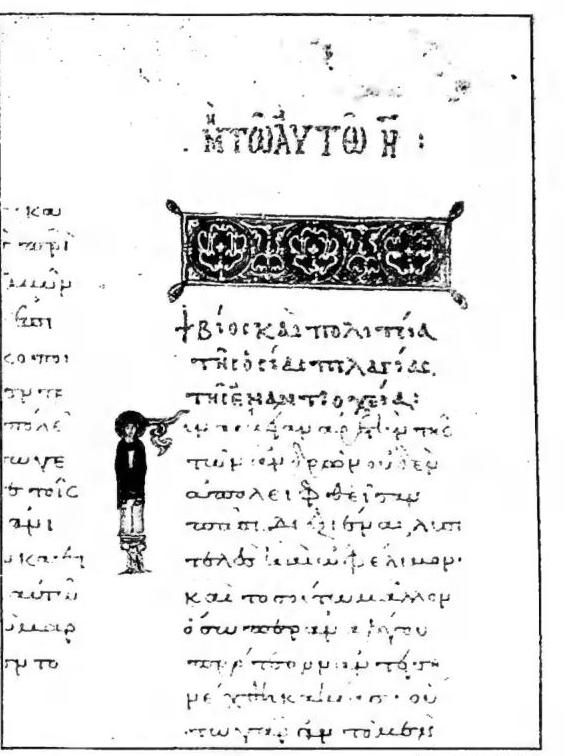
PEIRESC, NICOLAS-CLAUDE FABRI de — Autograph letter from P. to G. Aleandro (18 Dec. 1620) — Vatican Library, cod. Barb. lat. 2154, f. 109 V.
2. The question of Grace
PELAGIUS acknowledged that human nature had been enriched by God with many benefits: a) the grace of creation, whereby God gave us reason and freedom; b) the grace of the remission of sins: Baptism and Penance restore us to a state of innocence; c) the grace of instruction, which comprises the various precepts of the Law, the teachings of Scripture, and the salutary example of Jesus Christ, which all Christians must imitate. Yet he held so exalted a view of the autonomy and rectitude of human reason and of the full exercise of freedom that he would not admit that it could be subject to any influence other than that arising from the blindness induced by sin or habit; no atavistic force, no external supernatural intervention (neither the influence of the devil nor the action of Grace within the conscience) could weigh upon our judgments, favour or force our choice, or prevail over the will. Our responsibility is unlimited. Grace, that is, access to the benefits of divine nature (promised by salvation), granted equally to all, at least to all Christians, consists chiefly in a revelation of the Mysteries, in the presentation of the precepts and examples of the Old and New Testaments, and perhaps also in a help ever proportionate to antecedent and consequent merits; it is not truly a ‘motion’ or a mysterious attraction or a certain privilege dependent on God’s free bestowal: ‘God shows no partiality’ (De natura, De libero arbitrio).3. Theory of man’s original state and the value of Baptism
Proceeding from these principles, PELAGIUS was led implicitly to contest the doctrine of original sin. The soul, which does not derive from human generation, ex traduce, but is created immediately by God, cannot, on coming into the world, bear the burden of a sin anterior to birth, entirely foreign to the individual’s consciousness and will (Expositio in Rom., V, 12; ed. Souter, pp. 46–47); considered thus in itself it is morally neutral, yet nonetheless capable, by virtue of the faculties with which it is endowed, of elevating itself, to a certain degree, to virtue—what PELAGIUS calls ‘natural holiness’ (Epistle to Demetrias, 2–3; De libero arbitrio). Such a conception of original integrity led PELAGIUS to depreciate the Sacrament of Baptism. Since the personal sin of Adam had only physical consequences (mortality, sickness) and, morally, no other value than that of a bad ‘example’, without diminishing in any way man’s supernatural endowments, Baptism, though indispensable for pagans unto their salvation and for adults for the remission of their personal sins, loses all meaning when administered to children (parculi), who are innocent by definition. It may be administered to children out of convenience and to secure their entry into the ‘kingdom of heaven’, but it is a real abuse to say that it is conferred upon children in remissionem peccatorum.4. Freedom and predestination
Lest he become embroiled in contentious disputes, PELAGIUS did not express his precise thought on the question of Baptism; instead he posited free will as the axis of his system (Testimonia libri). The gift of freedom is an incomparable privilege that God has bestowed upon man; it is a faculty whereby, while distinguishing him from other species, God has elevated man to the dignity of ‘voluntary executor’ of His own designs. This power entails as a corollary the possibility of refusing to do God’s will: consequently, the permission to sin. Man can choose between good and evil; to leave him all the merit, God does not intervene in his decision (Epistle to Demetrias, 2–3). According to an expression of Julian of Eclanum, which must be interpreted in the juridical sense of the words: ‘Man, by free will, has emancipated himself from God’ (St AUGUSTINE, Opus imperfectum, I, 78).The first stage of morality therefore consists in becoming aware of this admirable freedom; in general, man does not measure accurately the powers that are at his disposal. He does not realize that he has the capacity to acquire virtue, justice, and sanctification by his own means (Epistle to Demetrias, 8). Encouraged by example, he must strive to become for others a living example. The Pelagian morality is a morality of honour (Virginum laus, 12 and 16). This autarchic conception of virtue led the Pelagians to undervalue or repudiate certain essential aspects of religious life: the sense of human frailty and of temptation, the virtue of humility, faith in the efficacy of the Sacraments and of priestly actions, the utility of prayers for others, the reversibility or solidarity of merits and sufferings—in a word, the Communion of Saints. Pelagianism is an individualistic religion, which shuns any consideration of a sentimental or mystical character and which is chiefly expressed in acts of justice (De vita christiana).
Such a conception contains serious psychological, metaphysical, and above all dogmatic errors. The Pelagian, steeped in the idea of his own freedom, fails to recognize the real conditions under which our activity unfolds, the uncertainties of the will, the possible or inevitable falls: “Man can, if he wills, avoid sin” (Testim. lib.). Such a mentality excludes the idea of assistance from God, habitual or frequent, as well as the need to resort to a concrete Grace, relative to each of our acts. The Pelagians especially reject the idea of a weakening of original freedom: the sin of Adam (or rather of Eve) has no influence whatsoever on our original condition. It cannot constitute the object of hereditary transmission; it has neither obscured nor corrupted human reason; it has in no way limited our autonomy nor impaired our dispositions toward virtue and justice. However, the Christian dispensation and the benefit of Baptism have restored all these gifts (De natura).
On the other hand, it is repugnant to the goodness of God, “source of all equity and justice,” that He could have issued a general or a priori condemnation against His creatures. He, who respects the independence even of these, knows only in His foreknowledge the merit or demerit that creatures can acquire. Hence, there is no “predestination”; there is only “vocation,” an appeal, that is, unencumbered by any violence. The Pelagians reacted with extreme energy against the fatalism diffused in certain popular or monastic circles and against a false interpretation of the Augustinian doctrine of Grace, when people persisted in discovering in it the denial of free will and the irrevocable subjection of our destiny to a tyrannical choice of God. The apology of free will constituted the guiding idea of Pelagianism and one of the most important factors in its successor.
5. Diffusion and collapse of Pelagianism. — Pelagianism spread especially in Roman society and in the West as a broad moral restoration movement, which demanded of all the faithful the integral observance of God’s law, aiming thus to diffuse an ideal of perfect justice and to constitute in this very world the “immaculate and unblemished Church.” Between 411 and 515 such a conception, practically underscored by the duty to abandon wealth, met with the greatest favor in Italy, especially in Sicily (St. Augustine, Ep., 157).
But as early as 411–13, Caelestius, explicating one aspect of P.’s thought, began to attack the practice of infant Baptism, denied the existence of original sin, and firmly upheld the absolute independence of free will (propaganda in Africa; treatise of the Definitiones). Wherever it took root, it provoked lively polemics: in Carthage, in Ephesus, in Constantinople. P., less combative, sought to mitigate the irritating aspects of his doctrine, yielded to the demands for conciliation regarding the necessary cooperation of Grace (Council of Diospolis, 415), but defended, not without talent, the natural rights of the human condition, the possibility of avoiding sin, the existence of a conscious and meritorious free act (treatises De natura, De libero arbitrio; letters to Pope Innocent).
In 417–18 his Roman supporters categorically denied the doctrine of original sin. Julian of Eclanum, who became the champion of the second generation of Pelagians, refused to subscribe to the Tractoria (encyclical of Pope Zosimus) and openly rebelled against the authority of the Church, winning over to his schism 17 bishops of Italy. Rejecting the religious rigorism of P., Caelestius inclined toward naturalism and rationalism, adduced proofs of the moral “neutrality” of the child and of the freedom of indifference (Libri ad Turbantium, 421–22). Around 427–29 in Constantinople the discussion turned rather to the physical consequences of Adam’s sin (concupiscence, necessity of death); the exiled Pelagians, driven from the West, made approaches to Theodore of Mopsuestia and then to Nestorius. In Africa, Aquitaine, and England, the Pelagian campaign spread, focusing especially on the question of free will and criticizing St. Augustine’s theories on Grace and Predestination. Against the censures of the Church of Rome and the bishops of Africa, the Pelagians abusively invoked the authority of the Greek Fathers (St. John Chrysostom; translations by Anianus). Condemned unequivocally by Popes Zosimus (Tractoria, summer 418) and Celestine, by the Councils of Africa, Antioch, and Ephesus (431), and by the imperial constitutions of Honorius (418) and Valentinian III (425), the dissenters were forced to resort to clandestine activity; they then concentrated their attacks on the doctrine of Predestination (cf. H. von Schubert, Der Sogenannte Praedestinatus etc., Leipzig 1903), continued their propaganda in England (mission of St. Germanus of Auxerre, 429) and in Ireland, multiplied their intrigues in Campania and above all in Illyricum (region of Aquileia), where they maintained their positions until the time of St. Leo the Great (c. 440). The last vestiges of Pelagianism as a sect did not disappear beyond the pontificate of Gelasius (496).
6. Catholic doctrine in the face of Pelagianism. — No trace remains of the earliest reactions against P.’s teaching on Grace, the illicitness of wealth, etc. But as early as 411–12, at the initiative of the deacon Paulinus of Milan, a disciple of St. Ambrose, the clergy of Carthage and Bishop Aurelius condemned Caelestius, who rejected the practice of infant Baptism; in 415 St. Jerome especially refuted the doctrine of impeccantia and certain imperatives of Pelagian morality (Letter to Ctesiphon and Dialogues against the Pelagians). With a deeper theological sense, St. Augustine in De peccatorum meritis et remissione et de Baptismo parvulorum (412–13) grasped the essential elements of the doctrine, refuting with a single argument the theory of the innocence of children and the erroneous conception of an innate justice or one acquired solely by the effort of the will. The letter to Hilary c. the year 415 (St. Augustine, Ep., 157), the De Gratia Christi et de peccato originali in 418 finally brought to light the deficiencies of the Pelagian theory and at the same time fixed the doctrine of Grace, its necessity, its internal and gratuitous character. The methodical refutation of the theses of Julian of Eclanum, begun in Contra II epistulas Pelagianorum (420) and in Contra Iulianum (421), continued in the Opus imperfectum. To this anti-Pelagian summa of St. Augustine are to be added the Commonitoria of Marius Mercator, the opuscula of St. Prosper of Aquitaine, and a great doctrinal synthesis (composed c. 435), the Hypomnesticum.
Tanta literary and theological activity among Catholic authors prepared the dogmatic intervention of the Church’s magisterium: the condemnation of the errors of Caelestius on Baptism and original sin pronounced at Carthage (411–12); the solemn and cumulative condemnation of Caelestius and PELAGIA at the Councils of Carthage and Milevis in 416; the infliction of excommunication upon PELAGIA in January 417; the decrees of the great African Council held at Carthage on 1 May 418, in which the reality of original sin was defined and the classical theology of grace was established (nine canons specify its supernatural character, its necessity, and its efficacy; the third canon, which denies the existence of the “limbus,” was not included in the Roman collections); the Tractoria of Zosimus (summer 418), which confirmed the acts of the Council of Carthage and insisted on the hereditary character of original sin and on the physical, moral, and supernatural consequences of Adam’s fall; the declarations of the Council of Ephesus (22 July 431); and, lastly, the collection of official sentences of the Roman See, gathered in the Capitularia caelestiniana (printed under the title Sedis Ap. Episcoporum auctoritates, in PL 51, 205–12).
From all these texts it emerges: 1) a clear condemnation of the Pelagian conception that denied grace the character of an intrinsic and gratuitous aid required for the performance of any virtuous act; 2) the affirmation of original sin inherited from Adam, considered as real and inherent in every human being; 3) the salvific character of Baptism, even for infants who have not yet committed any actual sin. Far more complex to establish was the Catholic doctrine concerning free will in its relation to divine action and predestination; it could receive its clarification only after a long period of uncertainties and conflicting solutions, at the Council of Orange (529; V. SEMI-PELAGIANISM).