
ETHICS. - From the Greek ἠθικός, moral, pertaining to conduct, to the character of man: it is the philosophical study of custom, of human conduct.
I. OBJECT AND METHOD OF ETHICS
The object of ethics is human activity considered in itself and in its intrinsic value: considered in itself, and not in its results, as πρόττειν "not as ποιεῖν, as agere and not as facere; which distinguishes the ethical and moral consideration from the technical one that studies human action in relation to the object produced, to the factum. Furthermore, with the words "in its intrinsic value" it is affirmed that ethics is not limited to "describing human custom, but is a search for the criterion or criteria for evaluating human actions. That is, it is affirmed that ethics is "and cannot but be normative, against the positivist conception of ethics as pure description, "science of customs" in the sense of L. Lévy-Bruhl. Ethics is a normative science because man cannot do without making moral evaluations and therefore without appealing, as a criterion of evaluation, to a norm. Now either one entrusts to reason the investigation and justification of moral norms, and then one necessarily elaborates a normative ethics, or one leaves moral evaluation at the mercy of arbitrariness, taste, whim, and one truly falls into dogmatism in the pejorative sense, that is, into the claim to give value judgments without justifying them.
The attempt, moreover, to escape normative ethics by erecting as a mutable criterion of evaluation history, that is, the custom of a society in a given epoch, is vain, since such custom is also determined by the action of men (heroes, political innovators) who, in their time, were by no means conformists and set out precisely to modify the existing custom. So that the historicist is singularly incoherent when he affirms that the criterion of moral evaluation is history, but then exalts the "historical men" who have, at least in part, determined the direction of history.
The demand for a normative ethics poses the problem of its justification. Two possible paths present themselves: the intuitionist one and the one that grounds ethics on a metaphysical conception. By ethical intuitionism is meant every theory which entrusts the discovery of moral norms to an immediate apprehension irreducible to rational knowledge (moral sentiment, emotional intuition of values, etc.). But if moral intuition were the apprehension of an objective norm or value, the divergences in moral evaluations would not be explained; and if it is a subjective sentiment, it is not a sufficient foundation for a universal norm. There remains therefore the other path, that of metaphysical foundation. The method of ethics will therefore be deductive, but in this sense: it will consist in the application of metaphysical principles to human conduct, as it is attested to us by experience and by the phenomenology of moral life.
II. HISTORY OF ETHICS
Ethical speculation in Western culture has Socrates as its initiator. The exercise of a bold rational inquiry, which does not accept as indisputable presuppositions the positive laws, the customs and the religion of the time, but asks what their value is, is common to Socrates and the sophists. Socrates too asks what virtue is, what is just, without assuming as a criterion of truth what is thought about these problems, indeed demonstrating that beneath common opinions that are apparently firm there lie ignorance and uncertainty. But Socrates' conclusions are very different from those of the sophists. First of all, Socrates concludes his critical inquiry in a positive way: by affirming the existence of objective moral norms and by making virtue consist in the observance of these. The sophists, including Protagoras in Plato's dialogue of the same name, presuppose that virtue is a particular technique, an art or a trade: Socrates demonstrates that it is not an art, but is the art of being men, and that this art is founded on knowledge. Hence the famous Socratic thesis that identifies virtue with knowledge; which perhaps does not have the excessively and erroneously intellectualistic sense that Aristotle attributes to it (Eth. nicom., VI, 13), but simply affirms that there is no virtue, nor morally good action, if man does not know what the true values are, if he does not know toward what he must orient his life. When man does not let himself live, does not let the ends of his life be imposed on him by circumstances or by impulses, but proposes them to himself, on the basis of an exact knowledge of values, and when he brings it about that this true knowledge determines him to act, then he acts virtuously. Certainly Socrates did not ask what this bringing it about that true knowledge determines us is, did not ask whether it is still knowledge or is will. That it is will and freedom Aristotle will recognize, and, above all, Christianity. A consequence of the Socratic thesis, that virtue is knowledge, is the affirmation that no one does evil voluntarily, that is, no one does evil when he knows it as evil (Protag., 353 ff.), which is demonstrated by means of the identification between good and pleasure. This too is a Socratic thesis, much discussed, and it does not seem that it must be interpreted in a utilitarian sense, given the nobility of Socrates' moral figure; the identity between good and pleasure established by Socrates is rather to be understood in the sense that man always tends toward the good, and only the true good is that which procures true pleasure. From the Socratic identification between good and pleasure two theories could arise, which indeed distinguished two Socratic schools: one, the Cynic school (v. CINICI), affirms that virtue alone is enough to procure true pleasure, therefore nothing other than virtue is necessary to procure man's good; the other, the Cyrenaic school (Aristippus, v. CIRENAICI; EDONISMO), affirms instead that pleasure is the supreme good of man.
Plato, together with Socrates, conceives the supreme good as a unity of virtue and happiness, of intelligence and pleasure (Phil., 65-67 and passim) but gives this ethical conception a metaphysical basis. The good is hypostatized in the idea of the Good, which stands at the summit of the world of ideas. The true good of man is the good of the soul, which is distinct from the body, and akin to the world of ideas. To Plato's metaphysical and anthropological dualism there corresponds an ethics of detachment from sensible pleasures. Philosophy is conceived as meditation, care of death (Phaedo, 64 a, 67 e), because only death frees the soul from the body and makes it capable of perfect wisdom. In the Gorgias it is said that it is better to suffer injustice than to do it, because doing injustice brings disadvantage to the soul, that is, to what is highest in man (473 c). For Plato too, then, good and useful are identified, but useful is only what benefits the soul. Despite this primacy of the spiritual life and of contemplation, Plato gives great importance to political life (Respubl., Polit., Leg.) but even politics must be oriented toward man's spiritual life, not toward economic good.
The affirmation that the supreme end, the supreme good, man's beatitude consists in contemplation also remains in Aristotle, from the Protrepticus to the Eudemian Ethics and to the most natural expression of his ethical thought, the Nicomachean Ethics (cf., for the theory of beatitude, Book X). But for the attainment of this beatitude, which is realized by few men, in few moments of their life, all those goods are needed that can make life tranquil and permit the exercise of contemplation. Of these, some fall to one's lot, such as good health, a sufficient quantity of wealth (Eth. nic., I, 8); others are obtained through the exercise of virtue. Virtue is a habit (ἔξις) that man procures for himself by the repetition of good acts (op. cit., II, 1). In order for an act to be virtuous it must be performed consciously and with deliberate will; Aristotle thus emphasizes, in addition to the intellectual element, the volitional one in virtue (op. cit., III, 3) and for this reason he is distinguished from what he interprets as Socrates' intellectualism, and affirms that virtue is not reduced to knowledge, to φρόνησις, but demands a volitional element (op. cit., VI, 13). Virtue is not the suppression of the sensible impulse, of the affection, of the πάθος; but the equilibrium of opposing passions. Hence the definition: «Ἔστιν ἄρα ἡ ἀρετὴ ἕξις προαιρετική, ἐν μεσότητι οὖσα» (op. cit., II, 6).
Stoicism (v.) and Epicureanism (v. EPICURO) represent in a certain sense a return to the two Socratic schools, the Cynic and the Cyrenaic. Noteworthy in Stoicism is the concept that the moral life, virtue, consists in being in accord with oneself, that is, with one's own nature, which, being a moment of universal nature, already bears within itself a vestige of that reason which animates all of nature and which is its supreme law. In order to follow nature-reason, man must free himself from the passions, of which the Stoics made a phenomenology that exercised its influence even on the treatises on the passions of Descartes and of Spinoza (Ethica, part 3).
Christianity brought a profound renewal in ethics. The affirmation that man counts as a moral person, for his good will, independently not only of his social position, but also of the intellectual qualities, of the abilities he may possess (an affirmation that can already be found in the Stoicism) finds its foundation in the concept that all men are children of God and equal before Him. Hence the first commandment of evangelical morality, which joins together the love of God and the love of neighbor, to which the greatest emphasis is given (Mt. 22:37; Mk. 12:29). Moral perfection is not the prerogative of a group (Pharisees) or of a class, but is open to all, even to the poor, indeed especially to the poor, to the persecuted, to those who "count for nothing" in society (Mt. 5:3). From God men have been entrusted, as a gift, with their natural qualities and their external goods, which they must make fruitful (the parable of the talents, ibid., 25:14; Lk. 19:12) with a view to obtaining the one thing that matters: the salvation of the soul, eternal life (the parable of the hidden treasure and the precious pearl, Mt. 13:44). Eternal life, beatitude, consists in contemplation (Jn. 17:3), but not in philosophical contemplation, which can be exercised by few men in this world, but rather in a contemplation that will take place beyond this life and that will be given to anyone who has acted with rectitude and good will. The moral life is not an intangible patrimony, a conquest made once and for all; it is built up at every moment, and good will, love toward God (Lk. 7:47; 19:1) obtains for us the forgiveness of sins and the possibility of beginning anew. The moral life, virtue, always demands a choice, and therefore sacrifice (Mt. 7:13; 11:34; 16:24): serene equilibrium, harmony, is not obtained in this life, which is a life of struggle, but only in the next.
For ethics as for philosophy in general, the chief task of Christian thought, patristic and scholastic, was to harmonize the conclusions of reason, as they were offered in Greek speculation, with revealed truths. St. Augustine, who received the first stimulus to philosophy from reading Cicero's Hortensius, always conceived of philosophy as a search for that wisdom which is at once beatitude, fullness of spiritual life. Nor, on the other hand, did it ever seem possible to him that beatitude could be separated from the possession of truth (Contra Acad., I, 5, cited by Mausbach, I, p. 53). The path to the attainment of beatitude is marked out by the moral law, which, like the eternal truths, is the reflection in us of something superior to us, of the lex aeterna (De libero arbitrio, II). The moral good consists in adhering with the will to what the moral law prescribes. Man becomes virtuous "cogitando animum illis incommutabilibus regulis luminibusque virtutum, quae incorruptibiliter vivunt in ipsa veritate sapientiaque communi" (ibid., II, 52, cited by Mausbach, I, p. 94). Against Manichaeism St. Augustine defends the freedom of the will, although he affirms its insufficiency in the state of fallen nature, after sin, against Pelagius. Only Grace can bestow that love of God which is the principle of all the virtues and free one from cupiditas, from self-love, which is the root of all evils.
A singular insistence on distinguishing the moral good from the useful, and on underlining the importance of intention in moral activity, is found in St. Anselm, who defines justice (in the broad sense of morality) as "rectitudo voluntatis propter se servata," after having observed that "sicut volendum est unicuique quod debet, ita volendum est quia debet, ut iusta sit eius voluntas" (De Verit., ch. 12. Cf. De lib. arbitrii, ch. 3; De conceptu virginali, De casu diaboli, chs. 3 and 23-24). St. Thomas, following Aristotle, founds ethics on finality, and to the concept of end he traces back that of law: the eternal law defined as "ratio divinae sapientiae moventia omnia ad debitum finem" (Sum. Theol., 1a-2ae, q. 93, a. 1); the natural law, which is "participatio legis aeternae in rationali creatura" (ibid., q. 91, a. 2); the positive law, which is the application of the natural law made by human authority according to the different historical situations (ibid., q. 95 in its entirety). The natural moral law is known by reason and followed freely. Freedom is justified by the very nature of the will, which attains the intellectual knowledge of the good and, as such, is determined only by that object which exhausts in itself the reason of good, and is undetermined with respect to particular goods (ibid., q. 16, 1a, qq. 82-83; De ver., q. 24). To the analysis of the virtues is dedicated principally the very rich 2a-2ae of the Sum. Theol. To beatitude, qq. 1-5 of the 1a-2ae.
With the disintegration of the metaphysical basis of ethics, in the scholasticism of the decadence, a tendency arose to "positivize" morality, that is, to conceive of the moral life as obedience to positive laws, posited not by the demands of human nature, but by an exterior will, divine or human (Ockham). "Nature" is therefore conceived no longer as modeled on an eternal law, and as bearing in itself moral demands, but as the opposite of law, the blind impulse to self-preservation of the animal individual, in struggle with other individuals. The life conformable to nature will then be indicated either in the refined pursuit of pleasure (L. Valla and the Epicureanism of the Renaissance) or in the sublimation of vital impulses: audacity, will to power, capacity to succeed, to do something great, to achieve an end by overcoming every obstacle (virtue in Machiavelli's sense).
From a pessimistic consideration, on the other hand, of nature as egoistic impulse, Hobbes's theory will be born concerning the necessity of a positive law founded solely on the will of the legislator and capable of imposing itself on individuals. The necessity of law, however, is always in function of the utility, of the security of individuals, threatened by the struggle among individual egoisms.
Against this Hobbesian affirmation, that human tendencies are only egoistic, and that the moral and civil law has no other purpose than that of procuring the maximum utility, a current arose, which has its major representatives in Shaftesbury and F. Hutcheson, which affirms that in man, alongside the egoistic impulse, there is an original altruistic tendency or benevolence which is the moral impulse. And just as there is an original moral impulse, so too there is an original faculty of evaluating actions morally, of sensing the beauty (morality) of an action, a "moral sense" that is not reducible to theoretical, rational knowledge, nor still less to a calculation of the advantages that an action can procure for itself.
This doctrine of the moral sense, analogous to the one Rousseau put into the mouth of the Savoyard vicar (Emile, IV), exercised a certain influence on the pre-critical Kant (v.). From the intuitionism of the English moralists and from Rousseau, Kant retained even in the works of his maturity (Grundlegung zur Metaphysik der Sitten [1785] and Kritik der reinen Vernunft [1788]) the conviction that the moral law is given immediately as a Faktum der Vernunft, that is, it is not deduced from any theoretical knowledge. The moral law is given as universally valid, and therefore cannot be known by induction from experience. It does not express a necessity, but a command, an imperative, which may also fail to be observed by man. There are two types of imperatives: the hypothetical one, which subordinates the performance of the commanded action to the attainment of an end (do this if you wish to obtain that other thing), and the categorical one, which commands an action absolutely. The moral law is a categorical imperative and therefore presupposes no end, object or matter, but holds by virtue of its form of law, by virtue of its universality: it is a purely formal law. In this consists the formalism of Kantian morality (Kritik der prakt. Vernunft, theorems I-III). If the will must follow a purely formal law, it is free (you can, because you must), that is, not determined by anything extrinsic, but only by itself: it is autonomous (v. AUTONOMY). Under the influence of the Kantian e. the ethical idealism of J. G. Fichte was formed, who holds that to affirm freedom it is not enough to affirm that the I gives itself its law, but that it is necessary to think the I as creative activity of all reality (cf. especially Grundlagen der gesamten Wissenschaftslehre [1794], part 3, and Sittenlehre [1798]).
To the moral genius of Romanticism, which identifies the moral good with the full development of individuality,
Hegel responds by identifying moral perfection with Sittlichkeit, that is, with the firm insertion of the individual into the social structure of his time, with the "superseding" of individual personality in the life of the State (it is significant that Hegel considers morality as a part of law, in a broad sense). Cf. especially, for Hegel, Grundlinien der Philosophie des Rechts.
In the second half of the 19th century there occur: 1) a resurgence of utilitarianism (already affirmed by Bentham at the beginning of the century) in positivism (Stuart-Mill, Spencer); 2) an affirmation of naturalism or vitalism, with Nietzsche; 3) an affirmation on the part of Marxism of the primacy of economic values, from which an attempt is made to deduce, rather than an individualistic utilitarianism, an e. of solidarity, in which the individual must sacrifice himself for the prosperity of the group.
In the 20th century the idealist revival in Italy has assumed, as regards e., two different forms: one of Hegelian inspiration, with a historicist character, the other represented by P. Martinetti (v.), who affirms the primacy of moral and religious values. In the Filosofia della pratica B. Croce distinguishes the action of ethical knowledge; within the sphere of action (which he identifies with volition), he distinguishes the volition of the particular (economics) from the volition of the universal (e.). Applying to e. the central theory of his Logica, namely the identification of the defining judgment and the individual judgment, which means identification of necessary truths and truths of fact, he affirms that the practical judgment is not a judgment about values or ideals, but a historical judgment, and that history is the supreme criterion of value. In fact, what comes to pass in history is the work "not of the individual, but of the Whole. They are (the events that have happened) the work of God: and God is not judged" (Filosofia della pratica, 3rd ed., Bari 1925, p. 61). For Gentile, practical activity and theoretical activity are one and the same thing, and the good is all that is actualized: evil is the fact, the past.
In the idealism of transcendence of P. Martinetti (cf. Il regno dello spirito [1908]; La libertà [1928]; Ragione e fede [1934]), the moral good is not what comes to pass and affirms itself in history, but is the duty that manifests itself in the interiority of consciousness, as the demand to live according to reason. What is involved here is a reason understood in the Kantian sense, as the faculty of the Absolute. To live according to reason means to raise oneself to the intelligible world, of which our spirit is a part, and which finds its highest unity in God. Among the liveliest currents of contemporary e., mention should be made of the material ethics of values of M. Scheler (Der Formalismus in der Ethik und die materiale Wertethik, Halle 1916), who holds that one can elaborate an e. that is material (as opposed to the formalism of Kantian morality) and yet pure, a priori, that is, expressing rigorously universal laws. Such a material e. is founded on an intuition of values considered as such, in their essentiality, prescinding from the concrete goods in which they are incarnated. M. Scheler's material ethics of values has as its presupposition Husserl's theory of the intuition of essences. The intuition of values is, however, according to M. Scheler, of an atheoretical, emotional nature. Scheler wrote, in addition to his systematic work, admirable essays in the phenomenology of the moral life. A position akin to that of M. Scheler is taken by N. Hartmann in his ample, rich and systematic treatise (Ethik, Berlin 1920).
Contemporary French e. too, when it does not wish to be purely descriptive and does not resolve itself into sociology (Durkheim, Lévy-Bruhl), inclines toward intuitionism (Rauh, Bergson).
III. FUNDAMENTAL PROBLEMS
It has been said that ethics, or moral philosophy, must rationally justify moral evaluations, that is, the judgments by which we qualify certain actions as good and certain others as bad. Now, if ethical intuitionism is excluded, for the reasons stated, one will not be able to justify an ethical evaluation except by appealing to a moral norm and deriving that norm from metaphysics. The moral norm presents two characteristics: that of holding absolutely and that of expressing not a necessity, but a duty (not a Müssen, but a Sollen), that is, a command that can also be disobeyed, an ideal that can also be betrayed. The first characteristic is justified in a metaphysics of finality, in a finalistic conception of reality; the second is justified by the recognition of human freedom.
1. The end
If indeed one asks what the moral law is, what it expresses, one must answer that it indicates the path to be followed so that man may attain his perfection, his end as man. But in order for the law to have an absolute value, to be, to use a Kantian term, a categorical imperative, there must exist an end of man as such; that is, the end to be realized must not be arbitrarily chosen by each individual, an end that men in fact propose to themselves but might also not propose to themselves; otherwise there would be no duty, no norm with absolute value, but each person could choose his own law. Therefore the end to be attained must be an end by right, an end toward which man is oriented by nature, by virtue of his essence. The concept of an end by right, or end of human nature, corresponds in a certain sense to the concept of value as understood, for example, by M. Scheler: in the sense, that is, that the end of human nature is not a given fact, felt hic et nunc as good, but is a good known in its nature or essence as good, known in its ratio boni. One cannot therefore object (as Kant objects) to an ethics of the end understood in this sense, that it suspends our moral will upon the sensible impulse toward an object, since that end which lies at the foundation of the moral law is a perfection toward which man is oriented by a requirement inherent in his nature. But it is impossible to justify such a concept of an end by right or of value unless one traces value back to being, unless one conceives value, that is, as the object of the intelligence and will of the Creator. And in this, in tracing the being of value back to real being, Christian ethics departs from the majority of contemporary philosophies of value. For an end exists only in an intelligence, and therefore if there are ends in nature, if there is an end of human nature independently of what individual men may or may not propose to themselves, it means that there is an intelligence at the foundation of nature, at the foundation of man's very being, which gives a meaning to the activity of every thing and therefore also to the activity of man. Values are nothing other than the ends that the creative intelligence posits, in creating them, for the various beings. Just as every thing is according to an idea of the Creator, so must it be conformable to what God, in creating it, wills it to be.
In attaining the end of his nature, a being capable of feeling will also obtain the greatest joy of which it is capable: in the traditional concept of beatitude there are in fact implicit that of objective perfection and that of the greatest joy. In a finalistic conception of reality, indeed, pleasure, in the broadest sense of delectatio, is the subjective resonance of an objective perfection attained; therefore it is unnatural to separate pleasure from value. And the separation can follow two paths: that of rigorism and that of hedonism. By rigorism we mean an ethical doctrine that commands the exclusion of pleasure. In this sense Christian ethics is not rigoristic, as has sometimes been objected to it: it only inculcates the necessity of not letting oneself be guided by the pleasure of the moment, which can sometimes fail to correspond to the greater objective value. And since man often, in order to pursue pleasure, neglects the objective good, Christian ethics affirms the value of renunciation, of ascetic exercise, not as a value in itself, but as a means of obtaining that freedom from sensible impulses which allows him to choose the greater objective good. Hedonism, on the other hand, is the theory that places the purpose of human action in pleasure. And this theory too is excluded by the finalistic conception of reality, according to which every being has an objective perfection to attain, which is the end of its nature. Logically, hedonism is the consequence of a pessimistic conception of reality, in which, since it is held that nothing has meaning, that nothing is worth doing, there remains nothing but to entrust oneself to the pleasure of the moment.
2. The law as the way to the end
It must be borne in mind, however, that finality is given to every being with its very nature, immanent to it, since the Creator (of nature) and the Finalizer are the same Being. Therefore the law that expresses the orientation toward the end expresses the deepest requirements of human nature. The natural moral law is understood in Christian ethics as the reflection in human nature of the intelligible order that presides over creation (the lex aeterna).
The natural moral law has two characteristics that distinguish it from other natural laws: it must be known in order to be followed, and it is followed freely. Man is a self-conscious and free being: therefore he not only lives the law of his nature, but knows it, and could not follow it if he did not know it. It should be noted, moreover, that this knowing the natural law, like every other human knowing, is immediate only with respect to the most universal truths and mediated for the more determinate truths. Man knows that he must pursue his end as man, that he must be fully himself, but in order to know what his end as man is and how he will be fully himself he must reason: he must reflect on his nature in order to conclude what the values are that he must realize and in what order. This theory of traditional ethics, that the knowledge of our duties is obtained by reasoning, often meets with opposition. Often the objections are determined by the confusion between moral knowledge, the knowledge of duty, between what E. Juvalta (I limiti del razionalismo etico, Turin 1945, p. 4) calls the justificatory exigency and the executive exigency. Now when traditional ethics affirms that the knowledge of the moral law is the work of reason, it does not at all mean that following that law, acting morally, is the fruit of reason, of logical necessity, which would be equivalent to denying freedom.
The affirmation of freedom is, on the other hand, together with the finalistic conception of reality, a fundamental presupposition of Christian ethics. If freedom is denied (as, for example, in Spinozistic pantheism), every command, every moral duty loses meaning, since it makes no sense to command one who is already determined. The freedom affirmed by Christian philosophy, from St. Augustine to St. Anselm to St. Thomas, is not simple spiritual spontaneity; it is freedom as risk, as option, as self-determination.
The affirmation that the knowledge of our duties is the fruit of reasoning is the only theory that can reconcile ethical objectivism (the affirmation of objective values and norms) with the fact of the variations of the moral conscience, of its progress and its regressions. If the moral conscience were the fruit of an intuition, divergences in moral evaluations could not exist: divergences exist because, starting from certain universal premises on which all agree (no one denies that one must do good, attain the perfection of man), there remains to be determined in what good and perfection consist. And when it comes to concluding to the most determinate norms, to specifying what the good is, one always appeals, consciously or unconsciously, to a conception of man.
Nor is it in fact true that, even starting from the most diverse philosophical conceptions, one arrives at the same conclusions with regard to moral precepts, as Schopenhauer would have it when he affirms that, if it is difficult to found morality, it is easy to preach it. In reality Schopenhauer's observation is not always true, since divergences exist also in special ethics. It suffices to think of the oppositions that Christian ethics has always encountered and still encounters — even on the theoretical plane; of the difference that exists, for example, between the ethics preached by Kant and the ethics preached by Nietzsche. In the second place, it is to be observed that philosophers are not always consistent and that they often deduce their moral judgments not from the metaphysics they profess in words, but from a metaphysics latent in their spirit, which is perhaps what Bergson called «the natural metaphysics of the human intelligence».
3. The values of moral actualization
A framework for the determination of what man ought to be is offered by St. Thomas in Sum. Theol., 1a-2ae, q. 94, a. 2, where, after having said that the supreme principle of morality is the one that commands to do good and avoid evil, he observes that the good of man implies the actualization of a plurality of values, in conformity with the complexity of human nature. Man has three types of goods to attain: those inherent in his preservation as a being, those inherent in his animal life, and those characteristic of his spiritual nature. Aiming to preserve himself in being, man actualizes those values that in a broad sense could be called economic; aiming at the fullness of his animal life, he actualizes vital values, those that have as their poles the healthy and the unhealthy; aiming at the perfection of his rational nature, he actualizes spiritual values that culminate in contemplation. Two are the fundamental requirements of a fully human ethics: 1) to respect the hierarchy of values, 2) to sacrifice as little as possible of the inferior values.
Against the first requirement go all those ethics that in some way overturn the hierarchy of values. Utilitarianism, for example, places economic values at the summit, positing as the supreme good the sensible well-being of the individual. Utilitarianism differs from hedonism, since from the experience of the harms that the pursuit of the pleasure of the moment often brings, it draws the consequence that one must measure out pleasure and sometimes renounce it in order to obtain a more lasting well-being. And since the means par excellence for procuring well-being is money, utilitarian ethics leads to a type of civilization in which money has the supreme importance. Now history attests of how many evils the avri sacra fames is the origin. Christian ethics, on the other hand, which commands the subordination of the pursuit of well-being to other values, is also the one that requires that to all be given that amount of well-being that permits a human level of life, precisely because it recognizes that the actualization of the inferior values is a condition for the actualization of the superior values.
Vitalism, which places at the summit vital values, the values of human animality (force, audacity, pride), represents another type of overturning in the hierarchy of values. We have a typical example of it in the ethics of Nietzsche. Placing these values at the summit leads logically to the exaltation of the superman, of the will to power, to the legitimization of the slavery of the weak in general and of woman in particular, to the exaltation of war. Also in this regard, Christian ethics, which is sometimes accused of depressing «life», is instead the one that recognizes the right to life not only of some, but of all, and, by subordinating vital impulses to spiritual values, guarantees to woman respect for her dignity as a person and does not reduce her to a mere instrument for the propagation of the species.
Certainly, the subordination of economic and vital values to spiritual values often demands a choice, an option, and this implies sacrifice, but the necessity of sacrifice is imposed by the very complexity of human nature and is not an arbitrary imposition of Christian ethics, which on the contrary is the one that sacrifices the least of what is authentically human.
The primacy of spiritual values is to be understood in a twofold sense: in the sense that reason must be in a certain way the form of morality, that is, must regulate the actualization of all values, and in the sense that at the top of all values stand those of the contemplative life. In the first sense, reason must affirm its primacy especially in social life, which is a characteristic manifestation of human nature — which is a corporeal and spiritual nature — because, being rooted in the needs of man as an animal, it is then a condition for the actualization of spiritual values. This is already verified in the first and most elementary form of human society, the family, which, oriented as it is to generation, presupposes the corporeal being of man, but is also the environment in which man receives the first form of culture and learns to raise himself to God. And it is likewise verified in civil society, which organizes itself into a State. For as St. Thomas observes (De regimine principum, ch. 1), man must live in society in order to have that means of defense and preservation that other animals already have in their organism and in their instinctive activities; but in civil society and from the relationship with other men he finds the indispensable conditions for his own spiritual life. And precisely for this reason society is not the supreme end of man, but the means by which man actualizes the supreme value of his nature, which is contemplation, as Plato and Aristotle had already seen. If in fact one does not admit that the end of man is contemplative activity, the human individual is fatally reduced to a link in the chain of generations and to a cog in the state machine; that is, the value of man as a person is denied.
But which contemplation? Not scientific or philosophical contemplation, which 1) never fully satisfies man's desire to know and 2) falls to the lot of few individuals and not for the whole time of their life, whereas the supreme good of human nature must be accessible to all men. If one does not wish to deny to man the possibility of attaining an end conformable to his nature, one must admit the existence of a future life in which there is fully actualized, for all those who have merited it by following the moral law, the supreme value of human nature, the most perfect knowledge accessible to man of the most perfect intelligible object, which is God (C. Gent., III, ch. 25).
Bust. Starch dell'a, in generale: H. Sidgwick, Outings of
the history of ethics, Londra 1886 (trad. it. di Z. Zini, To-mo 1922); F. Jodl, Gesch. der Ethik, 2 voll., 1ª ed., Stoczerda 1882-
1886, 3ª ed., Stoczerda-Berlino 1920; E. Westermarch, The
Origin and development of the moral ideas, 2 voll., 2ª ed., Londra
1912-17 (trad. Franc., Parigi 1928-29); R. Zucken, Die Lebensenzhausungen der grauen Denker, 18ª ed., Berlino 1922 (trad. it.
di Pino Martinetti, Torino 1922); O. Dittrich, Gesch. der Ethik,
2 vols. (up to the end of the Middle Ages), Leipzig 1923-34 (with an extensive
bibl.). Works on the a., of the classics and of the principal periods of the
storia della filosofia; e. greca: E. Zeller, Die Philosophie der
Griechen, 4ª, 5ª, 6ª ed., Lipsia 1903-22; Max Wundt, Gesch. der
griechischen Ethik, 2 voll., ivi 1908-11; E. Zeller-Mondolfo, La
filosofia dei greci, 2 voll. (solo la filosofia presocratica), Firenze
1932-38; L. Robin, La morale antique, Parigi 1938.
E. cristiana: C. E. Luthard, Gesch. der Christlichen Ethik,
2 voll., Lipsia 1888-93. Nella collezione Les moralistes chré-
tices edita a Parigi da Lecoffre, Gabalda sono pubblicati singoli
volumi contenenti testi scelti e commentati dai Padri del de-serno. Clemente Alessandrino, Origene, Tertulliano, s. Basilio,
s. Giovanni Crisostomo, s. Agostino, s. Tommaso, s. Francesco
di Sales, Pascal, Nicole, Malebranche, Bourdaloue, Ollé-La-grume, Blondel, J. Mousbach, Die Ethik des hl. Augustin, 2 voll.,
2ª ed., Friburgo in Br. 1929; M. Wittmann, Die Ethik des hl.
Thomas von A., Monaco 1933; A. D. Sertillanges, La philosophie
morale de si Thomas d'A., 1ª ed., Parigi 1916, nuova ed., Pa-rigé 1940; J. Klein, Zur Sittenlehre des Dans Scotus, in Provenchannische Studien, 1 (1914), pp. 401-37; 2 (1915), pp. 137-60;
E. Garin, Filosofi italiani del Quattrocento, Firenze 1943.
E. moderna: V. Delbos, Le problème moral dans la philosophie de Spinoza et dans l'histoire du spinozisme, Parigi 1893;
S. Stephen, The english utilitarianism, 2 voll., Londra 1900; E. Garin, L'illuminium regime, I moralisti, Milano 1941; V. Delbos,
La philosophie pratique de Kant, 2ª ed., Parigi 1926; H. J. Paton,
The categorical imperative, Londra 1946; G. Gurwitch, Fichtes
System der konkreten Ethik, Tubinga 1924; R. Haym, Die romanische Schule, 4ª ed., Berlino 1920; H. Eber, Regels Ethik in
Ihrer Entwicklung bis zur Phänomenologie, Strasburgo 1910;
Ch. Andler, Nietzsche. Sa vie et sa pensée, 6 voll., Parigi 1920-31.
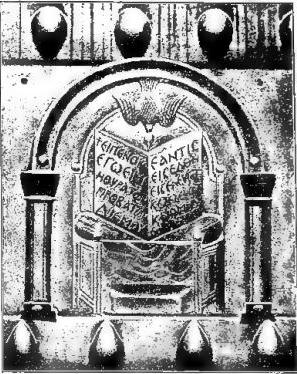
(Av. A. M. Schneider, Die Hayla Sophia zu Kantantinopoli,
Berlin 1929, lav. 35)
ETIMASIA - Throne with the Gospels (text of Jn 10:7-9) and the symbol of the Holy Spirit. Bronze panel of the imperial door of Hagia Sophia (loc. IX) - Constantinople.
Contemporary ethics: D. Parodi, Le problème moral et la philosophie contemporaine, 2nd ed., Paris 1921; G. Gurwitch, Morale théorique et science des moeurs, ibid. 1937; M. Wittmann, Die moderne Wertethik, Münster 1940; R. Le Senne, Traité de morale générale, 2nd ed., Paris 1947 (extensive bibliography); F. Battaglia, Il problema morale nell'esistenzialismo, Bologna 1949.
Systematic works of Christian ethics: V. Cathrein, Moralphilosophie, 2 vols., Freiburg im Breisgau 1890-91; Italian trans. by E. Tommasi, Florence 1913-20; A. Ferretti, Ethica, 3rd ed., Rome 1923; M. Gillet, La morale et les morales, Paris 1925; E. De Bruyne, Ethica, Antwerp 1924; Y. Simon, Critique de la connaissance, Paris 1934; E. Baudin, Cours de philosophie morale, Paris 1936; Fr. Tillmann, Die philosophische Grundlegung der Katholischen Sittenlehre, 2 vols., Düsseldorf 1938; J. Leclercq, Les grandes lignes de la philosophie morale, Louvain-Paris 1947; O. Lottin, Principes de morale, Louvain 1947.
Sofia Vanni-Rovighi