

PALLIOTTO (Pallium, Pannus; Antealtare, Frontale, Antependium). - Covering of the altar table, formerly called vestis or pallium, after the 15th century p. (from palliare = to cover).
In the ancient Church, on account of the veneration in which it was held, the altar was surrounded with a certain richness and, where possible, covered with sheets of gold and silver, or at least with precious fabrics, as is known for the East from St. Ephrem (d. 373), from the Chronicon Paschale, from St. John Chrysostom. For the West the famous mosaics of Ravenna (S. Vitale and S. Apollinare) give a fine example; in the Liber Pontificalis one reads of many rich coverings offered by the popes, for example by Pope Zachary (741-52) for the basilica of St. Peter, and by others who covered the altar on every side, or at least on the two principal sides. But after the 11th century, with the moving of the altar against the wall of the church, that is, at the back of the apse, only the front part was covered, whence the names ante-altare, frontale, antependium.
The Caerimoniale episcoporum (l. I, ch. 12, no. 2) does not prescribe it, but recommends its use; in the Missal (Rubr. gen. tit. XX) it is said to make the p. in the colors, if possible, of the feasts and of the Office.
Bibliography5 works
Pietro Siffrin
ART
To the centuries from which no cloth antependia survive belong some extremely precious altar coverings in goldsmith's work, ivories and marbles. Among the oldest examples, from the mid-8th century, is the marble antependium of the altar of Duke Ratchis in the church of St. Martin at Cividale, coming from St. John, a masterpiece of a naive and primitive art; and, among the most conspicuous, the gold and silver antependium of the altar of the basilica of St. Ambrose in Milan, where Magister Vuolvinus (835) employed every variety of goldsmithing technique (repoussé, niello, enamel) with incomparable refinement, following models proper to Carolingian art and a predominantly Byzantine technique.
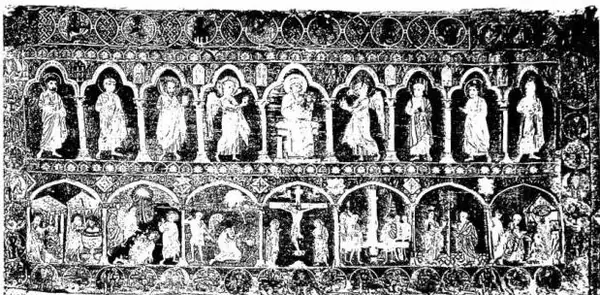
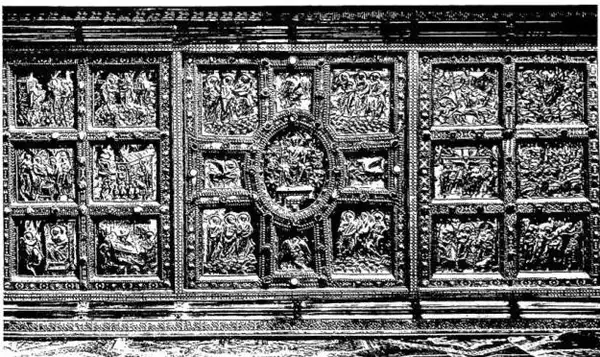
To the 11th century belong the gold antependium, held to be a gift of Henry II (1014-24), formerly of the cathedral of Basel, now in Paris in the Musée de Cluny, and the altars of the Treasury of Conques. More numerous are the examples from the 12th century: the Byzantinizing antependium, with ivory compartments bearing Stories of the Old and New Testaments, now dismembered but preserved almost in its entirety in the sacristy of the cathedral of Salerno; the silver antependium with the Redeemer and Stories of his life in the cathedral of Città di Castello; and that of Patriarch Pellegrino II (1195-1204), with Venetian and Byzantinizing features, in the collegiate church of S. Maria Assunta at Cividale. From the 13th century there is an example of an antependium in white and green marble inlays with triangular and lozenge tesserae, divided into three compartments by trilobate arcading, in the abbey of Fiesole, formerly on the altar of St. Romulus, by Master Constantine, as appears from the inscription of 1273; and in the abbey of Sesto al Reghena in Friuli there is a reassembled antependium by a Byzantinizing sculptor, perhaps Lombard. At Pistoia, in the Church of St. James, is the silver antependium, whose oldest parts (1287) present the figures of the Virgin and the Apostles within Gothic architectural settings; from 1316, also at Pistoia, is the chased altar by the Pistoian Andrea d'Ognabene. In the sacristy of the cathedral of Ascoli Piceno is preserved a silver antependium of the second half of the 14th century, of cruder art, with Stories of the life of the Redeemer; equal technical ineptitude is shown by the antependium of the collegiate church of Monza, the work of the Milanese Borgino del Pozzo (1350-57).
From the early 15th century, in Florence, is the antependium of the Baptistery, by the Florentines Betto di Geri and Leonardo di ser Giovanni (1366); in Venice, in the Treasury of St. Mark, is the antependium of Gregory XII (1408), of which only the architectural decorations and the figures are original. Among the rare examples of wooden antependia is the one from the Aosta Valley, preserved in the Museo Civico of Turin, with Romanesque and Gothic elements and French influences.
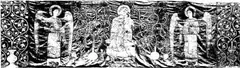
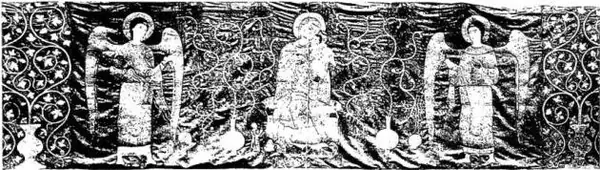
Many are the cloth antependia attributable to the 13th century; a magnificent example is in the Musée du Cinquantenaire in Brussels, two in the cathedral of Anagni, one in the cathedral of Salzburg, two in the Historisches Museum of Bern, one in the Historisches Museum of Dresden, one from the Mass vestments of the Order of the Golden Fleece in the Museum of the Court of Vienna — all highly valuable and well-preserved works, closely linked to elements of the painting of the period, true masterpieces of needle painting (v. RICAMIO).
In Italy, important are the two antependia of the Treasury of the cathedral of Anagni, mentioned among the gifts of Boniface VIII; the first, with the Tree of Life, is a rare example of a Northern school; the second, of Cavallinian inspiration, the work of central Italy, with the Stories of Jesus, of the Virgin and of Saints.
An antependium imported from the East is in the Galleries of Genoa, donated to the city by the Emperor Michael Palaiologos (1271-76), who is depicted there being introduced into the cathedral by St. Lawrence.
Works from the beginning of the 14th century are in the Provinzialmuseum of Hannover and in the cathedral of Halberstadt; in Italy, most notable is the antependium, of uncertain provenance, of the church of S. Maria at Zara, which Toesca believes was designed by a follower of Duccio, Cecchelli a local monastic work, Coletti by a follower of Paolo Veneziano.
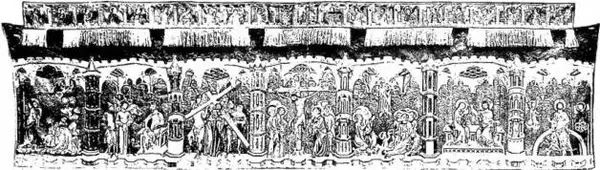
At the Pitti, in the Museo degli Argenti, is an antependium embroidered by Jacopo di Cambio, formerly in S. Maria Novella; and likewise in opus florentinum, with embroidery partly in relief and with paintings in the shading of the flesh tones (Toesca), by the celebrated embroiderer Geri di Lapo is the great antependium of the church of S. Maria at Manresa in Catalonia. From the 15th century there are also preserved beautiful historiated antependia: in the basilica of St. Francis at Assisi the antependium of Sixtus IV in embroidered silk, perhaps to a design by Pollaiuolo; at Siena in the Museo dell'Opera del Duomo another antependium with Stories of Christ and figures of Saints; at the Madonna del Monte of Varese an antependium donated by Beatrice d'Este and Ludovico il Moro (1491); at the Museo Poldi Pezzoli of Milan an antependium with the Sforza emblem; at Cortona in the church of St. Francis the Passerini antependium; in the collegiate church of S. Gimignano the antependium of the golden doves around the monogram of Jesus (1449); at Florence in S. Maria Novella an important antependium in brocade with embroidery depicting fourteen Little Stories of the Life of the Virgin. Of antependia in Gobelin tapestry fabric, magnificent examples are preserved in the Bavarian National Museum and in Bruges (Civil Hospital).
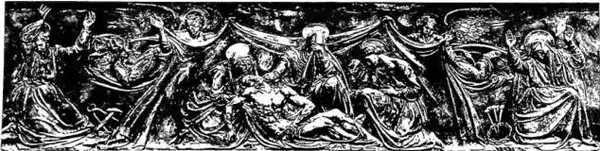
Purely ornamental motifs predominate in the later antependia; in Rome, the collection of the church of S. Maria della Vallicella is important. But in the 16th century one also encounters antependia historiated in the center and at the borders, among floral decorations: in the Vatican's Museo Sacro the antependium designed by A. Allori with the Deposition; in Florence in an antependium of the Museo Nazionale, of ca. 1580, there are medallions with figures of Saints and in the center the Deposition; at Siena in another antependium of the Museo dell'Opera del Duomo the widespread pomegranate motif triumphs within a frieze with the figures of the risen Christ, the Virgin and the Magdalene. Or decorative motifs frame the mottos and emblems of the donors (v., e.g., at Turin in the Museo Civico and at Siena in the Episcopal Seminary the two antependia with the coats of arms of the Borromeo family).
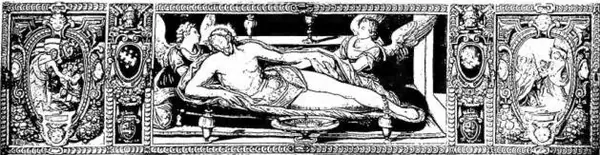
In Italy, from the 18th century, antependia are preserved: v. the examples of the Treasury of the basilica of St. Francis at Assisi, of Milan in the Castello Sforzesco, formerly at Lorico in Valtellina, of Siena in the Museo dell'Opera del Duomo, bearing the coat of arms of Alexander VII, of Brescia in the Duomo Nuovo with that of Bishop Ottoboni. Exceptional for the 17th and 18th centuries are the antependia still rich in figures, such as those of the Jesuit church at Cologne and those of Neuburg and of the Bavarian National Museum. - See plates XLVII-XLVIII.
Bibliography11 works
Luisa Mortari