
ASIA MINOR (Ἀσία ἡ ἐλάττων, ἡ μικρά Ἀσία). - A rather late designation (4th century AD: cf. Orosius, I, 2) that preceded in learned usage the Byzantine-medieval Anatolia (or "Land of the Levant," ἀνατολή, as it must have appeared to the Greeks of the Aegean; whence our Natolia and the Turkish Anatola; or also Rumili, with allusion to the ancient Roman domination); toponyms, the one and the other, of fluctuating territorial meaning and in any case different from the more definite modern acceptation.
I. GEOGRAPHY
Asia Minor is, after Arabia and India, the largest peninsula of the Asian continent, of which it forms the western extremity. Bounded on three sides by the sea (the Euxine or Black Sea to the N., the Aegean to the W. and the Mediterranean to the S.), it joins to the east with the continental mass through the Armenian plateau, where any dividing line would evidently have only a conventional value: one can trace such a line, running from the mouth of the Phasis (Rion) to the head of the Gulf of Alexandretta. Beyond the first limit the ancients placed Colchis (Georgia), while by the second Cilicia was separated from Mesopotamia (Iraq).
The area of the peninsula proper slightly exceeds 500,000 sq km and is today entirely comprised, politically, within that of Turkey (v.), which is however somewhat larger, given that it also includes part of the neighboring regions. Asia Minor has undergone, in historical times, considerable changes, more than in its natural landscape (silting up by rivers, especially those emptying into the Aegean, which has widened the small coastal plains; changes in the level of inland lakes, etc.), in the ethnic composition of its inhabitants. After the exodus of the Greeks from the western coastal regions and the almost total elimination of the Armenians, widespread especially in the eastern interior zones, the population of Asia Minor is today made up in absolute predominance of Muslim Turks.
For other geographical information, v. TURCHIA.
Bibliography3 works
II. THE RELIGIONS OF ASIA MINOR
The religious panorama of A. M. before the Christian era was complex and in the process of development. Its complexity came from the variety of peoples who inhabited it, with different languages, customs and cults. The development tended to make the discrepancies disappear and to introduce a certain common character into all forms.
The Hellenistic kings of Asia and Egypt, successors of Alexander the Great, wanted to unite the various Asiatic peoples, Greek or Macedonian, with the bonds of a single civil, social and religious culture, seeing in this an advantage for the duration of their dominion. To achieve this in the religious field they could not place too much reliance on the Greek religion, which, even before Alexander's expedition, had set out upon an unstoppable decline. With the exception of Dionysus, who had wide widespread in Hellenistic territory, the other Greek divinities exercised little influence. And it is noteworthy that even in Lydia, a region that opened itself to Hellenism more than the others, of the inscriptions found of a religious character, 237 concern Anatolian divinities, while only 171 refer to Greek divinities.
But both the philosophy of the time, Stoicism, and the Oriental religions worked to achieve a certain unity of religious conception.
Stoicism taught that a divine force, the lógos, animates the entire universe and the beings contained in it, including man. Since all men participate in this force and receive their nobility from it, they are equal, despite differences of race or nationality. With this doctrine Stoicism abolished the distinction, dear to the Greeks, between Hellenes on the one hand and barbarians on the other. The ideal State was one that abolished every national barrier, to make the entire world a single great city. Stoicism furthermore recognized one single divinity, and identified it with the force that governs the world and regulates its development. Since this was conceived as immanent in the world and in all beings, and not as transcendent, the Stoic conception was pantheistic. Moreover, since this force acted according to fixed and immutable laws, the most rigid determinism was admitted in all events, and human freedom came to be denied.
That despite pantheism such a conception was capable of arousing true religious sentiments in the souls of its adherents can be seen from the famous hymn of Cleanthes, one of the first Stoics, and later at Rome from the writings of Marcus Aurelius and Epictetus. Furthermore, by a fortunate illogicism, while determinism was admitted in all things, much insistence was placed on voluntary effort and the practice of virtue. The ideal of morality consisted above all in the full and absolute conformity of the soul with the law of the cosmos, in the calm and unshakeable certainty that this law, despite any external appearance, led everything to an excellent end.
It goes without saying that in a philosophical doctrine only a few spirits inclined to meditation could find satisfaction. The mass of the people followed the ancient ways and turned to its own divinities. These were tolerated by Stoicism, which interpreted them, in accordance with its system, as naive and infantile personifications of physical phenomena.
Astrology (v.) had a universal diffusion; and not only among the educated classes but also among the common people. Since it had been discovered that the motion of the stars was accomplished according to fixed laws, it was taught that whatever happened on earth was determined and ineluctable. And this whether it concerned physical phenomena or social and moral phenomena. Such a doctrine admitted fatalism, and again denied human freedom; its events, its vicissitudes, the end of life were written in the stars. It was enough to know how to read this celestial writing, in order to trace an exact horoscope (v.) of the course of each man's life. One needed only to know the precise moment of birth or conception. From that moment he in fact came to be geared into the vast organism of the universe and had to follow its movements and repercussions fatally. Once this was known, one investigated the position of the stars at that given moment, and predicted the future in all its minutest details.
The doctrine found a good reception among the Stoic masters (with the exception of Panaetius) and their adherents, since it agreed with their idea of the divine force that governs the world with fixed and ineluctable laws; but it also had a vast diffusion in all classes of society. Astrology, however, by reducing man to a mere wheel of a gigantic organism that invariably followed its own paths, in the long run made its oppressive weight felt. And men sought escape from fate.
As a reaction against fatalism, in the Hellenistic period there was a reinvigoration and a vast diffusion of magic. It was thought that there existed formulas and practices by which one could force the hand of the gods and change adverse fate.
If the divine stars could, as a result of the unitary connection of all the parts of the universe, exercise their influence on earth and on man, there had to be means, by virtue of the same principle, to counteract their action in one way or another. It was a matter of knowing them and knowing how to use them. The only good side of magic was man's reaction against a doctrine that made him a mere marionette in the hands of the puppeteer. But of religion in magical practices one cannot speak. The religious act in fact tends to dispose the divinity favorably in order to obtain its help; the magical action, on the other hand, seeks to force it. In the first case man's interior attitude is one of humble subjection to the divinity; in the second it is one of presumptuous superiority, or, as has been said, of egoistic arrogance. In any case, the belief became extremely widespread that with such practices one could change one's adverse destiny and be freed from one's star.
But the people resorted to them also for other particular purposes. A quantity of magical papyri have come down to us with the most diverse and strange formulas, either to obtain liberation from a disease, or for the prosperous success of a love affair, or for the happy conclusion of a business deal, and so on. In such cases the spirits were compelled by the magician to appear, and by incantations were forced to render service and to reveal the cause of a disease or the nature of the remedy. Then it was a matter of driving them away and preventing them from taking revenge, and one resorted once again to magical practices to obtain this.
Astrology and magic, connected together, spread in every region of Asia Minor and in Egypt, and from there passed to Rome, where they took firm root, and extended to the other parts of Europe, resisting all assaults well into the Middle Ages.
If astrology came from Babylonia and magic predominantly from Egypt, a cult that had universal diffusion was the work of the Hellenistic kings: this is the cult of the kings.
Alexander, after the victories that carried him as far as the lands of the Indus, had himself recognized as a god by the Greeks. The purpose of this was political: it was intended to place all the peoples composing the new empire on the same level: Macedonians, Greeks and Asians were to feel equal before a king-god. At the same time it was intended to confer absolute power on the ruler by his elevation to divinity. For the same reasons, upon the dismemberment of the empire after his death, the successors in Asia and Egypt, the Seleucids and the Ptolemies, set about instituting their own cult. They proceeded in stages: first deceased monarchs were deified, then they went on to institute the cult of the living king. This institution constituted the stool on which the absolutism of the ruler was raised. Participation in this cult was required of all the subjects of the Hellenistic kingdoms, and became the symbol of loyalty. But there was very little spiritual content in it; and among the thousands of inscriptions with religious content, not one is found that shows anyone having turned to the king, living or dead, for succor in his religious needs. To obtain this, souls turned to the ancient gods.
These local divinities were numerous, but, as we said at the beginning, they followed a unifying tendency. As protectresses of a particular State and of the people composing it, now that the various States had been absorbed by the great Hellenistic kingdoms, they could no longer be considered as guardians of a particular State that no longer existed: they had to lose their local characteristics and cut their ethnic or state ties, in order to acquire more universal characteristics. In these new conditions they could address themselves to all peoples, even beyond the ancient boundaries in which their cult flourished. Men were now part of an empire and had lost their particular State; they therefore no longer felt bound to the divinity of the ancient State, but could freely turn even to divinities previously foreign to them, in their own religious needs.
To respond better to the broader needs of men, the propagandists of a divinity widened its field of activity, attributing to it properties and qualities drawn from others. Moreover, the worshippers of one religious form did not exclude the other forms or the other divinities, but regarded them as different aspects and various names of the same divinity. And one could freely follow one or more different cults. In this movement one cannot speak of monotheism, but rather of a tendency toward a unity of beliefs, or better of cult, which moreover did not reach its end even shortly before the various religions disappeared when Christianity triumphed. The development described is noticed more during the Roman era at the twilight of Hellenism, but its beginnings occurred in this era.
The aspirations of Greeks and Orientals in the decades before our era turned toward salvation. And since men felt powerless to attain it by their own strength, they turned their gaze toward help from on high. Liberation, however, was not conceived by all in an identical form. The wars that devastated the various regions of Asia, the disturbance of internal order, made people desire peace and the re-establishment of an orderly civil coexistence. This was regarded as salvation; and when Augustus gave it, then he was exalted with the most divine titles and considered as savior. Others groaned under the belief in fate, and salvation for them meant being freed from their own unlucky star. The Persians, on the other hand, had a doctrine which showed life as a continuous struggle between good and evil, and men divided into two opposing camps always at war with one another. And since they saw that evil and falsehood prevailed, they awaited a divine messenger who would come to make the kingdom of justice and truth triumph, and re-establish a new order with a humanity transformed and concordant in good. The helper they awaited had been foretold, so they thought, by the very founder of their religion, Zoroaster; and they lived in expectation of him. More than the cults, it was man's noble yearnings toward salvation that would open hearts to the Christian message.
Bibliography3 works
Giuseppe Messina
III. CHRISTIANITY IN ASIA MINOR
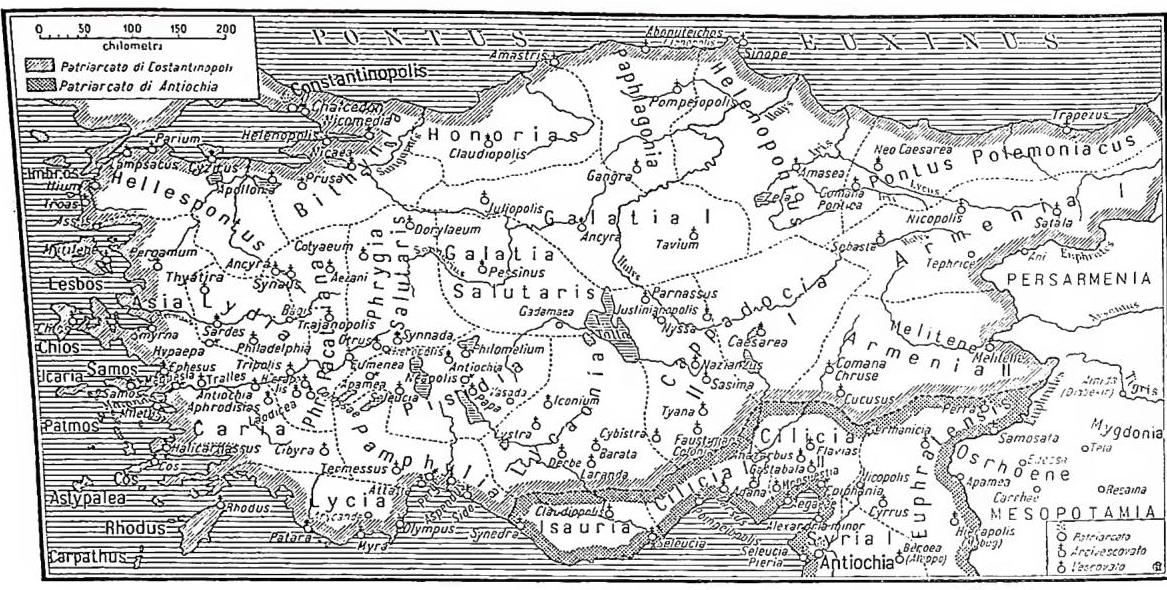
The occupation of A. M. by the Romans, preceded by a long Greek dominion, began with the death of Attalus (133 B.C.), who left them his kingdom as an inheritance, and through successive vicissitudes was completed only at the beginning of the 2nd century. The extent of the territory, but above all the diversity of its peoples and their gradual subjugation, advised the Romans not to make of it a single province. And the provinces varied from time to time in number and extent according to the various arrangements given to the region by the emperors.
A. M., whose many cities heard the word of St. Paul and then of St. John toward the end of the 1st century, is one of the imperial regions where the word of Jesus was most preached. The Church of Ephesus, the richest city of A. M., owes its foundation to St. Paul and, according to a generally accepted tradition, the apostle John governed it for many years. The Churches of Alexandria Troas, of Laodicea, of Hierapolis, where the deacon St. Philip, later confused with the Apostle of the same name, and his daughters, known as prophetesses, resided, are remembered in the Pauline letters. Those of Smyrna, Pergamum, Sardis, Philadelphia and Thyatira, Ephesus and Laodicea, are the recipients of John's Apocalypse. The Christian communities of Tralles and of Magnesia on the Meander are remembered around the year 100 in the letters of St. Ignatius of Antioch, successor of Evodius, left in the city by St. Paul, when the Apostle had to go elsewhere. Besides in the coastal zone of A. M., Christianity penetrated into Pisidia through St. Paul; Iconium, Antioch of Pisidia, Lystra, Derbe, had their Christian communities very early, and in the rest of the country the Gospel spread rapidly. The Christian communities of Galatia are also daughters of the apostolate of St. Paul, who addressed to them one of his most famous letters. He also wrote to the Christians of Colossae in Phrygia, which, however, does not seem to have been evangelized by him personally. The island of Cyprus was visited by St. Paul and by the Cypriot St. Barnabas around the year 47, when the proconsul Sergius Paulus also converted to Christianity. The evangelical doctrine developed quite rapidly on the island, thanks to the apostolate of preachers who came from neighboring Syria. Bithynia on the coasts of the Black Sea was evidently evangelized before the end of the 1st century, since at the beginning of the following one Pliny the Younger, who governed the province under Trajan, attests that Christianity not only flooded the countryside, but formed a void around the temples. A short time later, the city of Sinope had a bishop, who was the father of the heretic Marcion.
But around the year 95 the Christians of Pergamum and of Smyrna were harassed, on account of the persecution of Domitian, which, according to tradition, made shine forth if not a martyr, at least the most glorious of the confessors, the evangelist John (Tertullian, De praescriptione, 36).
Despite the grave dangers of Gnosticism at the end of the apostolic age, and then of Marcionism and Montanism, of which the bishops of A. M. managed to gain the upper hand with the synods celebrated in Phrygia, Christianity had made the most rapid progress. In the 3rd century Dionysius of Alexandria declares that Phrygia possesses the most populous church, while the pagan rhetorician Lucian of Antioch laments the great number of Christians who fill Pontus from the time of Marcus Aurelius, and around 190 the bishops of this region write to Pope Victor concerning the paschal question. On the contrary, only in the 3rd century was lower Pontus methodically evangelized.
In the 2nd century Cappadocia also had Christian communities, in the central part of A. M., where the famous "Legio Fulminata" had long been quartered, in which, from the time of Marcus Aurelius, a good number of Christian soldiers served, for the most part recruited in the eastern extremity of that province. Nevertheless its capital, Caesarea, does not figure in Christian history until around the year 200, when its bishop Alexander, a disciple of Pantaenus and of Clement in the Didaskaleion of Alexandria, was imprisoned during the persecution of Septimius Severus.
Around the year 300 the Christianization of the East was much advanced and the organization of its hierarchy perfected, as well as the ecclesiastical circumscriptions formed in general on the model of the administrative divisions. The subdivisions imposed by Valens and Theodosius raised the civil provinces to twenty and consequently the ecclesiastical ones. To the ancient Asiatic metropolises, Ephesus, Cyzicus, Sardis, Aphrodisias, Myra, Antioch of Pisidia, Laodicea of Phrygia, were added those of Side, Eucarpia and Iconium. The metropolises of Pontus, Caesarea of Cappadocia, Ancyra, Nicomedia, Gangra, Amasea, Neocaesarea, were completed with the addition of Tyana and of Melitene.
Bibliography11 works
Alberto Galietti
IV. THE APOSTOLIC VICARIATE OF ASIA MINOR
It is a foundation of the Congregation of Propaganda, which entrusted the spiritual care of A. M. to the prelates of Constantinople and Smyrna as early as the 17th century. After various vicissitudes, in 1818 the apostolic vicariate of A. M. was formally erected and entrusted to the archbishop of Smyrna, who had been re-established shortly before. The northern part of A. M., however, remained with the apostolic vicariate of Constantinople, from which the independent Mission of Trebizond was detached in 1931. The apostolic vicariate of A. M. (in the strict sense) has had very few Catholics down to the present day.
Bibliography3 works
Giorgio Hofmann
V. ARCHAEOLOGY
The archaeology of Asia Minor has received great impetus in recent times, but it is far from having yielded its greatest results, especially as regards Christian origins. In any case, it is necessary to distinguish the monuments of the coastal cities (Ephesus, etc.), imbued with Hellenism and also with Romanitas, from those of the interior, which bear more pronounced Oriental characteristics.
As regards the pre-Constantinian age, various epigraphic materials have been collected in Phrygia, which was deeply penetrated by Christianity and suffered grievously in the Diocletianic persecution. The epitaph of Abercius (v.) is famous. But the groups of crypto-Christian epigraphs with the formula ἄσται αὐτῷ πρὸς τὸν θεόν (particularly in southern Phrygia) are also interesting, as are those with the display of the Christian quality (χρηστιανός, χρηστιανός) and not infrequently the cross (northern Phrygia), which must belong to the heretical congregations of the Montanists. The inscription of Aricanda (v.) also deserves mention. A memorial of a martyr that tends to be believed authentically pre-Constantinian is the marble sarcophagus-shaped reliquary (now in the museum of Brussa) which, as the epigraph asserts, contains relics of the bones of the martyr St. Trophimus (this is St. Trophimus of Antioch in Pisidia, sacrificed at Synnada under Probus: 276-82). It is doubtful, on the other hand, whether the metrical epitaph of a young man named Gennadius, discovered in the territory of ancient Laodicea Combusta, refers to a bishop and a confessor of the faith. But Marcus Julius Eugenius was a soldier and confessor (in the time of Maximinus) who, after the peace, having become bishop of Laodicea, splendidly rebuilt the church and in the end prepared his own tomb. This he asserts in an interesting epitaph dating to ca. 340: from which we also learn certain particulars of the rebuilt basilica, since it mentions the porticoes, the fountain, the inlays, the paintings. Another epigraph, found on the site of a city founded by the emperor Hadrian in Bithynia (Hadriani ad Olympum), speaks of a young reader or psalm-singer who now sleeps protected by Christ and has gone to claim his place at the heavenly agape. The epigraph may belong to the 3rd century.
This epigraphic material nevertheless needs to be further investigated and better dated and interpreted. It will then be necessary to distinguish clearly what is pagan and what is Christian, since various epigraphic expressions may lend themselves to ambiguity. There are moreover formulae (such as those concerning the violation of tombs) that are repeated from one place to another. The figured symbols on the stelae also merit attention. Certain figurations are repeated from the times of the most ancient local civilizations.
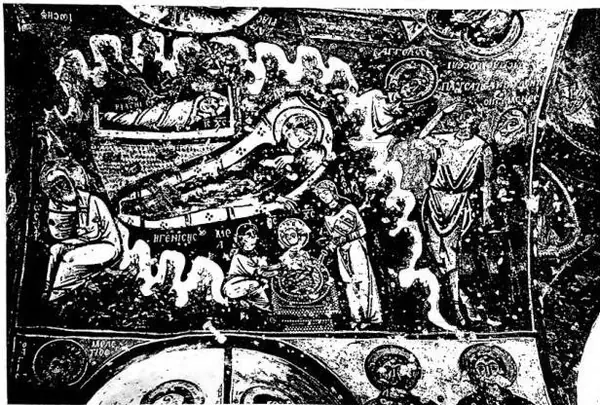
As regards monumental remains, apart from some small hypogeum (e.g., the catacomb of the Seven Sleepers at Ephesus) and some burial chamber hewn in the rock, the cemeteries of Asia Minor were under the open sky, and there stelae were seen (like the Montanist ones mentioned) and altars. The epitaph of Abercius is on an altar-shaped cippus (βωμός). Sarcophagi were also seen there, but we are quite in the dark about the sculpture of primitive Christianity in these regions. One may suppose that sarcophagi with niches and columns of the so-called Asiatic type had developed, but the oldest example of it with a Christian subject is from the beginning of the 5th century and does not come from Asia Minor; it is the fragment of Psamatia (Constantinople), now in the Berlin museum. There must also have been the type with figures in very high relief on a neutral background, as in another fragment (Berlin museum) said to come from Sinope, which has a very animated group of unclear interpretation (but the Asiatic origin of the fragment, which is from the 5th century, is not well established). It seems that the Ravennate sculpture of the 5th century reflects Asiatic modes. All this needs further study. One must nevertheless presume that a rich Christian iconography developed early in Asia Minor, if the series of the Sinope Gospel Book (6th century; fragmentary, today in the National Library of Paris) appears so important, closely related to the famous Gospel Book of Rossano (also of the 6th century). A great impetus to Marian iconography must have manifested itself after the Council of Ephesus (431), and we think that the Berlin ivory diptych with Christ between Peter and Paul and the Madonna enthroned between Angels may be one of the oldest manifestations (perhaps 2nd half of the 5th century) of this post-Ephesine iconography. The Theotókos between the angels returns in a Sinai icon and in the Madonna della Clemenza in the basilica of St. Mary in Trastevere in Rome. It therefore had wide diffusion in the East and in the West. Much later the rock churches of Cappadocia would have a very remarkable series of pictorial figurations, which would develop a great abundance of iconographic themes drawn from the canonical books and from the apocrypha. As we have seen from the epitaph of bishop Eugenius, there was development quite early also in sacred buildings. At Ephesus, where Hellenistic and Roman influences prevailed, important basilicas were erected (v.). An ancient tradition asserted that there the Madonna would have followed St. John (and the tradition must have been dictated by the adoption willed by Jesus when for the last time from the height of the cross he spoke to the Virgin). At Korykos there is another basilica with a mausoleum of the 4th century, erected in honor of two unknown martyrs, and there is also a large necropolis with limestone sarcophagi, some of which are pit graves in the rock, or cut from a block of rock in the form of an ark. At Meriamlik (ancient Seleucia) there exist traces of the grandiose sanctuary of St. Thecla, around which a veritable citadel formed. At Uzundia-Burdj (ancient
Diocesarea) there is the utilization of the great temple of Jupiter, which occurred very early. After the cella was demolished, an apse was added to the colonnaded peribolos, which was transformed by fillings into a perimeter wall.
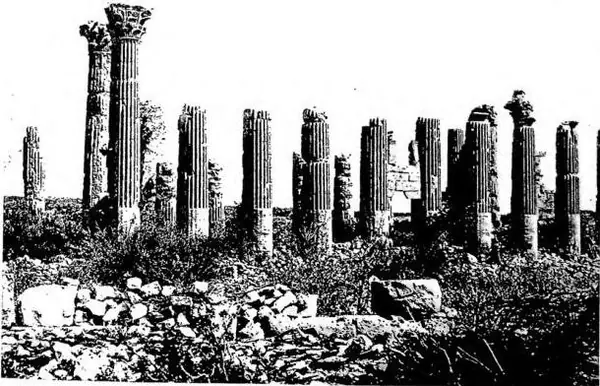
There is then a very large series of buildings erected on a central plan with the usual accompaniment of dome or barrel-vault coverings. Of interest is the sanctuary of St. Nicholas at Myra, which, however, was remodelled even in relatively recent times. There is then St. Clement of Ancyra and above all the imposing church of Dere-Ağzi, which also has alongside it two octagonal mausolea. These structures are strongly influenced by the art of the first Byzantine golden age, although they have local characteristics. The Fathers of the Church of the 4th century speak of octagonal buildings. But one type that has survived to us is that of Suwasa, perhaps of the 5th century. A center of great interest for its many ecclesiastical buildings is Binbirkilisa in Lycaonia: it is a true Christian city whose buildings, dated by Strzygowski to the 4th or 5th century, were assigned by Ramsay to later periods on the basis of epigraphic evidence. It may be believed that the 5th century is the earliest period. Still in the 10th-11th centuries building was done according to the ancient style, but with more mediocre execution. There are churches with a simple basilical plan, cross-shaped churches, churches with matronea, octagonal buildings, etc., with extensive use of barrel vaults or transverse arches (especially in the minor aisles to serve as a counterthrust to the vault turned over the central nave) and a certain preference for horseshoe arches. The facades must sometimes have had two lateral towers and a portal with a double arch resting on a central column. Of great architectural interest is the church of Alahan-Monastir (Kogia-Kalessi) in Isauria. It is a basilica with a deep apsidal presbytery, which has the two pastophoria on the sides. The small aisles end in an apse at the height of the triumphal arch. Columns set against piers support the transverse arches of the central nave. The divisions between this and the side aisles are by columns and piers. Above the naves are the matronea. The intermediate barrel vault opened into a dome, now fallen. On the front a triple window opens. A construction of a more spatial type is St. Clement of Ancyra. It is a building in the form of a broad cross with a central dome and a deep apsidal choir flanked by triconch cells covered by domes. However, this basilica betrays the influence of the Justinianic structures of Constantinople. It has been rightly attributed to the 6th-9th century.
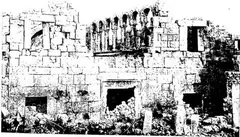
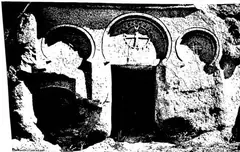
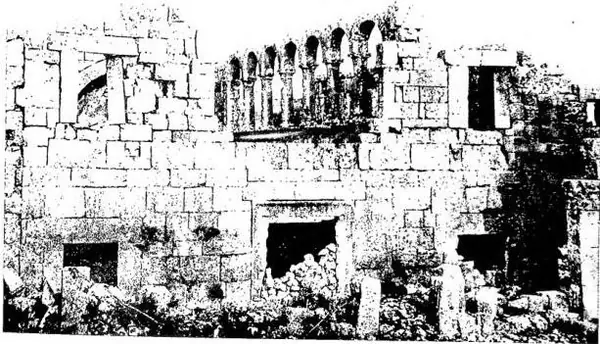
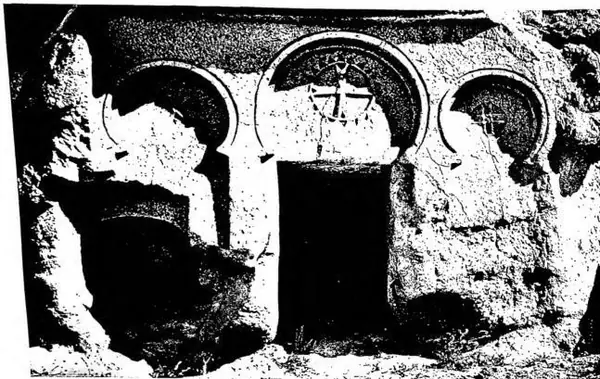
Undoubtedly Asia Minor is the greatest center from which Byzantine art radiated. One must not forget that the two builders of Hagia Sophia in Constantinople were from Asia Minor. Here the scarcity of construction timber and the abundance of stone forced the search for every structural experiment and the remedying of all the drawbacks of a massive construction. Naturally, later, Byzantine art, having reached its splendor, flowed back into the Asiatic regions. But the problem hinges on the origins of this art. It has been observed that, if very ancient Oriental elements penetrated into it, far stronger was the will to render in structures of entirely stone the spatial conceptions of the Roman age, and the radiation of the grandiose art of the City does not seem to be excluded either. Therefore, Oriental modes, Hellenistic modes (local and from the not distant center of Antioch), Roman modes gave the impulse to these architectural experiments, which appear so varied and so suggestive. Certainly the architects of Asia Minor knew how to achieve a perfect correspondence between exteriors and interiors and a harmony that is not found in other places. But besides the buildings under the open sky, one must not neglect either the important underground churches, especially those of Cappadocia (Göreme, Soğanle, etc.). - See Plates XV-XVI.
Bibliography24 works
Carlo Cecchelli