
SEVILLE, ARCHDIOCESE OF. - Archdiocese and capital of the province of the same name in Andalusia (Spain). The archdiocese comprises, within its territory of 27,716 sq. km., the civil provinces of Seville and Huelva, as well as part of those of Cadiz, Cordoba and Malaga. It has a population of 1,752,000 inhabitants, of whom 1,751,840 are Catholics, distributed in 320 parishes, served by 451 diocesan priests and 325 regulars; it has two seminaries, 65 male religious communities and 216 female ones (Ann. Pont. 1953, pp. 403-404).
It is the ancient Hispalis in the province of Baetica. In Seville, throughout the entire Visigothic era, there were venerated St. Felix the deacon, commemorated on May 2 in the marble Calendar of Carmona of the 6th century and in that of Cordoba of 961, and Sts. Justa and Rufina, who, provoked by the pagans during the festivals of the Adonia (July 17-19), smashed in Seville the image of the Phoenician goddess Salambo and were martyred (F. Cumont, Les Syriens en Espagne et les Adonies à Seville, in Syria, 8 [1927], pp. 330-41). The Passio (BHL,
4569) places their martyrdom on July 19, as does also the Jeronymian Martyrology, which however names only Justa; the Mozarabic calendars instead on July 17. Their relics are mentioned in epigraphs, one of which is from 662 (J. Vives, Inscrip. crist. de la España romana y visigoda, Barcelona 1942, nos. 333 and 306).
The first known bishop is Marcellus (3rd century), attested by the Catalogo emilianense (ms. R. II, 18 of the Escorial); present at the national Council of Hiberis in the year 900 was Sabinus (PL 84, 301); he later had himself represented at the Council of Arles of 314. In 441 the bishop Sabinus II was expelled from the see by a faction supported by the Suevic king Rechila, and in his place a certain Epiphanius was elected (Hydatius, Chron., ad ann. 441); Sabinus II could not return to the see until 461 (Hydatius, loc. cit., in España Sagrada, IV, Madrid 1756, p. 426); Sallustius is named in a document of Nov. 30, 520 (Jaffé-Wattenbach, no. 786) as vicar of Pope Hormisdas; Zeno, given as predecessor of Sallustius at the end of the 5th century and vicar of Pope Simplicius (ibid., no. 590), was not bishop of Seville, but of Merida in Lusitania (v. J. Vives, Inscrip., cit., no. 363, commentary, at the end). The see was metropolitan when in 589 the prelate St. Leander celebrated the first provincial Council and was designated in a public document as metropolitan of the province of Baetica (PL 84, 358), a title later given to all his successors beginning with his brother St. Isidore (d. 636), who celebrated the second provincial Council in 610 and probably also a third, of which only one canon is preserved in the pseudo-Isidorian collection (Decretales Pseudoisidorianae, ed. P. Hinschius, Leipzig 1863, p. 396). During the governance of the two holy brothers the see of Seville (569-636) was spiritually the true capital of Spain; to St. Leander is owed the conversion of the Visigothic people, solemnly proclaimed in the III Council of Toledo of 589 (St. Isidore, De viris ill., 57); St. Isidore (v.) completed his work, gave the Visigothic Church precious disciplinary laws in the IV Council of Toledo, ordered the canonical legislation in the Collectio Hispana, infused great vitality into the episcopal schools, and brought forth a literary production that made him the teacher, not only of Spain, but of all medieval Europe. The disciples formed in his school extended his influence to the most important Churches of the peninsula, such as Toledo and Saragossa. Thanks to these two prelates of Seville the Church of Spain remained united to Rome and received the pontifical direction uncontaminated. St. Isidore was also a master of monks and his Rule long contested with that of St. Benedict the hegemony in the monasteries of the peninsula, until in the 11th century the Rule of the abbot of Montecassino definitively triumphed following the Gregorian reform.
The successors of Leander and Isidore up to the Arab invasion (711) are known especially through the Catalogo emilianense and the subscriptions of the Councils of Toledo. The bishop Bracarius in the second half of the 7th century was not the author of the De ecclesiasticis dogmatibus as has been claimed (J. Madoz, in Razón y Fe, 122 [1941], pp. 237-39; Epistolario of Alvaro de Cordoba, ed. Madoz, Madrid 1947, p. 168, n. 15). Oppas, the last bishop of this period, betraying the cause of King Roderic, contributed to the ruin of the Visigothic monarchy and to the triumph of the invading Arabs. Seville was subdued by Mūsā b. Nuṣajr in 712, and, after a Christian uprising quickly suppressed, underwent Arab domination for five centuries under a regime of tolerance, with all the difficulties that characterize the history of the Mozarabic Christians, while nevertheless perfectly preserving the ancient organization. Within the city were preserved the metropolitan church of St. Vincent and of Rubina (according to the testimony of Ibn al-Qūṭijjah: Iftisīb, 11) and that of Sts. Justa and Rufina; these could be repaired, but not enlarged, and worship had to be limited to the interior, without any external manifestation. Probably in 825 there were martyred in Cordoba the two brothers Adolphus and John, natives of Seville (Martyrology of Usuard under Sept. 27) and in 856 their sister Aurea, a nun in the monastery of Cutechara after the death of her brothers (v. St. Eulogius of Cordoba, Memoriale Sanctorum, III, 17), victims of the persecution of 'Abd ar-
Raḥmān II and of his son Muḥammad (853-59), which was a consequence of a militant proselytism led by St. Eulogius, a martyr in 859. And since the Christians were offering themselves spontaneously for martyrdom, the Council of Cordova of 852, presided over by Recafredo, metropolitan of S., and provoked by 'Abd ar-Raḥmān himself, forbade such a course of action (v. St. Eulogius, op. cit., II, 16), though without great result: Alvaro de Cordova places this bishop among the persecutors of the Christians (v. Vita Eulogii, n. 7). Another prelate of S., named Juan, apostatized at the end of the 11th century amid torments and justified his conduct by declaring that what matters for a Christian is not the lips but the conscience; that against his will he had denied with his tongue, and since he was faithful to Christ with his heart, one should not look at what his lips manifested to men (v. Hugh of St. Victor, Ad archiep. Hispalensem, in España Sagrada, IX, 3rd ed., Madrid 1860, pp. 434-38). Of the other prelates of S. of the Mozarabic era it suffices to recall Nonnito, successor of Oppas Teudula, at the beginning of the 9th century, who wrote against Adoptionism, and another John known from the letters of Alvaro of Cordova (Epp., III and VI; ed. cit.). The last known was Clement (ca. 1144), who had to flee from his see as soon as he was elected, at the arrival of the Almohads, who were fanatical persecutors of the Christians until 1248, when the king of Castile Ferdinand III the Saint reconquered S., the most important city of Muslim Spain. The first archbishop of the new series was the infante don Philip, son of the king. One of the most remarkable personalities of this era in the ecclesiastical history of S. was Rodrigo de Santaella, a man trusted by the prelates of S. from 1491 to 1509, acknowledged as the founder both of the present Seminary (1505) and of the civil University (1508), both erected by bulls of Julius II. After the city was reconquered by King St. Ferdinand, the formation of the clergy was carried out in the Studium generale, founded near the Cathedral by Alfonso the Wise; but that institution disappeared in the 15th century, and then the two prelates Diego Urtado de Mendoza and his brother Diego de Deza gave all their support for the erection of the Seminary; indeed the second founded in 1515 the celebrated ecclesiastical College of St. Thomas; a third was instituted by don Alonso Manrique around 1532. Between 1614 and 1633 three other colleges arose; the most important was the one founded by the canon don Gonzalo de Ocampo in 1615. After many vicissitudes brought about by the revolutions of the 18th and 19th centuries, the Seminary flourished again in 1848, unifying what had been possible to save from the previous institutions; in 1897 Leo XIII raised it to a Pontifical University and it preserved this character after the publication of the constitution Deus scientiarum Dominus. Following the discovery of America, Seville became the economic capital of the Spanish Empire, seat of the House of Trade and an obligatory passage for all those, lay or ecclesiastical, who were heading to the West Indies; there is located the Archive of the Indies, which with over 3,000,000 documents constitutes the source for the history of the colonization and evangelization of the New World.
The processions of Holy Week in Seville are everywhere renowned, of unequalled religious fervor and of a typically local character, organized by the confraternities that draw their origin from the Middle Ages. Their pasos are due to the best artists of the Spanish Renaissance.
Giusto Fernández Alonso
ART
The great mosque built in 1171 was adapted as the Cathedral, of which the Alminar or Giralda, one of the most artistic monuments of S., and a few other minor parts still survive; the rest was much modified in the following centuries; indeed the building proper was entirely renewed according to new designs from 1401 onward; completed in 1506, it was restored between 1511 and 1519 following the collapse of the vault and of many pillars. The interior consists of a quadrilateral measuring 130 x 76 m., with five naves, of which the central one is over 40 m. high; around it open 54 chapels with a total of 80 altars. The stained-glass windows were executed between the 16th and 19th centuries. At the center of the main nave stand the "Capilla mayor"
and the choir; the "Mayor" has the grandiose retablo, the work of the Fleming Dancart of 1482; behind the chapel is the "Sacrestia alta" with a venerated image of the Madonna. In the chapter house (16th century) is the image of the Immaculate Conception, a work by Murillo. At the sides of the choir are four chapels: in that of St. Peter is the tomb of Archbishop Diego Deza and 9 paintings by Zurbaran. The "Capilla Real" is in Renaissance style (1551-75); on the altar is the Virgen de los Reyes, carried by King Ferdinand in all his campaigns; in front is the bronze and silver sarcophagus with the body of St. Ferdinand, transferred here in 1579. On the altar of the crypt below stands the ivory statuette of the Virgen de los Batallas (14th century).
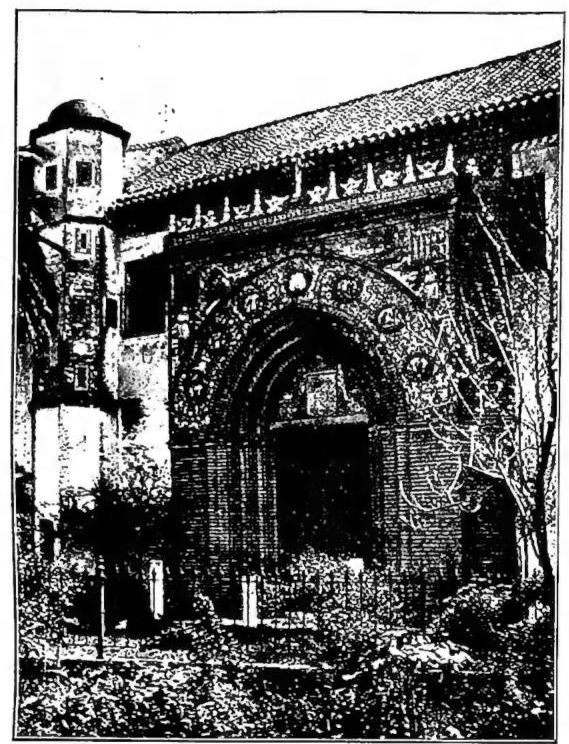
Other notable churches are: the church of El Salvador, over an ancient mosque, with artistic retablos, a Christ by M. Montañés, an Ecce homo attributed to Murillo and the venerated image of the Virgen de las Aguas of the 13th century. The church of St. Martin with Gothic vaults of the 14th-15th century was restored in 1896 and in 1926. The parish church of St. Gil has the apse of the 13th century; the rest is of the 14th century, but rebuilt in the 17th century; it was set on fire in 1936 and restored. The interior preserves remains of a mosque, with panels and mosaics of the 14th century in the apse; in a new chapel is the Virgen de la Macarena (Our Lady of Hope), the most popular in the city. On the night of Holy Thursday two pasos leave the parish of St. Gil with a guard of pretorians and return on the morning of Good Friday. The church of St. Marina has a portal with sculptures of the 14th century and a bell tower with an Arab base; it was devastated in 1936 and is under restoration; the interior is a former mosque transformed, and in its wilḥrib is the chapel of the Santo Cristo. The church of St. Catalina too was built in the 14th century over an ancient mosque, of which the restored tower remains; the 14th-century portal was added there in 1929 and comes from the church of St. Lucia. The church of St. Isidore of the 14th century, recently restored, has an interior with three naves; in the sacristy there is a chapel erected on the spot where St. Isidore died (a. 636). The convent of St. Paul, founded in 1475, preserves a Gothic portal, and in the adjoining church, with an ogival vault, statues of St. John the Baptist and St. John the Evangelist, the work of M. Montañés (1638), and Gothic tombs. The church of St. Roman of the 14th century also preserves sculptures by Montañés, as does the chapel adjoining the convent of St. Inés. The church of the University was built by the Jesuit Bartolomé Bustamante (1565-79). The church of St. Maria la Blanca is an ancient synagogue of 1391 transformed, with Visigothic capitals, like that of St. Bartholomew. The "Palacio Arzobispal" is of the 17th century with a Baroque facade; it contains a collection of paintings, among them that of the Virgin giving the chasuble to St. Ildefonso, painted by Velazquez. The asilo de Venerables sacerdote contains a chapel with frescoes by Valdés Leal in the dome and ancient stained-glass windows with scenes from the lives of saints.
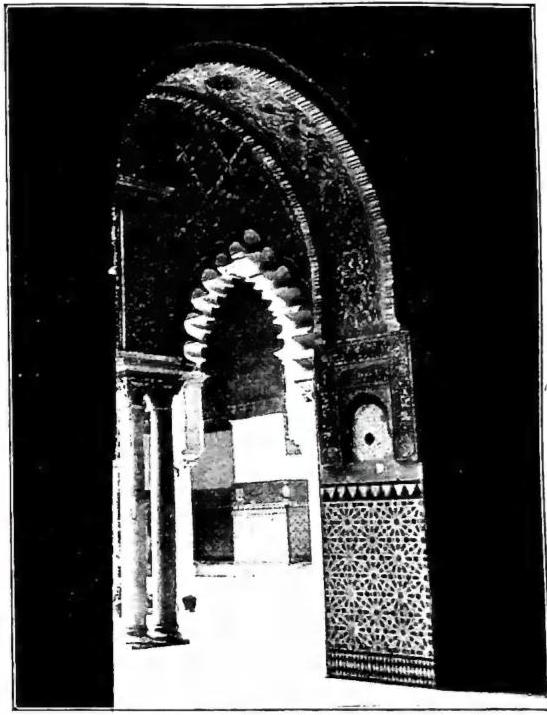
The "Alcázar" or "Alcazaba," built by the Arab conqueror Mûsâ in 712, extended as far as the Tower of Gold and the banks of the Guadalquivir; it was at once a fortress and a royal residence; in the 11th century the kings of the Banû Abad dynasty (1023-91) adorned the palace with the columns and materials of the city and of the palace of Medina-Az-Zahara. The sultan Abû Ja'qûb Jûsuf (1171-76) erected the Tower of Gold. Ferdinand II, having occupied S. in 1248, built the vaulted gallery of the baths of Maria de Padilla; the palace was enlarged by King Peter I the Cruel in 1364-66; later, in the 15th century, other works were carried out there in the time of the Catholic Monarchs Ferdinand and Isabella, and again in 1526 for the marriage of Charles V. In the hall called that of Charles V are the tapestries representing the conquest of Tunis, commissioned by Charles V in 1551 from Pannemaker after cartoons by Juan Vernia.
The provincial archaeological museum was located in 1945 in the ancient building of the Fine Arts of the Ibero-American Exposition of 1929; it comprises Roman, early Christian, Visigothic, Hispano-Arab, Moorish, medieval and Renaissance archaeological collections.
The provincial museum, on the other hand, is in the ancient convent of La Merced (17th century) and houses the Academy of Fine Arts and the Museum of painting and sculpture. The ancient church is transformed into the "Salon Murillo" and there are gathered 54 paintings and some sculptures; the paintings by Murillo belong to his last period and come from the churches of S. of the Capuchins and of the Augustinians; there are moreover paintings by Zurbaran, by Velazquez, by El Greco, by Montañés, by Pacheco, by Roclas, etc. In the suburb called S. de la Triana, from the Roman Traiana called by the Moors Terayana, are found: the church of St. Anne erected by Alfonso the Wise and consecrated in 1280; restored afterward; it has three naves, and in the transept choir is the image of the Virgen de la Rosa by A. Fernández, from the beginning of the 16th century. Moreover the "Cartuja," an ancient charterhouse founded in 1409, transformed into a ceramics factory in 1839; in the Gothic church, and precisely in the chapel of St. Anne, the remains of Christopher Columbus were deposited from 1513 to 1536; then there are remembered the church of N. S. de les Cuevas with an alabaster statue of the Madonna under that title; the church of St. Hyacinth of 1775 with a frescoed dome. In the surroundings of S. are found the ruins of the ancient city of Italia, founded by Scipio, then a Roman colony, birthplace of the emperors Trajan, Hadrian and Theodosius and of the poet Silius Italicus; much of its material is today in the Museum of S. The Colombina Library was established by the Chapter in 1551 following the legacy, received from Ferdinand, son of Christopher Columbus, of his father's library and his own. Born at S. were St. Isidore of S. (v.), the painters Murillo, Velazquez and the two Herrera.
Bibliography17 works
Enrico Jos.