

CONCLAVE.-
In ecclesiastical language, c. indicates the place where the cardinals assemble, after the death of the pope, in a kind of enclosure and seclusion in order to proceed to the election of the new supreme pontiff. The same term denotes the body of cardinals gathered for the election of the pope. This term appears for the first time in the apostolic constitution Ubi periculum of Gregory X of July 1274.
I. HISTORY
Nicholas II in 1059 (bull In Nomine Domini) reserved the election of the pope to the cardinals and bishops alone, and Alexander III in 1179 (const. Licet de vitanda) recognized only the Sacred College of Cardinals as competent to name popes, fixing the required majority at 2/3 of the votes.
These wise measures removed many drawbacks from papal elections, but left one rather serious one in existence: the protracted length of the elections and of the vacancies of the Holy See, always very harmful for the discipline and the life of the Church.
A singular episode of ecclesiastical history gave rise to the creation of the conclave. Already, moreover, in 1216, when it was a question of giving a successor to Innocent III, the citizens of Perugia had forced the cardinals, by means of an enforced enclosure, to come promptly to the election: likewise the Romans, at the death of Gregory IX (22 Aug. 1241), had shut the cardinals up in the Septizodium of Septimius Severus on the slopes of the Palatine. But after the death of Clement IV (29 Nov. 1268), the eighteen cardinals composing the Sacred College, assembled in the papal palace of Viterbo to proceed to the appointment of the successor, could not manage to reach an agreement; it is related that, the personal interventions of the king of France, Philip III, having proved vain, St. Bonaventure, minister general of the Franciscans, then at Viterbo, eighteen months after the death of the Pope, advised the citizens to shut the cardinals strictly within the papal palace, so that, removed from every outside influence, they might more easily resolve to reach a conclusion; but, despite the enclosure, the cardinals did not agree. The podestà of the city, Alberto di Montebuono, and Raniero Gatti, commander of the troops guarding the c., impatient at such delay, had the roof of the palace removed and allowed the cardinals nothing but bread and water. Finally, by means of a compromise, the cardinals appointed Teobaldo Visconti of Piacenza, archdeacon of Liège and then apostolic legate in Syria, who took the name Gregory X.
Mindful of the need to avoid in future such pernicious vacancies of the Apostolic See, Gregory X, in the fifth session of the Second Council of Lyon, in 1274, promulgated the constitution Ubi periculum, which in some way came to canonize the conduct of the citizens of Viterbo. Its prescriptions were rigid, and many have remained substantially in force down to our own day. These are the principal ones: after the pope's death the cardinals shall wait ten days for the arrival of their colleagues for the c.; then, with a single servant each, lay or priest, they shall assemble if possible in the very palace where the pope died, or in some nearby city in the episcopal palace or another suitable one, where in a single hall without dividing walls or curtains they shall lead a common life, except for free access to a reserved room. These two rooms had to be so well closed that no one could enter or leave them without being observed: no one could speak secretly with any cardinal, but if ever he had to do so, it was with the permission of the Sacred College and publicly; neither messages nor letters could be admitted or sent; the keys of the c. are to be kept, the inner ones by the cardinal camerlengo, and the outer ones by the marshal of the c. That dignity belonged for almost five centuries to the Savelli family (1274-1712), and on the death of the last of the Savelli it passed to the Chigi family, which still holds it. Provisions were to be introduced through a window with a well-guarded wheel, and examined in case they contained letters or notes. If, after three days, the cardinals had not reached an election, for the following five days they could have only one dish for dinner and one for supper; once these five days too had passed, they could have only bread, wine and water: a severity perhaps excessive, which was softened by Clement VI (bull Licet in constitution of 6 Dec. 1351).
Like all bold reforms, the laws of Gregory X met with difficulties in their implementation. The next c., from which Innocent V emerged (21 Jan. 1276), lasted a single day, but unfortunately in that same year no fewer than three elections followed one another, and both Adrian V and John XXI abolished the Gregorian laws (licet of 30 Sept. 1276). The consequence was that elections held outside the c. again became long. For the election of Nicholas III (25 Nov. 1277) 7 months and 8 days were spent, for that of Martin IV 10 months and 19 days (22 Feb. 1281), for that of Nicholas IV 10 months and 12 days (22 Feb. 1288). Worse still happened at his death, which occurred on 4 Apr. 1292: the vacancy lasted 2 years and 3 months.
This experience was eloquent enough, and therefore Celestine V, in the 5 months of his pontificate, before his resignation, with no fewer than three bulls (Quia in futurum of 28 Sept. 1294; Pridem of 27 Oct. 1294; Constitutionem of 10 Dec. 1294) restored the Gregorian laws. His successor in fact (Boniface VIII) was elected in c. in a single day: he confirmed the prescriptions of his predecessor and inserted the Gregorian laws into his Liber Sextus (v. CORPUS IURIS CANONICI). From then on the law of the c. was always observed, even during the Avignon period, albeit with some non-substantial modification suggested by changing circumstances of time and place.
Many popes made adjustments, modifications and expansions to the law: among these is to be remembered the bull of Pius IV of 9 Oct. 1562 In eligendi, which regulated minutely the authority of the cardinals and of the Congregations during the vacancy. Other popes concerned themselves with the manner of election, which remained fixed in one of the three still in force: by inspiration, by compromise, by secret scrutiny secret scrutiny; very soon the accessio took place, whereby some cardinal, in view of the imminent success of some candidate who lacked only a few votes, acceded by orally changing his original designation so that two thirds of the suffrages might be reached; it will be seen how Pius X replaced this accessio with a second scrutiny. Pius X likewise provides for eliminating any intervention of civil authority in the c. (v. VETO).
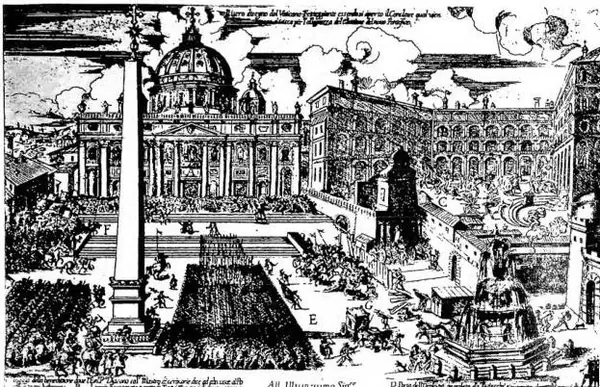
All the c. of the Avignon period (except the one from which Martin V was elected, held at Constance on 11 Nov. 1417) down to our own day (with the exception of the one in which Pius VII was elected, held at Venice) were held in Rome. The first two after the schism took place in the Dominican convent of the Minerva, and from them emerged the popes Eugene IV (1431) and Nicholas V (1447). All the other c. from the 15th to the 18th century were held in the Vatican. Some of them were very brief; a single day for the one from which, for example, Julius II (1503) and Paul III (1534) emerged; others were laborious and long, such as the one that gave the Church Benedict XIV (lasting from 19 Feb. to 17 Aug. 1740, that is 6 months).
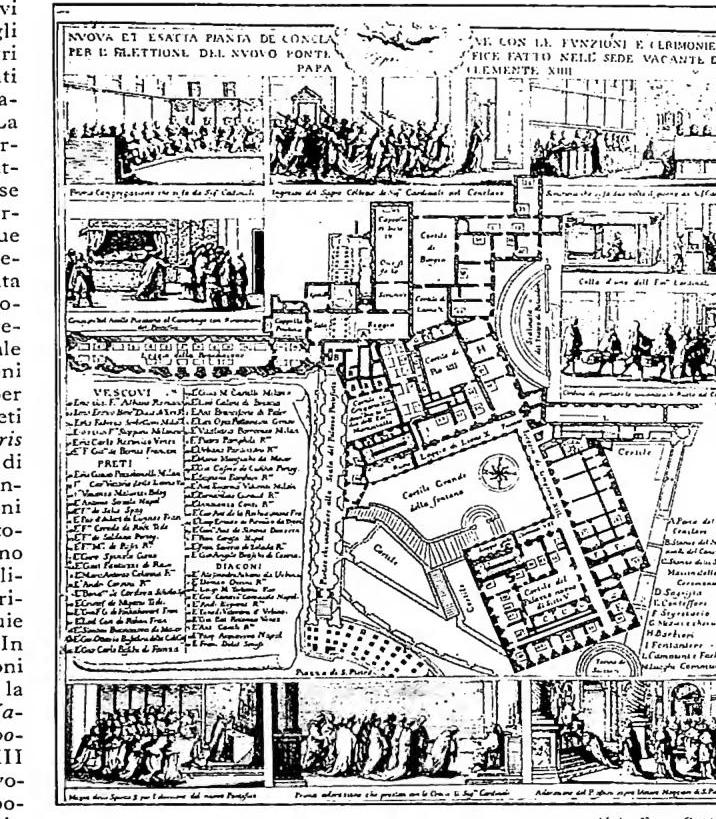
For the needs of the c. the Vatican was isolated by means of masonry, and to communicate with the outside world there were only four wheels guarded by prelates (auditors of the Sacred Rota, protonotaries, bishops and archbishops assisting the Throne) and on the outside by detachments of guards.
On the death of Pius VII (1823) the Pontifical Palace of the Quirinal was preferred for the c., since, being situated higher and more regular, it allowed a better arrangement of those two or three hundred persons who make up the c.: there were elected Leo XII (1823), Pius VIII (1829), Gregory XVI (1831) and Pius IX (1846). On the death of Pius IX (1878) it was necessary to return to the Vatican; the same was done for the c. from which emerged Pius X (1903), Benedict XV (1914), Pius XI (1922), and Pius XII (1939).
The stormy events of the last century induced the popes Pius VI, Pius VII and Pius IX to prepare norms for the case of assaults or violations of the freedom of the Sacred College. Of these extraordinary dispositions, that of Leo XIII (apostolic constitution Praedecessores Nostri) of 24 May 1882, drafted in the period of the most acute Italian anticlericalism, when an attack on the Vatican could be feared, remained in force until the recent constitution Vacantis Apostolicae Sedis of Pius XII (v. infra). Such norms (together with those contained in the Instructio annexed to the constitution) were reproduced at the end of the CIC (document III), but, after the aforementioned constitution of Pius XII, they are abrogated, and therefore are no longer reproduced in the recent editions of the CIC. In reality the c. held after the capture of Rome have been fully free and tranquil; after Pius X they have also been wrapped in the deepest secrecy.
II. CURRENT LEGISLATION
The current discipline of the conclave, regulated until now by the constitution of Pius X of 25 Dec. 1904 Vacante Sede Apostolica, reproduced as the first supplementary document at the end of the CIC, first underwent small modifications through the work of Pius XI, who on 1 March 1922 issued the motu proprio "Cum proxime", also reproduced at the end of the Code (document IX), and finally through the work of Pius XII (const. Vacantis Apostolicae Sedis, 8 Dec. 1945, in AAS, 38 [1946], p. 65 ff.), which essentially maintains the law of Pius X, making only small adjustments to it, apart from one notable one concerning the requirement of one additional ballot paper beyond the two thirds of the votes. The small changes will be noted in their place.
On the basis of these constitutions, the cardinals may neither issue new laws nor modify them, nor carry out graces and dispositions given by the deceased pontiff and not yet executed.
In particular they must avoid allowing the rights of the Apostolic See to be diminished in any way (n. 2). In urgent cases the arbiter is the Sacred College, which decides by majority of votes (n. 5).
During the vacancy a general congregation, that is, of all the cardinals, must be held every day: particular congregations will then be held, with the frequency that may be necessary, constituted by the camerlengo and the deans of the three Orders of the Sacred College, that is, by the cardinal dean of the bishops, the cardinal dean of the priests and finally the cardinal dean of the deacons: the said deans, however, may be part of the particular congregations only for three days, whereupon their respective vice-deans of the Orders take their place, and after another three days those next in order of seniority (n. 6). The particular congregation must deal only with matters of lesser importance; any considerable or contested matter must be submitted to the general congregation (n. 7). The votings take place by written and secret votes in rebus gravioris momenti. Of special importance are the preparatory general congregations that precede the conclave and that establish what concerns the obsequies of the pontiff. In the said congregations the constitution Vacantis Sedis Apostolicae of Pius XII must be read, and the cardinals must take a special oath, in which they promise religiously to observe the said constitution in force as well as the most complete secrecy, to which the dependent conclavists will also be bound. Two commissions of cardinals must then be appointed, one for the admission of the conclavists and for the designation of the various servants and attendants of the conclave, and the other for the construction and enclosure of the conclave and for the distribution of the cells: the Fisherman's Ring is then broken, as is the lead of the Apostolic Chancery. The cells of the cardinals are as a rule distributed by lot.
With the death of the pope the offices of all the cardinals cease, except for the camerlengo of Holy Roman Church and the major penitentiary: the latter and his officials continue to exercise the most important functions, which are described by the const. of Pius XI Quae divinitus of 26 March 1935, n. 12, since they refer to cases of conscience and of the internal forum, always urgent in themselves. The camerlengo, with the vacancy of the See, far from lapsing, sees the moment arrive for him to carry out his most important functions, since "the care and administration of the temporal goods and rights of the Holy See fall to him"; therefore, as soon as he has received from the master of the Chamber news of the pontiff's death, he goes to the Vatican palace to take possession of it and to exercise his office; he also takes possession of the Lateran palace and of the villa of Castel Gandolfo (n. 15). It falls to him to officially establish the death of the pope and to draw up the authentic record of it, to arrange for the embalming (respecting the will of the deceased), to notify the cardinal vicar for the functions to be carried out in the City, etc. (n. 15).
The dean of the Sacred College will then convoke all the cardinals in the Vatican
(n. 16). During the vacancy neither the office of the cardinal vicar nor that of the pontifical almoner ceases (nn. 20 and 21). The Sacred Congregations and the apostolic tribunals during the vacancy will continue to function, limited to their ordinary faculties, excluding all matters that require reference to the pontiff and also those of some importance which, not being urgent, can be postponed until after the election of the pope (nn. 23-25). During the vacancy every power over the State of Vatican City belongs to the Sacred College (n. 23). Provision is then made for the obsequies of the pope, called the novendiali, of which the last three days are the most solemn (nn. 29-31).
The election of the supreme pontiff is reserved to the cardinals alone (including those only created in consistory and even those excommunicated, provided they are not renunciatory, whose resignation has been accepted by the deceased pontiff). No right over the election has any eventual council, which with the death of the pope remains ipso facto suspended (n. 33). According to the constitution of Pius X, the cardinals entered the conclave ten days after the death of the pope: Pius XI (to give time to those far away, especially those from America) extended this period to fifteen days and permitted the Sacred College to prolong it further, but not beyond a total of eighteen days. This Pius XII sanctioned in the const. Vacantis (n. 37).
The cardinals who arrive after the conclave has begun, provided the election has not yet taken place, may enter and participate in the votings. Thus it would happen for the cardinal who had had to leave the conclave by order of the physician and then had re-entered. On the other hand, the cardinal who had not wished to enter the conclave or, having entered, had wished arbitrarily to leave it, would remain deprived of the right to vote (n. 40). The cardinals who, not being prevented by health, do not take part in the conclave, are excommunicated (n. 41).
Each cardinal may bring with him two secretaries or attendants (ecclesiastical or lay); of these, however, only one (who must be a layman) may accompany him into the conclave (n. 49). These "conclavists" must not be prelates (for fear that they may exercise influence on the election) nor religious or blood relatives and relatives by marriage in the first or second degree of the cardinals (n. 44), and they must be admitted after a diligent examination of their qualifications by the appropriate commission: they must take a most solemn oath binding them to the most absolute secrecy under the severest penalties. There remain enclosed in the c. the pontifical sacristan with a few assistants, at most six masters of ceremonies, the secretary of the Sacred College (assessor of the Sacred Congregation of the Consistory), one religious confessor, a physician, a surgeon, a pharmacist, at least two architects (n. 54 of Vacantis) with a few servants and the minimum necessary of other laborers (nn. 51-56). Since 1878 the cardinals make use of the Vatican kitchen, and the picturesque carriages of the "dapiferi" have ceased, which before 1870 brought lunch and dinner from the individual cardinals' kitchens to the Vatican.
(Int. Eur. Catl.)
Once the pope's funeral rites have been completed, and the c. prepared in the meantime, the dean or one of his delegates celebrates the Mass de Spiritu Sancto and a prelate or a religious delivers the discourse de eligendo summo pontifice, exhorting them to elect the most worthy. After the Mass, either in the morning or (more usually) in the evening, they enter the c. in procession behind the papal Cross, carried by the master of ceremonies, and, having reached the chapel, the constitution of Pius XII Vacantis is again read and the oath is again taken, then the cardinals withdraw to their cells. Meanwhile the conclavists take the oath before the camerlengo: the master of the Chamber and the marshal of the c. swear separately according to special formulas. Then, after the bell has rung three times, the c. is closed, and, once all the premises have been checked to remove any outsider, the roll-call of the conclavists is carried out in the chapel (n. 54).
The election of the pope must take place in the c. and after it has been closed; however, this is not established under penalty of nullity of the election (nullity had been established by Gregory XV, with the constitution Aeterni Patris of 15 Nov. 1631). Pius X wisely wished that the validity of the election should be beyond all dispute, and therefore eliminated this sanction, as well as the other of Julius II (constitution Cum tam divino of 14 Jan. 1505) by which a simoniacal election would be null (cf. now nn. 57 and 92 of the constitution Vacantis Sedis Apostolicae).
The enclosure of the c. cannot be violated: transgressors will be expelled, and punished by the new pope (n. 58). Once the c. is closed, no one is admitted to speak with the cardinals or with the conclavists except in the presence of the prelates guarding the c. and provided that he speaks in a loud and intelligible voice. If any outsider should dare to enter the c., he will for that very reason be deprived of every rank, honor, office or benefice (n. 59). Letters and printed matter cannot enter and still less leave the c. before being reviewed by the secretary of the Sacred College and the prelates assigned to this. It is absolutely forbidden, under penalty of excommunication, to send out of the c. newspapers or periodicals. Pius XII in the Vacantis has forbidden the introduction into the c. of telegraphic, telephone, microphone, radio, photographic, cinematographic apparatus, etc. (n. 64).
Cardinals and conclavists are bound to the most perfect secrecy so as to disclose nothing that directly or indirectly pertains to the election, under penalty of excommunication reserved exclusively to the pope (n. 60). The cardinals cannot disclose the outcome of the scrutinies to their household members under the same penalty (n. 61). This secrecy must be observed (but excommunication is not threatened) even after the election has taken place, unless the new pope dispenses someone from it in a particular way.
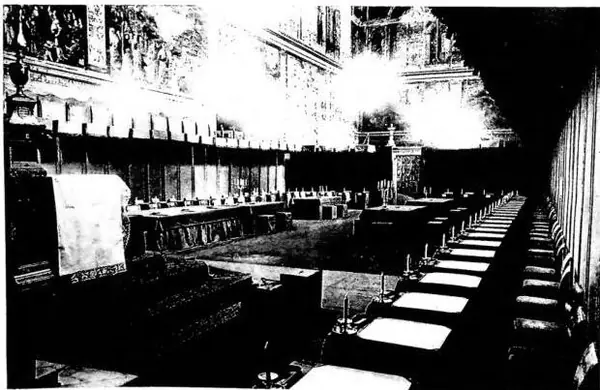
The election usually takes place in the Sistine Chapel, along whose walls as many thrones are erected as there are cardinals. One ballot is held in the morning and one in the evening: after an unsuccessful ballot (that is, according to the recent Vacantis [n. 68], every scrutiny in which a candidate does not obtain as many votes as two thirds of the voters plus one) another is held immediately, so that in fact there are four scrutinies a day. According to the norms given by Pius X, the ballot was constructed in such a way as to guarantee the most absolute secrecy and at the same time make it possible to verify whether the cardinal had given his vote to himself (which verification was made only when exactly two thirds were reached on one name). Pius XII, by requiring one vote beyond two thirds, has made the verification in question useless in every case and consequently has simplified the ballots, which now contain only the name of the elect and no indication of the elector (nn. 72-77). During the elections the cardinals dressed in the violet croccia or mozzetta were accustomed to abstain from celebrating, but they received communion in the Sistine Chapel itself: now, however, they have the faculty of celebrating Mass even during the c. (n. 65). Both in the morning and in the evening every unsuccessful scrutiny is announced to the crowd, which for the occasion gathers in St. Peter's Square, by means of the "fumata," which is dark and smoky (because, in addition to the ballots, paper or damp curls are burned in it); the scrutiny that has instead given the pope produces a clear "fumata" produced by the ballots alone.
Forbidden, under penalty of excommunication, are simony, dealings and agreements about the successor while the pope is living, the acceptance and even the direct or indirect communication of the vote of some power or sovereign (v. VETO). Forbidden under the same penalty, and null, is any pact or promise, even sworn, by which a cardinal commits himself to vote in a given manner. However, exchanges of ideas about the election are not forbidden, provided they take place during the vacancy of the Holy See (n. 95). Likewise null are the "capitulations" (v. CAPITOLAZIONE) to which the cardinals might have bound the one to be elected before giving their vote (n. 94).
After the canonical election, the dean asks the assent of the elect with a special formula consecrated by Pius XII (n. 100 of the Vacantis). Once this consent is given, the new pope already acquires full jurisdiction over the whole Church. The dean of the deacons, then, will announce to the people from the window of the loggia: "Annuntio vobis gaudium magnum. Habemus papam dominum cardinalem... qui sibi nomen imposuit...". The cardinals adore the newly elected: in the Sistine Chapel the canopies of all the cardinals except that of the one named are lowered. The new pope, clothed in white garments, gives the first blessing to the people from the window of St. Peter's. The first to give it after 1870 was Pius XI (1922).
The coronation (v.) takes place in the following days through the office of the dean of the deacons (n. 108) with the related solemn function in St. Peter's, with messages to the whole world, to heads of state, etc.
The conclavists enjoy various privileges: in the past they had very ample faculties and prerogatives which the new pope promulgated as one of his first acts: in the last c. only the privilege of the domestic oratory was granted to them. Establishing such privileges is up to the new pope each time, who also takes into account the duration of the c. itself. - See plate VIII.
Bibliography4 works
Roma papale e medioevale, Rome 1893, coll. 545-52; Lucius Lector (Msgr. G. Guthlin), Le conclave, Paris 1894. Further bibliography in A. Molien, s. v. in DDC, III, coll. 1319-42.