
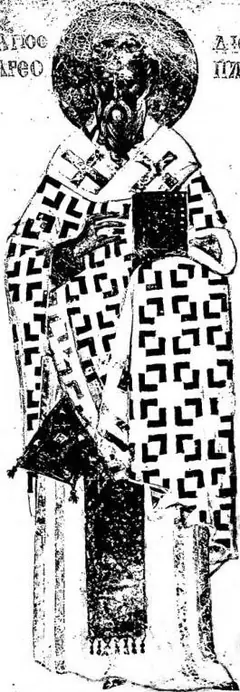
DIONYSIUS THE AREOPAGITE. - I. THE WORKS. - The corpus of the Areopagitic writings contains the following treatises (as is attested by the very ancient Syriac version of Sergius of Reshaina [d. 536] and by the oldest commentary preserved to us, that of St. Maximus the Confessor [d. 662], a large part of which, according to H. Urs von Balthasar, Das Scholienwerk des Johannes v. Scythopolis, in Scholastik, 15 [1940], p. 16 ff., would derive from the commentary of John of Scythopolis, who lived a hundred years earlier):
1. De coelesti hierarchia (CH). The word "hierarchia", introduced by D. into ecclesiastical language (J. Stiglmayr, Über die Termini Hierarch und Hierarchia, in Zeitschr. f. kath. Theol., 22 [1898], p. 180 ff.), here means the order of the angels determined by the degree of assimilation to God, or of deification (θεωσις), union (εωσις) with God, by the gift of divine light which they receive and transmit to the lower rank (μετοχή, μετάδοσις).
The names of the ranks of the angels are taken from Holy Scripture; as for the system of triads, D. claims to have received it from his teacher, but it is without doubt of Neoplatonic origin (especially from Proclus, cf. H. Koch, Pseudo-Dionysius, Mainz 1900, p. 178): a) Seraphim, Cherubim, Thrones; b) Dominations, Virtues, Powers; c) Principalities, Archangels, Angels. Through these ranks the gift of divine light descends and ascends.
2. De ecclesiastica hierarchia (EH). The treatise begins with a reference to the preceding work. The sacred order of the Church corresponds to the celestial order. The ranks of the EH too are ranks of approach to God, of deification. But since in human nature the spirit is bound to the body, our hierarchia needs sensible symbols that lead us "hierarchically to uniform deification" (PG 3, 373 A). There is then described and mystically interpreted a triad of sacraments: Baptism (θεογενεσία); the Holy Eucharist (σύνδεξι) and Confirmation (or rather μύρῳ τελετή, the consecration of the holy oil). There follows the order conferred on the clergy: a) Ordo hierarchicus (D. uses the word hierarchos instead of episkopos), who is the head of the EH as Christ is of the entire hierarchia. b) Ordo sacerdotalis (D. says hiereis and not presbyteroi). c) Ordo diaconorum (leiturgodiaconi), with a brief description and interpretation of the rite of ordination of these three ranks. In the triad of the subjects, who are called telumenoi, the author begins with the lowest: a) catechumens, energumens, penitents; b) populus sanctus, the Christians who may assist at the Holy Eucharist; c) monks, whom D. usually calls therapeutai. The last chapter of the treatise is an appendix; funeral rites are also explained mystically with orthodox eschatological doctrine (cf. J. Stiglmayr, Die Eschatologie des Ps-Dionysius, in Zeitsch. f. kath. Theol., 23 [1899], p. 1 ff.).
3. De divinis nominibus (DN). The principal work, whose title and method are of Neoplatonic origin (cf. H. Koch, op. cit., pp. 9 f., 224 ff.). It is a doctrine of the triune and one God based on the explanation of his names in Holy Scripture. Such a positive and manifold science seems to be impossible because God is above every essence (ὑπερνόμος) and above every name (ὑπερνόμος). Indeed it does not touch the superessential unity (ἔνωσις) of God but only the distinctions (not the Trinitarian ones; διχρίσεις) and powers (δυνάμεις) in the divinity, which are πρόνοια ἐκφαντορικαί and θεία θελήματα, creative powers that give being and perfection to every creature. The cause of all things can and must be enunciated from the things caused. The names that thus in a positive manner reveal God to us are: ch. 4: τὸ ἀγαθόν; ch. 5: τὸ ὄντως ὄν; ch. 6: ζωή; ch. 7: σοφία. The first is of Neoplatonic origin; the following triad too corresponds to a triad of Proclus: οὐσία - ζωή - νόος. There follows in ch. 8: δυνάμεις; ch. 9 contains a series of opposite notions which according to E. Ivanka (Aufbau der Schrift « De divinis nominibus » des Ps-Dionysius, in Scholastik, 15 [1940], p. 392) are taken from Plato's Parmenides. This influence would also explain how the next chapter treats: αἰών, χρόνος; ch. 10: εἰρήνη; ch. 11: sanctus sanctorum and similar biblical expressions; ch. 13: τὸ τέλειον καὶ ἕν. This last predication shows once again the insufficiency of all the preceding ones, including the first (bonum). Therefore the theologians (according to D., the inspired authors of Holy Scripture) would have preferred the negative method (ἀποφανική: PG 3, 981 A/B) to the positive method (καταφαντική).
4. De mystica theologia (MTh). In this small treatise the negative method is joined with mystical experience (ἔκατασις: negation, abandonment of self). The negative method is the complement of the positive one for attaining to the total transcendence of God (PG 3, 1000 B). The most divine and lofty objects of the visible and intelligible world are only the foundation, the place for the parousia of the invisible and unknowable God. From here one enters into the γνῶρος τῆς ἀγνωσίας... ἐνοῦμενος τῷ παντελῷς ἀγνώστῳ... καὶ τῷ μηδὲν γινώσκειν ὑπὲρ νῦν γινώσκων (Cf. Vl. Lossky, La théologie négative dans la doctrine de Denys l'Ar., in Rev. des sciences phil. et théol., 28 [1939], p. 214 ff.). The positive method with its θέσεις descends from God down to the last creatures; the negative method begins from these and ascends through its ἀφαρέσεις and arrives, by removing everything, at the vision of the invisible God who is hidden by the light of existing things (PG 3, 1025 B).
5. Ten epistles. They are small additions to the themes of the preceding works. Only the 7th and the 8th (cf. J. Stiglmayr, Ein interessanter Brief aus dem kirchlichen Alterthum, in Zeitschr. f. kath. Theol., 24 [1900], p. 657 f.) and also the 6th and the 10th have a more personal character.
In these preserved works D. also cites other works of his own and of his teacher Hierotheos; but it is probably a matter of literary fiction.
II. THE AUTHOR
From the works themselves it would follow that the author's name is Dionysios (ep. 7, 3). His teacher would have been a certain Hierotheos, and before him the apostle Paul, who through Hierotheos and Dionysios would have been ἐπὶ τὴν θείαν φωτοδοσίαν χειραγωγός (DN, 2, 11; 3, 2; 7, 1). As this expression already indicates, D. would have converted from paganism, and the sophist Apollophanes reproaches him for being πατρόνιας ὡς τοῖς Ἠλλήνων ἐπὶ τοὺς Ἠλλήνων οὐχ ὁσίως χρώμενος (ep. 7, 2). According to ep. 7, D. and Apollophanes would have witnessed the eclipse of the sun on the day of the crucifixion, and according to DN 3, 2, D. would have been present at the dormitio of the Blessed Virgin. From all this it has been believed that the author is the Dionysius the Areopagite of Acts 17, 34. Under this name his writings are cited for the first time by the Monophysite patriarch Severus of Antioch (512-18) and then by the Monophysites in a dispute with the Orthodox at Constantinople under Justinian I (533). But the spokesman of the Catholics, Hypatios, bishop of Ephesus, observed that if these writings had been by D., they would not have been ignored by either St. Cyril or St. Athanasius (E. Schwartz, Acta conc. oec., IV, II, p. 173). This argument holds even today. The absence of any citation for four or five centuries, the style entirely different from that of the apostolic writers, the developed doctrine of the Trinity, Christology and ecclesiology make it evident that the author was not the Areopagite. This is today generally admitted.
But for the Middle Ages the fact that St. Maximus the Confessor had defended the authenticity and orthodoxy of the Areopagitic writings was decisive. The very great influence of the Areopagite on the theology and mysticism of the Western Church from Scotus Eriugena down to Dionysius the Carthusian is well known. Hugh of St. Victor, Albert the Great and St. Thomas wrote commentaries (cf. M. Grabmann, Geschichte der scholastischen Methode, I, Freiburg 1909, pp. 88-92, who is against an overvaluation of the influence as regards St. Thomas). The medieval Latin form of D.'s works is found in the Solesmes edition (2 vols., 1937 ff.): «Dionysiaca, Recueil donnant l'ensemble des traductions latines... et synopse marquant la valeur de citations... remises dans leur contexte au moyen d'une nomenclature». Criticism revived in the times of Humanism with L. Valla and then with the Oratorian G. Morino. In the past century Catholic scholars, such as Fr. Hipler, in order to save it from the charge of forgery sought to prove that the allusions to apostolic events and persons must be interpreted by means of facts and men of the 4th century, or wished to suppose that these passages had been added by a later Monophysite forger; but they were refuted by H. Koch (Der Pseudo-epigraphische Charakter der Dionysiusschriften, in Theolog. Quartalschr., 77 [1895], pp. 362-71; id., Proklus als Quelle des Ps. D. in der Lehre vom Böhen, in Philologas, 54 [1895], p. 438 ff.) and J. Stiglmayr (Der Neuplatoniker Proklus als Vorlage des sog. Dionysius Areop. in der Lehre vom Übel, in Hist. Jahrb., 16 [1895], pp. 353 ff., 721 ff.), who proved positively that D. in De divinis nominibus, 4, 18-34 followed the treatise of the Neoplatonist Proclus (d. 485): De malorum subsistentia. Moreover Stiglmayr, seeing in the σύμβολον τῆς θρησκέως of De ecclesiastica hierarchia 3, 7 the Credo, was able to establish as a terminus that the a.
476, when the Credo was introduced into the liturgy by the Monophysite patriarch Peter Fullo (Das Aufkommen der ps.-Dionisch. Schriften, Feldkirch 1895); and he concluded from the liturgy that the homeland of D. must be sought in Syria (Eine syrische Liturgie als Vorlage des Ps. Aeropagites, in Zeitschr. f. kath. Theol., 33 [1909], p. 383 ff.; cf. also I. M. Hanssens, De patria Ps. Dion. Ar., in Ephemerides liturgicae, 38 [1924], pp. 283-92). But against his further attempt to prove that the pseudo Areopagite is the patriarch Severus of Antioch (Der sog. Dionys. Areop. und Severus von Antiochia, in Scholastik, 3 [1928], pp. 1-161) J. Lebon wrote (Le ps. Arèop. et Sévère d'Antioche, in Revue d'hist. eccl., 26 [1930], p. 881 ff.), showing the insufficiency of many historical arguments and finally also expressing doubts about the Monophysitism of D. H. Koch had insisted too much on the general dependence of D. on Neoplatonic philosophy. Stiglmayr in his translations and short commentaries on the works of D. (articles cited in Zeitschr. f. kath. Theol., 1898, 1899, 1900) and in Bibl. d. Kirchenväter (Munich 1911 and 1933) was able to gather many brief allusions and parallel passages in Clement of Alexandria, Origen, Cyril of Jerusalem, St. Basil and Gregory of Nyssa. Lately there has been a desire to go further: thus Ceslao Pera (Denis le mistique et la ἀνεφάγια, in Revue des sciences phil. et théol., 25 [1936], pp. 5-75) claimed to show in D. a disciple of St. Basil; but his argumentation is entirely insufficient. Much more cautious is E. von Ivanka in his article Der Aufbau der Schrift De divinis nominibus (in Scholastik, 15 [1940], p. 386 ff.), although he has discovered a surprising analogy between the attributes of God in De divinis nominibus and the names of Christ in De perfecta Christiani forma of Gregory of Nyssa; he admits that if this case remains isolated it cannot shake the foundations laid by Stiglmayr and Koch. Nevertheless such works are of great importance for the still entirely fluctuating evaluation of the author and his work. Thus for K. Richstätter (Der Vater der christlichen Mystik und sein verhängnisvoller Einfluss, in Stimmen der Zeit, 114 [1928], p. 241 ff.) the unsuccessful synthesis of D. between Neoplatonism and Christianity is responsible for the pantheistic and quietistic currents in mysticism from the Middle Ages onward. According to him and the dogmatic theologian J. Pohl, modern Catholic theology and mysticism should renounce the authority of D. Instead H. Ball (Byzantinisches Christentum, Munich 1931, pp. 62-249) sees in D. one of the greatest theologians of the Eastern Church; he fully accepts the conclusions of modern criticism but explains the falsification as an essential element of the hieratic style. In a more indirect and scientific manner Vlod. Lossky fights for the cause of D. (cf. article cited, in Rev. des sciences phil. et théol., 28 [1930], p. 210, note 1).
Bibliography5 works
Edmondo Beck
DIONYSIUS THE AREOPAGITE IN THE LATIN WEST
The first entry of D. into the West goes back to around 758, as appears from a letter of Pope Paul I to Pepin the Short, who reminds the king of the sending of a consignment of books among which figure Aristotle and D.; but this first shipment seems to have had no effect. In the year 827 the ambassadors of the Greek emperor Michael the Stammerer offer, among other things, to Louis the Pious the manuscript containing the entire Corpus Dionysiacum. From documents of the time it is known that the abbot Hilduin immediately set about the Latin version, which was completed between the years 828-30 and the year 835; this first version, hitherto unknown, has been rediscovered and edited by Fr. G. Théry (Études dionyssiens. Hilduin traducteur de Denis, II, Paris 1937).
The version that instead circulated in the Middle Ages was that of Scotus Eriugena in the year 858 under Charles the Bald: Fr. G. Théry has established that Scotus knew Hilduin's version and improved it, that is, made a revision of it, and that the new version can be called "optical" as opposed to the other, which should be called "phonetic." Later, toward the middle of the 13th century, a certain John Sarracenus made a revision of Scotus's translation, purging it of Grecisms (G. Théry, Jaen Sarrazin, traducteur de Scot Eriégne, in Studia mediaevalia, Miscellanea R. J. Martin O. P., Bruges [1948], pp. 358-81), which would be used by St. Albert the Great, St. Thomas and later scholastics. Other versions are owed to Robert Grosseteste in the 13th century, to Ambrose Traversari (of whom Nicholas of Cusa would make use) and to Marsilio Ficino himself in the full Renaissance, impatient with the barbarous Latin of the first versions. But the defects of those are not always imputable to the translators, because the Greek codex itself (Paris, Bibl. Nat. gr. 437) on which they are based presents not a few errors: nevertheless it remains to their great credit to have created a doctrinal contact between the Greek world and the Latin one, which has no equal except in the entry of the systematic works of Aristotle. It should be noted that the news of Scotus's version provoked a reaction from Rome: Pope Nicholas I, in fact, writing to Charles the Bald (around the year 861-62) complains that the copy for approval was not sent to Rome, "praesentum cum idem Ioannes multae scientiae esse praedicetur olim, sed non sane sapere in quibusdam frequenti rumore dicatur" (PL 122, 1025-26).
There is not yet a comprehensive study that treats in depth the influence of D. on scholastic speculation and on Western spirituality: such influence, however, has been notable and in not a few crucial points of nascent Christian theology and mysticism is to be called decisive and superior to that of St. Augustine, and this not only thanks to the cover of the pseudonym but because of the speculative depth of the doctrines, the methodical procedure and the arduous and sublime style in a shrewd synthesis of biblical and Neoplatonic terms. In fact, if D. takes schemas and terms from Neoplatonism, all his thought is an indictment against the fundamental Neoplatonic motifs. Thus, speaking of the divine emanations or processions, he affirms that all are found united in God (DN, V, 2) and further on (XI, 6) directly refutes the capital principle of Neoplatonism of (participated) "participations," to which he opposes the Christian conception. God becomes the unique, absolute cause, immediately present to every reality: the doctrine of intermediaries, emanatist and dispersive, is completely absorbed into Christian creation, and such intermediaries therefore lose that proper ontological sphere that Neoplatonism had assigned to them as the last bulwark of polytheism. Of this transformation, on which the whole medieval assimilation of D. rests, St. Thomas had clear knowledge (cf. Comm. in l. De divinis nominibus, ch. 5, lect. 1; ed. Parm., XV, 347 b.; Comm. in l. De causis, lect. 3; ed. Parm., XXI, 722 a.
In every phenomenon of spiritual irradiation, the definitive judgment of its value depends not only on the reality and objective consistency of what provoked it, but also on the intrinsic reality of the phenomenon itself, that is, on the way in which the scholastics appropriated the terms and developed their own reflections. In this direction a history of Latin Dionysianism will make clear how what is most profound and perennial that medieval thought elaborated for the following centuries, overcoming the quarrels of the schools and the limits of the systems, is owed to the presence of D.: the essence of this influence is to be seen not so much in a body of well-defined doctrines, but in the typically speculative orientation and in a complex of suggestions that it offers, in a particular mentality that the books of this distinguished unknown author have created. Fr. Théry (Études Carmélitaines, 23 [1938], II, p. 70 ff.) distinguishes the periods of this influence: a) in the 9th century, with Hilduin and Scotus Eriugena, with echoes in Paschasius Radbertus and Hincmar of Reims; b) 12th-13th centuries, with Hugh Etherian, John of Salisbury, G. Sarracenus, Hugh and Thomas of St. Victor called Thomas
Gallus and who was at Vercelli the master of St. Anthony of Padua; and St. Bernard himself, albeit only through the Ambigua of St. Maximus the Confessor (cf. E. Gilson, La théologie de st Bernard, Paris 1947, p. 38 ff.); c) 13th century (2nd half), with St. Albert the Great and his disciples St. Thomas and Ulrich of Strasbourg, d) 14th century, of often anonymous expansion especially among the Roman mystics, attested by the wealth of Dionysian manuscripts in Austrian libraries, unlike the French ones (cf. G. Théry, Catalogue des manuscrits dionysiens des bibliothèques d'Autriche, in Arch. doctr. et litt. du Moyen Age, 10 [1935-36], pp. 163-264 and 11 [1937-38], pp. 87-130; it is a matter of fully 50 manuscripts). In this period mention should be made of the Dominicans Theodoric of Freiberg and Eckhart, Tauler and Bl. Suso himself, and, at the end of the century, G. Gerson, studied by Combes (Jean Gerson commentateur dionysien, Paris 1940). One can, it is probable, add a 5th period from the 15th century onward with Denis the Carthusian and Cistercian spirituality, Nicholas of Cusa continued by Lefèvre d'Etaples in France, Marsilio Ficino and Florentine Humanism. The mystical theology of D. is carried to its ultimate consequences by the anonymous Englishman of the 14th century in the writing: Cloud of Unknowing (Nube dell'inconscibile).
It is symptomatic that D. had greater success in speculative circles as in the Dominican school (St. Albert comments on him in full: his commentary on the De divinis nominibus is still unpublished) and seems scarcer in the Franciscan school. Of St. Thomas, who cites him about 2000 times, Durantel (St Thomas et le Pseudo-Denis, Paris 1919, p. 63) has maintained that to D., more than to others, the Angelic Doctor has recourse in the crucial moments of his thought: something that Durantel sought to prove by making a minute comparison of all the Thomist citations. An analogous work had already been done in the 16th century by the Jesuit Balthasar Cordier, a meritorious translator, editor and commentator of the entire Corpus Dionysiacum (Prolegomena: PG 3, 96). It should be noted that St. Thomas had identified the Neoplatonic character of D. (s., plerumque utitur stilo et modo loquerodi quo uebantur platonici, qui apud modernos est inconsuetus: Prologus in Comm. sup. I. De Divinis Nom., ed. Parm., XV, p. 259, col. b) and had warned against the misunderstanding (perversus intellectus) made by some of certain Dionysian expressions, as Amalric of Bène slipped into formal pantheism (cf. C. Gent., I, 26: "Quod Deus non est esse formale omnium", and Comm. sup. I. De Divinis Nom., c. I, l. 2; ed. cit., p. 266, col. a).
D.'s influence on Nicholas of Cusa was filtered into a more direct fidelity to Neoplatonic principles, especially those of Proclus, whom Cusanus considers a disciple of D. (De venatione sapientiae, ch. 22; Paris ed. 1514, vol. I, fol. ccixv.); Baur, who has noted the citations of D. in Cusanus, affirms that the so-called "negative theology" does not stand on its own but functions dialectically with the preceding positive theology, that is, the investigative theology of the divine attributes. At that same time the chancellor Gerson calls him the founder of speculative mysticism: "Magnus Dionysius eductus a Paulo primus videtur hanc theologiam speculative tradidisse" (cf. A. Combes, Etudes Gersoniennes, in Arch. doctr. et litt. du Moyen Age, 12 [1939], p. 291).
Recently, regarding the thesis maintained by J. Baruzzi about St. John of the Cross as inclined to mystical negativism and quietism (Saint Jean de la Croix et le problème de l'expérience mystique, II, Paris 1931) through the influence of D., Puech responded that it is rather in Origen that we find the dramatic and affective character proper to the "spiritual marriage" and the "dark night" of the great Spanish mystic: a judgment that may concern the objective content of the doctrines, not their historical filiation, because it is beyond doubt that the mysticism of D. had reached St. John of the Cross through the scholastic and Thomistic tradition in which he had been formed and of which the very Dionysian terminology preserved by him is the evident proof (cf. Ascent of Mount Carmel, II, ch. 7, 5). The psychological-anthropological character of the new mysticism goes back, as at its first origin, to the same Aristotelian psychology of the apprehensive and appetitive faculties whose nature and functions St. John shows (for example, in the Dark Night) that he knows to the bottom.
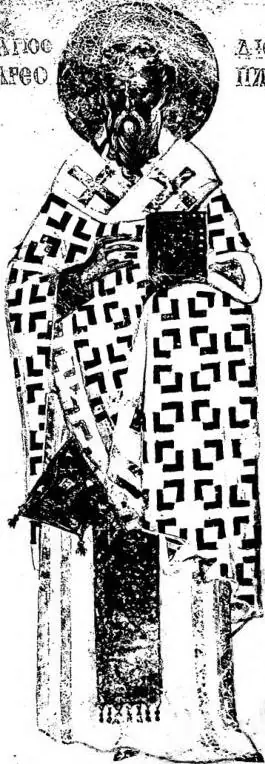
Thus, without D.'s contribution and stimulus to Western thought, the latter would probably have closed itself off within Augustinian psychologism and would have been incapable of achieving, above all through the merit of St. Thomas, the synthesis of Platonism and Aristotelianism to which Neoplatonism had applied itself in vain, and it would not have been able to confront on the theoretical plane the threat of Averroism. - See plate XCIX.
Bibliography11 works
Cornelio Fabro