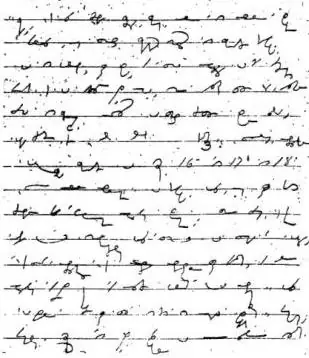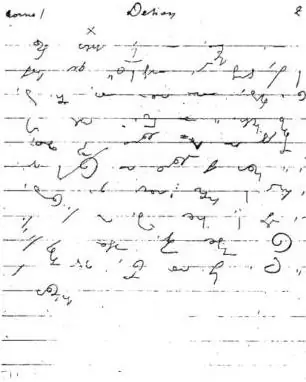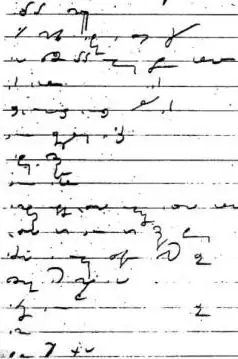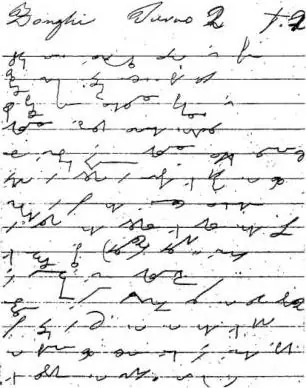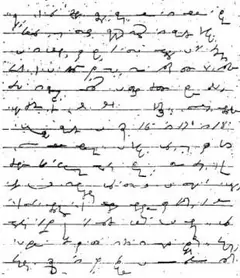
TACHYGRAPHY. - T. (from the Greek ταχύς "swift" and γραφή "writing"), modernly called "stenography," is abbreviated writing with suitable signs and rules, for the purpose of saving time and space and of recording speech.
To the Egyptians and the Hebrews (c. 1000 B.C.) are traced the first abbreviations (v.) of writing, devised to save labor and material, or for secrecy. But when the need arose to follow and preserve the words of orators and public debates, an attempt was made to replace common abbreviations with new and special writing expedients: simplifications of letters, variations of signs and monogrammatic formations, from which a particular script derived.
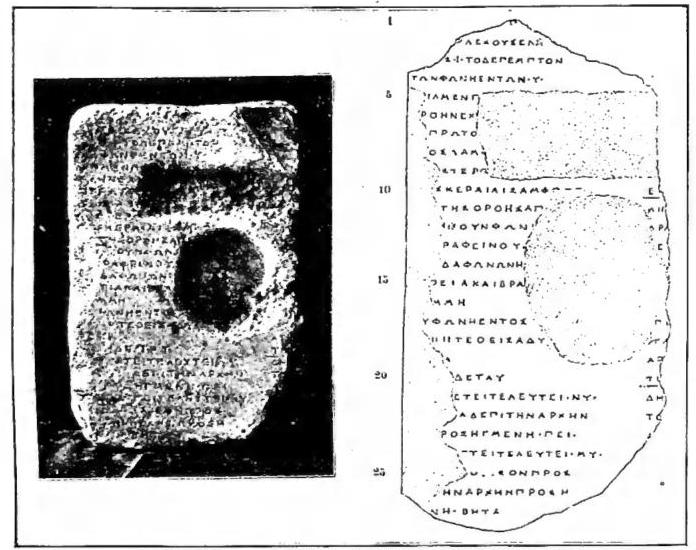
It is believed that in Greece attempts of this kind arose as early as the 4th century B.C., following the development of eloquence and philosophical dissemination, and the collection of Socrates' discourses by means of σημεία, or signs (distinct from γράμματα, or common letters), is attributed to Xenophon (cf. Diogenes Laertius, Vita Xen., II, 48). However, no traces of this ancient Greek t. survive, and it is still doubtful whether the signs of a slab from the Acropolis (350 B.C.), now in the National Museum of Athens, and those of two tablets of the 3rd century found in 1894-95 among the ruins of the temple of Apollo at Delphi, belong to it. The oldest and most certain examples of Greek t. date to the 2nd-4th centuries A.D. (the funerary stone of Asterius at Salona, the Leipzig papyri, syllabaries).
More numerous are the accounts concerning Latin t. The first notae vulgares are attributed to the poet Quintus Ennius (Isidore, Etym., II, 22); Marcus Valerius Probus established a system of sigla (singulae litterae) in opposition to a genuinely tachygraphic one. But the best known is the one that took its name from M. Tullius Tiro (100-4 B.C.), freedman of Cicero, whose first application would have occurred, according to Plutarch, on 5 Dec. 63 B.C., when, by arrangement of Cicero as consul, Cato the Younger's speech against Catiline was recorded in the Senate.
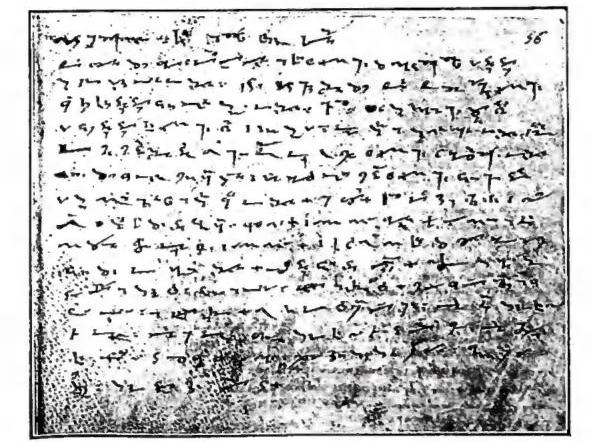
However, no direct knowledge of Tiro's work survives either. The oldest documents with Tironian notes (so called from the 4th century onward) date to the 9th-10th centuries (the Commentaries of Cassel, Paris, Bern, Madrid), and from them an attempt has been made to deduce historically their formation and development. According to the most recent studies, the notae consisted first of all in the simplification of the sigla and letters already in use, especially of cursive writing; they could have multiple forms and various positions, be traced upright or inverted, according to the meanings to be assumed and the parts, initial or secondary, of the words to be indicated. The signs could combine on the model of ancient ligatures; contraction and truncation, crossing and the dot were also widely used, recourse being had, for the need of distinctions, even to Greek signs or those of Italic scripts. From the 1st century, with the development of a Greek t. corresponding to the spread of Hellenic culture, reciprocal Greco-Latin influences are also noted in monogrammatic formation, with a more decided use of two kinds of signs: signum principale, for the fundamental part of the word, signa auxiliaria (small and traced as superscripts) for the endings. Although it has not been possible to reconstruct, despite various attempts, a Tironian grammar, it is by now certain that this t. did not consist merely of a collection of conventional signs to be kept laboriously in memory.
Others contributed to the development of Roman t. after Tiro, and especially Vipsanius Philargyrus, freedman of Agrippa (13 B.C.), Aquila, freedman of Maecenas (8 B.C.), and Seneca, perhaps the philosopher, who collected the whole (as St. Isidore attests) and arranged it in 5000 notes; of its diffusion the writers speak from the 1st century B.C. onward (Cicero, Quintilian, Horace, Ovid, Martial, Manilius, Pliny). Ausonius (v.) dedicated an ode to it. It received new growth from Christianity through the work of the notarii or exceptores, who recorded the trials of the martyrs, sometimes themselves condemned (St. Genesius of Arles, St. Adrian of Nicomedia, St. Cassian of Tangier) for having thrown down their tablets and stylus and declared themselves Christians. St. Cassian of Imola (v.) would have been martyred by the youths to whom he taught t. St. Cyprian, bishop of Carthage, updated the notes for the use of the Church, and they then had wide application in the propagation of the Christian word.
It is not excluded that t. contributed to the composition of the Gospels, and it is held that St. Paul dictated to tachygraphs (cf. L. De Grandmaison, Jésus Christ, I, Paris 1920, p. 1; G. Ricciotti, Paolo Apostolo, Rome 1946, ch. 8 and elsewhere). More certain information is had concerning it with regard to the Fathers of the Church, both in the East and in the West, who sometimes allude to it in their works; especially St. Jerome (J. de Ghellinck, Sulle orme dei primi scrittori cristiani, in Civ. Catt., 1934, II, pp. 43-56) and St. Augustine, who made use of it for his colloquies, writings and disputations (P. Gorla, S. Agostino, Milan 1936, pp. 483, 487, 614, 693). A stenographic service was organized, with the involvement of St. Augustine himself, for the Conference of Carthage (411). There is, moreover, evidence that notarii were employed in various councils and synods of the Church, beginning with the Council of Nicaea (325).
Under the Empire of Byzantium and during the barbarian dominion in Italy, the notarii had offices and colleges at the courts, and from them the notariate originated (v. NOTARIO). Likewise at the pontifical Court, with the popes Gelasius, Vigilius, Pelagius and St. Gregory the Great, whose works were preserved by his tachygraph Aemilianus. In this period the examples of oratorical t. become various; tachygraphic signs, alternated with the abbreviations of common writing, are instead rather frequent in documents and, as signum recognitionis, in royal and imperial diplomas, especially those of the Merovingians and Carolingians, and also in papal bulls; while the greatest use of Tironian notes, for brachygraphic purposes, is found in the codices written in monastic scriptoria (Montecassino, Bobbio, Fulda, Corbie, Reims, Tours, St. Gall); so that the abbreviations of writing often come to conform to those of t., not a few of which remain in current use.
From the 6th to the 11th century, meanwhile, a Greek syllabic t. (the Byzantine-Egyptian system and the system of Grottaferrata, attributed to St. Nilus the Younger) and a Latin one are formed and enter documentary use (the latter was believed to have arisen in the Lombard chancery following the decline and transformation of the Tironian notes). Schiaparelli distinguishes two types of it (ancient and new), and in 1887 examples of it were discovered by J. Havet in the bulls of Pope Sylvester II.
Among the codices that survive with Greek tachygraphic notes, notable are the cod. Nomus (Brit. Mus., Add., 18231) of 972, the ms. Par. 3032 of Hermogenes' Ars rethorica, and the cod. Vat. gr. 1809 in Grottaferrata characters. With Tironian notes are the Breviarium Alaricianum, the Capitularies of the Frankish kings, published in 1747 in Paris by the Benedictine P. Carpentier (Alphabetum Tironianum), a manuscript of St. Martin of Tours containing the Bucolics and the Georgics of Virgil, a text of St. Isidore that is found in Venice, a Mass entirely in notes, coming from the monastery of St. Remy and owned by the Vatican Library (cod. Reg. lat. 191), the Psalters of Paris and of Bern. Tachygraphy had a revival in England through the work of the monk J. Tilbury (1115-90), considered the author of the Ars notaria (1174), an attempt at a new system on grammatical principles, which departs from the Tironian notes (cf. V. Rose, Ars notaria, in Hermes, 8 [1874], pp. 303-26), but which does not seem to have had any practical application. Two manuscript copies of it are found, in London and in Oxford, and a 12th-century codex (Plut. XXX, 29) at the Biblioteca Laurenziana in Florence, under the title of Ars notaria Aristotelis.
(photograph L. Ciochi, Florence)
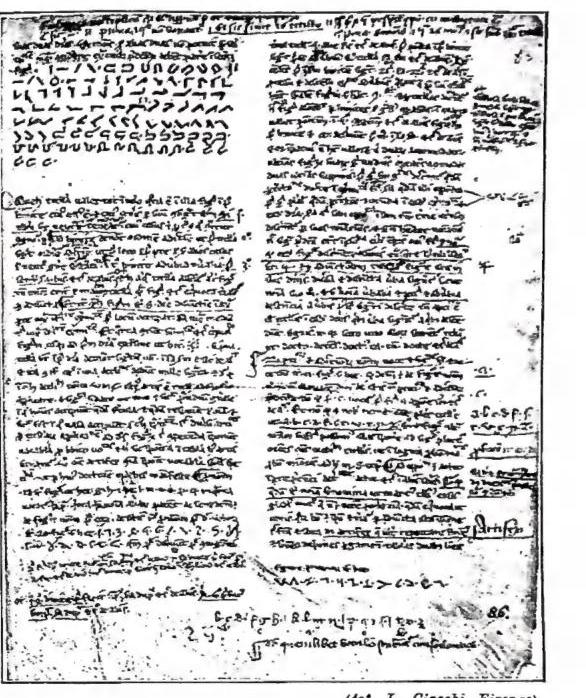
Tachygraphy established itself widely in the medieval Universities for taking down the lectures of jurists and counted among its devotees also St. Thomas Aquinas, whose tachygraphic autograph (ms. 3997) of a page of the Super Boetium de Trinitate is preserved at the Biblioteca Casanatense in Rome. Dante too alludes to tachygraphy (Par., XIX, 133-35), and it, although by then far removed from the Tironian notes and confused with steganography (secret writing) or with the conventional abbreviations of the time, supplied the needs of religious oratory (13th-16th centuries) with the collection of the vernacular sermons of St. Bernardino of Siena, by the cloth-shearer Benedetto di Mastro Bartolomeo (1427), of the sermons of Fra Girolamo Savonarola, by the notary Lorenzo Violi (1492-98) and of the discourses of Martin Luther.
With the invention of printing and the abandonment of many abbreviations, there appeared on the one hand a new direction of tachygraphy and on the other a current of studies and research on the ancient Tironian notes, whose rediscovery was due to the abbot G. Triennio (v.). He was followed by learned scholars, among whom P. Bembo, who in 1513 received from Pope Julius II the task of deciphering the De sideribus of Gaius Julius Hyginus in Tironian notes; the Belgian Joest Lips (1574-1606), the Dutchman G. Gruter (1560-1627), who made the first collection of notes and gave rise to the studies on the Tironiane, in which J. Mabillon (De re diplomatica, I, Paris 1681, p. 18 and pl. 16), the aforementioned P. Carpentier (1697-1767) and Ulrich Kopp (1762-1834), author of the Palaeographia critica (Mannheim 1817), who listed 13,000 notes, interpreting them as having come, through conventional modifications, from the letters of the Latin alphabet. These studies were renewed and expanded in France by E. Chatelain, J. Tardif, J. Havet, V. Jusselin; in Germany by W. Schmitz, who published and illustrated the Commentaries of Cassel (1893), C. E. Krause (1853), O. Lehmann (1869), F. Ruess (1879); in Austria by Th. Sickel (1867); in Italy by C. Paoli (1840-1902), L. Schiaparelli (1871-1934), C. Cipolla, Cardinal G. Mercati, A. Cerlini; and, with a particular approach, by G. L. Perugi, who, in a work of his from 1911, contested Kopp's deductions, upholding a new theory (not conventionalism, but a phonetic-syllabic basis and derivation of the signs from the scripts of the paleo-Italic peoples) and ruling out the use of the notes for tachygraphic purposes.
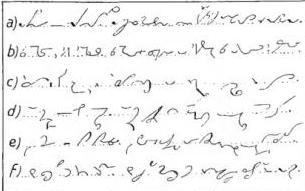
The new direction of tachygraphy, determined in England by political and parliamentary developments, manifested itself at the beginning of the 17th century with the system of the priest J. Willis (1602), who introduced the term "stenography", adopted a geometric alphabet and the criterion of selecting the elements indispensable for the construction of words. He was followed by countless authors, the most notable of whom were S. Taylor (1786), who made the system completely geometric with the omission of vowels, and I. Pitman (1837), who elaborated the concept of "phonography". The geometric school spread especially in France (Th. Bertin, 1792; I. Prevost, 1866; E. Duployé, 1867, a system that is still the best known there) and in Spain (F. Marti, 1800), while in Germany the cursive system of F. X. Gabelsberger (1789-1849) established itself for its rational and scientific merits. In Italy, especially through the impetus of political events, geometric systems imitating French and English models (Molina, Amanti, Taylor-Delpino) spread from as early as 1797, as well as, from 1885, the Pitman-Francini; what prevailed, however, and is still the most widespread, was the application of Gabelsberger's system made by Enrico Noe (1835-1914) and published in 1863. Meanwhile mixed systems have arisen, in England (J. Gregg, 1888, very widespread in America, in addition to Pitman), in Italy (Meschini, 1906 and 1916; Cima, 1917) and unified in Germany (Einheitswirtschaft, 1924), and in Hungary (Radnai, 1927), while shorthand has extended its applications to every field (politics, journalism, schools, commerce and industry, the army, the courts).
In the very life of the Catholic Church shorthand has notable achievements to its credit. Mention should be made of the shorthand service for the Vatican Council (1869-70) organized by order of Pius IX and entrusted, under the direction of the priest Virginio Marchese (1831-1917), to 23 clerics of different nationalities (Th. Granderath, Geschichte des Vatikanischen Concils, French trans., I, Brussels 1907, p. 476; II, ibid.
1907, p. 438 and elsewhere; F. Giulietti, Un testamento stenografico e il Concilio Vaticano del 1870, Florence 1950).
The stenographic art has had and still has numerous devotees in the modern ecclesiastical world. Among the authors of systems are to be counted: for France Msgr. Villecourt (1787-1867) and the abbé Emil. Duployé (1883-1912); for Germany the Benedictine Girolamo Gratzmüller (1853); for Italy the priest Salvatore Morso (1813), the abbé Luigi Caterino (1822), the canon Taddeo Consoni (1826), the Dominican Ludovico Roletti (1853), the Augustinian Serafino Marchionni (1903); for England the Rev. Philip Gibbs (1736) and the Jesuit William Tatlock, who applied (1913?) the Pitman system to the Latin language. The missionary J. Le Jeune (1860) used a stenographic system of his own invention to spread religious writings in the Chinook language among his confreres and the evangelized Indians of British Columbia (J. Mooney, Shancap Indians, in Cath. Enc., XIII, p. 764). - See pl. CXX.