
TACHIGRAFIA. — Tachygraphy (from the Greek ναχός, “swift,” and γραφή, “writing”), nowadays called “stenography,” is abbreviated writing using suitable signs and rules, with the aim of saving time and space and of recording speech.
abbreviations (v.) of writing are traced back to the Egyptians and the Hebrews (ca. 1000 B.C.), devised in order to save labor and material, or for secrecy. But when the need arose to follow and preserve the words of orators and public debates, attempts were made to replace ordinary abbreviations with new and special writing devices: simplifications of letters, variations of signs, and monogrammatic formations, from which a particular script developed.
It is believed that attempts of this kind arose in Greece as early as the 4th century B.C., following the development of eloquence and the dissemination of philosophy; Xenophon is credited (cf. Diogenes Laertius, Vita Xen., II, 48) with recording the discourses of Socrates by means of σημεία, or signs (as distinct from γράμματα, or ordinary letters). No traces of this ancient Greek tachygraphy have, however, been found, and it is still doubtful whether the signs on a stele from the Acropolis (350 B.C.), now in the National Museum of Athens, and those on two tablets dating from the 3rd century, discovered in 1894–95 among the ruins of the temple of Apollo at Delphi, belong to II. The oldest and most reliable examples of Greek tachygraphy date from the 2nd–4th centuries A.D. (the funerary stone of Asterius at Salona, papyri from Leipzig, syllabaries).
There is more information concerning Latin tachygraphy. The first notae vulgares are attributed to the poet Quintus Ennius (Isidore, Etym., II, 22); Marcus Valerius Probus established a system of sigla (singulae litterae) in opposition to a genuinely tachygraphic system. The best known, however, was the system that took its name from M. Tullius Tiro (100–4 B.C.), Cicero’s freedman; according to Plutarch, its first application is said to have occurred on 5 December 63 B.C., when, by order of Cicero as consul, Cato Uticensis’ speech against Catiline was recorded in the Senate.
The work of Tiro, too, is not directly known. The oldest documents containing Tironian notes (so called from the 4th century onward) date from the 9th–10th centuries (the Commentaries of Cassel, Paris, Bern, and Madrid), and attempts have been made to deduce from them the historical formation and development of the system. According to the most recent studies, the notae consisted first of all in the simplification of sigla and letters already in use, especially those of cursive writing; they could have multiple forms and various positions, and could be drawn upright or reversed, according to the meanings they were to assume and the initial or secondary parts of words they were intended to indicate. The signs could be combined on the model of ancient ligatures; contraction and truncation, crossing and the dot were also used extensively, with Greek signs or signs from Italic scripts being employed when distinctions were necessary. From the 1st century onward, with the development of a Greek tachygraphy corresponding to the spread of Hellenic culture, reciprocal Greek-Latin influences can also be observed in monogrammatic formation, together with a more deliberate use of two classes of signs: signum principale, for the fundamental part of the word, and signa auxiliaria (small and written as superscripts), for the endings. Although it has not been possible, despite various attempts, to reconstruct a Tironian grammar, it is now certain that this tachygraphy consisted not merely of a collection of conventional signs to be laboriously memorized.
Others contributed to the development of Roman tachygraphy after Tiro, especially Vipsanius Philargyrus, Agrippa’s freedman (13 B.C.); Aquila, Maecenas’ freedman (8 B.C.); and Seneca, perhaps the philosopher, who collected the whole system (as St. Isidore attests) and arranged it into 5,000 notes. Writers from as early as the 1st century B.C. speak of its diffusion (Cicero, Quintilian, Horace, Ovid, Martial, Manilius, Pliny). Ausonius (v.) dedicated an ode to II. It received a new impetus from Christianity through the notarii or exceptors, who recorded the trials of the martyrs and were sometimes themselves condemned (St. Genesius of Arles, St. Adrian of Nicomedia, St. Cassian of Tangier) for having thrown down their tablets and stylus
and declared themselves Christians. St. Imola (v.) is said to have been martyred by the youths whom he taught tachygraphy. St. Cyprian, bishop of Carthage, revised the notes for the use of the Church, and they subsequently found wide application in propagating the Christian word.
It cannot be ruled out that tachygraphy contributed to the composition of the Gospels, and it is believed that St. Paul dictated to tachygraphers (cf. L. De Grandmaison, Jésus Christ, I, Paris 1920, p. 1; G. Ricciotti, Paolo Apostolo, Rome 1946, chap. 8 and elsewhere). More certain information is available concerning the Fathers of the Church, both in the East and in the West, who sometimes mention it in their works; especially St. Jerome (J. de Ghellinck, Sulle orme dei primi scrittori cristiani, in Civ. Catt., 1934, II, pp. 43–56) and St. Augustine, who used it for his conversations, writings, and disputations (P. Gorla, S. Agostino, Milan 1936, pp. 483, 487, 614, 693). A stenographic service was organized, with the involvement of St. Augustine himself, for the Conference of Carthage (411). There is, moreover, evidence that notarii were employed at various councils and synods of the Church, beginning with the Council of Nicaea (325).
Under the Byzantine Empire and during the barbarian rule in Italy, the notarii held offices and formed colleges at the courts, and the notariate originated from them (v. NOTARIO). The same was true at the papal court, under Popes Gelasius, Vigilius, Pelagius, and St. Gregory the Great, whose works were preserved by his tachygrapher Emiliano. During this period, examples of oratorical tachygraphy became increasingly numerous; tachygraphic signs, alternating with abbreviations of ordinary writing, are instead fairly frequent in documents and, as signum recognitionis, in royal and imperial diplomas, especially those of the Merovingians and Carolingians, as well as in papal bulls. The greatest use of Tironian notes, for brachygraphic purposes, is found in codices produced in monastic scriptoria (Montecassino, Bobbio, Fulda, Corbie, Reims, Tours, S. Gallo); consequently, abbreviations in writing often came to conform to those of tachygraphy, many of which remain in current use.
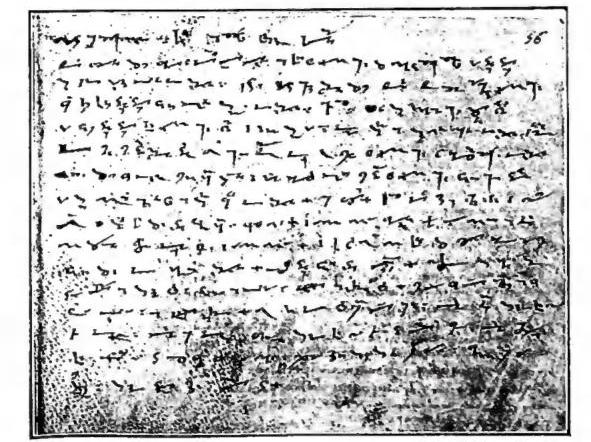
Among the codices preserved with Greek tachygraphic notes, the following are noteworthy: cod. Nomus (Brit. Mus., Add., 18231), from 972; ms. Par. 3032 of Hermogenes’ Ars rethorica; and cod. Fat. gr. 1809, in Grottaferrata characters. Bearing Tironian notes are the Breviarium Alaricianum and the Capitularies of the Frankish kings, published in 1747 in Paris
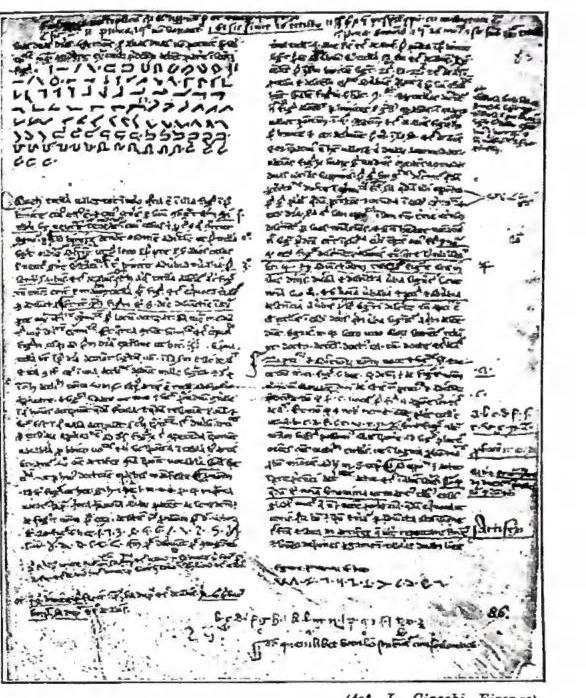
(phot. L. Ciochi, Florence) TACHIGRAFIA - Ars Notaria Aristotelis with tachygraphic notes. Florence, Biblioteca Laurenziana, cod. Laurent. XXX, 29 (13th century).
Tachygraphy became widespread in medieval universities for recording the lectures of jurists, and among its practitioners was also St. Thomas Aquinas, whose tachygraphic autograph of a page from the Super Boetium de Trinitate is preserved in the Biblioteca Casanatense in Rome (ms. 3997). Dante also alludes to tachygraphy (Par., XIX, 133–35), and it, although by then it had moved away from Tironian notes and become confused with steganography (secret writing) or with the conventional abbreviations of the period, served religious oratory (13th–16th centuries) through the recording of the vernacular sermons of St. Bernardino da Siena by the cloth shearer Benedetto di Mastro Bartolomeo (1427), of the sermons of Fra’ Girolamo Savonarola by the notary Lorenzo Violi (1492–98), and of the speeches of Martin Luther.
(courtesy of F. Giulietti)
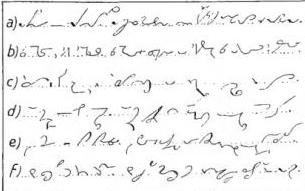
TACHIGRAFIA — Essays on modern systems of Italian shorthand.
a) Gabelsberger-Noe; b) Taylor-Delpino; c) Pitman-Francini;
d) Marchionni; e) Meschini; f) Cima. Text: Shorthand is an extremely ancient art. Modern scholarship attributes its invention to the Romans.
Among these, J. Mabillon (De re diplomatica, I, Paris 1681, p. 18 and pl. 16), the aforementioned P. Carpentier (1697–1767), and Ulrich Kopp (1762–1834), author of Palaeographia critica (Mannheim 1817), in which he listed 13,000 notes, interpreting them as having originated, through conventional modifications, from the letters of the Latin alphabet, came to prominence. These studies were renewed and expanded in France by E. Chatelain, J. Tardif, J. Havet, and V. Jusselin; in Germany by W. Schmitz, who published and illustrated the Commentarii of Kassel (1893), C. E. Krause (1853), O. Lehmann (1869), and F. Ruess (1879); in Austria by Th. Sickel (1867); in Italy by C. Paoli (1840–1902), L. Schiaparelli (1871–1934), C. Cipolla, Cardinal G. Mercati, and A. Cerlini; and, with a particular orientation, by G. L. Perugi, who, in a work of his from 1911, challenged Kopp’s deductions, advancing a new theory (not conventionalism, but a phonetic-syllabic basis and the derivation of the signs from the scripts of the Paleo-Italian peoples) and excluding the use of the notes for shorthand purposes.
The new direction of shorthand, occasioned in England by political and parliamentary developments, appeared at the beginning of the seventeenth century with the system of the priest J. Willis (1602), who introduced the term “stenography,” adopted a geometric alphabet, and applied the principle of selecting the elements indispensable for constructing words. He was followed by countless authors, the most notable being S. Taylor (1786), who made the system completely geometric by omitting the vowels, and I. Pitman (1837), who developed the concept of “phonography.” The geometric school spread especially in France (Th. Bertin, 1792; I. Prevost, 1866; E. Duployé, 1867, a system that remains the best known there) and in Spain (F. Marti, 1800), while in Germany the cursive system of F. X. Gabelsberger (1789–1849) became established because of its rational and scientific merits. In Italy, especially as a result of political events, geometric systems modeled on French and English systems (Molina, Amanti, Taylor-Delpino) gained currency from as early as 1797, as did the Pitman-Francini system from 1885; however, the application of the Gabelsberger system made by Enrico Noe (1835–1914) and published in 1863 prevailed, and remains the most widespread today. Meanwhile, mixed systems arose in England (J. Gregg, 1888, widely used in America alongside Pitman), in Italy (Meschini, 1906 and 1916; Cima, 1917), and unified systems in Germany (Einheitswirtschaft, 1924) and Hungary (Radnai, 1927), while shorthand extended its applications into every field (politics, journalism, schools, commerce and industry, the army, and the courts).
Shorthand also achieved notable recognition in the life of the Catholic Church itself. Worth recalling is the shorthand service for the First Vatican Council (1869–70), organized by order of Pius IX and entrusted, under the direction of the priest Virginio Marchese (1831–1917), to 23 clerics of different nationalities (Th. Granderath, Geschichte des Vatikanischen Concils, French trans., I, Brussels 1907, p. 476; II, ibid. 1907, p. 438 and elsewhere; F. Giulietti, Un testamento stenografico e il Concilio Vaticano del 1870, Florence 1950).
The art of shorthand has had, and continues to have, numerous practitioners in the modern ecclesiastical world. Among the authors of systems are to be counted: in France, Msgr. Villecourt (1787–1867) and Abbé Emil. Duployé (1883–1912); in Germany, the Benedictine Girolamo Gratzmüller (1853); in Italy, the priest Salvatore Morso (1813), Abbé Luigi Caterino (1822), Canon Taddeo Consoni (1826), the Dominican Ludovico Roletti (1853), and the Augustinian Serafino Marchionni (1903); in England, the Rev. Filippo Gibbs (1736) and the Jesuit Guglielmo Tatlock, who applied (1913?) the Pitman system to the Latin language. The missionary J. Le Jeune (1860) used a shorthand system of his own invention to disseminate religious writings in the Chinook language among his confrères and the evangelized Indians of British Columbia (J. Mooney, Shancap Indians, in Cath. Enc., XIII, p. 764). — Vedi tav. CXX.
RIBL.: I. W. Zebke, Geschichte u. Literatur des Geschwindschreibkunst. Dresden 1878; V. Gerdthausen, Gesch. der griechischen Tachyographie, in Archiv für Stenographie, 57 (1906, 1), p. 49 ff.; A. Mentz, Geschichte u. Systeme d. griechischen Tachyographie, Berlin 1907; L.-E. Guénin, Hist. de la sténographie dans l’antinité et au moyen âge, Paris 1908; A. Navarre, Hist. générale de la stée, ibid. 1909; E. Majetti, Disegno storico della stenografia, Naples 1910; Chr. Johnen, Gesch. d. Stenographie. Zusammenhang mit der allgemeinen Entwicklung der Schrift, I, Berlin 1911; L. Schiaparelli, Segni tachigrafici nelle notee iuris, in Archivio storico italiano, 72 (1914, 11), p. 241 ff. and 73 (1915, 1), p. 245 ff.; id., Avviamento allo studio delle abbrevature latine nel medioevo, Florence 1926, passini (cf. especially pp. 34–36, 65–68); G. Aliprandi, Bibliogr. stenogr. ital. dal 1900 ad oggi, Padua 1931; H. I. Milne, Grech shorthand manuals, sillabary and commentary, London 1934; G. Aliprandi, L'innocenti di storia della stenogr., Turin 1940; A. Mentz, Tyronschen Noten, Berlin 1940; G. Costamagna, La pretesa formax. di un nuovo tipo di scritti, tachigr. sillab. nell'epoca longob., in Atti del I Congr. intern. di studi longob., Spoleto [1952], pp. 227–34; E. Arna, La technique du livre d'après St Jérôme, Paris 1953, pp. 51–62.