
Sacred Scripture
Sacra scrittura · 1,473 articles · Principal contributors · All subjectsSection editors, 1948–54: Antonino Romeo (vols. I, IV–VI, VIII, X–XII); A. Romeo (vols. II)
Most cited sources Genesis 2641 Paralipomenon 197Matthew 184Josue 1794 Kings (2 Kings) 1753 Kings (1 Kings) 169Numbers 168Acts 165
Related subjects Geography & DiocesesEcclesiastical HierarchyHistory & BiographyDogmatic TheologyChristian ArchaeologyNon-Christian Religions
Principal entries
All entries, A to Z
-
1 and 2 (3 and 4) Book of Kings (RE, I E II (III E IV) LIBRO DEI)
Two books of the Old Testament, which summarize the history of the Hebrew people from the last years of David (d. 970 B.C.) to the… -
1 and 2 Corinthians, Epistles to the (CORINTI, EPISTOLE I E II AI)
Letters addressed by St. Paul to the faithful of the community of Corinth (v.), two of the four major ones in the Pauline corpus. They are… -
Aaron (ARONNE)
First high priest and progenitor of the priesthood of Israel. Firstborn of Amram, son of Kohath and of Jochebed, both of the tribe of Levi… -
Ab ('AB)
Fifth month of the Hebrew calendar, of 30 days. It began with the new moon of July. The name, corresponding to the Assyrian abu, does not… -
Abaddon
Hebrew term (perdition, from abhad "to perish"), which occurs in the wisdom literature of the Old Testament (6 times) and in Rev. 9:11. The… -
Abana (ABANA)
River of Damascus, mentioned by the Syrian general Naaman (II Kings 5:12), who contrasts its importance with the modest course of the… -
Abarim (ABARIM)
A chain of mountains in the region of Moab, extending for about 100 km along the eastern shore of the Dead Sea, between the Arnon and the… -
'Abba
1. An Aramaic term, the emphatic state of 'ab, "father," which occurs in a vocative sense in the New Testament, always followed by ὁ πνεῦρ… -
Abde' ('ABDE')
Arabized name of the ancient Nabatean city of "Palaestina tertia" Eboda (Ptolemy, V, 16, 4) or Oboda (Stephen of Byzantium, Onomast., 525… -
Abdias (ABDIA)
Fourth of the minor prophets of the biblical canon, author of the shortest book of the Old Testament (21 verses), containing an oracle… -
Abdon
One of the minor judges, son of Hillel, a native of Pirathon, present-day Far'ata, 10 km southwest of Nablus. A wealthy landowner, he had… -
Abednego (ABDÉNAGO)
'Abedh-nebhō, which occurs in an Assyrian-Aramaic inscription (E. Schrader, Die Keilinschriften und das Alte Test., Giessen 1872, p. 429)… -
Abele (Akele) Sijjōn (ABELE (LEGG. AKELE) SIJJÖN)
"Those who mourn for Zion," among the Jews. The term occurs after the Arab conquest of Palestine (634-40), but already in the Talmüd there… -
Abel (ABEL)
Name of five Palestinian or Transjordanian localities. 1. Abel beth-Maacha "A. of the house of Maacha (v.)", or Abel Majim "A. of the… -
Abel (ABELE)
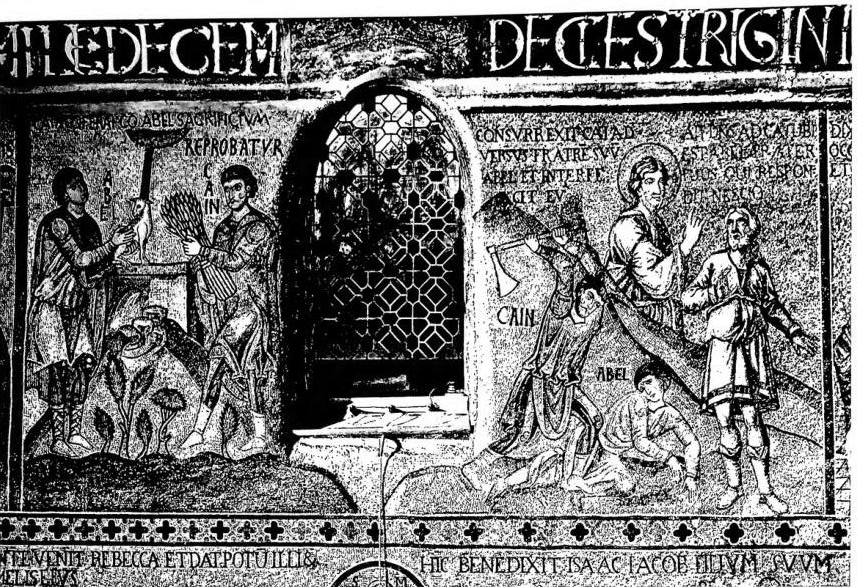
1. IN SACRED SCRIPTURE. - Second son of Adam, whose name is interpreted by the rabbis as "breath," with an allusion to his ephemeral life… -
Aberle, Moritz von
Theologian and biblical scholar, b. 25 Apr. 1817 at Rottum near Biberach, ordained priest 29 Aug. 1842, d. 3 Nov. 1875 at Tübingen, where… -
Abesan (ABESAN)
A minor judge, he governed Israel for 7 years. A native of Bethlehem (probably of Zebulun, about 12 km. northwest of Nazareth), he was the… -
Abia
Name of various biblical figures (Hebr. Abiyām in Kings, 'Abiyāhu and 'Abiyāh in Chronicles, 'Yahweh is father'). 1. Son of Rehoboam and… -
Abiathar (ABIATHAR)
High priest, great-grandson of Eli through Phinehas, son of the high priest Ahimelech; he escaped the massacre that Saul made of his… -
Abigail
Name of two women in the Bible. 1. Wife of Nabal, a resident of Maon, who owned vast fields and flocks on Carmel, at the edge of the desert… -
Abilene (ABILENE (VOLGATA: ABILINA))
Tetrarchy (Luke 3:1), so named from its capital Abila, often mentioned by Flavius Josephus as Abila of Lysanias. Abila stood east of the… -
Abimelech
A proper name, which in Hebrew means: "the Father" or: "my father (divine name?) is king." From the El-Amarna letters, Abimiliki of Tyre is… -
Abina, Rabbi (ABINA, RABBI)
Jewish doctor of the school of Sura on the Euphrates, the last of the Amoraim (v.). He was a disciple of Rabbi Ashi ben Simai (v.), who had… -
Abisag (ABISAG)
A girl from Shunem (today Solem), a locality on the southern slopes of the lesser Hermon. Of rare beauty, she was chosen by the courtiers… -
Abisai (ABISAI)
Nephew of David, son, like Joab, of his sister Zeruiah. A faithful collaborator of his uncle, he accompanied him by night into the tent of… -
Abiu (ABIU)
Second-born of Aaron (Ex. 6:23), he followed Moses on Sinai with Aaron and the 70 elders (Ex. 24:1-9). A. and his three brothers are the… -
Abner (ABNER)
Cousin of Saul on his father's side (I Sam. 14:50 f.; according to I Chron. 9:9 he would have been his uncle) and commander of his army… -
Aboab, Isaac (ABOAB, ISACCO)
Rabbi who lived around 1300 in Spain. In his work Menôrâth ha-mâôr ("the candelabrum of lights"), he expounds in popular form the talmudic… -
Abomination of Desolation (ABOMINAZIONE DELLA DESOLAZIONE)
Idolatrous profanation in the devastated Temple, at the approach of the collapse of Jerusalem, foretold by Jesus. Jesus refers to Daniel… -
'Aboth (Pirqē 'Abāth, "Chapters of the Fathers") ('ABOTH (PIRQĒ 'ABĀTH, «CAPITOLI DEI PADRI»))
Treatise IX of the IV order of the Mishnah (v.), not followed by the commentary or gēmarā. It has no logical connection with the treatises… -
Abraham (ABRAMO)
Patriarch of the Old Testament, son of Terah, descendant of Shem. His story, rich in detail, is narrated in Gen. 11:26-25:11. I. ABRAHAM IN… -
Abraham Ecchellensis (ABRAMO ECCHELLENSE)
In Arabic Hāqil because he was a native of the village of Hāqil in Lebanon (b. 1605, d. July 5, 1664). He studied at the Maronite college… -
Abraham of Balmes (Ben Meir) (ABRAMO DI BALMES (BEN MEIR))
Jewish grammarian, b. in Lecce in the 15th century, d. in Venice in 1523. A celebrated physician, trained at the University of Padua, he… -
Abram, Nicolas
Humanist and Jesuit exegete from Lorraine, b. at Xaronval in 1589, d. at Pont-à-Mousson on 7 Dec. 1655. Having entered the Society (1606)… -
Absalom (ABSALOM)
Third-born son of David, endowed with natural charms but with unbridled ambition. Eager to excel, he took as his pretext the rape of his… -
Abū 'l-Faraj Hibatallah (ABŪ 'I-FARAḠ HIBATĀLLAH)
Coptic writer of the 13th century, also called Abū'l-FaraḠ ibn al-'Assal, brother of Abū Ishāq. He made himself famous for his "Gospel… -
Acacia
A tree of the mimosa family, mimosa nilotica of Linnaeus or acacia arabica; it is the spina aegyptiaca of the ancients. Very widespread in… -
Accaron (ACCARON)
The northernmost of the five Philistine cities (Josh. 13:3), famous for its sanctuary of Beelzebub (v.) (II Kings 1:2-16). It is commonly… -
Achab (ACHAB)
King of Israel from 875 to 853 B.C. His story is told in 1 Kings 16:29-22:40. He inherited from his father Omri a prosperous and feared… -
Achaicus (ACAICO)
A Christian of Corinth, one of the first converted by St. Paul in Achaia. The Roman name, perpetuated in the family of L. Mummius, the… -
Achan
Son of Charmi, of the tribe of Judah (Heb. 'Akān "afflicting" [?]; Septuagint 'Aẓāp; cf. the name ākran in Num. 1:13; 2:27). Taking part in… -
Achaz (ACHAZ)
King of Judah for 16 years, probably from 743 to 728, or from 741 to 726. Son of Jotham, he succeeded him at the age of 25. Since A. had… -
Achimelech (ACHIMELEK)
Son of Ahitub, high priest in the sanctuary of Nob (I Sam. 21-22). He is commonly identified with Ahijah (v.). In reality the two names… -
AchiOr
Name of two biblical figures. 1. Supreme military commander of the Ammonites. To Holofernes, the Assyrian general, who was asking him for… -
Achis (ACHIS)
Son of Maoch and king (séren) of Gath, one of the 5 Philistine satraps, a contemporary of David. David, after being saved at Nob by the… -
Ackermann, Leopold
Exegete, b. and d. in Vienna (17 Nov. 1771-8 Sept. 1831). Having entered (1790) the Canons Regular of St. Augustine, under the name Peter… -
Acosta (da Costa), Uriel
Jewish rationalist, b. in Oporto between 1580 and 1585, d. in Amsterdam in 1640. From a wealthy Marrano family, he studied philosophy and… -
Acra (ACRA)
A citadel built by order of Antiochus IV Epiphanes, king of Syria, in the interior of Jerusalem, around 168 B.C., to station a security… -
Acts of the Apostles (ATTI DEGLI APOSTOLI)
Book of the New Testament, placed after the Gospels, which presents itself as the continuation of the Gospel of Luke. SUMMARY: I. The… -
Adadremmon (ADADREMMON)
A word that occurs only in Zach. 12:11, where the prophet, foretelling the death of the Messiah (v. 10), compares the mourning that will… -
Adam (ADAMO)
The first man created by God and father of the human race. SUMMARY: 1. Sacred Scripture. - 2. Rabbinic literature. - 3. Christian… -
Adama (ADAMA)
A city of the Pentapolis (v.), named alongside Zeboiim, on the border of Canaan (Gen. 10:19). Its king Shinab, in coalition with the other… -
Adam of Courland (ADAMO DA COURLANDON)
Liturgist, exegete and moralist, b. at Courlandon (Champagne), dean of the chapter of Laon from 1195, d. at Laon in 1233 or 1234. From 1213… -
Adar
Twelfth month, of 29 days (from mid-February to mid-March approximately), of the Hebrew calendar. The name is Babylonian (addaru, in… -
Adarezer (ADARÉZER)
Aramean king of Zobah. The Hebrew name is Hadad'ezer and Hadar'ezer: the latter form, found in Chronicles and in the Septuagint (Ἀδραχάς)… -
Adarsa
Thus the Vulgate, 1 Macc. 7:40, which has Adazer in 1 Macc. 7:45 (Adas in the Greek text and in Flavius Josephus; Dessau [Gk. Δασακού] in 2… -
Adler, Jakob Georg Christian
Danish Orientalist (1756-1834), from 1792 general superintendent of the Duchy of Schleswig. As a young man (1780-82) he consulted the… -
Adommim (ADOMMIM)
A locality that marked the northern border of the tribe of Judah with that of Benjamin (Josh. 15:7; 18:18). It is identified with Tal'at… -
Adonias (ADONĪA)
Fourth son of David (and of Haggith), born in Hebron after David had been proclaimed king of Judah (II Sam. 3:4; I Chron. 3:2). When David… -
Adonibezec (ADONIBÉZEC)
Canaanite king of Bezeq, a city identified by some with present-day Bezhab southeast of Lydda, by others with the Bezeq of Saul (1 Sam.… -
Adonisedec (ADONISÉDEC)
Amorite king of Jerusalem at the time when Israel, led by Joshua, penetrated into Palestine. When the Israelites had captured Jericho and… -
Adramelech
Son of the Assyrian king Sennacherib (704-681), in Assyrian Adar-malik. A. and his brother Sharezer, because they were not chosen to… -
Adramelech (ADRAMELECH)
A divinity probably Syrian (Adad-malik) of the inhabitants of Sepharvaim (perhaps Sabara'in) transplanted by Sargon into Samaria. Others… -
Adret Shelomoh ben Abraham (ADRET SHÉLÔ-MÔH BEN ABRAHAM)
Jewish decisor, b. around 1235 in Barcelona, d. in 1310. He studied under distinguished masters, among them Nahmanides. Around 1280 he was… -
Adricomius, Christian Kruick van (ADRICOMIO, CHRISTIAN KRUCK VAN)
Dutch Palestinologist, b. at Delft on 14 Feb. 1533, d. at Cologne on 20 June 1585. The humanist Martin Dorpius, his great-uncle, saw to his… -
Aetini, Agostino
Augustinian, b. at Torretta di Val Glano (Arezzo), around 1671, distinguished himself chiefly in biblical teaching. He published Biblia… -
Afiqomen (AFIQOMEN)
A special unleavened bread (v.) and its related rite in the present-day Passover supper of the Jews. Three unleavened breads prepared… -
Agabus (AGABO)
A prophet of the Church of Jerusalem, who appears in two episodes connected with the ministry of St. Paul. While visiting, in 41 (it… -
Agag
King of Amalek. To punish the raids and killings he had committed against Israel, God ordered the extermination of the Amalekites (v.), who… -
Agarei or Agarenes (AGAREI O AGARENI)
An Arab tribe, devoted to pastoralism, against whom the Transjordanian tribes of Reuben, Gad and Manasseh fought. From the order in which… -
Agar (AGAR)
Egyptian slave in the service of Sarai (Sarah), wife of Abraham. According to the custom of the time, she was given by her barren mistress… -
Agelli (Ajelli, Agellius), Antonio
Theatine biblical scholar, b. in Sorrento in 1532, d. in Rome on 19 Nov. 1608. Having entered the Theatine Regular Clerics of S. Paolo… -
Aggeus (AGGEO)
Prophet, tenth in the series of the "minor" prophets, the first among those after the exile. He is identical with the prophet of Ezra 5:1… -
Agraphon (ÁGRAPHON)
An isolated saying (λόγιον) of Jesus (in his earthly life), transmitted outside the canonical Gospels. Not called a. are the entire… -
Agricola, Michael
Born around 1508 or 1512 at Torsby, in the parish of Perna or Pernaja, and died suddenly on 9 April 1557, near Viborg (Viipuri), in whose… -
Agur, Son of Jakeh (AGUR, FIGLIO DI JAQEH)
Unknown sage, author of a group of maxims in Prov. 30. St. Jerome in the Vulgate, identifying him with Solomon, interpreted the two names… -
Ahiah (ACHIA)
ACHIA (Heb. 'Abiyyah, "brother of Yahweh"; the name of about 20 persons in the Old Testament, rendered by the Vulgate as Achias or Ahia… -
Ahiah (AHIA)
Prophet of Shiloh (hence called the Shilonite), the only one of the reign of Solomon and of the time of the schism of the tribes. He… -
Ahimaaz (ACHIMAAS)
The swift and heroic son of the high priest Zadok. Having remained with his father in Jerusalem and joined with Jonathan, son of Abiathar… -
Ahiqar (AHIQAR)
Assyrian sage, chancellor of Sennacherib (705-681 B.C.) then of Esarhaddon (681-669). He is mentioned by the Vulgate, under the name Achior… -
Ahithophel (ACHITOFEL)
A shrewd counselor, and later a traitor, of David, a native of Giloh (Gilo) in the mountains of Judah, father of the hero Eliam (II Kings… -
Aijalon (AIALON)
1. Amorite city (Judg. 1:35), called Ajalāna or Jalāna in the el-Amarna letters, and Ajīrum in Egyptian documents. First mentioned in… -
Aimo, Bishop of Halberstadt (AIMONE, VESCOVO DI HALBERSTADT)
B. around 778, d. 26 or 27 March 853. According to some, his birthplace was in Eng- IN OKTYMVIDPOSITVSESTKORPVS BONEMERIEFAVSTIIE… -
Akiva (or 'Aqibā') ben Joseph, Rabbi ('AQIBĀ' (O 'AQIBĀ') BEN JOSEF, RABBĪ)
One of the principal Tannaitic doctors, b. in Judea around 40, d. in 137. Legend has adorned his life with the marvelous (a rough shepherd… -
Akkad (ACCAD)
Ancient city of northern Babylonia, one of the four founded by Nimrod in Shinar (Gen. 10:10), perhaps the present-day Tell ed-Deir; there… -
Alanus de Rupe (De Rupe, De La Roche, Van den Clip) (ALANO DELLA RUPE (DE RUPE, DE LA ROCHE, VAN DEN CLIP))
Dominican preacher, propagator of the Rosary, b. in Brittany around the year 1428, d. at Zwolle on 8 September 1475. He entered the… -
Alba, Juan de
Spanish Carthusian exegete, born into a noble Madrid family in the first half of the 16th century. Thoroughly versed in Greek and Hebrew… -
Alber, János Nepomuk (ALBER, JANOS NEPOMUK)
Hungarian Piarist, exegete and historian, b. at Magyaróvár on 7 July 1753, d. at Pest on 21 June 1830. He taught science and biblical… -
Albert John of Haarlem (ALBERTO GIOVANNI DI HAARLEM)
Carmelite, b. at Haarlem (northern Holland), where he took the religious habit; d. at Louvain in 1496. After his studies at Louvain, he was… -
Albo, Josef
Spanish Jewish apologist and theologian. He lived successively in Daroca (province of Saragossa) and in Soria (Castile); d. in 1444. He… -
Alcázar, Luis de (Ludovicus ab [o de] Alcásar) (ALCÁZAR, LUIS DE (LUDOVICUS AB [O DE] ALCASAR))
Jesuit exegete, b. in Seville on 6 April 1554, d. there on 14 July 1613. He taught philosophy and, for twenty years, Sacred Scripture at… -
Alcimus (ALCIMO)
Contemporary and antagonist of Judas Maccabeus (v.). He changed his Hebrew name 'Eljāqim (or Jēhōjāqim) to the Greek 'Αλκίμωσ in order to… -
Alemanno, Johanan
Jewish Platonizing philosopher, born, according to some, in Constantinople, but who lived in Florence in the second half of the 15th… -
Alexander, Archibald
Presbyterian theologian of the United States, b. at Augusta (now Rockbridge) on 17 April 1772, d. at Princeton (New Jersey) on 22 October… -
Alexander I Balas (ALESSANDRO I, BALA)
King of Syria (150-145 B.C.), whose history is narrated in 1 Macc. 10:1 - 11:17. He was called a son of Antiochus IV, but was probably… -
Alexander, Joseph Addison
Third son of Alexander Archibald (v.), Presbyterian exegete, b. in Philadelphia in 1809, d. at Princeton in 1860. From 1838 he taught… -
Alexander of Bremen (ALESSANDRO DA BREMA)
Franciscan, author of a commentary on the Apocalypse. He was canon-scholastic of the cathedral of Bremen; he entered the Order of Minors… -
Alexandra Asmonea (ALESSANDRA ASMONEA)
Princess of the Hasmonean family (v.), daughter of Hyrcanus II, high priest and ethnarch; she married her cousin Alexander, son of… -
Alexandreion
A Palestinian fortress, built near the Jordan, where Qarn Sartabe ends, by Alexander Jannaeus (d. 76 B.C.). It often served as a refuge for… -
Alfonso of Zamora (ALFONSO DI ZAMORA)
Converted rabbi, b. at Zamora in 1474, baptized in 1506, d. in 1531. He was the first professor of Hebrew at the University of Salamanca.… -
Allioli, Joseph-Franz von
Biblical scholar, b. 10 Aug. 1793 at Sulzbach (Bavaria), d. 22 May 1873 at Augsburg. In 1816 he became a priest at Regensburg and a doctor… -
Allo, Ernest
Dominican exegete, in religion Bernard Marie, b. 3 Feb. 1873 at Quintin (Côtes-du-Nord), d. in Paris 17 Jan. 1945. He completed his… -
Alpha and Omega (ALFA E OMEGA)
Allegorical formula from the Apocalypse (1:8; 21:6; 22:13), which brings together the first and last letter (the beginning and the end) of… -
Alpheus (ALFEO)
The name Ἀλφαῖος is probably the Hebrew or Aramaic Halpai (1 Macc. 11:70; Calphi, Gk. Χαλφί), formed like Ἀγγαῖος from Haggai; it… -
Altar (ALTARE)
A flat, horizontal surface, raised from the ground, destined for sacrifice. 1. HEBREW ARCHAEOLOGY. - In the Old Testament (Hebr. and Phoen.… -
Alter, Franz Karl
Jesuit philologist, b. at Engelsberg (Czechoslovakia) on 21 Jan. 1749, d. at Vienna on 29 March 1804. Having entered (1766) the Bohemian… -
Alting, Jakob
Calvinist Hebraist, b. at Heidelberg in 1618, d. at Groningen in 1679. He was the son of the Calvinist theologian Johan Heinrich (v.)… -
Amama, Sixtinus
Dutch Reformed theologian, b. 1593, d. 1629. He was a profound connoisseur of the Hebrew language, of which he published two grammars and a… -
Amandus of Zierikzee (AMANDO DA ZIERIKSEE)
Dutch Franciscan exegete, b. around 1450 on the island of Walcheren, d. 8 June 1534 at Louvain. A doctor of theology, he was renowned as a… -
Aman (AMAN)
Omnipotent minister at the court of Ahasuerus (Xerxes I, 486-65) in Susa. Son of Hammedatha (a Persian name; Vulgate Amadathi), he is… -
Amasa (AMASA)
Military leader, son of Abigail, sister of David, and of Jether (or Jetra) the Ishmaelite (I Chron. 2:17) or the Jezreelite (II Sam.… -
Amasias (AMASIA)
Two biblical figures. 1. - King of Judah (c. 797-789), son of Joash, whom he succeeded at the age of 25. He avenged the killing of his >… -
Amélineau, Émile-Clément
French Egyptologist, b. at La Chaize-Giraud (Vendée) on 28 Aug. 1850, d. at Châteaudun in Jan. 1915. A priest, he followed the courses of… -
Amelote (Amelotte), Denis (AMELOTE (AMELOTTE), DENYS)
Oratorian theologian, b. at Saintes in 1606, d. at Paris in 1679. A doctor at the Sorbonne, he joined Condren (v.), of whom he was one of… -
Amen-em-ope
Egyptian high official, son of Kanccht, resident at Persepolis, who lived, according to A. Erman, H. O. Lange, R. Griffith, around 1000… -
Am Hâ-Âres (AM HÂ-ÂREŞ)
A Hebrew expression ("people of the land"), which in the earliest documents indicates simply the people of a particular region or the… -
Amico, Bernardino (Bernardino da Gallipoli)
Franciscan of the Observant Minors, b. at Gallipoli in the kingdom of Naples (the years of his birth and death are unknown to us). In 1596… -
Amman (Ammon), Kaspar
Augustinian theologian, b. at Hasselt (Liège) around 1450, d. in 1524. He was a master of theology, prior at Lauingen and provincial of his… -
Ammon
Son of Lot, born from the incest committed by his younger daughter while he, drunk, was sleeping. The Hebrew name 'Ammôn (from ben-'ammî… -
Ammonites (AMMONITI)
A people (Hebr. Bēnē-ʿAmmōn "children of Ammon," twice [1 Sam. 11:11; Ps. 83 Hebr., 8] only ʿAmmōnī, gentilic adjective ʿammōnī; Septuagint… -
Amnon (AMNON)
Firstborn son of David, by his second wife Ahinoam of Jezreel, born in Hebron (II Sam. 3:2). Seized by a wicked passion for his sister… -
Amon (AMON)
King (14th) of Judah (probably 641-39 B.C.; F. X. Kugler, A. Pohl: 639-38 B.C.). Son of Manasseh and of Meshullemeth, he succeeded his… -
Amorites (AMOREI)
Name (Aramaic 'āmōrā', plur. 'āmōrā'ē and in Hebrew form 'ēmōrā'im, "expounder") originally given to the lower Jewish teachers who… -
Amorrhites (AMORRITI)
A people settled in Canaan before Israel (Hebrew hā-'Emōrī, always with the article and in the singular, Septuagint 'Αμορραῖοι, hence… -
Amos (AMOS)
Third of the minor prophets, in the order of the Bible. 1. THE PROPHET. - Asserting that he is "neither a prophet, nor the son of a… -
Amphipolis (ANFIPOLI ('ΑΜΦΙΠΌΛΙΣ))
City of eastern Macedonia (today the village of Neokhori [on], about 5 km from the Aegean Sea, on the river Strymon (today Struma), which… -
Amraphel (AMRAFEL (SETTANTA) ἈΜΑΡΡΆΛ))
King of Shinar, who with Arioch (v.) and Tidal followed Chedorlaomer (v.) of Elam in the expedition against the Syro-Palestinian peoples… -
Amri (AMRI)
Sixth king of Israel (884-873 B.C.), founder of the fourth dynasty, who ascended the throne in the 27th year of Asa king of Judah (I Kings… -
Anammelech (ANAMELECH)
Deity (together with Adrammelech, v.) of the inhabitants of Sepharvaim transplanted by Sargon to Samaria, who offered children to it as a… -
Ananias (ANANIA)
Various figures of the Old and New Testaments. I. OLD TESTAMENT. - 1) Fictitious father of the angel Raphael (v.), who calls him "the… -
Anathoth (ANATHOTH)
A Levitical city of the tribe of Benjamin (Josh. 21:18; 1 Chron. 6:45 [Heb. 60]). It was the birthplace of two companions of David, Abiezer… -
Ancessi, Victor-Antoine
French Orientalist, b. at Saint-Affrique on 16 Aug. 1844, d. there on 12 Dec. 1878. After completing his studies at the Jesuit college of… -
Andrew of Saint Victor (ANDREA DI SAN VITTORE)
Regular canon, b. in England around the beginning of the 12th century. He entered the abbey of St. Victor in Paris, where he was a disciple… -
Andrew the Presbyter (ANDREA IL PRESBITERO)
Byzantine writer, author of "catena" commentaries on Prov. and Is., perhaps also on Act. and the Catholic Epistles. The place… -
Andronicus (ANDRONICO)
Prime minister of Antiochus IV (v.) Epiphanes, king of Syria, during the period when the latter went to Cilicia to quell a revolt at Tarsus… -
Angel (ANGELO)
A spiritual creature, messenger (ἄγγελος from ἀγγέλλω = announcement) of God and his minister in his relations with men. SUMMARY: 1. The… -
Angilmo di Luxeuil (ANGELOMO DI LUXEUIL)
Benedictine exegete, among the best of the 9th century, d. around 855. He was trained under a certain Mellinus (PL 115, 108), and taught… -
Ani, Wisdom (Maxims) of (ANI, SAPIENZA (MASSIME) DI)
Egyptian collection of gnomic sentences, akin, in subject matter, to the biblical wisdom books. The text is found in a papyrus of the 22nd… -
Anna (ANNA)
Name of various women of the Old and New Testaments. 1) ANNA, wife of the Ephraimite Elkanah (v.) living at Ramathaim-zophim (I Sam. 1-2).… -
Annas (ANNA)
Name of two Jewish high priests of the 1st century A.D. 1) A. (Ánano) I is called 'Αννάς in the New Testament, 'Ανανός by Flavius Josephus.… -
Annius of Viterbo (ANNIO DA VITERBO)
Dominican scholar, among the most debated of the Renaissance, b. at Viterbo in 1432, d. at Rome on 13 Nov. 1502. He took the Dominican… -
Annunciation (ANNUNCIAZIONE)
It is the angelic message of the incarnation of the Word of God to the Virgin Mary. 1. IN HOLY SCRIPTURE. - The episode (Lk. 1:26-38) takes… -
Anonymous of Piacenza (ANONIMO PIACENTINO)
This is the designation for an unknown person who made a pilgrimage to the Holy Land with some companions, leaving an account of his… -
Ansaldo (ANSALDI)
The following belonged to this family: 1) CASTO INNOCENZO - Dominican theologian, exegete and historian, one of the greatest scholars of… -
Antarado
A city on the northern Phoenician coast opposite Aradus (v.), of which it was the ancient colony; today it is Tartus with 3,500… -
Antero Maria di San Bonaventura (ANTÈRO MARIA DI SAN BONAVENTURA)
Theologian, exegete and preacher, in the world Filippo Miccone, b. 5 Sept. 1620 at Sestri Ponente (Genoa), d. 7 July 1686. Altering the… -
Antichrist (ANTICRISTO)
Adversary of Christ who, at the end of time, will seduce many Christians with satanic prodigies and cunning, and will finally be… -
Antilogy (ANTILOGIA)
The term (ἀντιλογία) means "contradiction"; it is used by students of biblical sciences to designate those cases in which two passages of… -
Antioch in Pisidia (ANTIOCHIA DI PISIDIA)
A city of Asia Minor, founded by Seleucus I (312-280 B.C.) with colonists from Magnesia, on a site famous for the sanctuary of the Phrygian… -
Antipas, Julius Herod (ANTIPA, JULIUS HERODES)
Tetrarch, son of Herod the Great and of the Samaritan Malthake, in the New Testament always called Herod (as on his coins). Born in 20-22… -
Antipatris (ANTIPATRIDE (ANTIPATRIS))
A Palestinian city founded on the site of ancient Aphec (v.) in the plain of Sharon by Herod the Great, who named it after his father… -
Antisemitism (ANTISEMITISMO)
Aversion to the Jewish people, occurring in ancient and modern times, based on social rather than religious grounds. The term is very… -
Antonia
Fortress that arose in Jerusalem, on the eastern hill, northeast of the Temple, at the foot of the Bezeta rock. Its purpose was to protect… -
Antonio della Madre di Dio
1. Spanish exegete, Discalced Carmelite, b. at Valladolid, d. in 1679. He was general visitor of the West Indies and taught at Salamanca in… -
Aod (AOD)
The second "judge" of Israel, son of Gera (distinct from the son of Balan in I Chron. 7:10), of the tribe of Benjamin, raised up by Yahweh… -
Apharsachei (Apharsachei, Apharsatachei, Apharsei) (AFARSACHEI (APHARSACHEI, APHARSATACHEI, APHARSEI))
Tribes imported by the Assyrians into Samaria at the time of the second colonization carried out by Esarhaddon or by his son Ashurbanipal.… -
Aphec (APHEC)
Name of 5 localities in Palestine. 1. Canaanite city in the mountains of Judah, whose king was defeated by Joshua (Josh. 12:18 and 15:52… -
Apion (APIONE)
Alexandrian grammarian of the first half of the 1st century AD, called Pleistonikès "rich in victory," on account of his oratorical… -
Apocalyptic, Literature (APOCALITTICA, LETTERATURA)
A body of pseudonymous Jewish writings, arising between the 2nd century B.C. and the 2nd century A.D., which for about a century critics… -
Apocryphal Epistles to the Corinthians (CORINTI, EPISTOLE APOCRIFE AI)
A brief letter of the Corinthians and a somewhat longer reply of Paul (III Cor.), suggested, it seems, respectively by I Cor. 7:1 and 5:9.… -
Apollonia of Macedonia (APOLLONIA DI MACEDONIA)
A city of Mygdonia, later of eastern or "first" Macedonia: today Pollina, located south of Lake Bolbe (today Besik). Dedicated to Apollo… -
Apostles (APOSTOLI)
In medieval canon procedural law, this was the name given to the letters that the lower judge had to transmit, within a fixed time, to the… -
Apostles (APOSTOLI)
Title of the twelve collaborators chosen by Jesus, to whom he entrusted the continuation and completion of his redemptive mission (Mt.… -
Aqrabbim (ACRABBIM)
A locality situated between the Dead Sea and the desert of Zin (Num. 34:3-4; Josh. 15:2-3), on the road that climbed from Sela (Petra) to… -
Aquila and Priscilla (Prisca) (AQUILA E PRISCILLA (PRISCA))
Jewish-Christian spouses, "co-workers" of St. Paul (Rom. 16:3). Having come from Rome following the decree of Claudius (year 49-50) that… -
Aquino, Filippo D' (Giuda Mordechai)
Hebraist, b. at Avignon or Carpentras (2nd half of the 16th century), d. at Paris in 1650. He converted from Judaism and was baptized at… -
'Arabāh ('ARABĀH)
A biblical geographical name (with the article: ha-'arābhāh, or in the plural: 'arēhāth). It designates (in opposition to the "mountain"… -
Aram
A region of western Asia, mentioned in the Bible, which with A. also designates the people (v. ARAMEI). Aram Nahārajim (Gen. 24:10 and… -
Arameans (ARAMEI)
A people that resided in Aram. In a letter from el-Amarna (14th century B.C.) the term aḫlamē occurs, which was understood as designating… -
Araneo, Clemente
Dominican preacher and controversialist of the 16th century, b. at Ragusa (Dalmatia). He appears in 1547 as a member of the province of… -
Ararat
Mountainous region between the river Araxes and lakes Van and Urmia. This geographical name from the Old Testament (Gen. 8:4; 2 Kings… -
Ar of Moab (AR DI MOAB)
Capital of the Moabites (Num. 21:15, 28; Deut. 2:9, 18, 29). God forbade the Israelites to take it (Deut. 2:9). Its history merges with… -
Aratus (ARATO)
Greek poet, who lived between the end of the 4th century and the middle of the 3rd century B.C., born probably at Tarsus in Cilicia, but a… -
Arbela (Ἀρβήλα [τὰ]) of Galilee (ARBELA ("ΑΡΒΗΛΑ [ΤᾺ]) DI GALILEA)
A locality in northern Palestine stormed by the Syrian Bacchides (v.), who captured there many Jews who had taken refuge in it, at the… -
Archangel (ARCANGELO)
The term occurs only twice (I Thess. 4:16; with the article: Jude 9) in the New Testament, in the singular, and designates Michael (v.)… -
Archelaus, Herod (ARCHELÀO, ERODE)
The eldest surviving son of Herod the Great (and of Malthace) and his principal successor (4 B.C. - A.D. 6). Like his two co-heir brothers… -
Archisynagogue (ARCHISINAGOGO)
He who presided over the synagogues, or religious assemblies, of the Jews. Chosen from among the elders of the community, he had high… -
Arculf (ARCULFO)
Bishop in Gaul (see unknown). He made a pilgrimage to the Holy Land in 670 and recounted his journey to St. Adamnan (v.), abbot of Hy or… -
Areopagus (Ὁ Ὄρειος Πέλαγος 'Hill of Mars') (AREOPAGO (Ὁ ὌΡΕΙΟΣ ΠΈΓΑΣ «COLLE DI MARTE»))
A rocky hill in Athens, southwest of the Acropolis, where, according to mythology, Mars was acquitted of the murder of Halirrhothius, son… -
Argob
1. A warrior or official of the court of Facce, king of Israel, with whom he was killed in Samaria by Facce (II Kings 15:25). 2. A region… -
Arias Montano, Benito
Spanish Orientalist, exegete and humanist, b. in 1527 at Fregenal de la Sierra, d. at Seville on 6 July 1598. A priest around 1555, he made… -
Ariel (ARIEL)
A biblical Hebrew term which, because of its double etymology (from 'āri' "lion" and from 'ārah' "to burn"), means now "lion of God" and… -
Arimathea (ARIMATEA)
A city of Judea, the homeland of the Sanhedrist Joseph (v.) of A. (Mt. 27:57; Mk. 15:43; Lk. 23:51; Jn. 19:38). On the basis of the data of… -
Arioch
Name of three biblical figures. 1. One of the four eastern kings who invaded Canaan as far as the Pentapolis (v.) and were driven back by… -
Aristea
Pseudonym of the author of the Letter to Philocrates, which narrates the origin of the Greek biblical version of the Septuagint (v.). Some… -
Aristobulus of Alexandria (ARISTOBULO DI ALESSANDRIA)
Hellenistic Jewish philosopher, who lived, it seems, in Alexandria at the time of Ptolemy IV Philometor (181-145 B.C.), to whom he… -
Arizzara, Giacinto
Dominican of the 18th century, professor of Sacred Scripture and of Oriental languages at the University of Modena. As a Hebraist, not… -
Ark (of Noah) (ARCA (DI NOÈ))
A large floating wooden receptacle, which Noah before the flood (v.) built by God's command, as a refuge for himself, his family and all… -
Ark (of the Covenant), Ark of the Testimony (ARCA (DELL'ALLEANZA), ARCA DELLA TESTIMONIANZA)
Thus the Pentateuch designates the most important and ancient object of Israelite worship from Moses to the exile; the other sacred books… -
Arlotto da Prato
Franciscan theologian, b. at Prato, d. at Paris in 1286. He studied at Paris and, having become a « magister », taught theology at least… -
Armagedon (ARMAGEDON)
Hebrew name ("mount of Megiddo") of the place where, after the Angel has poured out the sixth bowl, the "kings of all the… -
Arnon
Eastern tributary (today Wädi el-Mö-gib) of the Dead Sea, the largest after the Jordan. It is formed by the confluence of the Seil es-Sufçi… -
Aroer
Three biblical localities. 1. A city on the southern border of the Amorite kingdom of Sihon, from which it was taken by the Israelites… -
Arosio, Luigi
Priest, b. in Milan on 16 Nov. 1822; d. there on 2 July 1901. He spent his whole life in the care of souls in his native city, first as… -
Arphaxad (ARFAXAD (ARPHAXAD))
Two biblical figures. 1. A. (Heb. 'Arpahšad), son of Shem, born 2 years after the flood (Gen. 10:22; 11:10), grandfather or… -
Artapanus (ARTAPANO)
Storico giudeo, vissuto in Egitto prima dell'era cristiana. His work Περί Ἰουδαίων was used by Flavius Josephus and was cited by Eusebius… -
Artaxerxes (ARTASERSE)
Greek form of the name ('Αρταξέρξης'; Heb. 'Artaḥšatā'; Assyrian Artaḥsatsu; from the Persian Artaḥšatā "the great commander") of three… -
Artegiani, Angelo Guglielmo
Augustinian, born at Rocca Contrada (Arcevia) on 27 November 1683, died at > (phot. Pont. comm. arch. sacra) > ANCIENT CHRISTIAN ART -… -
Artemas (ARTEMA)
Disciple and collaborator of St. Paul, who in 64 or 65 hypothetically assigned him to Crete to replace Titus, who had been invited to join… -
Arvad (ARADO)
A small Phoenician island (800 by 500 m) with a city of the same name (today Ruvād, with 2500 inhabitants), two and a half km from the…