
GOLDSMITHING. - I. PALEOCRISTIAN GOLDSMITHING. - In the biographies of the popes, in the Liber Pontificalis, one finds lists of precious objects or coverings of rare metals donated to the ancient Roman churches, but the donations earlier than the 6th century must be accepted with reservation. Antiquity often used to gild bronze (v. the statue of Marcus Aurelius, or the shafts of the columns of the Lateran Basilica, today applied to the altar of the Most Holy Sacrament). In the field properly of goldsmithing, it is noted that silver or copper received gilding, and the existence is also known of an alloy of gold and silver that had the color of amber, and for this reason was called electrum. When two metals were not mixed by fusion, but inserted one into the other, one had what is now called agemina, that is, an inlay work (v., for example, the small silver crosses inserted in a bronze door of the 5th century in the Lateran Baptistery). The metals were also decorated with engravings (chased plate). If, for the due relief, a black paste was inserted into the cuts, one had the work of niello (from nigellus). But more vivid effects were offered by the inclusion of glass pastes (enamels), of which the oldest technique is the pouring of the glassy material into the cavity (technique of champlevé, that is, of reserved cutting), and then comes that of the alveoli with applied thin plates (technique of cloisonné). In-
Rare stones were also inserted (especially garnets); or gems and cameos were added, supporting them with delicate frameworks of simple or pierced strips. The plates of gold or silver (or of other metal) were reduced to leaf by the work of beating and not infrequently were pressed onto matrices to obtain the figures in relief (but the bronze reliefs were obtained by fusion).
In truth goldsmithing had great traditions, and therefore an entire exquisite technique. The bishops vied with one another to furnish the house of God with precious things. The faithful offered to it also their private objects with even profane figures, and this explains why some have been found in the treasures of the basilicas. Sometimes sovereigns donated even their crowns. A notice in the Chronographia of Theophanes (ad a. 593) informs us that the emperor Maurice received from Sophia, widow of Justin II, and from his wife Constantina a splendid crown. The sovereign, after admiring it, sent it to the church and had it suspended above the altar by means of three gold chains strewn with precious stones. This greatly displeased the two donors. A famous document of donation to a church is the Charta Cornutiana (a. 471), concerning the liberality of the Catholic Goth Fl. Valila. There, among other things, mention is made of an abundant silver service of vessels and lamps, and its total weight is indicated, verified at the public scales (ad stateram urbicam).
The discoveries of goldsmithing (without taking into account the more decidedly profane objects) have been several. However, they represent only a minimal part of what the documents lead one to suppose, since antiquity and the Middle Ages took great pleasure in precious furnishings. Invasions, various thefts, appropriations that provoked the destruction of the objects in order to melt down the metals, or to use the rare stones (thus in the French Revolution and in the Napoleonic period) and also meltings or sales to meet particular needs, reduced the immense patrimonies of the basilicas and monasteries to a few and often mutilated examples. Sometimes an object was integrated at a much later period.
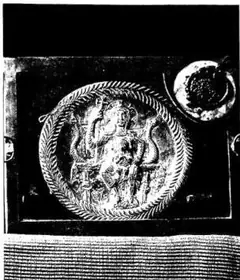
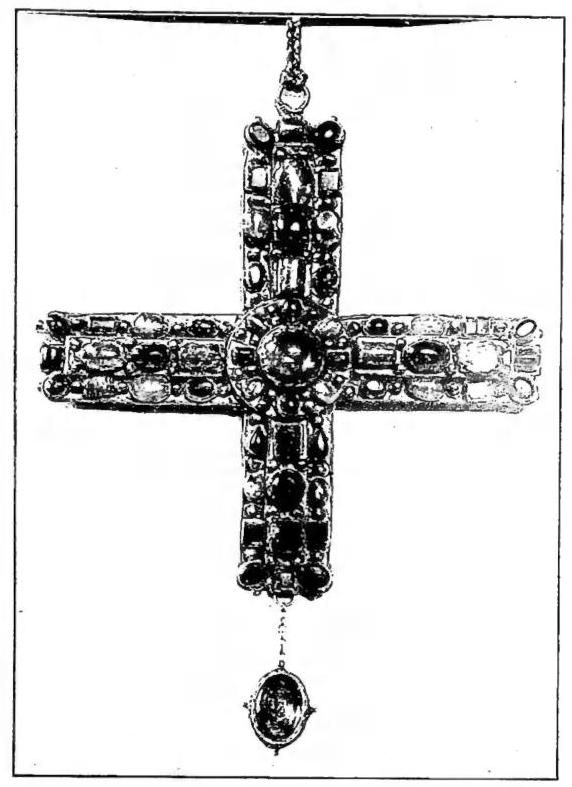
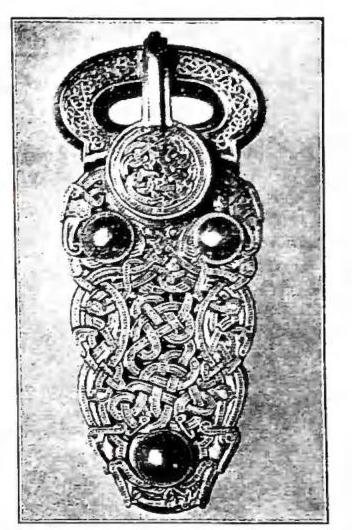
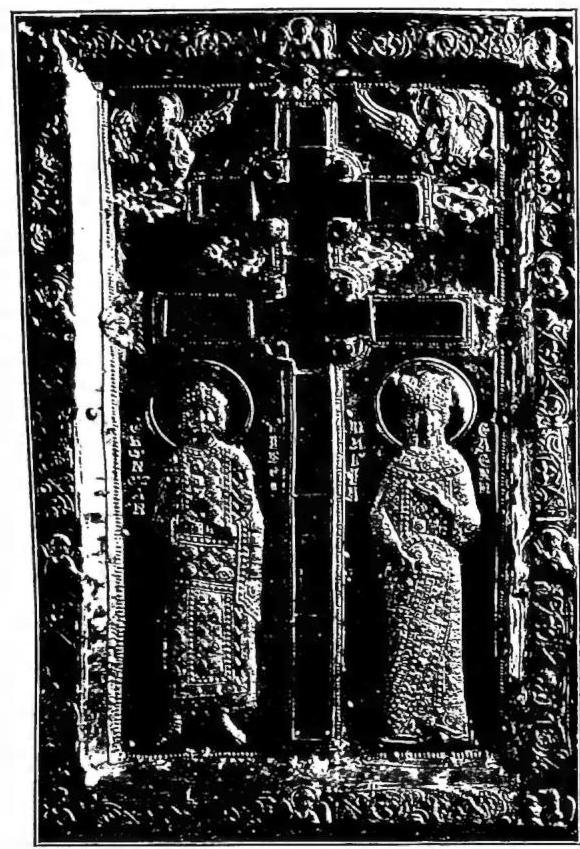
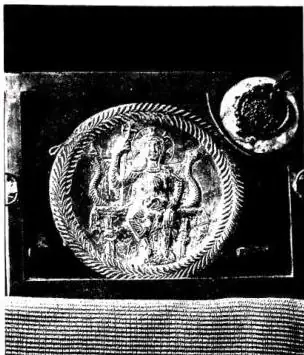
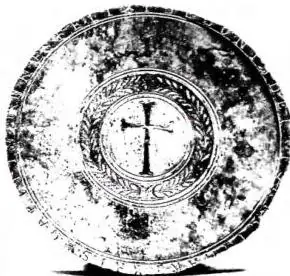
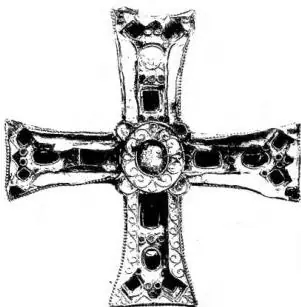
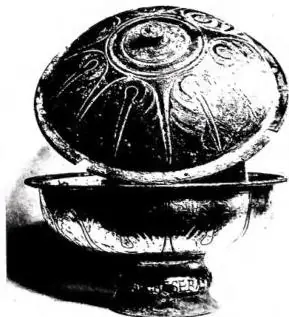
A famous discovery of furnishings was that carried out by Grisar beneath the altar of the private chapel of the Popes in the Lateran Patriarchate (Sancta Sanctorum). Omitting the goldsmithing of more recent date, let us recall the gemmed cross of the 6th-7th century, which contained a fragment of the true Cross immersed in balsam (now, like all the other relics, in the Sacred Museum of the Vatican Library). It is a work in solid gold with settings of red stones, mountings of gems and edges of those very thin beaded threads called "filigrees." This "staurotheca" (reliquary of the Holy Cross) must surely be identified with the one that Stephen II (752-57) carried in procession through Rome when the Lombard king Astolf threatened the City. It is still covered with the balsam with which it was anointed by the Popes in the Middle Ages. Another cross reliquary from the same treasure is, conversely, entirely in enamels and contains figures of the cycle of the Infancy of the Savior. An inscription on the side gives the name of Paschal I (817-24). The "cloisonnage" of enamels has here one of the oldest examples of this technique, since it is not in thin partitions, but in broader crustae, which would seem an imitation of the opus sectile marmoreum, were one not to notice the border of the inlays. Both the staurotheca and this reliquary were kept in silver boxes with relief figures of the first decades of the 9th century. The only remnant of the oldest donaries to the Vatican Basilica (now in the treasury of St. Peter's) is the cross of the emperor Justin II and his consort Sophia (565-78). The object consists of a gilded silver plate with relief images and with additions of precious stones or pearls, some mounted in capsules on the edges, others hanging. In the reliefs appear the faces of the imperial couple. An inscription (which may be a version of an original in Greek) declares: "Ligno quo Christus humanum subdidit hostem - dat Romae Iustinus opem et socia decorem." For gifts in other churches of Rome let us recall: among the relics of the Sts. Four Crowned Martyrs a stupendous round casket, in the form of a vase, used for the head of St. Sebastian. Gregory IV (827-44) offered it to the Basilica (inscription), but the casket is older than this Pope because on the bottom is the monogram of a matron perhaps of the 5th century: Anatole. The object is of Hellenistic art. The church of Sts. Sylvester and Martin ai Monti has an exceptional example of a silver lamp (of the gabata type) with transenna-like interweaving with the dedication: "Sancto Silvestro ancilla sua votum solvit."
In recent times a group of sacred silver objects was discovered in the vicinity of Città di Castello (at Canoscio), comprising pyxes, trays, spoons, a strainer. The pyxes have the form of those of the treasure of Carthage, now in the British Museum (a treasure rightly judged to be of the 4th-5th century). The xenodochium of Pammachius at Porto revealed plates and a silver spoon (4th-5th century). They were dispersed among various collections. Conversely, a fine group of Christian silverware of the 5th century coming from the Caelian house of the Valerii (two spoons, two amulae and a small amphora with sacred images, a cup) are in the Sacred Museum of the Vatican Library. Let us also recall the famous treasure of the Esquiline, today for the most part in the British Museum, but it has representations only of a profane character.
From Antioch on the Orontes, or from its vicinity, come several examples of silver reliefs of the 6th-7th centuries, among which a chalice, a cross and three book covers (the most suggestive being the one with two apostles) and furthermore an extraordinary chalice, a Syrian work of the 6th century. It is entirely traversed by a vine-leaf foliage in openwork, and there project from it the figures of Christ, of the Apostles, of a sheep and of an eagle (v. reproduction at the entry ANTIOCHIA DI SIBIA). The relic is now in a private collection in New York. The island of Cyprus has given back two series of objects (both brought to light in the district of Kyrenia): the first is in the British
Museum, the second is divided between the Morgan collection (New York) and the Museum of Nicosia (with the latter were coins of the period 565-685, and the other may likewise be considered as of the 6th-7th centuries). Interesting is the group of the Morgan collection with plates figured with the story of David (Wilpert believed it to be a forgery, but without sufficient proof). In the Museum of Cairo is the treasure discovered at Luxor, where there are silver book covers with inscriptions, one of which commemorates an "abba" Abraham (it was the material of a deaconry of the 5th-6th centuries). The treasure of Stümä (district of Aleppo) is in the Museum of Constantinople: three plates and two flabella (works of the 6th-7th centuries). One of the plates has the scene of the Last Supper, which is found in the paten of another treasure, that of Riha (south of Antioch: see reproduction at the entry COMMUNION EUCHARISTIC). Here reappeared a chalice and two patens, referable to the 6th century. The Communion of the Apostles there assumes a most beautiful animation. Other groups of objects: that of the treasure of Traprain Law (Scotland, now in the British Museum), which comprises, among other things, an amphora perhaps of the 4th century, with vigorous repoussé work (scenes of the Old and New Testament); that of the treasure of Lampsacus (candlestick, low-footed vessel: perhaps a chalice, basin: 6th century?); the aforementioned treasure of Carthage (4th-5th centuries); that of Mildenhall (with splendid plates, spoons, etc.; in the plates are pagan figurations: 4th century?); these last three groups are in the British Museum, as is also the treasure of Sutton Hoo. Besides the objects of the Treasure of the basilica of Monza (v.) and of the monastery of Bobbio (v.), a series of silver reliquary caskets is found in churches and museums, such as the small cubic casket of Sts. Nazarius and Celsus of Milan, which some have wished to consider a Renaissance imitation, whereas it is certainly Early Christian and perhaps of the age of St. Ambrose, founder of the Basilica. There, in the scene of the Adoration of the Magi, the offerers do not wear the traditional garments, but are powerful half-nude figures. The style is sincerely impressionistic (one may make the comparison with the analogous stylistic tendencies manifested by the remains of the original door of the Ambrosian Basilica); but one should also see the treatment of the apostolic figures in another casket: that of unusual shape - it is a polygonal pyx - found at Pola and now in the Museum of Vienna, 4th century. The cathedral of Grado has an oval casket and a round one. The first has rather crude images (clipei with Christ and Sts. Peter and Paul; etc.) but nevertheless linked to the classical tradition, the second has a triumphant Madonna enthroned holding the processional cross. Although they differ in workmanship and in stylistic derivation, both may be considered as of the 5th century, that is, of the earliest phase of the basilicas on the island of Grado. Of great importance is the oval casket (likewise silver) of Henchir-Zirara near Tebessa (Numidia), today in the Museo Sacro Vaticano. There is the representation of a young martyr between two candelabra; it is from the beginning of the 5th century. Of about the same period is the casket found at Brivio (Lombardy), today in the Museum of the Louvre (with the Adoration of the Magi, the Three Youths in the Furnace, the Resurrection of Lazarus). Likewise of the same epoch there is a capsella from the Sancta Sanctorum with the Adoration
of the Cross. We omit examples of small reliquary caskets
from the barbarian period, among which most notable is the one
from Hertford, which also has an application of gems,
those from St-Benoît-sur-Loire, from St-Bonnet-Avalouze,
from the cathedral of Chur and from the church of Sion, both
in Switzerland, from the monastery of St-Maurice d'Agaune also
in Switzerland; the latter is a marvellous example with
a gold transenna on a red background, stones, a cameo: a Frankish work of the 7th century.
As for chalices and patens, let us recall the chalice with
two handles, entirely faceted with lobes in the lower part,
which comes from Gourdon (today in the Bibliothèque nationale
in Paris). Garnets and turquoises form the centres of the delicate appliqués
in gold filigree that wrap around the upper part of the cup:
a Merovingian work of the 6th century, although found together with
Byzantine gold coins. The chalice is accompanied by a rectangular
gold plate with a cross in the middle. Interesting
is the contrast of the gold openwork with the red background. Lost
is the tall chalice of Chelles, which, besides similar openwork, had
checkerboard sections of white and green enamels. It was believed
to be the work of St. Eligius, the famous Merovingian goldsmith. Of historical
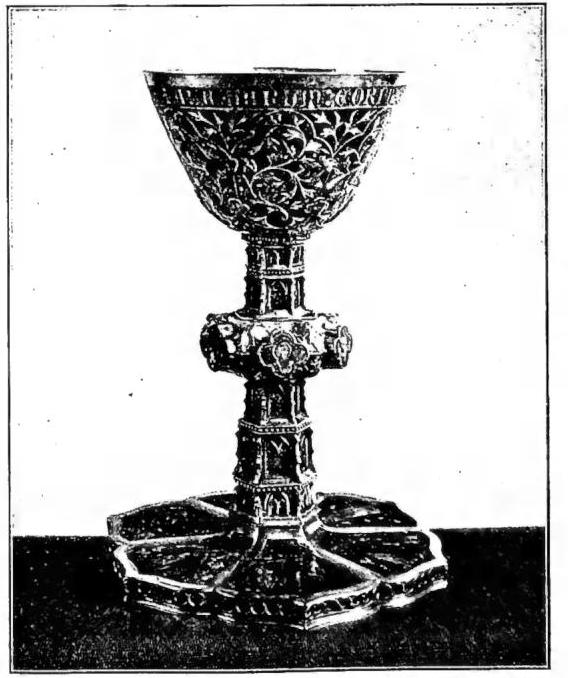
value is the chalice of Kremsmünster (Austria) with the
epigraphic record of Tassilo, duke of Bavaria («Tassilo
dux fortis Liutpric virgo regalis»: end of the 8th century). Most
elegant in its slender type, it bears interlace decorations
comparable to the Scandinavian oval ones with figures of
Christ and the Evangelists. Conversely, a chalice of
Celtic workmanship, that of Ardagh (Ireland), is low. Of simple
workmanship and with an inscription relating to an Ursus the deacon is the chalice of Lamon (Trentino). See ill. under the entry CALICE. Among the
patens: that of Berezoff (Siberia), formerly in the Stroganoff collection and today again in Russia (with a beautiful figuration of
two angels and of the Cross; the work is more of the 5th than of the 6th century);
that of bishop Paternus, also found in Russia; that of
Suger (background in green enamel with small fish in gold
leaf standing out; a border of gold frames with stones;
the object was part of the treasure of the abbey of St-Denis
and has been believed to be of the 6th century). For us it may be a Merovingian
production of the 7th century. Among the vessels is remembered that
of Emesa (today in the Louvre). It is in the shape of an amphora and has clipei
with Christ, the Madonna and Saints: a Syrian work of the 5th century.
Of the crowns hanging from the ciborium above the altar, the
Monza ones have been cited. But to these must be added the copious group
found at Guarrazar, and now all collected in Madrid (National Museum). It is a stupendous ensemble of votive crowns with repoussé work, openwork, gems. The crowns still
have their suspension chains, themselves well worked.
From the centre hang the crosses profusely gemmed.
It is learned from an inscription that the donor was «Recesvin-thus Rex» (associated with his father Chindaswinth in 649, he
became sole king in 653 and died in 672). A cross-reliquary
copiously gemmed and with a border of pearls
(6th-7th centuries) is in the cathedral of Tournai.
As a fixed altar worked in precious materials one can
cite, for the early Middle Ages only, the one owed
to the goldsmith Vuolvinius in the Basilica Ambrosiana. It is in repoussé
with the Histories of St. Ambrose and is richly decorated
with enamels, gems, cameos. Its date is debated. Some
parts were added at a later moment, but certainly
the oldest portion is of the 9th century.
A Carolingian reliquary of which only reproductions
exist was that of the abbey of St-Denis. It was
called the escrain de Charlemagne, but it must have belonged to
Charles the Bald. It was entirely studded with gems.
Of processional crosses: the well-known ones of Brescia (Museo
sacro), of Ravenna (Cathedral), of Cividale (Museum), the
first (8th century) adorned with gems and with gilded glass (the most beautiful
known) with portraits of a family of the 4th century,
the second with medallions in silver repoussé (busts
of saints). The central part with the Madonna is later
than the 6th century, in which the cross must first have been
executed, the third (with a crude Crucifix) is a barbarian work
perhaps of the 8th century. Among crosses of small dimensions
(for individual use) various encolpia are of precious material.
Most interesting is the gold one found at S. Lorenzo fuori
le mura in Rome and now in the Museo Sacro Vaticano. It has floral
designs standing out on the sacred background of niello. To it
is added a ring set with a screw. An inscription says:
«Nobiscum Deus Emmanuel - Crux est vita mihi. Mors,
inimica tibi». The work is perhaps of the 6th century.
Bibliography
IV, L'orfèverie, Paris 1901; M. Rosenberg, Gesch. der Goldschmiedekunst auf technisch. Grundlage, Darmstadt and Frankfurt
a. M. 1910-25 (various vols.); id., Der Goldschmiede Merkzeichen,
Frankfurt a. M. 1921-22 (2 vols.); H. Leclercq, Orfèverie,
in DACL, XII, II, coll. 2447-2581; see also in DACL the entries
Calice, Patène, Guarrazar, Emésène, Monza, etc.; W. F. Vol-bach, Metallarbeiten des christlichen Kultes in der Spätantike
und im frühen Mittelalter (Katal. d. Röm.-Germ. Central-Mus.),
Mainz 1921; J. Braun, Die Reliquiare des christlichen Kultes
und ihre Entwicklung, Freiburg in Br. 1940; C. Cecchelli, La
vita di Roma nel medioevo, I, Le arti minori e il costume, I: Le
oreficerie, Rome 1951. On the chalice of Tassilo, see now G. Haschoff,
Der Tassilobelch, Munich 1951.
Carlo Cecchelli
II. MEDIEVAL AND MODERN ART
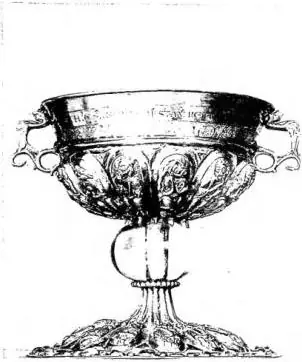
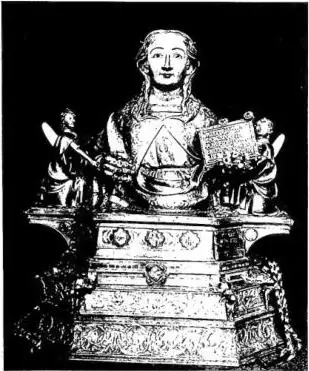
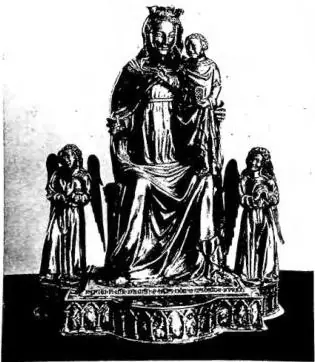
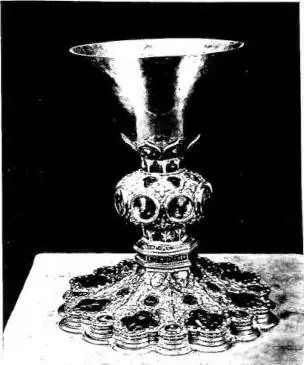
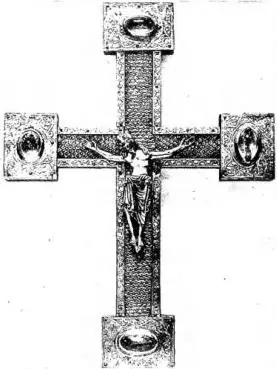
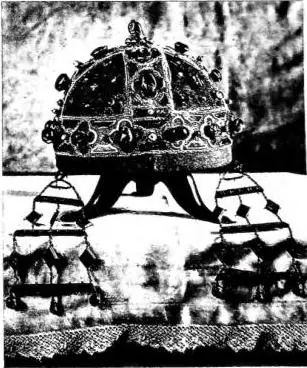
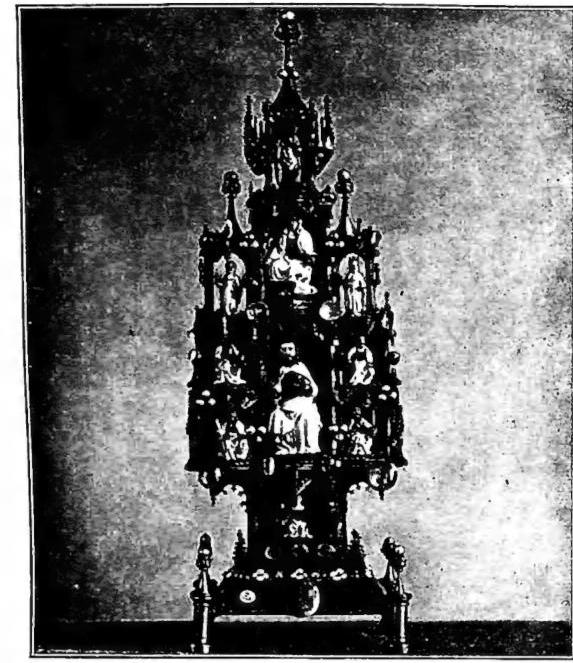
Around the year 1000 works of exceptional beauty appear: the golden altarpiece of the basilica of St. Mark, the Evangeliary of Capua, the Cross of Gaeta, the Cross of Cosenza, the Evangeliary of Bishop Aribert in the Treasury of the cathedral of Milan, the small altar of the cathedral of Agrigento, the golden altar of the basilica of St. Ambrose in Milan, show a sum of experience and an indisputable taste. From that time it seems possible to see the goldsmith's art channel itself into two different streams: in the north, in the German lands, the goldsmith's art was then particularly practiced at Hildesheim, at Essen and at Regensburg, from whose workshops came the golden altar of the cathedral of Basel, today in the Musée de Cluny in Paris. In France, on the other hand, works of the goldsmith's art were produced especially in the Benedictine abbey of Dijon, in Paris, in Chartres, in Limoges (v.). The latter city soon assumed a decided pre-eminence over the others through the use of champlevé enamels, which replaced filigrees and Byzantine-style enamels. In the south the most active center was then southern Italy, principally the court of the Norman kings of Sicily, Palermo, where Arab and Byzantine artists worked with combined experiences. Here Byzantine techniques and forms were maintained with greater fidelity, while nevertheless absorbing into the decorative repertoire some element of Arab taste, such as the stylized palm tree, an example of which appears on the coif of Constance II, in filigree, pearls, enamels and gems (Palermo, Cathedral), in the reliquary of St. Marcian (Messina, Cathedral) or in the superb mantle of Roger in Vienna (Kunsthistorisches Museum). In Gothic goldsmithing the prevailing tendency is toward the imitation of architecture (13th-15th centuries) with the use of spires, pinnacles, ogival arches, statuettes within niches and even the very form of reliquaries built as Gothic little temples. Some techniques were neglected (the use of gems set into planes of filigree), other techniques were added: piercing, low relief with smooth motifs on a stepped background. Pictorial quality is achieved not with juxtapositions of colored gems but with sculpture, chasing, embossing, piercing and above all with the use of enamels. These, now, are translucent, that is, poured onto the background decorated in relief and with such a variety of color as to rival painting, especially at Siena, mistress of the new technique after the example given in 1290 by Guccio di Mannaia in the chalice for Nicholas IV (Treasury of St. Francis in Assisi). From Siena, highly expert goldsmiths moved to work in Naples, in Sicily, in Avignon, in Hungary: master Toro of Siena was in Avignon, as was also Giovanni di Bartolo, the great Sienese goldsmith, author of the exceptional reliquary bust of St. Agatha in the cathedral of Catania. The perfection of techniques (reliquary of the Holy Corporal executed by Ugolino di Vieri of Siena in 1338 for the cathedral of Orvieto), the gentleness of the motifs and all the experiences of the Sienese school sought to surpass the Venetian workshops, where the goldsmith's art acquired in the 14th and 15th centuries a great development, abandoning itself to the most delightful caprices of Flamboyant Gothic. In these works the surfaces are continually pierced, fringed, adorned with layers of curled leaves, with the most slender filigrees around crystal cups, with a free, rich, happy compositional or ornamental fantasy (chalice in the Victoria and Albert Museum, London; candlestick in the basilica of St. Mark in Venice; cross of St. George of the Schiavoni, etc.). Also in the other regions of Italy there were, in the Gothic period, flourishing schools: in Abruzzo, especially in the workshops of Aquila, Teramo, Sulmona, grandiose processional crosses were produced, adorned with friezes and pierced spheres, with superimposed figures executed in full relief. When the Sienese influence somewhat mitigated the local harshnesses, works of great value were produced, chiefly through the merit of Nicola da Guardiagrele, in which every detail is seen and treated with attentive experience. In Lombardy, following contacts with France and Germany, Gothic style assumed very pronounced forms both in the hackneyed decoration and in the ascending line. Imitations of Spanish goldsmithing, grandiose and magniloquent, appeared in Sicily, where, especially for the cathedrals of Palermo, Catania, Enna, reliquary caskets were made (Catania, Cathedral: reliquary casket of St. Agatha; Enna, Cathedral: casket by Paolo Gili) of grandiose proportions on the model of those of Juan de Arphe. The Gothic also took on Catalan accents in Sardinia (processional cross of the parish churches of Guspini; reliquaries in the church of St. Eulalia in Cagliari) and in Sicily (reliquary cross) at Mazzara, at San Martino delle Scale, at Caltanissetta, etc. Splendid during the Gothic period was French goldsmithing, and of unsurpassed elegance the skillful union found in it of architectural lines with plastic and chromatic decoration in translucent enamels (urn of St-Taurin at Evreux). Linked to French art was that of Flanders, which has left very notable works between the 14th and 15th centuries in the Golden Horse of the parish church of Altohing in Bavaria, and in the Calvary of Matthias Corvinus of the cathedral of Esztergom. In Germany a few types were repeated that derive from Romanesque models, even if their lines assumed the intonation proper to architecture.
English goldsmithing of the 15th century shows a decided orientation toward French models. Extremely rich too was the production of goldsmithing also in the Iberian region, which had very active workshops at Barcelona and at Saragossa, where themes and models derived from France and from Tuscany were elaborated. Typical are the reliquary busts of the cathedral of Saragossa, the casket of the parish church of El Salvador de Burriana of Los Cuevas de Canart, the crosses adorned with enamels of the churches of Cuencabuena, Linares and Parreras on the island of Majorca, the chalices of the cathedrals of Tortosa and of Toledo.
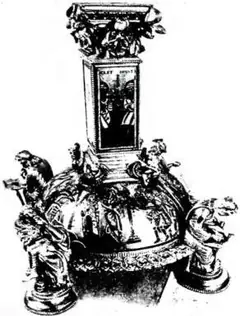
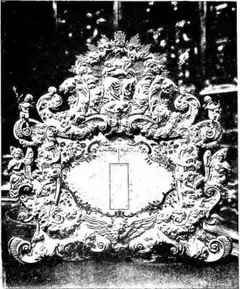
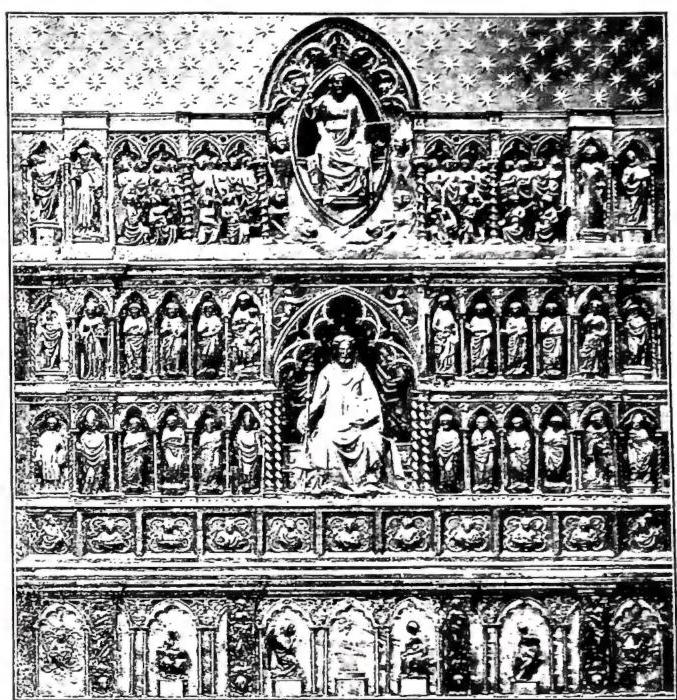
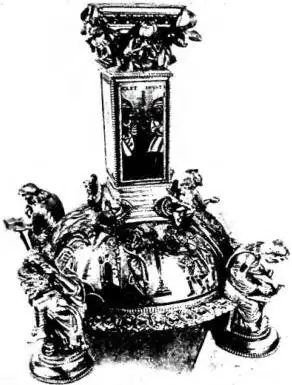
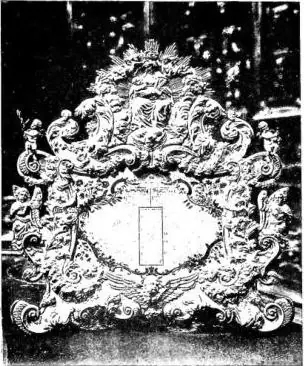
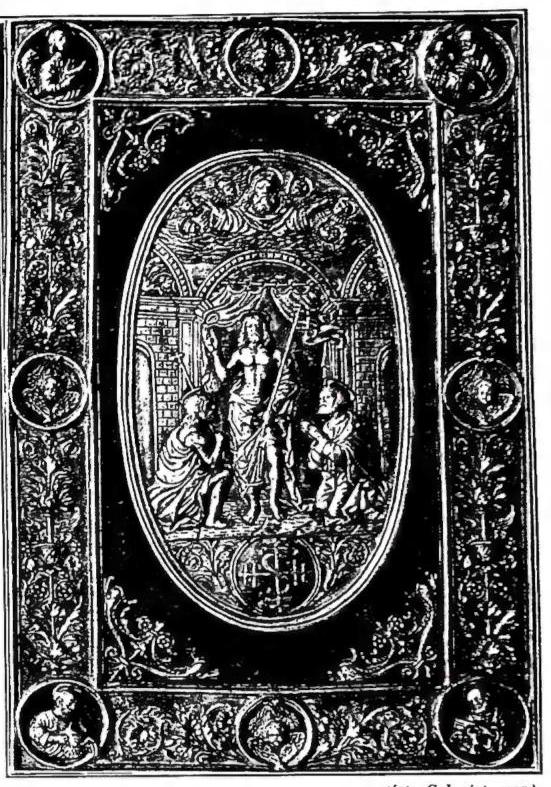
It was in this period, moreover, that the guilds of goldsmiths began to be formed, which established the statutes relating to the alloy of silver and gold, to the obligation of marking works and to the rules for authentication. Not all silverware, however, bears such a mark, nor the monograms of the authors and the monograms of the consuls who were to authenticate; this practice became general almost only in the 17th-18th centuries. In Tuscany the goldsmith's art had already in the Gothic period participated vividly in pictorial and plastic problems and had remained so adherent to the other arts as necessarily to have to follow the progress that occurred in the first half of the 15th century. Above all the effects derived from the Florence-Siena and Siena-Florence contact found, in goldsmithing, an explication as direct as in no other decorative art. At the end of the 14th century the relations between Siena and Florence were these: Siena held the field through a most refined decorative sensibility that drove it predominantly toward pictorial forms: in a century it had pushed the small translucent decorative enamels of Guccio da Mannaia to the enameled painting of the reliquary of Ugolino di Vieri; Florence, on the other hand, absorbed and imitated all the decorative conquests of Siena, but for its part was inclined to transfer, wherever possible, into the highly ductile material, researches of a more properly sculptural kind. Sienese goldsmithing led to the reliquary of Ugolino da Vieri; Florentine goldsmithing to the antependium of Pistoia. But Siena did not manage to escape Florentine imitation, and in the first half of the fifteenth century the antependium of the baptistery of St. John is a work of sculpture in which notable artists took part, such as Verrocchio, Pollaiolo, Michelozzo and the most expert goldsmiths; in Florence it was the most skilled sculptors, such as Lorenzo Ghiberti (v.), Antonio Pollaiolo (v.). These were the greatest, but, says Benvenuto Cellini, "there have been countless men of this art of goldsmithing, all of them our Florentines." A goldsmith and sculptor too was Benvenuto Cellini (v.), whose truly exceptional technical virtuosity and acute sensitivity in feeling the voices of the material are well known. He worked among goldsmiths of great fame whom he praised or hated, such as Luca Agnolo, such as Amerigo Amerighi, excellent in working enamel, Piero di Nino, expert in filigree, Lucanio da Jesi. Rare works are joined to names: the salt cellar of gilded silver in the Museum of Vienna to Benvenuto Cellini, the Farnese casket in the National Museum of Naples to Antonio Manno and Giovanni di Castel Bolognese, the Cross of gilded silver in the Vatican Basilica to Antonio Gentile, the pax of Pius IV in the cathedral of Milan to Caradosso, the pax in the Treasury of the cathedral of Palermo to Sansovino, the Evangeliary of the cathedral of Padua to the goldsmith Alvise, the cover of the Grimani breviary in the Marciana Library to Alessandro Vittoria, to Pietro Lierni the Cross of Domaso, to Girolamo delle Croci, to the Rocchi brothers, to Giulio Danti, to Bartolomeo Spano very many other works, at Lodi (church of the Incoronata), at Perugia (Cathedral), at Reggio Emilia (Cathedral); but all the goldsmiths of the Renaissance, even while working in workshops in which various survivals of the earlier centuries remained, ended up using the same techniques and putting their hands into the same decorative repertoire. And this not only in Italy but almost everywhere throughout Europe. The technique of minute, fragile, most elegant relief is common to all goldsmiths. The relief creates small planes, highly mobile surfaces multiplied by continuous facets, and the light, finding curves, hollows and planes, plays with them, kindles and extinguishes the tone of the gold, makes it transparent and opaque, pale and brilliant. On the surfaces thus chased, the plastic elements are superimposed or else enclosed in niches, increasing the chiaroscuro movement. In the search for color, they availed themselves of every experience: enamel was superimposed on tiny sculptures also adorned with hardstones, whose infinite possibilities were studied in decorating and in creating cups, objects and jewels and in engraving gems, studying them in the light of color; in binding them among friezes, in modeling pearls to form small figures or monsters, in engraving crystals, alternating them with gilded chased surfaces, Italian goldsmiths were most expert. Not only sacred goldsmithing but also the great dishes of gilded silver (Florence, Palazzo Pitti; Cagliari, Cathedral; Trapani, Museum, etc.), the salt cellars (Rospigliosi collection), the table centerpieces, the candlesticks, the small caskets, the buttons, the jewels, any sacred or profane object was adorned with decorative motifs drawn from the vegetable or animal world, vying in monstrous pairings with Romanesque decorations, in naturalistic variety with Gothic decorations, in decorative rhythms with the most changeable Oriental ornamentation: tritons and nereids, centaurs and sirens, dolphins and horses, winged fish and quadrupeds, candelabra and festoons; monsters and chimeras, dreams and follies. The ornament flourishes alike on the crosses, on the chalice and on the jewel, a flowering of matter modeled into forms of miraculous harmony. In the last decades of the sixteenth century, the decoration on the surface of the works barely managed to be held in check by the constructive line, by the profiles and the projecting moldings, strongly felt, that articulated the surface. It was enough to exaggerate the proportions of the plastic ornaments and to diminish the rigor of the architectural articulation, to generate the end of the Renaissance equilibrium. From Baroque architecture, in Italy and throughout Europe, goldsmithing drew certain experiences but did not think, rightly, of wishing to imitate the architectural forms themselves also in the relationship between mass and space, as had happened in the Gothic period: it took its inspiration from the instability of surfaces, from the contrasts between curves and straight lines, from the grafting of plastic forms into the very course of the ascending line of the stems, from the taste for polychromy. In order to obtain dynamic effects, goldsmiths were driven to study the surface of the material, to agitate it by means of violent repoussé work, of insistent hammering, and at the same time to interrupt the mixed and undulating lines with cuts, fragmentations, resumptions and flourishes. As the proportions of the objects increased by far, through that love of the grandiose typical of the century, it became necessary to abandon the minute decoration dear to the Renaissance for other, easier means that allowed magnificent effects to be obtained in a short time. The various surfaces of chandeliers, candlesticks, altar backboards, antependia, which formed the sumptuous church apparatus even in the humblest churches, were embossed and then adorned with garlands, festoons or statuettes, or else, especially in the antependia, with perspective views. The treasures of the churches of Italy overflow with Baroque works, for which, besides our own, foreign artists also labored, such as that Baldassarre Krigl who for the ostensorium offered by Prince Doria Pamphili to the church of St. Agnes executed a most rich inlay of precious stones and pearls. Toward the first third of the eighteenth century, goldsmithing once again reached great nobility of technique and form. From the various researches aimed at obtaining color solely by means of chiaroscuro contrasts there derived an entirely new experience, that of making the flows of light run over the precious planes of silver and gold leaf, without interruptions of frames or harsh contrasts, but with the natural passage from the base to the sphere or to the chalice, as in nature from the root to the flower. In this period goldsmithing itself acts strongly upon the formation of the architectural rococo: from the cartouches in silver leaf adorned with pendants, festoons, to the overdoors of the palaces of Filippo Juvara, from the refined motifs of table silver or of antependia, to the architectures of Raguzzini or of the Amato, the step was short. In the eighteenth century, more than gold, it is the triumph of silver and, among all gems, of the pearl. Silver (so sweet and soft), provides artists continuous possibilities for creating effects of calm and complacent light, aristocratic decorations and, made into filigree, it composes fragile and graceful objects; the pearl, united with pale gold, had very gentle applications in Venetian jewels. It is impossible to recall all the artists who in the seventeenth and eighteenth centuries worked for the Church and for the palaces. Mention is made of the Filiberti family, of whom many works remain in Parma; of Giovanni Giardina, of Giuseppe Galiardi, of Antonio Gigli; of Carlo Guarnieri; of Filippo Tofani, of Angelo Spinazzi, of Giuseppe D'Angelo, of Pietro and Filippo Juvara. To interrupt this admirable production, which even in Lisbon for the furnishings of the chapel of St. John supplied by Roman goldsmiths, and in Spain for the Sicilian silverware sent by the viceroys, aroused enthusiasms, the neoclassical fashion intervened: it solidified the volumes, halted and stiffened the undulating decorative lines, wearied the hands, dulled the imaginations. Decorative motifs drawn from Egypt penetrated: lotus and palm leaves on the bases, on the column-shaped shafts at other times fluted with Ionic or Corinthian capitals; the use of cameos even in jewels, of gems engraved in Hellenistic imitation, was pleasing, but, in general, the golden age of the goldsmith's art seemed by now to have set, above all because at the end of the nineteenth century the use of mechanical production became established, which could produce imitations of the antique according to types adapted to the functions of the Church and to the needs of civil life. The execution of the one-of-a-kind piece has been considered as an exception and as the work of isolated artists who continued to maintain, in Milan as in Florence as in Venice and in Palermo, nobility of technique and felicity of invention. - See plates XV-XVII.
Bibliography12 works
Accascina, L'o. italiana, Florence n.d.; A. Morassi, Antica o. it., Milan 1936; M. Accascina, V. Nellia, G. Vacca, s. v. in Enc. Ital., XXV, pp. 491-99.
Maria Accascina