
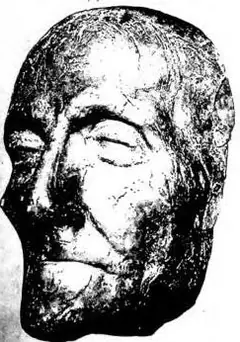
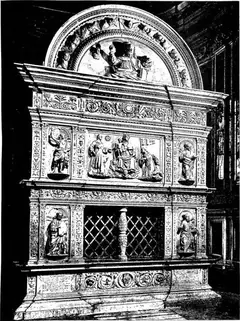
BERNARDINE OF SIENA, Saint. - Friar Minor, distinguished for learning and holiness, for his original and highly effective preaching, for the propagation of the cult of the name of Jesus and for a new spirit of reform given in the 15th century to the Franciscan Order.
I. LIFE
Of the noble Sienese family of the Albizzeschi, B. was born at Massa Marittima, in the territory of Siena, on 8 September 1380. Left an orphan of both parents at the age of six and raised by his closest relatives in Siena, he completed there his studies of rhetoric, philosophy and jurisprudence. Captured at first by a love of the Latin classics, he then devoted himself with all fervor to the study of Sacred Scripture and theology and to more intense practices of piety. At the age of 22 he entered the Friars Minor. Having received the sacred orders, he was in 1405 licensed to preach, which he continued until his death. Of the first fifteen years of his religious life we know little; it is certain that B. spent them above all in perfecting his theological culture, also preparing an abundant body of material such as emerges from several miscellaneous codices, recently discovered, which he in those years transcribed or had transcribed (cf. D. Pacetti, I codici autografi di s. Bernardino, in Archivum Franciscanum Historicum, 29 [1936], pp. 231-241, 523-30). His preaching during that period was confined mainly to Tuscany, and did not arouse great enthusiasm. From 1417 onward B. was able to extend it to upper and central Italy with the greatest fruit, everywhere reawakening in consciences the dormant religious sentiment, calling people back to the practice of the Sacraments, calming hatreds, reconciling factions, suggesting social reforms, inspiring works of charity and self-denial.
Well known are the Lenten sermons he preached at Genoa (1418), Milan (1419), Padua (1423 and 1443), Florence (1424 and 1425), Viterbo (1426), Gubbio (1427), Arezzo (1428), Venice (1429), Siena (1434), Massa Marittima (1444); and equally well known are the courses of sermons he gave at Genoa (Advent 1417), Treviglio (11-25 November 1419), Bergamo (June 1422), Verona (1 November 1422-17 January 1423), Vicenza (May-July 1423), Treviso (20 July-August 1423), Belluno (25 September-October 1423), Modena (November 1423), Bologna (January 1424), Prato (May-June 1424), Lucca (September-October 1424), Siena (20 April-10 June 1425), Assisi and Perugia (August-November 1425), Todi (January-February 1426), Rome (April-May 1426), Montefalco and Spoleto (June-July 1426), Amelia (December 1426), Orvieto (12 January-16 February 1427), Urbino (June 1427), Siena (15 August-6 October 1427), Forlì (29 May-2 July 1431), Matelica (September 1433), L'Aquila (August 1438), Milan (December-February 1442-43).
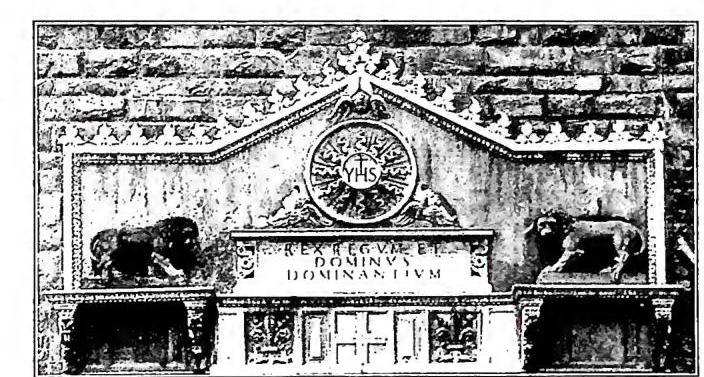
The marvelous success B. achieved everywhere was due not only to his exceptional eloquence and to the topicality of the subjects he preached but also to the holiness of his life. He was a great propagator of devotion to the Holy Name of Jesus, which he had carved or painted on tablets with the monogram YhS, and he recommended its veneration to the crowds. For this novelty of his, he was accused by rivals of superstitious and heretical worship and was referred to Rome twice (1426 and 1431), but he was found innocent; indeed Eugene IV, interrupting the second trial already begun without his knowledge, in a bull of 8 January 1432 gave most ample praise of B.'s doctrine and morals (cf. E. Longpré, S. Bernardin de Sienne et le Nom de Jésus, in Archivum Franciscanum Historicum, 28 [1935], pp. 443-76; 29 [1936], pp. 142-68; 30 [1937], pp. 443-77; 31 [1938], pp. 170-92). Within his Order he was the principal promoter of the reform of the Observants, for whom he founded many convents and of whom in 1438 he was elected vicar general (cf. Ilarino da Milano, S. B. da S. e l'Osservanza Minoritica, in S. Bernardino da Siena. Saggi e ricerche pubblicati nel V centenario della morte [Pubblicazioni dell'Università Cattolica del S. Cuore, nuova serie, 6], Milan 1945, pp. 379-406; D. Pacetti, S. B. da S. Vicario Generale dell'Osservanza con documenti inediti, in Studi Francescani, 17 [1945], pp. 7-69). He died at L'Aquila on 20 May 1444. He was canonized by Nicholas V at Pentecost in 1450.
II. WORKS
The most important writings left by B. are all sermons and in Latin, with the exception of the Florentine Lenten sermons of 1425 (cf. D. Pacetti and B. Bughetti, Intorno agli schemi in volgare di s. B. da S. per la Quaresima Fiorentina del 1425, offprint from Arch. Franc. Hist., Quaracchi 1941, pp. 1-108), of a few letters and of some treatises in the vernacular attributed to him (cf. St. B. da S., Le Operette volgari, fully edited by D. Pacetti, Florence 1938). Besides his own writings, many sermons have also come down to us, collected by listeners from the living voice of the Saint. There is thus a double series: Works written by B. himself and Sermons reported by listeners. These, with greater or lesser fidelity and almost always in abridged form, took down in shorthand on wax tablets or on paper the words of the preacher, now rendering them in the vernacular tongue in which they had always been pronounced by B., and now in Latin; so that reported sermons in Latin and reported sermons in the vernacular have come down to us. Of these, some are published, others unpublished. It has sometimes happened, for example at Padua in 1423 (cf. D. Pacetti, Una redazione inedita del «Seraphim» predicato da s. B. a Padova nella Quaresima 1423, in Bull. di Studi Bernardiniani, 4 [1938], p. 35 ff.), that several reporters or shorthand writers simultaneously collected the same course of sermons by the Saint, thus producing quite different redactions of the same ones. Although from the doctrinal standpoint the reported sermons do not have the same value as the Sermones or other writings, for the reason that the thought of the Saint was not always reported by the shorthand writers with absolute fidelity; they are fundamental in literature for their expressive vividness and spiritual introspection, and in civil history for the acuteness with which the social conditions of the time are grasped. The Sermones constitute the greater and more important part of the Saint's writings (almost all are preserved as autographs in codices of the Vatican Library and in the Comunale of Siena; cf. D. Pacetti, I codici autografi, op. cit.). Sketched at first for his own use, and after 1430 enlarged, definitively redacted and for the most part published by the author for the convenience of preachers (cf. D. Pacetti, Gli scritti di s. B. da S., in S. B. da S. Saggi e ricerche, op. cit., pp. 25-138), the Sermons are true theological treatises, above all of moral theology (cf. C. Piana, S. B. da S. teologo, in S. B. da S. Saggi e ricerche, op. cit., pp. 139-201), compiled in homiletic form, with great acumen and good taste, on the works of the great scholastic doctors and jurists (William of Auvergne, Alexander of Hales, St. Thomas, St. Albert the Great, St. Bonaventure, Duns Scotus, Gerald Odonis, Francis Mayron, Richard of Mediavilla, etc.) and of the Franciscan writers, especially Ubertino da Casale (cf. E. Blondeel, L'influence d'Ubertin de Casale sur les écrits de st. B. de S., in Collectanea Franciscana, 1935, pp. 5-44) and Peter Olivi, from whose exegetical writings, questions and various treatises he abundantly and judiciously drew (cf. D. Pacetti, Di alcune fonti cui ha attinto s. B. da S., in Saggi e ricerche, op. cit., pp. 92-130). Of special importance are the 11 sermons on the Madonna, which together constitute a solid treatise of Mariology (cf. G. Folgarait, La Vergine bella in s. B. da S., Milan 1939). For the novelty and originality of method and the topicality of content (cf. Ronzoni, D. D., L'eloquenza di s. B. da S. e la sua scuola, Siena 1899), these writings, as soon as they were made public, met with enormous success; and this explains the considerable number of codices (about 300) that are still extant, all transcribed within about 40 years, until they were all printed: Cologne ca. 1470; Strasbourg before 1474; Utrecht around 1475; Speyer 1484; Antwerp 1488; Basel around 1489, 1490-95 and 1498; Nuremberg 1493 (cf. Gesamtkatalog der Wiegendrucke, nos. 3881-94, Leipzig 1928); Lyon 1501. They were reprinted under the editorship of P. Ridolfi da Tossignano in Sancti B. Senensis Ordinis Minorum opera quae extant omnia (4 vols., Venice 1591); and then by Giovanni de la Haye, in Sancti B. Senensis Ordinis seraphici Minorum opera omnia (5 vols. in-fol., Paris 1635). This edition was reprinted at Lyon 1650, and at Venice 1745. These editions are very inaccurate. The Fathers of Quaracchi are preparing a critical edition of all the Latin and vernacular works, published and unpublished, written by the Saint or reported by others. In the meantime we can establish the following classification, bearing in mind the Venetian edition of 1745:
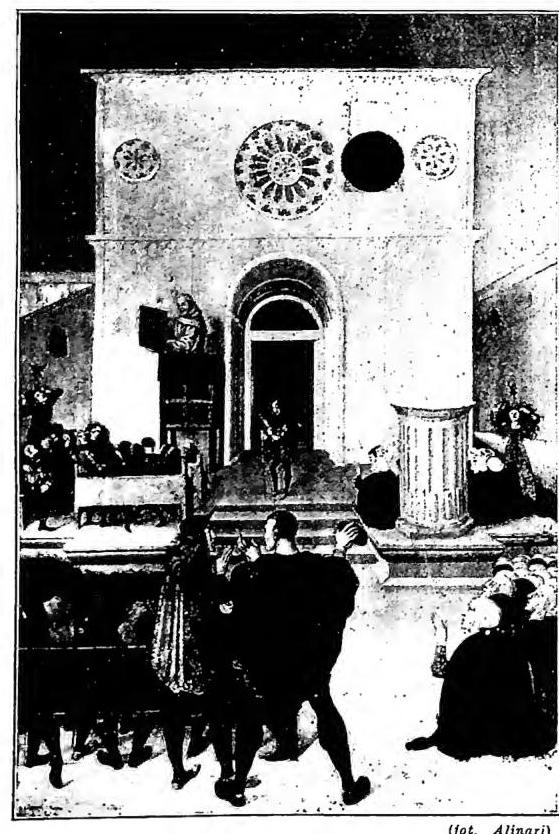
1. - Certain Latin works: a) Published: Quadragesimale De christiana Religione (finished and published by the Saint between 1430 and 1436), I, pp. 1-319. - Quadragesimale De Evangelio aeterno, sive de caritate (1430-37), II, pp. 1-430. - Tractatus De vita christiana (earlier than 1430), III, pp. 1-18. - Tractatus De B. Virgine (1430-40), IV, pp. 71-116, 119-30. - Tractatus De beatitudinibus evangelicis (1441-43), III, pp. 18-61, 249-51. - Tractatus
De Spiritu Sancto et de inspirationibus (1442-44), III, pp. 119-43; IV, pp. 32-50. - Sermones De Tempore, Extraordinarii et De s. Joseph (1440-44), IV, pp. 1-19, 14-31, 139-230; III, pp. 61-68, 393-421, 448-56; IV, pp. 143-47, 181-86; IV, 231-35. - b) Unpublished: Itinerarium anni seu sylva praedicabilis (1417-24), Siena, Bibl. Comunale, codd. U. IV, ff. 7-8. - Postillae super Epistolas et Evangelia totius anni, ibid., cod. U. V (?), f. 4. - Two incomplete Sermons without title are found in the autograph codex Chigiano C. VI, 163, ff. 212 r., 214 r., 215 v., 216 r.; 37 drafts of sermons, in the autograph codex U. III, 1 of the Comunale of Siena; questions, compendia and various autograph notes, in cod. U. V. 6, ff. 99 v.-100 v., 294 v., 331 r., 344 r.-v., 394 v., and in ff. 6 r.-60 v. of the autograph codex U. V. 5 of the same library. - c) Lost: Avventuale (1417) and Quaresimale (1418) of Genoa; Postillae super Epistolas et Evangelica a Septuagesima ad Pascha; Opusculum et 23 articula contra Fr. Manfredum Vercellensem.
2. - Doubtful Latin works: Tractatus confessionis, III, pp. 421-437. - De speculo peccatorum, de contemptu mundi, III, pp. 437-40. - De praeceptis Regulae FF. Minorum, III, pp. 440-43. - Tractatus de mortuis (De Morte), III, pp. 377-79. - Sermons: De luxuria; De satisfactione pro peccato; De iudicio extremo; De poenis damnatorum: III, pp. 383-90 (and III, 365-68); 373-77 (and I, pp. 65-69); 379-83.
3. - Spurious Latin works: Quadragesimale De pugna spirituali, III, pp. 69-118. - Commentarii in Apocalypsim, V, pp. 1-117. - Disputatio (dialogus) inter mundum et religionem coram Papa, III, pp. 445-48. - Sermons: De humilitate, seu de quatuor novissimis; De miseria conditionis humanae; De vilitate hominis; III, pp. 369-73, 390 ff.; De regno caelorum, IV, pp. 131-36; In Parasceve, vel Dom. 2e Quadragesimae: Assumpsit, ed. 1591, III, pp. 333-35; De Annuntiatione Virginis gloriosae, ed. Venice 1591, III, pp. 540-43.
4. - Vernacular works: Trattato della confessione «Renovamini»; La divota confessione volgare; Trattato dell'amor di Dio; Lettere (ed. D. Pacetti, Operette volgari, Florence 1938, 1-316). - Quaresimale fiorentino del 1425, cod. no. 28 of the Osservanza of Siena (cf. D. Pacetti and B. Bughetti, Intorno agli schemi in volgare di s. B. da S. per la Quaresima fiorentina del 1425, op. cit.). - Two sermons on the vanity of women and on widowhood (ed. L. Marri Martini, in La Diana, 1-2 [1930] and in Bull. Senese di Storia Patria, 3 [1931]); a Prologue and eight sermons from the same codex (ed. D. Pacetti, in S. B. da S., Prediche volgari inedite, Siena 1935, pp. 205-300).
5. - Reported sermons: a) Published Latin ones: Advent sermons of Genoa from 1417 (brief sketches of the first 9 sermons, reported by an anonymous Servite listener, ed. F. Delorme, La predication de st. B. d' Gênes en 1417 et 1418, in Bull. di Studi Bernardiniani, 7 [1941], pp. 185-215). - The Lenten cycle "Seraphim" of Padua (1423) reported by D. de Purziliis together with the sermons delivered by the Saint before and after the said Lent, III, pp. 146-362; and ed. Venice 1591, IV, pp. 77-95. - The last two sermons of Padua (1443), ed. S. Bastanzio, in Bull. di St. Bernard., 8 [1942], 3-9. - b) Unpublished Latin ones: Lenten cycle "Seraphim" of Padua (1423) reported by an anonymous writer, Rome, arch. FF. Minori conventuali, cod. D. 41 (cf. D. Pacetti, Una redazione inedita del «Seraphim», op. cit., pp. 35-63, 97-125, 162-88; Una predica sul SS. Nome di Gesù tenuta a Padova nel 1423 da s. B. da S. e raccolta da un suo anonimo ascoltatore, in Miscell.
Francescana, 42 [1942], pp. 257-76). - Corso di Siena (1425), riportato da G. N. de Griffulis, cod. Magliab. cl. XXXIX, 60 (cf. S. Tosti, Di alcuni codici delle prediche di s. B., in Arch. Franc. Hist., 12 [1919], pp. 198-210). - Corso di Assisi e di Perugia (1425) riportato da S. Giovanni da Capistrano, cod. di S. Cataldo, Modena (cf. D. Pacetti, La predicazione di s. B. a Perugia e ad Assisi nel 1425, in Collect. Franciscana, 9 [1939], pp. 494-520; 10 [1939], pp. 5-28, 161-88; G. Cantini, Due sermoni sul nome di Gesù secondo il cod. di S. Cataldo, in Bull. di St. Bernar., 2 [1936], pp. 288-300; 3 [1937], pp. 290-95). - Corso di Amelia (1426) riportazione anonima incompleta, cod. Vat. lat. 6966, f. 169 r-176 v. (cf. D. Pacetti, Le Prediche volgari inedite, op. cit., p. 22 sgg.). - Quaresimale di Padova (1443), riportato da D. de Purziliis, Bergamo, bibl. Civica, cod. A. A. 23 (cf. D. Pacetti, Nuovo codice di prediche inedite, in Bull. di St. Bernard., 1 [1935], pp. 191-204). - c) Edite volgari: Predica sul SS. Nome di Gesù, 1418-21 (ed. E. Bulletti, in Bull. di St. Bernard., 8 [1942], pp. 3-29). - Quaresimale fiorentino del 1424 (ed. C. Cannarozzi, S. B. da S., Le Prediche volgari, 2 voll., Pistoia 1934). - Quaresimale fiorentino del 1425 (ed. C. Cannarozzi, S. B. da S., Le Prediche volgari, 3 voll., Firenze 1940). - Corso di Siena del 1427 (ed. L. Bianchi, Le Prediche volgari di s. B. da S. dette nella piazza del Campo l'anno 1427, 3 voll., Siena 1880-88; P. Bargellini, S. B. da S., Le prediche volgari [I classici Rizzoli], Roma-Milano 1936). - Tre prediche « De benefacite » (ed. Z. Lazzeri, in Bull. di St. Bernard., 6 [1940], pp. 93-141). - d) Inedite volgari: Quaresimale di Firenze del 1425, Siena, convento dell'Osservanza, Cod. n. 27, f. 28r-218r.; riportazione anonima indipendente dalla edita sopra notata. La 1ª predica, Gli occulti giudizi di Dio (ed. D. Pacetti, in Le Prediche Volgari inedite, op. cit., pp. 155-77). - Corso di Siena del 1425, Firenze, bibl. Nac., cod. Magliab. cl. XXXV, 240; Pavia, Univ. cod. Ald. 162; riportazione anonima. Alcune prediche, ed. D. Pacetti, in Le Prediche Volgari inedite, op. cit., pp. 393-550; quella sulla Necessità dello studio, in Bull. di St. Bernard., 2 [1936], pp. 301-21; G. De Angelis, Quattro prediche inedite di s. B., ibid., 6 [1940], pp. 177-202; 7 [1940], pp. 50-57).
Bibliography27 works
245; G. Melani, S. B. da S. ed il Nome di Gesù, op. cit., pp. 247-300; C. Mesini, La sociologia di s. B. da S., op. cit., pp. 341-77; M. Agosti, La pedagogia di s. B. da S., op. cit., pp. 407-44; A. Gemelli, S. B. da S. francescano perfetto, op. cit., pp. 465-79; L. Di Stolf, S. Bernardina Sen. cinque de Humanismo ac studiis sententia, estratto dal periodico Antonianum, 1945, pp. 1-50; A. Lazzeri, S. B. teologo del SS. Nome di Gesù, in Studi Franc., 17 [1945], pp. 70-76; F. Sarri, Lirismo bernardiniano, ibid., pp. 91-110; D. Pacetti, La glossa bernardiniana all'Epistola e al Vangelo dell'Atessiniana, ibid., pp. 111-32.
Dionisio Pacetti
III. ICONOGRAPHY
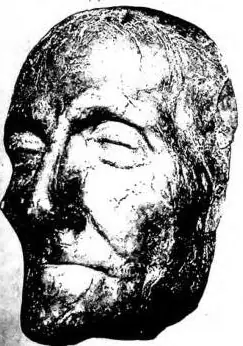
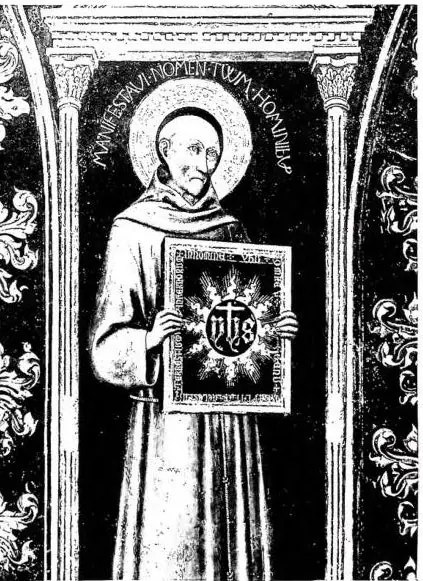
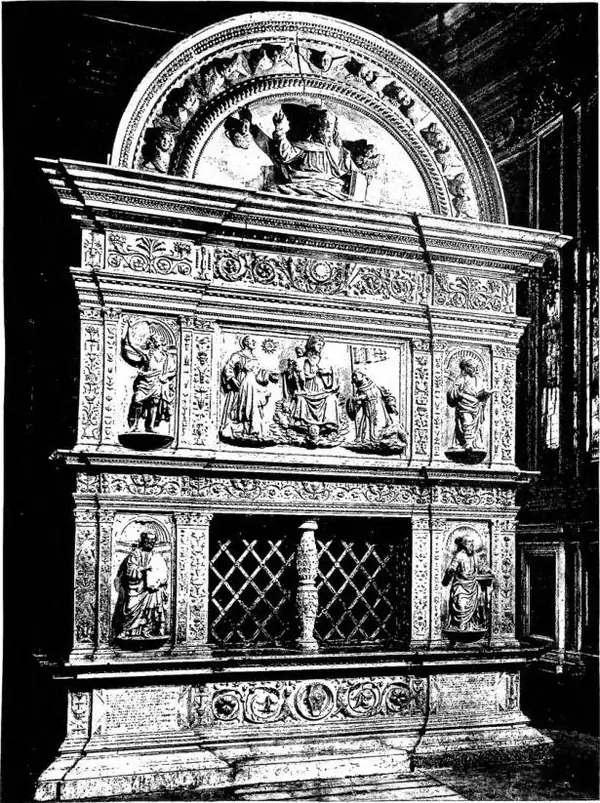
He is always represented in the Franciscan habit, barefoot and beardless; in one hand he holds a book and a Crucifix, and in the other the ravoleta that the famous preacher used to present to his listeners, with the name of Jesus surrounded by golden rays. At the Saint's feet are seen three mitres, in memory of the three bishoprics he refused. Among the oldest, and certainly most faithful, depictions that hand down to us his characteristic ascetically emaciated appearance, are probably those of Sano di Pietro (Siena, Palazzo Pubblico; there, Pinacoteca; Acquapendente, sacristy of St. Francis, and numerous other replicas or copies, among which many have passed into private collections). Throughout the whole of the Italian 15th century and beyond, St. B. is represented together with the highest sacred persons: for example, in contemplation of the Madonna (L. Lotto, Bergamo), kneeling in the presence of the Holy Family (Garofalo, Rome, Doria Pamphili gallery), at the foot of the Crucifix (Niccolò l'Alunno, Terni); of the great popularity that he at the same time enjoyed in Northern art, an engraving on copper from 1460 and some xylographic incunabula bear witness. St. B. in glory was depicted by the sculptors Agostino di Duccio (facade of the oratory of the same name in Perugia, 1457-61) and Urbano da Cortona (Siena, Opera del Duomo). To Fiorenzo di Lorenzo are attributed the eight miracles that occurred after the Saint's death. The most important cyclic representations of the legend are due to the frescoes of the young Pinturicchio in S. Maria in Aracoeli in Rome (1485). - See Tavy. LXXXVII-LXXXVIII.
Bibliography6 works
Kurt Rahe