TOULOUSE, Archdiocese of. - City and archdiocese in the department of Haute-Garonne in France.
It has an area of 6,302 sq km with a population of 512,240 inhabitants, of whom 500,000 are Catholics; the archdiocese is divided into the 4 archdeaconries of T., Villefranche, Muret and St-Gaudens, into 4 archpriesthoods, 32 deaneries comprising 575 parishes served by 453 diocesan priests and 159 religious; it has a major and a minor seminary, 12 male religious communities and 52 female ones (Ann. Pont. 1953, p. 426).
T. arose in a territory where the population was mixed: Ligurian and Iberian, and it was the capital of the "Volcae Tectosages." In 121 B.C. it was included in the new Roman "Provincia" and a Roman garrison had its seat there; Caesar in 52 B.C. established a praesidium there; it later became an oppidum latinum; little is known of its history during the Empire and under Diocletian; it was included in the province "Narbonensis prima." It reappears in history during the barbarian invasions; it was sacked by Ataulf, king of the Visigoths, in 413, became a royal residence during their domination, and in 506 the "Lex romana Visigotorum" was promulgated there. In 507 it passed under the dominion of the Franks. Throughout this period the inscriptions are few in number, considering the importance of the city (Pauly-Wissowa, VI A, II, col. 1686). Ausonius recalls the walls of red brick that surrounded T., whose Capitolium stood where the church of Notre-Dame du Taur stands today (E. Griffe, Le véritable emplacement du Capitole romain de Toulouse, in Bull. de littér. ecclés., 49 [1948], pp. 32-41). There is great uncertainty about its Christian origins and the related inscriptions are few in number (for the Christian sarcophagi cf. Wilpert, Sarcofagi, II, p. 231 ff. and passim). Around 250 there is a record of its first bishop Saturninus (v.). Bishop Rodanius, sent into exile together with St. Hilary of Poitiers in 355, died in Phrygia ca. 358 (Sulpicius Severus, Chronicon, II, 39, 45). After him are remembered Hilary and Silvius, who began the construction of the church of St. Saturninus, completed by his successor Exuperius, who transferred there the relics of the Saint; he received a letter from Pope Innocent I in 495 (Jaffé-Wattenbach, n. 293), and was in contact with St. Jerome, who in 406 dedicated to him his commentary on the prophet Zechariah (PL 25, 1415 ff.). Of his successors, Heraclianus was present at the Council of Agde in 506 and Magnulfus was represented at that of Mâcon in 585. Viligisilus in 614 took part in that of Paris and in 627 in that of Clichy. In the first half of the 8th century T. suffered the consequences of the Saracen incursions; but its bishops maintained good relations with the Carolingians, sharing in their fortunes. T. was subsequently governed by a dynasty of counts, the first of whom was Raymond, who maneuvered through the struggles with the dukes of Aquitaine and in those of Henry XII of Aquitaine with Louis VII of France. A grave blow to its prosperity was dealt by the religious disputes of the Albigensians, in which Raymond VI and Bishop Fulk (v.), the great supporter of St. Dominic (v.), found themselves opposed. It never succeeded in constituting itself as a true commune despite the privileges obtained. When the dynasty of the counts ended with Raymond VII (1249), his daughter Joan brought what remained of her father's inheritance to her husband Alfonso of Poitiers, brother of St. Louis IX, until in 1271 T. was incorporated into the Kingdom of France and became the capital of Languedoc. In 1296-97 it had as bishop St. Louis, a Friar Minor, son of Charles II of Anjou, king of Naples. Boniface VIII detached a part of the diocese to constitute that of Pamiers (v.); in compensation John XXIII on 25 July 1317 removed T. from the metropolis of Narbonne and constituted it as an archbishopric, giving it as suffragans Montauban, Pamiers, St-Papoul, Riez and Lombez.
The first archbishop was Raymond of Comminges (formerly bishop of Maguelonne) from 1309 to 1327, in which year he was created cardinal. He was succeeded by the Dominican William de Laudan (formerly bishop of Vienne); then Raymond de Carichale (1345-50), cardinal in 1350; Card. Francis de Gozie (1391-92), then Bernard of Rosier (1451-74), founder of the "Collège de Foix"; John of Orléans from 1503 to 1533, the year in which he was created cardinal.
T. continued its life until the Revolution, disturbed in the 16th century for a moment by the Huguenot troubles; from 1534 to 1550 it was administered by Card. Odet de Châtillon (v.), in March 1563 deprived of every rank and benefice for heresy; then Francis de Joyeuse (1584-1605); Louis de Nogaret (1614-27); Pierre de Marca (1652-62), Pierre de Bonzy (1672-73); Arthur R. Dillon (1758-63); Étienne Charles Loménie de Brienne (1763-89); Antoine J. de Clermont-Tonnerre (1820-30), P. T. D. d'Astros (1830-35), cardinal in 1850; Jules F. Desprez (1859-95), cardinal in 1879; François Désiré Mathieu (1896-99); from 1928 Jules Géraud Saliège, created cardinal on 18 Feb. 1946.
In the new diocesan circumscriptions fixed by the Concordat of 1801, T. was preserved as an archdiocese, eventually to include that of Narbonne (v.), and by the bull of Pius VII of 22 July 1822 the territories of the suppressed dioceses of Rieux and Comminges and part of those of Montauban, Lavaur, St-Papoul, Mirepoix and Lombez were added to it, so as to correspond to the department of Haute-Garonne. As suffragans it had the dioceses of Montauban, Pamiers and Carcassonne. On 19 Jan. 1935 the archbishop of T. was granted the faculty of adding to the title of Narbonne also that of St-Bertrand de Comminges and of Rieux (AAS, 27 [1935], p. 78).
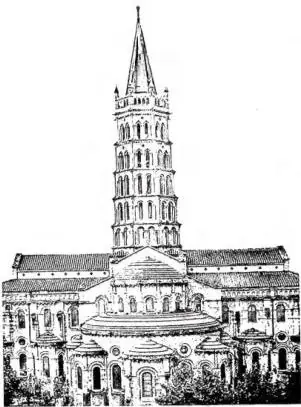
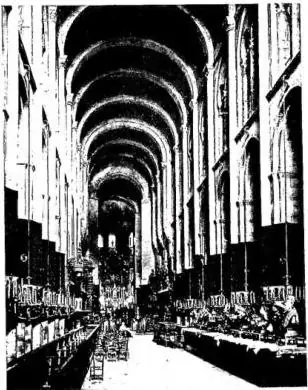
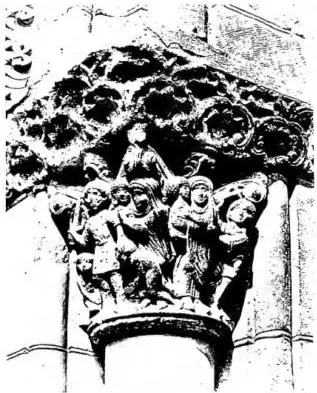
The Cathedral dedicated to St. Stephen traces its first origins to Bishop Exuperius of the 5th century and had a cloister (destroyed in 1812-17); rebuilt in 1078 by Bishop Izarn, in 1272 Bishop Bertrand de l'Isle Jourdain gave it that form by which it is the prototype of the other southern Gothic brick churches; in 1286 the same bishop erected its choir in Roquefort stone. It preserves stained-glass windows of the 14th-16th centuries and sculptures of the 17th century, as well as a rich series of tapestries of the 16th-17th centuries in the baptismal font chapel (L. Vié, La métropole St-Etienne de T., Toulouse 1950). Destroyed by the Saracens in 721, the church erected in honor of St. Saturninus was rebuilt in the following age thanks to the donations of Bishop Hugh (960) and of Raymond, count of Rouergue (961). A new building began to be erected ca. 1060, interrupted several times. The religious of the abbey in 1076 took the Rule of St. Augustine, aiming to make themselves independent of Bishop Izarn, who in 1082 ceded the church to Abbot Unandus of Moissac. But Gregory VII on 23 July 1083 re-established the Canons there. Pope Urban II in 1096 consecrated there the high altar, which still survives, and Callistus II in 1119 a second altar; meanwhile the construction of the building continued until in the middle of the 13th century the choir was raised, the crypts were modified and the Romanesque construction was reinforced. At the height of the transept the three stories of the bell tower were erected, to which two more were subsequently superimposed. With the Revolution the cloister and the monastic buildings were demolished; restorations were carried out in 1852-55. Medieval sculptures and capitals are preserved there (A. Auriol et R. Rey, La basilique de St-Sernin de T., Toulouse 1930; M. Aubert, L'église de St-Sernin de T., Paris 1933).
Notre-Dame de la Daurade (deaurata), which is said to have been founded by Bishop Exuperius, had a women's monastery attached to it, which passed to the monks in 843. Bishop Izarn ceded it in 1077 to St. Hugh of Cluny, and in 1627 it passed to the Congregation of St. Maur. It took its name from its gold-ground mosaics, which were lost when the church was demolished during the 18th century, but a 17th-century manuscript (Paris, Bibl. nat., no. 12608) described their subjects, which in three superimposed tiers represented scenes from the life of Christ, archangels, Prophets, Evangelists, Apostles (cf. J. Degert, La plus ancienne mosaïque de la Gaule, in Bull. de littér. ecclés. de Toulouse, 1905, pp. 3-15; id., Démolitions et reconstructions à la Daurade au XVIIe siècle, in Bull. de la Société archéol. du Midi, 1905, pp. 296-98; H. Woodroff, The iconography and date of the mosaics of la Daurade, in The Art Bulletin, 13 [1931], pp. 80-104; R. Rey, Le sanctuaire paléochrétien de la Daurade et ses origines orientales, in Annales du Midi, 61 [1949], pp. 249-73; E. Mâle, Les mosaïques de la Daurade, in Mélanges Ch. Picard, II, Paris 1949, p. 682).
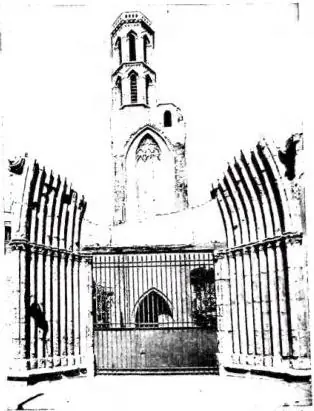
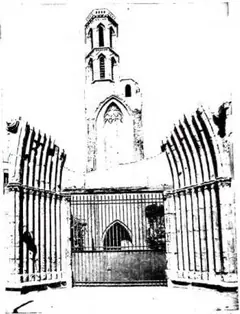
The church of N.-D. de la Dalbade, or La Dalbade, derives its name from the fact that its walls were whitewashed with lime (dealbata). It was rebuilt from 1503 to 1542 in the southern Gothic style and consecrated in 1548; it was badly damaged in 1926 by the collapse of the bell tower. On the portal (1537) is engraved the distich: « Chrestien, si mon amour est en ton coeur gravé, ne diffère en passant de me dire une Ave » (16th century); in the tympanum is a painted terracotta copy of the Annunciation of the Virgin by Fra Angelico; the three statues of the Madonna, of St. Catherine and of St. Barnabas are modern. The interior has a single nave measuring 19 x 24 m, with side chapels. The new bell tower is under construction.
St-Papoul, in the district of Castelnaudary, is the title of an ancient Benedictine abbey founded in 817 and dependent on St. Victor of Marseilles. The name is Gallo-Roman of the 6th century, and the cult of that saint would have replaced that of St. Peter (cf. Acta SS. Novembris, I, Paris
In 1887, p. 587). John XXII in 1317 raised it to the rank of episcopal see; it was rebuilt in the 14th century and secularized in 1670. The church has a fine Romanesque choir and a cloister with Gothic columns and capitals (E. Regnaud, Pouilles dans l'église de St-Papoul, in Bull. de la Soc. archéol. du Midi, 1905, pp. 259-60; Cottineau, II, coll. 2834-35; E. Griffe, Autour du nouveau Propre diocésain de T., in Revue d'hist. de l'Eglise de France, 28 [1942], pp. 75-79).
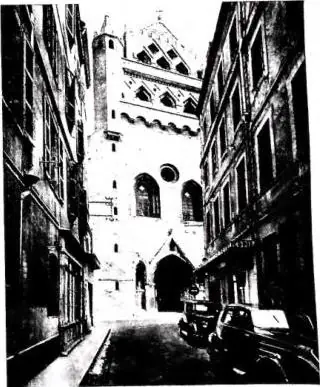
The church "des Jacobins" was built in 1230-92 after the Dominicans established at St-Romain had acquired the land; it had two naves; one to the north, called the church of the friars; the other to the south, the church of the laity, with five bays. A first enlargement took place in 1314-40 through the work of Card. de Peyre de Godin, and a second in 1369-85 on the occasion of the translation from Italy of the relics of St. Thomas Aquinas granted by Urban V (Ch. Higounet, La chronologie de la construction de l'église des Jacobins de T., in Bull. monumental, 107 [1949], pp. 85-100; E. Lambert, L'église et le couveur des Jacobins de T. et l'architecture dominicaine en France, ibid., 104 [1946], pp. 141-86).
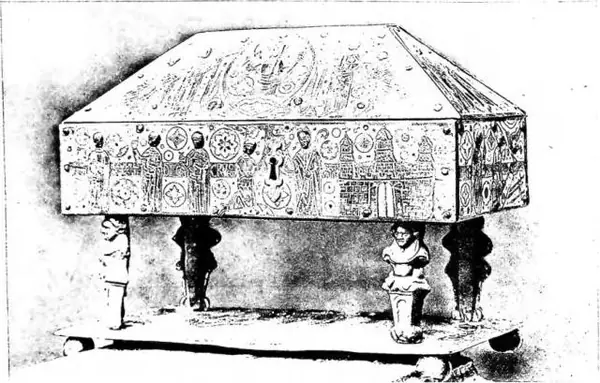
Some of the most important sacred buildings have been put to secular uses. In the ancient collegiate church of St-Raymond from the beginning of the 16th century, a museum has been set up that gathers Roman archaeological material and collections of Visigothic and medieval art up to Henry IV. The Natural History Museum is housed in the ancient convent of the Discalced Carmelites of the 17th century, where the material relating to prehistory and ethnography is also kept. The magnificent cloister, "des Augustins," has likewise been adapted as a museum.
Bibliography22 works
Enrico Josi
THE CENTER OF STUDIES
T. has always been, since Gallo-Roman antiquity, a center of culture, whence its appellation of "Palladia T." (Martial, IX, 100 [99], 3; Ausonius, Parent., 3, 14). Lively literary manifestations, between the 12th and 13th centuries, took place at the court of the counts of T., munificent patrons of the troubadour art.
1. The ancient University
The Treaty of Paris (12 Apr. 1229) imposed on Count Raymond VII, also on the advice of Card. Romanus of St. Giles, legate of Gregory IX, the duty of providing masters for a Studium to be erected at once at T. for the preservation of the faith against the Albigensian heresy. The Studium was solemnly inaugurated on 24 May 1229; Gregory IX, by the bull Olim operante Illo (27 Apr. 1233), confirming what Card. Legate Romanus had established in 1229, granted to the Studium of T. the privileges of the University of Paris (Bull. Rom., III, Turin 1858, pp. 480-81). The Studium Tolosianum thus constitutes the first example of a university arising by pontifical initiative. Innocent IV was regarded as the new founder of the Studium, by the bull of 22 Sept. 1245, In civitate Tolosiana (M. Fournier, op. cit. in bibl., n. 523). At the beginning of the 14th century Philip II the Fair, in his conflict with Boniface VIII, consulted the Studium, and while the University of Paris had declared for the Pope, that of T. sided with the King (cf. ibid., nn. 536 and 537). The general Statutes are those of the 14th century (1309-29), and in them one already notes the tendency to free itself from the jurisdiction of the chancellor and the bishop. The Statutes proper to the Faculty of theology, reorganized, are of 1366-89; Urban V, an alumnus and professor, granted to the church of the University (of the Dominicans) the body of St. Thomas Aquinas (bull Cum ex certis, of 1307), which was transported there on 28 Jan. 1369. The fame and prosperity of the Studium were greatly aided by the numerous colleges for poor students. Its constitution, while presenting the characteristics of the Universities of Bologna and Paris, constitutes a type of its own: a type later imitated for other French universities such as Cahors, Orléans, Poitiers and Bordeaux, to which T. communicated its privileges and its Statutes. The Hundred Years' War (1339-1453) and the unfortunate reform of the apostolic commissioners (1394-1425) shook the prestige of the University of T., which toward the middle of the 15th century passed under the direct influence of the civil power, and remained principally a university for law. It disappeared with the Revolution (decree of 15 Sept. 1793), revived with the Napoleonic reform (1808) and was reconstituted as a modern university following the law of 10 July 1896: characteristic in it is the Institute of Southern Studies.
2. The Catholic University
The "Institut Catholique de Toulouse" considers itself the spiritual heir of the ancient University; organized following the Dupanloup law (12 July 1875), it was inaugurated as a "Free Institute of Higher Education" on 15 Nov. 1877, with the Faculty of Law and courses of apologetic lectures, destined to develop immediately into the Faculties of Letters (16 Nov. 1878) and of Theology (25 Nov. 1879). The latter received canonical erection by decree of the Sacred Congregation of Studies, 15 Oct. 1889, and by the apostolic letter Eximia sacrarum, 20 Dec. 1889 (Leonis XIII Acta, IX [1889], 277-80); subsequently the Faculties of Philosophy and of Canon Law were erected, with approval of their respective Statutes (decrees of the Sacred Congregation of Studies, 30 June 1899; cf. Pius X, letter Quae super, 2 Apr. 1913; AAS, 5 [1913], pp. 179-80). The "harshness of the times" imposed, in 1886, the suppression of the Faculty of Civil Law; the Institute was nevertheless able to give life to the Higher School of Sciences (3 Nov. 1882); to a Higher School of Agriculture (13 Nov. 1919), and to the Higher School of Economic and Social Sciences (17 Nov. 1926). The new Statutes, after the apostolic constitution Deus scientiarum Dominus (v.), were approved by the Sacred Congregation of Seminaries and Universities of Studies, on 15 June 1936. A Catholic University for the southwest of France, the Institute embraces a circumscription of 17 dioceses, in the ecclesiastical provinces of T., Albi, Auch and Bordeaux. The 17 bishops, considered "protectors" or patrons, make up the episcopal "assembly", with a "permanent commission" of the "archbishops" with a suffragan chosen by the assembly; the grand chancellor is the archbishop of T. On the initiative of the Institute, there arose in 1951 the "Uni-
Université Internationale d'Été" arose in 1951, and there the Annuaire is published; the Bulletin de Littérature ecclésiastique, a scholarly journal, founded in 1880 and renewed by P. Batiffol in 1899, in which are also contained many notices on the fortunes of the Institute and of its masters; the Chronique of the University itself.
3. The Major Seminaries
The ancient diocesan Seminary was reconstituted in 1805 by the archbishop Primate. For the ecclesiastical students of the Athenaeum there are today open, from Oct. 1932, in its own environment: the Seminary Leo XIII, which continues the ancient "Séminaire de l'Institut" (1879), for students already priests, and the Seminary Pius XI, for seminarians preparing to receive the sacred Orders. Their direction is entrusted to the Fathers of St. Sulpice.
4. Other cultural institutions
The Academy of Sciences, Inscriptions and Belles-Lettres (1640), which has published Mémoires from 1782; the ancient Academy "des Jeux-Floraux," founded in 1323 and reorganized in 1694; the Archaeological Society "du Midi de la France" (1831), which has likewise published volumes of Mémoires (1832 ff.) and a Bulletin (1869 ff.). - See plates XXV-XXVI.