
CHANAAN and CHANAANITES, - People who in ancient times inhabited Palestine.
I. NAME
It is one of those by which the Old Testament designates the territory occupied by the Israelites.
The name is found in the el-Amarna letters (ca. 1375 B.C.) in the form kinaḥḥi (kinaḥna, kinaḥni). The Egyptians of the XIXth and XXth dynasties (14th-12th centuries B.C.) prefixed the article to it (p. ku'n), just as in Greek one finds ὁ γνᾶς. The etymology of the name is not certain: many authors derive it from the Semitic root kana' "to be low"; others instead think it is a pre-Semitic word. In the el-Amarna letters Kinaḥnaḥ is the name of a part of the Asiatic province of the Egyptian kingdom, which then comprised present-day Palestine, Phoenicia and Syria as far as the Euphrates. It cannot be proved that Palestine itself is called Kinaḥna in these letters, since the relevant texts deal rather with Phoenician cities situated on the coast of the Mediterranean (Acco, Tyre, Byblos), and with some inland cities such as Ḥaṣor (v. ASOR) southwest of the side of Ḥoleh. It seems that the name has a similar meaning in the inscription of Merneptah (the "stele of Israel"), in which the name of Israel is read for the first time: "Canaan is plundered with all its wicked; Ashkelon is deported, Gezer is bound, Jeno'am is annihilated; Israel is destroyed, it has no more seed."
In the Old Testament too there are texts in which Canaan means rather the land of the Phoenicians; thus, for example, Iudc. 4, 2, 23; 5, 19; II Sam. 24, 7; Is. 23, 11; Prov. 31, 24; and again in the New Testament Mt. 15, 22 (the "Canaanite woman"). But more commonly the Old Testament uses the words Canaan and Canaanites in a broader sense, calling thus the Palestine occupied by the Israelites and its pre-Israelite population, whatever its ethnic origin.
In the "table of the peoples" (Gen. 10) it is said (v. 19) that "the territory of the Canaanites extended from Sidon in the direction of Gerar (that is, to the west) as far as Gaza, and in the direction of Sodom, Gomorrah, Admah and Zeboiim (that is, to the east) as far as Lasha" (according to the Talmud and Jerome = Callirrhoe east of the Dead Sea; others identify it with Lajš [Dan], near the sources of the Jordan). "Sons of Canaan" (that is, members of the Canaanite family) are Sidon, the Hittites, the Jebusites, the Amorites, the Girgashites, the Hivites, the Arkites, the Sinites, the Arvadites, the Zemarites and the Hamathites (Gen. 10, 15-18), that is, the non-Israelite peoples of Palestine and Syria. In this text, as in others, the originally geographical term Canaanites is used to mean the pre-Israelite population residing there, without regard to the ethnic affiliation of the individual elements. By tracing the Canaanites back to Ham (Gen. 10, 6), the "table of the peoples" does not intend to speak of the ethnic origin of the "Canaanite" peoples, but of their political dependence on the Hamitic Egyptians.
Ethnographically the majority of the inhabitants of Canaan (that is, of Palestine-Phoenicia) seem to have been Semites, who immigrated in different periods; the oldest stratum probably in the 4th millennium, the most recent (the "Amorites", v.) ca. the year 2000. Sometimes, however, the Old Testament distinguishes between Canaanites and Amorites, calling Amorites not only the pre-Israelite inhabitants of Transjordan (cf. Num. 21, 13, 31; Deut. 3, 8; 4, 47 ff.; 31, 4; Ios. 2, 10; 9, 10; 12, 2; 13, 10; Iudc. 10, 8), but also a part of the inhabitants of Palestine proper, that is, those dwelling in the mountain (Deut. 1, 7.19.20.44: people dwelling in the south of Palestine; Ios. 10, 5 ff.), while to the Canaanites are attributed the plain and the valley of the Jordan (Num. 13, 29; Ios. 11, 3). Not rarely the Bible calls the whole pre-Israelite population Amorites (cf. Gen. 15, 16; Ios. 24, 15.18; Iudc. 6, 10); but in later times the Amorites, either exterminated or assimilated by the Israelites who had occupied the mountain, no longer existed, while the "Canaanites" in the strong cities of the plain had resisted the invaders and constituted a continuous danger for the Israelites (cf. Iudc. 1, 27-33).
The name of "Canaanites" thus came gradually to be used to designate all the pre-Israelite inhabitants of Palestine, all the more so since the small peoples of the Perizzites, Rephaim, Girgashites, Jebusites, etc. (cf. Gen. 15, 19 ff.) were no longer of any importance. The Canaanites of Phoenicia, geographically separated from Palestine and soon entering upon a historical and political evolution different from that of the Palestinian peoples, were called after their principal city, as in Homer, Sidonians (cf. Deut. 3, 9; Iudc. 10, 6.12; 18, 7; I Reg. 5, 6 [20]; 11, 1. 5. 33; II Sam. 23, 13).
We use here "Canaanites" to denote indiscriminately the population that inhabited cis-Jordanian Palestine before the immigration of the Israelites and maintained itself alongside them for several centuries.
II. HISTORY
1. The sources
The history of the Canaanites, as well as their language, religion and civilization, are known to us primarily from the excavations carried out in Palestine during the last decades. In almost every large Israelite city, beneath the strata belonging to the Israelite period ("Iron Age"), there are found more or less numerous strata that represent the pre-Israelite ("Canaanite") culture in its various phases. Quite a few pre-Israelite necropolises have also been discovered, especially important for the grave goods that, customarily given to the deceased, attest for the various periods the level and character of the civilization of those peoples. Alongside these archaeological sources, however, there is no lack of literary documents referring to pre-Israelite Palestine. The principal ones are: the tale of the Egyptian Sinuhe, who dwells for a long time in Palestine (the story refers to the times of Amenemhet I and Sesostris I, ca. 2000-1935, and seems to have been written in the second half of the 20th century), the "execration texts," today preserved in Berlin and Brussels (from the 19th century), the reports of the Egyptian pharaohs on the campaigns conducted in Palestine and Syria, among which first of all that of Tuthmosis III (ca. 1501-1450) referring to the campaign of 1479 against the allied princes of Palestine and Syria, and, of the highest importance, the el-Amarna letters (v. AMARNA), correspondence in the Akkadian language and cuneiform script of the pharaohs Amenophis III (1411-1375) and Amenophis IV (1375-1358) with the kings and governors of Syria and Palestine. These and other literary documents, compared with the results of the excavations and inserted into the general history of the Near East of the 3rd and 2nd millennium B.C., today provide us with a fairly concrete picture of the Canaanite history of that age.
2. The course of history
In prehistoric and protohistoric times Canaan seems to have been inhabited by non-Semitic peoples, whose ethnic affinity, however, cannot yet be determined. At Gezer (and perhaps also at Jerusalem) the remains of a "crematorium" (from the Neolithic age) have been found, evidence of the cremation of corpses, not practiced among the Semites. The first Semitic immigration seems to have taken place ca. 3000; but the particulars of that ethnic movement still elude us completely. The few Egyptian paintings of the 3rd millennium that represent inhabitants of Palestine or Syria present them as purely Semitic types. Egypt at that time, trading since 3000 B.C. with the Phoenician city of Byblos (v.), also took an interest in Palestine; the pharaoh Pepi I (ca. 2450 B.C.) conducted five military campaigns to secure dominion over it, and the imposing fortifications that arose in the 3rd millennium almost everywhere in Palestine show that the struggle between the powerful Egypt and the inhabitants of Canaan was fierce. From documents coming from the subsequent period it appears that Egypt in the meantime had succeeded in occupying southern Palestine or, at least, in establishing some strongholds there, such as the strong city of Gaza. The cultural influence of Egypt is confirmed by objects of Egyptian origin found in the excavations, and, on the other hand, there is also evidence that Palestine at that time supplied Egypt with its principal products, wine and grain.
Toward the end of the 20th century Palestine seems to have been invaded by another Semitic group, coming from northern Mesopotamia. The invaders were, it appears, of the same stock that at that time was invading Babylonia, where it founded the 1st Babylonian dynasty, called "Amorite." This new population, the "Amorites," occupied first of all Transjordan, but also the mountains of Cisjordan, while the "Canaanites" resisted in the plains. The Egyptian domination, which existed de jure, in reality seems to have been rather unstable, as is proved by the fact that in the "execration texts," especially those of Brussels, no fewer than 63 territories "rebellious" or at least suspect to the Egyptians are listed. The Egyptian hegemony was then completely eliminated by new invaders who poured in from the middle of the 18th century, namely the "Hyksos," who, having overwhelmed Palestine, succeeded in occupying even Egypt (ca. 1730-1580). In Palestine the Hyksos occupied the great cities — many of them display the fortification technique peculiar to the Hyksos — without, however, changing the cultural situation of the country, the occupation being of a rather military than political nature. The hegemony of the Hyksos, which extended over a large part of the Near East, favored the influx into Palestine of cultural elements of the most varied origin.
Once the Hyksos had been expelled from Egypt (ca. 1580), some of their nuclei seem to have maintained themselves in Palestine, but rather under Egyptian hegemony, which under the 17th dynasty (1580-1450) and even more under the 18th (1450-1315) was fully re-established. The list of the cities conquered by Tuthmosis III (1501-1450) in the campaign of 1479 against a coalition of Palestinian and Syrian princes lists no fewer than 119 Palestinian cities, situated however rather in the plain than in the mountains. During the 15th century Egyptian supremacy remained firm, and the period of peace favored the material prosperity of the country, which is manifested by the excavations. A serious disturbance was caused in the 14th century by the ever-growing pressure of the Habiru, about which the el-Amarna letters inform us. The Egyptians no longer had the strength to offer effective resistance to it, and not even the powerful pharaoh Ramses II (1292-26), who had to besiege even the city of Ascalon, succeeded in effectively re-establishing Egyptian supremacy.
The Israelites, having entered Palestine between the 15th and the 12th century — the date is not yet certain — had to deal not with the Egyptians, nor with a united Canaanite people, but with the kings of individual cities independent of one another. Nevertheless they did not succeed in overwhelming the great Canaanite cities of the plains, e.g., Gezer, Dor, Megiddo, Taanach, Beth-shan; indeed, better equipped for war, provided with iron chariots, they recovered to such an extent as to be able to separate the northern tribes of Galilee from those of Samaria (Judg. 5, 6 ff.) and, it appears, even between the tribe of Judah and those settled in the mountains of Ephraim a Canaanite isthmus had been interposed. The situation became critical, but a common action of five and a half tribes, led by Barak and assisted by Deborah, decided the fate of the Canaanites forever in the battle of the "waters of Megiddo" (Judg. 4, 24). From that time there is no more talk of great wars against the Canaanites; their remnants were little by little absorbed and assimilated by the Israelite element. David captured their last stronghold, the Jebusite fortress of Jerusalem, and made it the capital of his kingdom. In the administrative organization of Solomon (1 Kings 4, 7-19), the ancient Canaanite cities for the most part became the seat of the Israelite governor. The political importance of the Canaanites had ceased, but their religious and cultural influence in Israel continued to be felt for centuries in a baleful manner, especially in the northern kingdom.
III. CANAANITE CIVILIZATION
1. Politically the Canaanites were not a united nation, but each city (with its surrounding territory) was subject to its own king. All the literary documents mentioned above agree on this point. In time of war the princes threatened by an aggressor would unite in a league, as, for example, in 1479 against Tuthmosis III, or in the el-Amarna period, when certain cities formed an alliance under the leadership of 'Abdilpipa, king of Jerusalem, or in the time of Joshua, against whom stood the southern league of the kings of Jerusalem, Hebron, Jarmuth, Lachish and Eglon, and the northern league headed by Jabin, king of Hazor.
2. The language of the pre-Israelite population of Canaan is preserved for us only in a few glosses and phrases of the el-Amarna letters and in pre-Israelite proper names. From these scanty remains it appears that the Canaanites spoke a language little different from that of the Israelites, who seem to have accepted into their idiom not a few elements of that pre-Israelite Canaanite language. Of Canaanite literature, if there ever was any, nothing is preserved for us.
3. Canaanite secular culture gradually reached a relatively high level, thanks to foreign influence, to which Canaan was open in every direction: to the north to Hittite and Hurrian culture, to the east to that of Assyria and Babylonia, to the southwest to Egyptian culture, to the west to Aegean culture (of Cyprus, Crete, Mycenae). The cities were not large: in the Bronze Age they occupied from 2 to 10 hectares (for example, Canaanite Jericho about 2.50 hectares, the Jebusite Jerusalem about 5 hectares, ancient Gezer 9 hectares). Being for the most part places of refuge in time of war for the population that cultivated the surrounding territory and lived there in its huts, the cities did not need much space, but rather strong means of protection: a position difficult of access (on hills or on mountain spurs), high and strong walls 4-8 m. in width, often double, protected by glacis and ditches, fortified gates, sometimes built "in pincer fashion," underground galleries leading to the water sources when these were situated outside the enclosure (as, for example, at Jerusalem, Gezer, Gibeon, Lachish, Ibleam). The art of fortification reached great perfection as early as the 3rd millennium (for example, at et-Tell = Ai), but especially in the Hyksos period (18th-16th centuries), who seem to have brought a technique of fortification of their own. The fortified cities of the Canaanites therefore frightened the Israelites who, coming from the desert, were unprepared with the means suited to confronting such defensive works (cf. Num. 13, 29; Deut. 9, 1).
The houses are for the most part small and clustered together without order. In the houses of the rich and in the palaces of princes, however, a certain comfort is noticeable. Household utensils, whether of native manufacture or imported, not infrequently show good artistic taste, especially in the decoration of pottery and weapons. Nor was the art of writing unknown. For international diplomatic correspondence and sometimes also in private affairs the Accadian cuneiform script was used (as the el-Amarna letters and the tablets found at Shechem, Tell el-Hesi and Taanach attest); but an alphabetic script was also known, which seems to stand midway between that found in the Sinai peninsula (of the 19th or 16th centuries) and the Phoenician script, of which the oldest monument known so far is an inscription from Byblos (about 1500 or 1400 B.C.). Remains of this Canaanite alphabetic script have been found at various sites in Palestine, in the center and in the southwest, for example, at Shechem (an inscription ascribed to the 17th century) and in the excavations of Lachish (several inscriptions on vessels and implements, of the 17th-14th centuries); at Beth-shemesh (v.) a tablet with Ugaritic script (alphabetic-cuneiform) was even found. It is clear that the Canaanites knew the art of writing at least toward the middle of the 2nd millennium; but the discoveries made so far are not enough to reconstruct the genesis of the alphabetic script.
4. The Canaanite (pre-Israelite) religion was polytheistic. Originally the supreme (or only) Semitic deity seems to have been the god El, who, however, in very ancient times was supplanted by Baal (v.) with his consort ʿĀtērāh or Astarte. "Baal" ("lord") was the common name used to signify the god; almost every major city had one of its own; but the name also served to designate the deity simply, as appears from the el-Amarna letters and from the Egyptian inscriptions of the XIXth and XXth dynasties. Baal was the god of war and the god of heaven (baʿlu ina šamē); as such he was also the god of vegetation, especially of the storm that brings the rain. His symbol was the bull. In other cases the deity seems to have been represented in the form of a serpent (Beisan, Gezer, Beit Mirsim); but more commonly a simple stone stele (maṣṣēbhāh) was used to represent the god. Besides Baal, and partially confused with him, Hadad was worshiped, the god of the storm, originally domiciled in northern Mesopotamia and probably imported into Palestine by the Amorites (about 1900 B.C.).
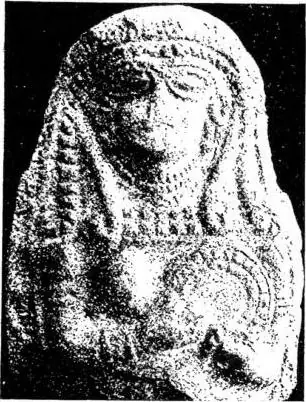
The companion of Baal was Astarte (Hebr. ʿĀtērāth), the Ishtar of the Babylonians, goddess of fertility and also of war. In Palestine this goddess is often confused with ʿĀtērāh, also a goddess of animal fertility. Her symbol was the tree trunk or "sacred pole"; the Old Testament called these trunks ʿĀtērāth. The cult of ʿĀtērāh and ʿĀtērāth was very sensual (sacred prostitution). Numerous are the statuettes (for the most part of terracotta) found in Palestine representing the goddess naked with the sexual characteristics strongly accentuated.
A third deity of the Canaanites was ʿAnat, also a goddess of life and fertility, in the texts of Ras Shamra the sister and consort of Baal. Her cult in Palestine is attested by a statue of her found at Beisan and by local names compounded with ʿAnat (cf., for example, Josh. 19, 38; Judg. 1, 33; Beth-anath; Josh. 21, 18 etc.; Anathoth).
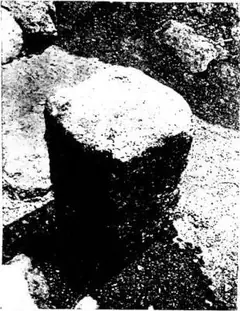
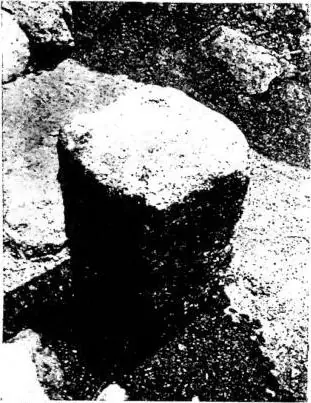
The places of worship of the Canaanites were the temples, and (more frequently, it appears) the so-called "high places" (bāmāth "excelsa"). So far very few authentically Canaanite temples have been found (for example, at Ai, at Shechem), but their existence can hardly be denied. Of the "high places," so often mentioned in the Old Testament, no traces have been preserved, as is easily understood, except in a sacred place excavated at Beth-shan (of the time of Tuthmosis III, 1501-1450) and outside Palestine, on the Zibb Atuf near Petra. The bāmāh (v.) was for the most part situated on a hill (but sanctuaries situated in the plain were also called thus; cf. Jer. 7, 31), and consisted of an altar, of maṣṣēbhāth and of ʿĀtērāth (luci in the Vulgate). Idols properly so called do not seem to have been used in the "high places," but rather in the temples. The (12?) maṣṣēbhāth found at Gezer, probably belonging to the period 1800-1600, regarded by many authors as a remnant of the sanctuary of that city, are perhaps nothing other than commemorative or funerary stelae of princes or of other illustrious personages. Objects of worship in individual houses were statuettes of gods or goddesses, especially of the naked goddess, found in great number in the excavations.
The cult itself consisted principally in sacrifices, whether bloody or unbloody. The animals that were immolated seem to have been, as appears from the bones found in the excavated sanctuaries, those prescribed by the Bible, especially sheep and young oxen; so far it has not been proved with certainty that among the Canaanites (contrary to Hebrew usage) the pig was also immolated. The Old Testament attests that among the Canaanites human sacrifices were also in use
(cf. Lev. 20:1-5; Deut. 12:31; 19:9 ff.). Archaeology has so far furnished no indisputable proof of them, but there are indications. Nevertheless, the interpretation of archaeological discoveries must be cautious. The skeletons of children enclosed in amphorae, found in some of the excavated cities, perhaps do not come from sacrificial offerings, but from burials practiced within the houses themselves; the bodies show no traces of wounds or of burning and are generally accompanied by the usual funerary gifts (vials with food, vessels with drinks, etc.). The so-called "foundation sacrifices" cannot be proven with certainty, but neither does the Old Testament indisputably attest their existence (the exegesis of 1 Kings 16:34 is controversial). It does emerge, on the other hand, from the Old Testament that human sacrifices were offered not only to Moloch (identical with the god Malik worshiped in Babylon), but also to the Canaanite god Baal (Jer. 19:5; 32:35). The existence of this barbarous practice among Israel is a convincing argument for its existence among the Canaanites as well; from these it had passed to the Israelites, as had so many other immoral and inhuman religious practices, for example, "sacred" prostitution (cf. 1 Sam. 14:24; 15:12; 22:47; 2 Sam. 23:7).
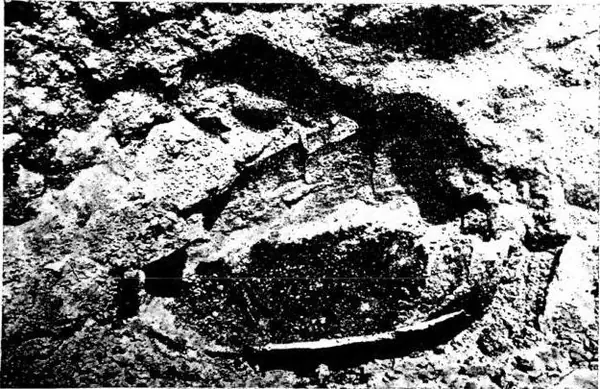
5. Abundant is the information furnished us by the excavations concerning the care of the dead; in almost all the great Canaanite cities either the necropolises or at least a great number of tombs have been found again. The dead were generally buried, as also among the Israelites, in natural caves or in underground chambers built in various shapes, mostly intended for entire families. The dead person was placed in the tomb without a sarcophagus; where a sarcophagus is used, as at Beisan and at Tell el-Far'ah (anthropoid sarcophagi), this happens through foreign influence (cf., for example, the sarcophagi of Byblos). The dead were given abundant gifts, particularly objects of everyday life: plates, brooches, amphorae, lamps, tools and weapons, various ornaments. This funerary furnishing attests the conviction that the deceased enjoys, after death, a life similar to the earthly one. The necropolises were generally located outside the cities; thus, for example, at Jericho, Tell el-Far'ah, Beisan, Gezer, et-Tell (Ai); but tombs of single individuals or of entire families were also made within the inhabited area (for example, in Gezer, Megiddo). Moreover, only the tombs of the wealthier are preserved for us; the common people buried their dead in simple graves dug in the earth, of which nothing has been preserved.
Bibliography12 works
Agostino Bez
IV. BEARERS OF CANAAN AND THE CANAANITES
In ancient Christian art, the scene was depicted of two scouts returning from the land of C., where Moses had sent them, carrying on a pole a branch with a cluster of grapes (Num. 13:2 ff.).
For Zeno, bishop of Verona (362-71), the pole that supported the cluster is a symbol of the wood of the Cross (PL 11, 469-70): immediately afterward St. Ambrose explains that the cluster of grapes prefigured Christ, "ille botrus peregrinus, qui sicut uva de vite, ita ille in carne crucis pependit in ligno" (De Fide, I, 20; IV, 12: PL 16, 559-60, 648-49). The same is taught by St. Augustine (Contra Faustum, XII, 42: PL 42, 276; Enarratio in Psalm., 55, 2 and 7: PL 36, 849, 653) and by a host of writers from the 5th to the 13th century, as C. Leonardi recently emphasized (Ampelos, il simbolismo della vite nell'arte pagana e paleocristiana, Rome 1947, pp. 147-85). The scene of the grape-bearers in ancient Christian art appears on a sarcophagus lid found at St. Victor in Marseilles (Wilpert, Sarcofagi, I, p. 271, pl. 17, 2), on a gilded glass in the museum of Pesaro (R. Garrucci, Storia dell'arte cristiana, III, Prato 1872, pp. 129-301, pl. 172, 10), and on another from the cemetery of Pamphilus (C. Leonardi, ibid., pl. XIV). It is likewise depicted on certain Christian terracotta lamps, as, for example, the one in the museum of Narbonne, published by E. Le Blant (De quelques sujets réprésentés sur des lampes en terre cuite de l'époque chrétienne, in Mélanges d'archéol. et d'histoire, 6 [1886], pp. 237-38), and on another in the museum of the Campo Santo Teutonico in Rome (O. Marucchi, Medaille und Lampe aus der Sammlung Zurla, in Römische Quartalschrift, 1 [1887], p. 327). The representation is also found in later monuments, as in a French illustrated Bible in the National Library of Vienna, in a biblia pauperum of Heidelberg, etc. (Leonardi, ibid., pls. XIV-XVI, 30-31). - See Pl. XXXVI.
Enrico Josi