
BONAVENTURE, Saint. - Doctor of the Church.
I. LIFE
St. B. was born in 1221 at Bagnorca, today a ruined suburb of Bagnoregio, near Viterbo. His father, probably a physician, was named Fidanza Giovanni, and his mother Ritella. Seeing the child gravely ill, she obtained his healing following a vow made to St. Francis of Assisi. The fact, attested by St. B. himself, had no small influence on his religious and intellectual orientation.
Sent to the faculty of Arts of Paris around 1236, he put on the Franciscan habit in the convent of the Friars Minor about 1243 and studied theology under the direction of Alexander of Hales (d. 1245), of John de la Rochelle (v.) d. 1245, of Eudes Rigault d. 1275, and perhaps also of William of Melitona (v.) d. 1257. In 1248 he began his teaching by commenting on the Gospel of St. Luke, and from 1250 on the Sentences of Peter Lombard. After 1253 he composed his Quaestiones disputatae and the Breviloquium, a small theological summa. Around that date the crisis broke out that was to set the secular clergy in opposition to the Dominicans and the Franciscans, first over the question of the University and later over the more important and vital one of the legitimacy of the two new mendicant Orders. They were attacked directly by William of St-Amour (v.) in his Tractatus de periculis novissimorum temporum (1256). St. B. replied in the name of the Friars Minor in his Quaestiones disputatae de perfectione evangelica. Intervening, Alexander IV momentarily calmed the conflict, imposing, among other things, on the University the obligation to receive officially among the doctors Friar B. and Friar Thomas Aquinas. The ceremony took place on 23 Oct. 1257, when St. B. had already had to renounce teaching, having been elected minister general of the Order of Friars Minor on 2 Febr. 1257.
This Order had had a prodigious development and then counted probably more than 20,000 religious. It found itself in the full crisis of development, disturbed by dangerous doctrines, such as that of Joachimism, and by the extremist tendencies of the Spirituals. It was necessary to moderate the zeal of some, to stimulate others to a more regular life, to perfect the administrative organization of the new institute. The new minister general, a pondered and firm spirit, was the providential man. His seventeen years of government influenced the future of the Order in so profound, happy and stable a manner that, with good reason, he is considered its second founder. If his administration met with misunderstandings, the great majority nonetheless paid homage to his virtue and his talent.
One of the most memorable acts of his generalate was the publication of the general constitutions, made at the Chapter of Narbonne (1260), whose text then served as the basis for the content and the form of the later constitutions of the Friars Minor. According to what the same chapter had requested, B. wrote the life of St. Francis of Assisi, in order to put an end to the interminable discussions about the ideal of the founder. If this concern led him to pass over in silence certain aspects or acts of the Poverello, one nonetheless recognizes in St. B. a great care to be objective, since he wished, before writing, to visit the places where the Saint had spent his life and to question his old companions. He took, in a most resolute manner, the defense of studies in the Order, against certain spirituals who judged them contrary to the spirit of St. Francis, demonstrating, by his own example, that they could serve to love God and to make Him loved.
St. B. resided habitually in Paris, which was then, as it were, the brain of Christendom, but he often traveled into the interior of France, to Italy, England, Germany and Flanders. Living thus habitually close to the University, he could not remain disinterested in the movement of ideas. For ten years he abstained from intervening openly, but then the spread of Averroist doctrines induced him to hold against them two series of Lenten conferences: De decem praeceptis (1267) and De donis Spiritus Sancti (1268). Almost all the theses he denounced were later condemned in 1270 by the bishop of Paris, Stephen Tempier.
A new attack against the mendicant Orders was launched in 1269 by Gerard of Abbeville (v.), and St. B. was one of the first to counter it with his Apologia pauperum (1270), "the most perfect work of Franciscan literature" (E. Longpré).
Seeing how, despite the intervention of Stephen Tempier and of the Holy See, the Averroist doctrines were spreading more and more, B. decided to mount the pulpit again. From 9 Apr. to 28 May 1273 he gave his conferences in Hexaemeron before a numerous audience composed of masters, bachelors and students, confronting the most serious problems of philosophy and theology and giving their solution. In no other work does his thought find fuller and more vigorous expression. These discourses were unfortunately interrupted by his promotion to the cardinalate. When Clement IV named him archbishop of York, B. was able to have his refusal accepted, but Gregory X, who needed him to prepare the forthcoming ecumenical council, named him cardinal bishop of Albano and enjoined him to repair as soon as possible to the pontifical court. For a year B. presided over the commission charged with preparing the Council, which was opened on 7 May 1274.
Shortly afterward there arrived at Lyons the four Friars Minor sent by the Pope previously to the Greek Church to prepare the union of the Churches, accompanied by the delegates of the Greeks. The union found its realization on 28 June and was the last great joy experienced by B., since, in consequence of his always delicate health, he succumbed to the exhaustion caused by so many journeys and so many labors. He died in the night between 14 and 15 July (1274), assisted by the Pope himself, who ordered the priests of the whole world to celebrate a Mass for the repose of his soul.
He was canonized by Sixtus IV in 1482 and proclaimed "Doctor of the Church" by Sixtus V in 1588. His feast is celebrated in the universal Church on 14 July. The title of "Devout Doctor," which he had received after death, was later replaced, beginning with Gerson, by that of "Seraphic Doctor." B. left the memory of a man naturally amiable and benign: Ecce vir bonus et benignus, verecundus visu, modestus moribus et eloquio decorus (Brev. Romano-Seraficum, ant. I ad I Vesp. 14 July); his very enemies were obliged to acknowledge the holiness of his life. He possessed the gifts of prudence and counsel in so high a degree that the cardinals, assembled to give a successor to Clement IV, being unable to agree, had recourse to his insight and elected the candidate recommended by him. What astonishes us most is that this perfect superior, who had to live in such close contact with so many human contingencies, was an eminent metaphysician, a profound thinker and a prolific writer.
II. THE WRITINGS
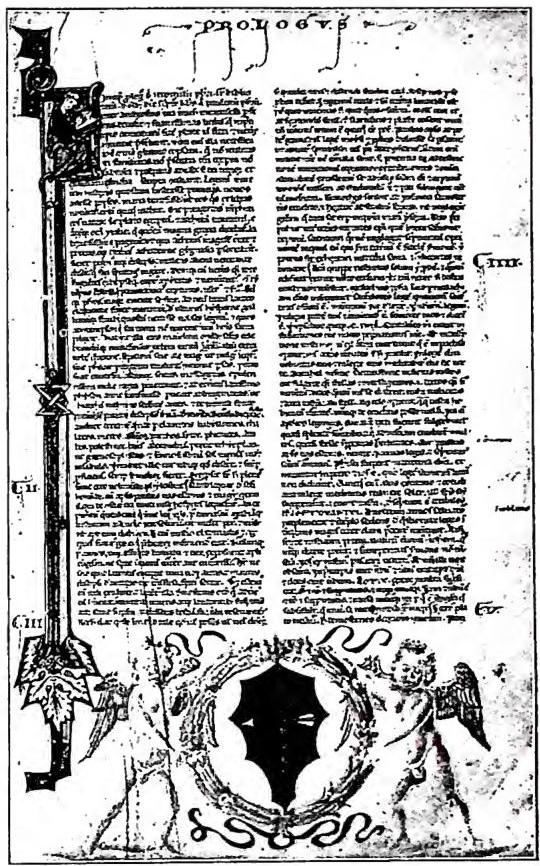
The works of B. were frequently copied, and many mystical opuscules were attributed to him. The complete or partial editions of the original Latin texts and the translations into modern languages number in the hundreds, but their list has only a historical value, now that the critical edition has appeared, willed by Fr. Bernardino da Portogruaro in 1871, prepared by Fr. Fedele di Fanna (d. 1881). It was brought to completion by the Friars Minor of the College of St. Bonaventure at Quaracchi near Florence, from 1882 to 1902, under the direction of Fr. Ignazio Jeiler. It is a distinguished work, judged, from its very first appearance, as a model of its kind. Despite the difficulties that such a work presented at the time when it was carried out, it had only to undergo small criticisms, retouchings or additions of secondary importance. It consists of 10 folio volumes (plus 1 unnumbered volume of tables for the Commentary on the Sentences [I-IV]). Here only the most important or most characteristic works are mentioned, and where appropriate the critical edition to which reference is made will be corrected, with mention of the works omitted from it and of the various manual editions that publishers have issued, as well as the most important studies and translations.
1. Theological works
The Commentarii in quattuor libros Sentent. Petri Lombardi (vols. I to IV) were written from 1250 to 1254 and are generally considered the best; in them he indeed reveals both the speculative power of his mind and his doctrinal tendencies. However, a beginner, even if endowed with genius, is not a mature man, and it is useful to check and, where needed, correct the Commentary with the later theological works.
The Breviloquium, written around 1257, is a very brief theological summa (vol. V, pp. 199-201; manual ed., literal commentary of popularization edited by Fr. Teodoro Barbaliscia, 2 vols., Pompei 1934). Master of his plan and of his method, the Seraphic Doctor reveals in it the high idea he had of speculative theology, and certain of his favorite theses are set out with greater clarity than in the Commentary.
The great edition has published several Disputed Questions: seven De scientia Christi, eight De mysterio Trinitatis, four De perfectione evangelica (vol. V, pp. 1-198). Others have been discovered subsequently: two De existentia angelorum and De mendicitate (they were identified and published by Fr. Ferd. Delorme in S. Bonaventurae collationes in Hexaemeron et bonaventuriana quaedam selecta, Florence-Quaracchi 1934, pp. 295-327 and 328-56); ten De caritate and De novissimis (they were rediscovered by Canon P. Glorieux and are in the course of publication in the France Franciscaine, 1936 ff., document II). Furthermore Fr. Vittorino Doucet (Descriptio codicis 172 bibliothecae communalis Assiviensis, in Archivum Franciscanum Historicum, 25 [1932], pp. 514-15; and Quaestiones centum ad scholam franciscanam saec. XIII ut plurimum spectantes, ibid., 26 [1933], pp. 474-96) and Fr. Francesco M. Henquinet (Un branillon autographe de s. Bonaventure sur le Commentaire des Sentences, in Etudes Franciscaines, 44 [1932], pp. 635-55 and 45 [1933], pp. 59-82) attribute to B., with more or less certainty, a body of theological questions sufficient to form a new folio volume of the great edition. They are, however, unpublished.
The text of the conferences on the Ten Commandments (1267), on the Gifts of the Holy Spirit (1268) and on the Hexaemeron (1273) was not drafted by St. B., but by his hearers (vol. V, pp. 327-503). Fr. Ferd. Delorme, op. cit., has published a text of the conferences on the Hexaemeron which makes it possible to check and sometimes correct the one published by the Fathers who edited Quaracchi (vol. V, pp. 327-454).
The small treatise De reductione artium ad theologiam (vol. V, pp. 317-26: ms.) has been regarded by a specialist (G. Rabeau, Introduction à l'étude de la théologie, Paris 1926, p. 365) as « the most important contribution of the Middle Ages to the introduction of theology ».
2. Exegetical writings
The most important is the Commentary on St. Luke (1248), a youthful work, probably retouched later, useful especially to preachers (vol. VII entire).
3. Ascetic or mystical writings
The most celebrated is the Itinerarium mentis in Deum (vol. V, pp. 293-316), written at La Verna in Oct. 1259, much read, translated and commented upon.
Almost as much could be said of the De triplici via (1259: VIII, pp. 3-27) where, in concise terms, St. B. has set out the great lines of his mystical doctrine (J. Fr. Bonnefoy, Une somme bonaventurienne de théologie mystique, le « De triplici via », Paris 1934).
Most devoted to the holy Humanity of Christ, B. wrote of it with sweetness in the Lignum vitae (VIII, pp. 68-87), in the Vitis mystica (VIII, pp. 159-229), from which the liturgy drew the proper lessons of the office of the Sacred Heart, and in the De quinque festivitatibus pueri Iesu.
If the famous Meditations on the Life of Christ are not, as we possess them, the work of B., it seems nonetheless that he supplied their primitive core and spirit (Fr. Col. Fischer, Die « Meditations Vitae Christi ». Ihre handschriftliche Überlieferung und die Verfasserfrage, in Archivum Franciscanum Historicum, 25 [1932], pp. 3-35, 175-209, 305-48). The considerable influence they had on spirituality and on art, especially on religious texts, must therefore be attributed in equal part to him. The Sermons of St. B. (V, pp. 532-74 and IX) were delivered before very diverse hearers and especially in learned circles: clergy, religious, universities, and this explains the richness of their doctrinal content (G. Cantini, S. B. da Bagnoregio, in Antonianum, 15 [1940], pp. 29-74, 155-88, 245-74).
III. THE DOCTRINE OF THE SERAPHIC DOCTOR
1. Origin of his doctrine
The considerable list of authors cited by B. was compiled by the father editors (X, pp. 265-77) and bears witness to the extraordinary richness of his documentation.
Miraculously healed by St. Francis of Assisi, B. became his humble disciple. Better educated than his seraphic father, he would know how to translate into formulas, and where necessary, to justify and defend the ideal of the Poverello of Assisi. Like him, he distrusted "Greek and Latin glories" and sought the imprint of God not only in the visible world, but still more in the invisible world. Like him, he condemned any knowledge that does not teach one to love and go to God with all one's soul. He is the "Franciscan doctor" par excellence. The doctrine of St. Augustine adapts marvelously to the Franciscan ideal, and B., more than any other of his contemporaries, speaks of him with the greatest reverence. He considers him the doctor "maxime authenticus inter omnes expositores sacrae Scripturae" (Qu. disp. de scientia Christi, q. 4, vol. V, p. 23), and it has been calculated that in the critical edition of Quaracchi he is cited no fewer than 2625 times. B. was not content to compile the usual florilegia or "chains" of texts, but drew directly from the works and so assimilated their doctrine that his work appears as the best synthesis of Augustinian thought in the Middle Ages (E. Longpré, S. Augustin et la pensée franciscaine, in La France Franciscaine, 15 [1932], pp. 5-76).
Among the authors preferred by B. one should also number Dionysius, that is, the pseudo-Areopagite, Boethius, St. Gregory, St. John Damascene, St. Anselm, Alexander of Hales, whom he respectfully regarded as "his master and his father." The principal source of inspiration remains Sacred Scripture; it could be largely reconstructed from the citations scattered throughout his works alone, so much so that their listing occupies 84 pages (in three columns) of the great edition. When he cites a text, he generally gives the reference, indicating the book and the chapter.
2. General characteristics of the doctrine of St. B. The unity of doctrine. - This is the characteristic that stands out most. According to the happy expression of Father Monnot, "philosophy, theology, mysticism are systematically fused, but not confused." The Seraphic Doctor knew how to distinguish appropriately, but this vivisection of the real world, necessary in laboratory experiments, did not make him lose sight of the whole. The only existing world, in which we move and which we must know, is that of a humanity founded on Christ, redeemed by him, oriented toward him. A purely natural order is only hypothetical; we know very little about it and can reconstruct it only through conjectures. As a true Franciscan, B. did not believe he should waste time in vain researches, but aiming at the end for which we are destined, he resolutely orients toward theology, indeed toward mysticism and ecstasy itself, all the lower sciences, including philosophy. This same sense of the real, of the concrete, explains the importance attributed to experience, "principle of knowledge" (III Sent., d. 24, a. 2, q. 3, f. 4, p. 522), and the expression ut patet per experientiam returns often. The most subtle reasonings, like the splendid demonstrations, fail to convince him where the conclusions clash with experience. He takes account of every scientific, historical or religious experience, and this explains his respect for tradition and his tendency, in doubt, to lean toward the opinion that comes closest to piety. His respect for authority, even purely human authority, has often been noted, and rightly so, but in this too we discern his fidelity to the truth. He always charitably explains an erroneous proposition when he can, and sometimes his charity appears all too ingenious, but after all, he wants the truth to be stated, "ne amore hominis veritati fiat praeiudicium" (II Sent., d. 44, dub. 3, p. 1016 b). He wants Aristotle to be followed, but only when he speaks the truth (Col. in Hex., ed. Fr. Delorme, p. 92).
3. The Christian philosopher
B. is the "Christian philosopher" par excellence. Philosophy, which in a world without grace would be an end in itself, in the present order can attain its goal only by submitting to faith and accepting its control; it is but the handmaid of theology, but an indispensable handmaid. B.'s philosophy fits squarely within the Platonic tradition; however, he knew Plato only indirectly, whereas he read Aristotle directly and without prejudices, judging and freely correcting him as needed. To Aristotelian abstraction he prefers the Augustinian theory of illumination, and it is from St. Augustine that he took the theory of seminal reasons, formal germs that God placed in matter. He does not share with other Scholastics the interpretation of Aristotelian hylomorphism, and this explains how he attributes the composition of matter and form, equivalents of potency and act, even to spiritual beings. Such particularities, like others that are noted when one speaks of the philosophy of St. B., do not constitute his philosophy. In the work La philosophie de s. Bonaventure by E. Gilson (Paris 1924, German trans. by Böhner), regarded as the most profound doctrinal study on the Seraphic Doctor, there is brought to light the solidity, the richness, the profundity of this genius, constantly strained toward union with God and judging everything by the standard of the sanctuary. To this care for the constant search for God there corresponds the exaltation of universal analogy and the doctrine of exemplarism that explains it (J.-M. Bissen, L'exemplarisme divin selon s. Bonaventure, ibid. 1924).
4. The theology of St. B
His theology draws its inspiration, like his philosophy, from St. Augustine, while being authentically Scholastic. He was the first in the Middle Ages to distinguish clearly Sacred Scripture, which was then what positive theology is for us, from speculative theology, the fruit and glory of human reason, but a fallible science (Proem. in I Sent., q. 2, ad 4, p. 11 b). With a sure hand, writing the Breviloquium, he sketched the ideal he formed of the theologian: to explain by deductive reasoning, starting from a divine attribute, both what God is in himself and what he has wrought outside himself (J. Fr. Bonnefoy, De synthesi operam Dei ad extra ad mentem s. Bonaventurae, in Antonianum, 18 [1943], pp. 17-28). Various authors (in particular A. Stohr, Die Trinitätslehre des heiligen B., Münster in W. 1923) have sought to trace the sources of B.'s Trinitarian theology and have spoken of St. Augustine, the pseudo-Areopagite, St. John Damascene, Richard of St. Victor, Alexander of Hales, Eudes Rigaud, etc., but although there is a little of all this in him and one notes in particular the influence of Greek theology, B. is entirely personal. In conformity with his theological conception, while not neglecting the psychological analogies of St. Augustine, he gives preference to a priori demonstrations of the Trinity over explanations by way of mysticism (J. Fr. Bonnefoy, Le St-Esprit et ses dons selon s. Bonaventure, Paris 1929, pp. 12-57).
His theology is markedly Christocentric and finds its greatest expression in the Collationes in Hexaemeron, and it can be affirmed that he paved the way for the Scotist doctrine of the absolute and universal primacy of Christ.
B., like almost all his contemporaries, denied the Immaculate Conception, but as happened with others, this error did not veil his Marian theology on the other points, and so it is that, with effective expressions and a particular insistence, he affirmed the universal Marian mediation (P. Di Fonzo, Doctrina s. Bonaventurae de universali mediatione B. Mariae Virginis, Rome 1938; E. Chiettini, Mariologia s. Bonaventurae, ibid. 1941).
5. The mystical theology of St. Bonaventure. In mystical theology B. occupies a preeminent and uncontested place: « His postquam maxime arduas speculationis summitates conscendit - wrote Leo XIII - de mystica theologia tanta perfectione disseruit ut de ea communi hominum peritissimorum suffragiis habeatur facile princeps ». « The doctrine of St. B. marks, in our view, the culminating point of Christian mysticism and constitutes the most complete synthesis that has ever been achieved » (E. Gilson, La phil. de s. Bonav., p. 472). This will not cause surprise, if one considers that he systematically made all sensory, intellectual and supernatural knowledge converge toward the peace of ecstasy: it is the program of his Itinerarium mentis in Deum, a perfect manual of mystical contemplation. It is also the fulfillment of the first commandment, since it prescribes not only to love God with all one's heart, but also « with all one's soul and with all one's spirit » (Mt 22:37). Like his Seraphic father, B. was the man of the Gospel, and from this comes all his strength and power of attraction.
6. The influence of St. B
His influence was and remains considerable. His works were widely read during his lifetime, and St. Thomas, on various occasions, made use of extensive passages taken from certain questions of his friend (P. Glorieux, De quelques « emprunts » de s. Thomas, in Recherches de Théologie ancienne et médiévale, 8 [1936], p. 166). Many authors have commented on or summarized B.'s Commentary, or have drawn inspiration from it (ed. of Quaracchi, I, pp. LXIV-LXXIII). The Capuchin Friars Minor were the most faithful to St. B. among the three Franciscan families, since both the Friars Minor and the Conventual Friars Minor adhered in their great majority to the Scotist school. The best-known follower of B. is Bartolomeo Barberi (v.), who left among other things a course of theology and a course of philosophy ad mentem Seraphici Doctoris Bonaventurae.
The voice of St. B. was heard not only at the Council of Lyon (1274), in which he acted as vicar of the Pope, but has been evoked in the later Councils of Vienne (1311), Constance (1414-17), Basel (1431), Florence (1439), the Lateran (1512), Trent (1545-63) and the Vatican (1869-70) (cf. Ludovicus de Castroplanio, Seraphicus doctor s. B. in oecumenici catholicae ecclesiae conciliis cum Patribus dogmata definiens, Rome 1874). In restoring scholasticism under the high patronage of St. Thomas, Leo XIII did not fail to recall the name of B. and praised the minister general of the Friars Minor for having undertaken the critical edition of his works.
The influence exercised by his mystical doctrine is even broader. It operated directly through the incredible diffusion of his « divine opuscules », as St. Francis de Sales used to call them; indirectly through the work of so many preachers, orators or saints, who were formed in his school and propagated his spirit. The great number of anonymous writings that circulated under his name are due, in large part, to his disciples. Nor was his influence lacking on Gothic art (R. Boving, B. und die französische Hochgoth, Werl in V. 1929); on the art of Giotto, with his life of St. Francis; on painters and masters of stained glass, who drew inspiration from his writings on the Passion (E. Gilson, S. Bonaventure et l'iconographie de la Passion, in Revue d'Histoire Francaise, 1 [1924], p. 420).
His memory is perennial in the Greek Church and among the dissidents eager for the union of the Churches, such as Arsenjew, Kobilinski; there are converts, such as Denissoff, who think that only the Platonic philosophy of St. B. and his Christocentric theology can provide a basis for understanding with the dissidents, on doctrinal questions. It may be that B. is called, in the near future, to play the part of conciliator, as already at the Council of Lyon.
Bibliography14 works
Giovanni Francesco Bonnefoy
IV. ICONOGRAPHY
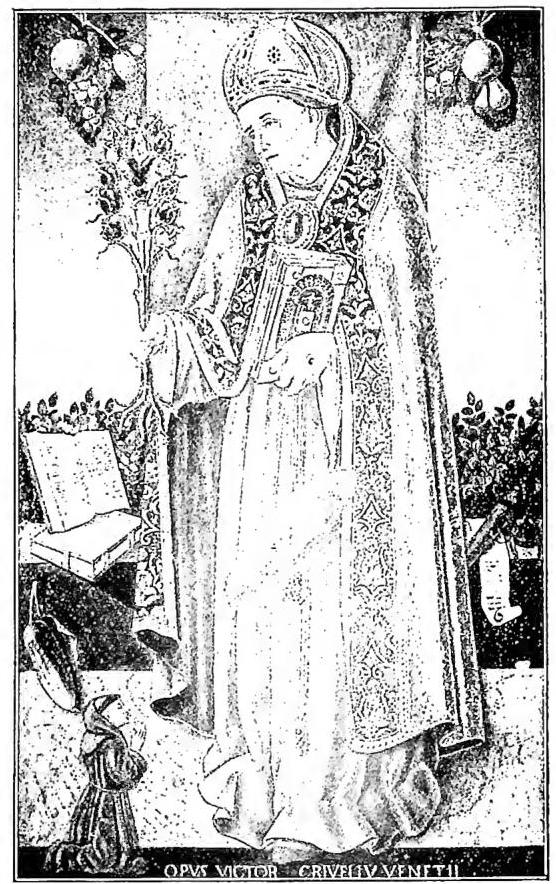
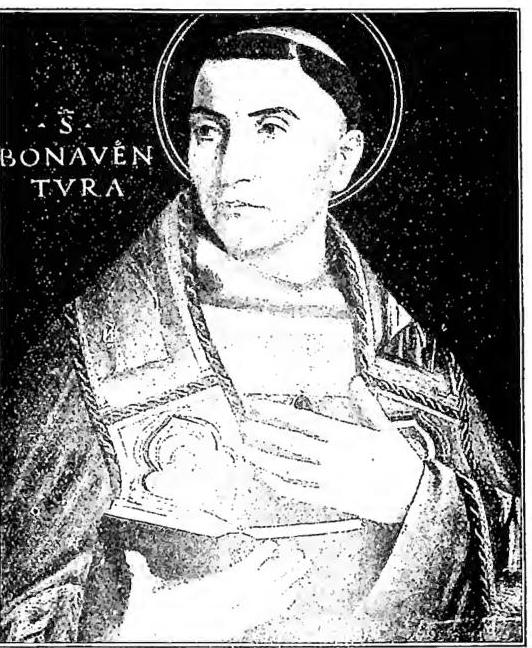
The holy General of the Franciscans is represented in the habit of the Order, and also dressed as a cardinal, specifically as cardinal-bishop. As a Doctor of the Church he sometimes holds a book in his hand; an individual attribute, especially dear to late German Gothic, is a living crucifix, that is, in the form of a tree, which characterizes him as the author of the celebrated treatise Lignum vitae. Among the most important depictions of the Saint in the Italian 15th century, one must include the fresco by Fra Angelico in the Chapel of Nicholas V (Vatican, 1447-49) beside St. Thomas Aquinas and the Doctors of the early Christian era, and various altarpieces by Butinone, Crivelli and Foppa; there is also no lack of paintings representing St. B. together with other Saints in adoration of a divine personage (such as those by Giov. Santi at Cagli and by Zaganelli at Forlì). As regards his life, Baroque art, and specifically Spanish art, offers us the most distinguished monuments with the eight altarpieces, now scattered among various museums and private collections, that Francisco Herrera the Elder and Francisco Zurbarán executed in 1629 for the church of St. Bonaventure in Seville.
Bibliography2 works
Kurt Rahe