
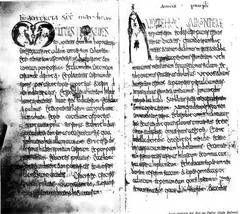
EPISTOLARY. - By "epistolary" (epistolare, epistolarium [-ius] and also epistolium) is meant the book containing the lessons and epistles of the Mass throughout the liturgical year. In the course of its history it has also borne other names, the principal of which are: apostolus, liber comitis or canacus or more simply comes (already in the charta Cornuttiana of 471), and capitulare lectionum, lectionarium [-ius]. Apostolus is the oldest name; comes and lectionarium designate, according to the case, the collection of epistles alone, or of Gospels alone, or of both together.
I. ORIONI
The scriptural reading in liturgical assemblies did not originally have a particular ordering. The contrary opinion of the Romanian Israelite L. Venetianer (Der Ursprung und die Bedeutung der Prophetenlektionen, in Zeitschr. d. deutsche Mag. Gesellschaft, 63 [1909], pp. 103-70), according to whom the early Church would have adopted the lectionary ordering of the Synagogue, however suggestive, has not been followed, contradicted by A. Baumstark (Liturgie comparée, Chevetogne 1940, p. 137).
(Ist. Biblioteca Vaticana)
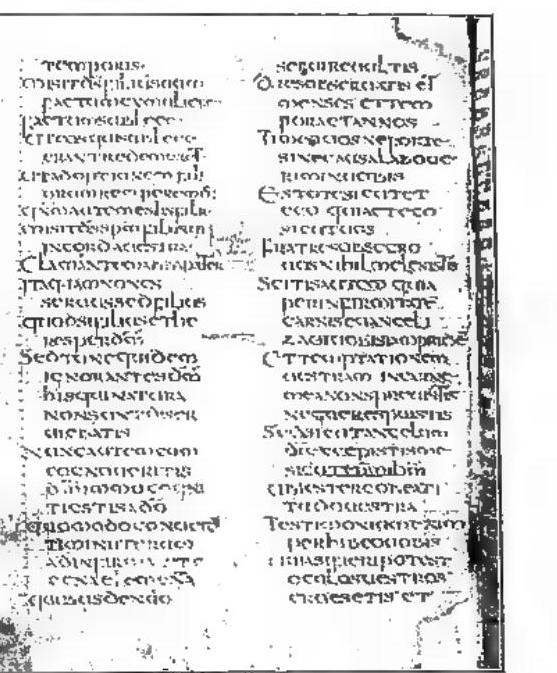
The sacred books were read in installments, continuously (lectio continua): "ex ordine" says St. Augustine (In epist. Johann. ad Parthos, prol.: PL 35, 1977), taking the text directly from the volume of the Bible (the "bibliotheca" of the Middle Ages), following the indication of the antistes, who presided over the assembly and for as long as he thought fit, or "prout tempus fert" (St. Justin, Apol., I, ch. 67, ed. Th. Klauser [*Floril. patrist., 7], Bonn 1935, p. 19; Contra Tryph.*, ch. 118: PG 6, 749).
This practice remained in force for quite some time, and we still find it at the beginning of the 4th century in Africa and in the middle of the 5th century at Ravenna with St. Peter Chrysologus (d. c. 450; cf. G. Lucchesi, Nuove note agiografiche ravennati, Faenza 1943, p. 110). Rome too had its lectio continua, and traces of it can be discerned in the ancient arrangement of the Gospel pericopes for Advent (readings from the Synoptics) and of the Easter cycle (Gospel of St. John: cf. P. Alfonzo, La «lectio continua» nei sinottici, in Rivista liturgica, 25 [1938], pp. 131-37). It is clear, however, that from the earliest times thought had to be given to the appropriateness of reading, at particular periods of the year, such as Lent and the Ember Days, or on the great solemnities of the Lord: Easter, Pentecost, Christmas, Epiphany, passages from the sacred books and biblical texts that had a more direct relation to the liturgical season or to the mystery being celebrated. The Fathers of the 3rd and 4th centuries mention proper readings for particular times and feasts: Genesis in Lent (St. Ambrose, De mysteriis, I, 1: PL 16, 380), Jonah and Job in Holy Week (id., Epist. XX, ad Marcell., chs. 14 and 25: ibid., 1040, 1044); at Easter the account of the Resurrection, which in Africa was read in the text of the four evangelists (St. Augustine, Sermo 86, Tract. de quarta feria post Pascha, in Miscellanea agostiniana, I, Rome 1930, p. 324). Between Easter and Pentecost the Acts of the Apostles (id., Sermo 315, 1: PL 38-39, 1426; Tract. VI in Johann., ch. 18: ibid., 35, 1433). Also on the solemnities of the martyrs the lectio continua was suspended, at least in some parts, as in Africa, in order to read the account of their deeds (cf. id., Sermo XVI, In natali sanctorum martyrum Scillitanorum, in Miscellanea agostiniana, I, Rome 1930, p. 80; see also ibid., p. 67, St. Cyprian).
The indication of the passage to be read was marked in the margin of the pages of Holy Scripture; then, at a later stage, an index of the initia of the passages was drawn up, numbered progressively (capitula, hence capitulare), and the list was placed at the beginning of the sacred volume, while in the text only the number corresponding to the list was written at the foot, marking the end of the pericope with a small cross. These are the first rough drafts of lectionaries. Only much later (7th-8th centuries) were the lectionary pericopes copied out in full, and the first plenary lectionaries appeared (the lectionary of Luxeuil is typical), which became the true liturgical book, still used today in cathedrals and in the better-ordered churches.
Certain books were therefore read at certain periods of the year, but it does not follow that these readings were already divided into fixed pericopes. Medieval liturgists, basing themselves on the Epistula ad Constantium, which they believed to be by St. Jerome, assigned the authorship of a first lectionary to the Doctor of Stridon. But the letter is apocryphal. Morin makes St. Victor, bishop of Capua (d. 554), its author (cf. G. Morin, L'auteur de la « Lettre à Constantine », in Revue bénédictine, 7 [1890], pp. 416-23).
The first historically certain attempts at systematic scriptural collections for liturgical use appear in Gaul in the 5th century. Gennadius of Marseilles (d. 452) relates that the priest Museus "hortans sancti Venerii episcopi (d. 452) excerptit ex sacris scripturis lectiones totius anni festivis diebus" (De scriptoribus ecclesiasticis, ch. 79: PL 58, 1104). A little later Claudianus Mamertus, a priest of the church of Vienne (d. 473), also compiled a lectionary (Sidonius Apollinaris, Epist., I, IV, 11: ibid., 516). But of both nothing has survived but the memory.
The inventory of the church of Cornutum (a small rural parish near Tivoli), in 471, lists among the codices belonging to it: "Evangelie IIII apostolorum (apostolum?), psalterium et comiteus". Is this a lectionary of its own (a rather improbable thing) or the lectionary of Rome? The second alternative will cause no surprise if one considers that it was precisely in the 5th century that Rome displayed a most fruitful liturgical activity. The two cycles that polarize the whole ecclesiastical year received their organization in this period: Advent through the work of Pope Gelasius (d. 489), who transferred the readings of the Ember Days of the tenth month to those of Lent and fixed the reading of Isaiah in December, and Lent through the work of Pope Hilary (d. 468).
We are, in any case, still in the realm of conjecture, even if well-founded conjecture. For the pre-Gregorian period the only certain document is the lectionary of Capua. It is a numbered list of 77 epistle pericopes, arranged according to the order of the liturgical year, placed at the head of the famous codex Fuldensis of the Pauline letters. In the margin of the pages of the text the beginning of the pericope is indicated by the corresponding number in the list. The list was written by Victor, bishop of Capua, in 546-47. This list of pericopes thus gives the physiognomy of the liturgical year at Capua in the middle of the 6th century.
II. FORMATION PERIOD
By the end of the 5th century the lectio continua had by then definitively given way to fixed pericopes. The disappearance of the catechumens, for whom it was principally intended as first Christian instruction, and the development of the liturgical cycle, which was becoming ever more clearly defined around the great Mysteries of the Redemption and the first feasts of the martyrs, determined the definitive choice of the scriptural pericopes to be read at Mass and the formation of various systems, according to the peculiarities of the different Churches. The liturgical books too acquired a particular character of their own and, in the case here in question, the division and the difference between the epistolary and the evangeliary became ever more pronounced. With regard to the former, the following systems may be distinguished:
1. Mozarabic system
The oldest document is the liber comicus (edited by G. Morin, in Anecdota Maredsolana, I, Maredsous 1893), which probably represents the use of Toledo at the time of St. Ildephonsus (d. 667). Advent is of 5 weeks, Lent has proper readings every day, except Tuesday and Thursday of the first three weeks, it does not have the series of Sundays after the Epiphany and Pentecost, but, in compensation, it ends with 32 "dominicae apostidiana". The sanctoral is very limited. The readings are three.
2. Gallican system
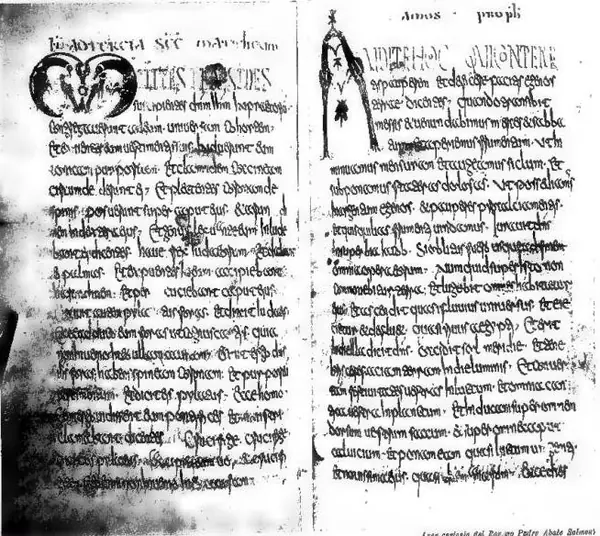
Its principal representatives are the lectionary of Luxeuil and the Missal of Bobbio. The first (recently published by P. Salmon, Le lectionnaire de Luxeuil, Rome 1944), is a Gallican book with very little Roman influence, from the end of the 7th century or the beginning of the 8th. The second, almost contemporary with the first, represents the liturgy of Gaul at the time of the Merovingians, with Visigothic, Irish and Roman influences (phototypic edition with critical introduction: C. Mohlberg, Missale Gothicum. Das gallikanische Sakramentar, Augsburg 1929). Characteristic features of the Gallican system of readings are: three lessons at Mass, the reading of the acts of the martyrs, the Canticle of Daniel among the readings on feast days, Acts and Revelation in Paschal time. Advent is of 6 weeks, Lent of s. An interesting peculiarity of the Gallican documents is the presence of more or less long series of "quotidian" or "dominical" lessons intended to serve on days when there is no proper formulary, especially the Sundays outside the fixed cycles (that is, our "dominicae per annum").
3. Ambrosian system
It is found essentially in the Sacramentary of Bergamo (edited by P. Gagin, in Auctarium Solesmense, series liturgica, I, Solesmes 1900) according to a manuscript of the 10th-11th centuries belonging to the library of S. Alessandro in Colonna at Bergamo. The codex does not contain the prophetic readings (Old Testament), which the Ambrosian liturgy still preserves, and therefore the Sacramentarium Bergomense was completed by Gagin with a manuscript of the 13th century belonging to the cathedral of Milan (ibid., pp. 193-207). For a long time the famous Capitulare Epistolarum s. Pauli (cod. Vatic. regin. 9) of the first half of the 8th century was held to be of great importance for the study of the Ambrosian lectionary. But Morin (Un système inédit de lectures liturgiques en usage en VIIe-VIIIe siècle dans une église inconnue de Haute-Italie, in Revue bénédictine, 20 [1903] pp. 375-86), recently followed by Borella (cf. M. Righetti, Storia liturgica, III, Milan 1949, pp. 514-15), has shown that this document does not reflect the Ambrosian rite in use at Milan, but in another church of northern Italy. In the Bergomense the structure of the Ambrosian liturgical year is already well delineated: Advent is of 6 weeks, 5 follow the feast of the Epiphany, pre-Lent has the usual three Sundays, Lent too is regular, whose first Sunday still bears the designation in caput Quadragesimae. After Easter there are 5 weeks, 22 after Pentecost, 2 post dedicationem ecclesiae. The sanctoral appears very developed.
4. Roman system
It is undoubtedly the most important and the one with the most numerous documents. A sure starting point is the work of St. Gregory, whose biographer John the Deacon affirms that precisely the lectionary was the basis of his reform of the Gelasian Sacramentary (Vita s. Gregorii, II, 17: PL 75, 94). The principal sources of the Gregorian and post-Gregorian lectionary are the comes of Würzburg, of Alcuin and of Murbach.
The comes of Würzburg published by G. Morin (in Revue bénédictine, 27 [1910], pp. 41-47), from a codex of the University of Würzburg of the 8th century, is defined by its editor as "the oldest lectionary of the Roman church". The lectional arrangement is the same one that must have been in place at the end of the 6th century, when St. Gregory directed his organizing genius toward it. All the offices introduced in the 7th century are missing, such as the octave of Christmas, the four feasts of the Madonna, that of the Cross, the Masses of the Thursdays of Lent and of the other days formerly aliturgical.
A formulary of this type of comes was taken as the basis by Alcuin for his famous Comes emendatus (edited first by J. M. Tommasi, Opera omnia, V, ed. F. Vezzosi, Rome 1750, pp. 297-423 and recently by A. Wilmart, Le lectionnaire d'Alcuin, in Ephemerides liturgicae, 50 [1937], pp. 136-197). It was drawn up in the years 782-84, therefore before Pope Adrian (d. 793) sent to Charlemagne the Gregorian Sacramentary, revised by him and holding authority at Rome. The archetype of Alcuin's lectionary can be placed between the end of the 7th century and the beginning of the 8th, in any case before the death of Gregory II (d. 731), the institutor of the Lenten Thursdays, which do not yet appear in the comes emendatus.
Throughout the document there is a perfect order in the distribution of the epistles; from Easter to the feast of the apostles Peter and Paul the catholic epistles are read, in the five weeks post Apostolorum, the Letter to the Romans, in the five Sundays post S. Laurentii, the Letters to the Corinthians and to the Galatians, for the Sundays of the 7th month and post S. Angeli, the Letters to the Ephesians, Philippians and Colossians, in the week of Pentecost the Acts. Note the order of the canonical succession of the sacred books (Rom., Cor., Gal., Eph., Phil., Col.), and the naming of the Sundays according to Roman tradition, contrary to Gallican use.
In the 9th century a supplement was added to Alcuin's comes, preceded by an anonymous preface: Hunc codicem. The author of this preface declares that the revision of the comes was made by order of Charlemagne, to bring it into harmony with the Gregorian Sacramentary. The additions were made particularly "in vigiliis Paschae vel in feriis atque in aliis quibusque ecclesiasticis officio". The author of this supplement was probably Helisachar, chancellor and confidant of Louis the Pious until 819. In later manuscripts the supplement was merged with the comes (cf. G. Morin, Une rédaction inédite de la préface au supplément du « Comes » d'Alcuin, in Revue bénédictine, 20 [1912], pp. 340-48).
The third fundamental document of the Roman lectionary is the comes of Murbach, written for the abbey of Murbach (in Alsace) at the end of the 8th century, now in the Municipal Library of Besançon (ed. A. Wilmart, Le « comes » de Murbach, in Revue bénédictine, 30 [1913], pp. 25-69). It is rather a capitulary, because it gives only the first and last words of each pericope. The arrangement of the lessons is the one that later became definitive in the Missale Romanum of St. Pius V. The organization of the Sunday cycle is complete: 5 Sundays after Epiphany, 4 after the octave of Easter, 1 after the Ascension, 25 after Pentecost, 5 before Christmas. Two days a week, Wednesday and Friday, are provided with proper readings. It knows the Lenten Thursday, but the readings are all different from those of Alcuin. It assigns 12 readings to the vigil of Easter and 6 to that of Pentecost. The calendar is that of the Gelasian Missal of the 8th century; so that it is legitimate to conclude with its editor that the comes is « an adaptation of the ancient Roman lectionary to the Missal composed in Gaul around the middle of the 8th century by the union of two authentic Roman Missals of the 6th and 7th centuries, the Gelasian and the Gregorian ».
The comes of Murbach and the supplement to the Alcuinian comes represent the stage of evolution closest to the Missale Romanum of the 16th century. The modifications made to it from the 9th to the 16th century are few and not significant. The principal ones are: a second reading taken from Isaiah on Christmas Eve, four lessons on the Saturday preceding Palm Sunday, originally an aliturgical day, the addition of three other lessons taken from J. Pt. 5 and from Ier. 20 at the Regections. The summer Ember Days, which had lost their original place, that is, within the octave of Pentecost, regained it in 1098 with Gregory VII, restoring there also their original readings, except the two of Wednesday. Of these modifications some remained, others disapp-
(Int. Enc. Cett.)
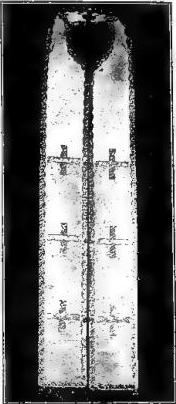
EPITRACHELIO - Pontifical Russian College of St. Teresa of the R. Gesù - Rome.
true and disappeared before they came into common use. Furthermore, the fixing of the feast of the Most Holy Trinity led to the suppression of the Sunday after Pentecost, the Sundays of Advent were reduced to four, the proper Masses on ferias "infra hebdomadam" disappeared with the progressive increase of the feasts of the saints.
The Missale Romanum, which Pius V by the bull Quo primum of 14 July 1570 prescribed for the universal Church, did nothing but sanction the state of affairs that had formed through the centuries up to that time. So that, despite the modifications, suppressions, and additions of 16 centuries, our Missal is substantially linked to the most ancient traditions of the Roman Church. - See plate XXXV.
Bibliography8 works
Annibale Bugnini