
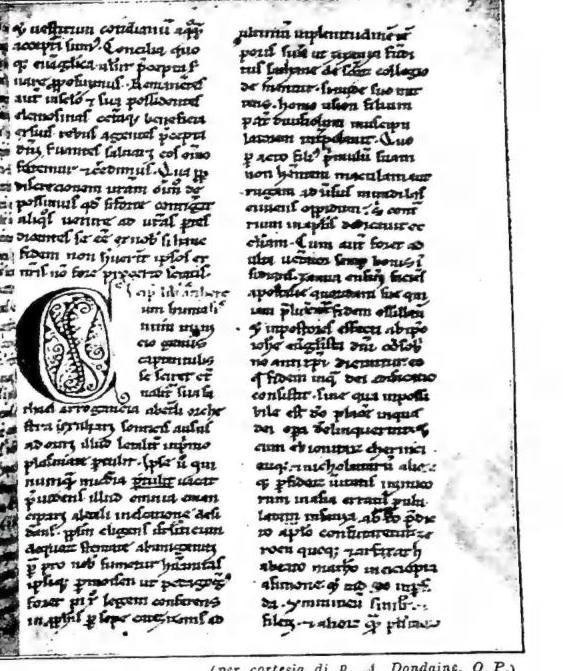
WALDO AND WALDENSIANS. - The Waldenses derive from a certain Valdés (Valdesius or Valdensis, later Waldo), whose first important data go back to a period that fluctuates between 1170 and 1176.
I. VALDO
The name, in French vernacular Valdés, probably derived from a village in the Dauphiné: Vaux-Milieu, from which came the wealthy merchant of the city of Lyon, who only belatedly, from 1368, was known by the name Peter, placed before that of Valdo: Petrus Valdo or de Valdo. Because of a strong emotion that, in all likelihood, the account of the legend of St. Alexis and the devastations of the famine of 1173 stirred in his soul, Valdo decided to distribute all his goods to the poor and to embrace poverty for the love of God. This "conversion" produced an enormous impression in Lyon, and immediately a first nucleus of disciples formed around him.
Their purpose was to observe "apostolic poverty"; later, in 1177, the "poor of Lyon" (as they were immediately called) deemed that they ought to imitate the Apostles also in preaching, and they had the Gospel translated into the vernacular, and then other books of the New and Old Testament: but unprepared as they were, they alarmed the ecclesiastical authority, so much so that the bishop of Lyon protested against these improvised lay preachers. Valdo then went to Rome during the Third Lateran Council of 1179. Alexander III approved their manner of life, but forbade them to preach without the request of the episcopal authority. The prohibition was then repeated for the group of the Humiliati (v.) or "poor Lombards".
II. THE SCHISM
If the "poor of Lyons" and the "poor Lombards," by then allies, had bowed to the will of the Pope, the Church would have surrounded them with esteem and admiration, but unfortunately they stiffened in disobedience. Having returned to Lyons, Valdo began preaching again with his followers and engaged in oral and also written polemic against the Cathars, considering himself more effective in this task than the Church's preachers. The bishop John Bellesmains (and not Blanchesmains [1182-93]), having vainly called them back to order, denounced them to Pope Lucius III, who condemned them together with the Humiliati in the Council of Verona (bull Ad abolendum of 4 Nov. 1184; Jaffé-Wattenbach, 15109).
III. THE "POOR LOMBARDS" SEPARATE FROM THE "POOR OF LYONS.". — After the condemnation there came an ever closer rapprochement between the Waldensians of Lombardy and those Humiliati who persisted in schism; these influenced with their own characteristics the ascetic form of the local Waldensians. The principal center remained Milan, from which they spread in schism to Cremona, Bergamo, Pavia, into Liguria and also into German territory, to Strasbourg, Trier, Magonza and into Austria. Expelled from Lyons as early as 1181 and then again later, the poor of Lyons reached Provence, Languedoc, Lorraine, Flanders and the territory of Liège, and finally Aragon and Catalonia. The repression against them, mild at first, became ever harsher, to the point of confiscation of goods and condemnation to the stake.
In 1205 came the separation between the "poor of Lyons," called "insabbatati," and the "poor Lombards" (v.), a separation that became definitive after the meeting of Bergamo in May 1218; nevertheless both groups continued to be designated by the nickname of "sandalati," "insabbatati," "sabbatati," "sotulari," etc., from the style of their footwear. From the very origins, in fact, the poor had adopted, as a sign of poverty, sandals of wood or leather that clung to the bare foot by means of laces drawn in the shape of a cross. The poor attached to them an excessive and superstitious importance. Before entering the sect, a long novitiate called nonellanus was required; the novice, on becoming professed, took the name of sandalatus. He took the vow, as in a religious order, of "perfect poverty," that is, not to worry about tomorrow and not to accept gold and silver, except as much as could serve the daily needs of food and clothing. With the vow of poverty, considered as essential, the Waldensians took that of chastity and of obedience to their superiors. Such an organization, however, bound only the "masters" and the "mistresses," sometimes also called "apostles." To the sect, however, there also belonged the "friends" or adherents, who, while continuing to frequent the Catholic churches, avoided receiving communion from Catholic priests held to be unworthy because of their wealth.
The result of the repression was to make the "apostolic style" of the "masters" gradually disappear, since it betrayed them too easily, to make the bonds between "masters" and "friends" firmer, to distance the members of the sect further from the Catholic Church and also, quite often, to bring into the Church Waldensians eager to escape the repressions, but sullenly hostile to the Catholic clergy.
IV. FROM SCHISM TO HERESY
From schism the sect did not take long to slide into heresy, first material, then formal. The principal error of the Waldensians has, in origin, a common ground with Donatism. The latter, while admitting the sacrament of Order, made the value and efficacy of the Sacraments depend on the holiness of the minister who conferred them. The Waldensians, however, went further, maintaining that holiness was sufficient to confer the power to baptize, confirm, consecrate the Eucharist, and absolve from sins. Without having in the least received the sacrament of Order, Valdo and his successors claimed to exercise all priestly powers and even episcopal ones. The Cistercian Alan of Lille, a contemporary of Valdo, attributes to them this formula: «Magis operatur meritum ad consecrandum vel benedicendum, ligandum et solvendum, quam Ordo vel officium». The error of the Waldensians is quite well understood from the profession of faith imposed by Innocent III (around 1210) on those who were converting: «We do not condemn the Sacraments that are celebrated there (in the Church) with the cooperation and the inestimable and invisible power of the Holy Spirit, even if administered by a sinful priest, provided he is approved by the Church; we do not reject any of the ecclesiastical offices and blessings imparted by such a priest, but we accept them as those of a very holy priest, with a sincere heart, because the malice of a bishop or a priest harms neither the Baptism of a child nor the consecration of the Eucharist nor the celebration of the other ecclesiastical offices celebrated for their subjects» (Denz-U, 424).
The error of the Waldensians, therefore, in this matter was twofold: 1) in that they made the efficacy of the Sacrament depend on the holiness of the minister; 2) in that they denied the necessity of the power of Order, replacing it with holiness, conceived in their own way. Indeed, an even subtler and more hidden error undermined their conception of holiness. In contrast with Catholic doctrine that only God is holy, that man becomes holy only through love toward him (a love that implies perfect obedience to his commandments and, consequently, total submission to the Church), the Waldensians, through ignorance, or perhaps through too literal an interpretation of the Bible, made holiness consist solely in the exterior practice of poverty.
There came to be formed among the Waldensians not a true and proper body of doctrine with a regular Confession of faith (ignorance did not allow them to reach so much) but a set of usages founded, as they believed, in Scripture, in which it is possible to distinguish the following elements: prohibition of any kind of oath; rigorous condemnation of lying, considered always as a grave sin; prohibition of military service and of the death penalty even after the sentence of a regular tribunal; prohibition of masses, prayers and suffrages for the dead; abolition of indulgences; refusal of obedience to superiors considered unworthy because they do not live like the Apostles; renunciation of the power of Order; right to preach for the laity, men and women.
V. HISTORY OF THE WALDENSES
In the history of the Waldenses three main periods are distinguished:
1. From the origins to the adherence to Protestantism
The Waldenses, struck together with the Cathars, from whom they were nevertheless clearly distinct, disappeared from many regions in which they had spread widely. The documents of the Inquisition, around 1321, present them thus: a) the manner of dress of the "apostles" and the "sandals" are no longer considered too dangerous; b) the Waldenses disguise themselves under the strangest garments; pilgrims, penitents, barbers, cobblers, peasants, above all itinerant peddlers; c) they have become bitter enemies of the Church, especially of the Catholic clergy, and claim to be the only representatives of the true Church; d) they attribute a special value to prayer said in secret, outside the churches, to the Lord's Prayer and excluding the other prayers, the cult of the Virgin and that of the Saints, the Latin text of the Bible or, at least, of the New Testament, which they almost always know by heart, often however without understanding it.
Against the repression of the Catholic authorities, the Waldenses took refuge, from the 13th century, in the valleys of the Cottian Alps: Val Freissinière, Val Argentiera, Val Luisa, Val della Dora Riparia, Val Luserna, Val Angrogna, Val Perosa, Val San Martino, Val Pragelato, around the famous fortress of Pinerolo or around Torre Pellice. Waldenses are also found scattered in Apulia and Calabria. In other localities, instead, the Waldenses disappeared, either merging with the predominant Catholic population or, more often still, joining dissident and heretical groups with which they came into contact (Cathars, Hussites, Moravian Brethren, Lollards).
In the Waldensian communities of the Alpine valleys, the "masters" or "apostles" took the name of "barba" from the word barba = uncle. This is the reason why the Waldenses of Dauphiné and Piedmont and, later, the Calvinists of the same regions were called "barba".
2. From the adherence to Protestantism to the Edict of Toleration of 1848
One of the clearest proofs of the doctrinal insufficiency of the sect was the ease with which the Waldenses passed over to Calvinism. Their first contacts with the Protestants occurred before Calvin had become the spiritual head of Geneva and had given his name to a new branch of the Protestant "reformation". The initiator of these was William Farel (v.), a religious agitator, who had belonged to the group of Meaux. In Dec. 1526 he took refuge in Basel; in 1526, while he was in Switzerland, at l'Aigle, in the canton of Valais, he received the visit of a "barba", one Martin Gonin of Angrogna, who had gone there to ask for advice and books. The relations continued: in 1530 two other "barba", Giorgio Morel of Val Freissinière and Pietro Masson, went to Farel. Morel, being more educated than the others for having read the works of Erasmus and knowing how to speak and write in Latin (cf. Beza, Hist. eccl., in Corp. Ref., I, 53), had conversations with Farel, Haller, Oecolampadius, Bucer and Capito, then returned to Mérindol where, with Gonin, he took care to introduce the Waldensian spirit into the Protestant movement. In 1532 Farel, invited to preside over a "comune", that is a general congress or chapter of the Waldenses, went there with Antoine Saunier and Robert Olivétan, Calvin's cousin. The "comune" assembled on 12 Sept. 1532 at Chanforans in the Val d'Angrogna; Olivétan was entrusted with the task of translating the Bible for the Waldenses. All this took place in the greatest silence, so as not to fall into the nets of the police. Martin Gonin, the first "barba" initiated, died in prison at Grenoble in 1536; the sect honored him as a martyr. At the conclusion of the "comune" of Chanforans it was decided to abolish, among the Waldenses, the prohibition of oaths and that of the death penalty given by a regular tribunal, fasts, prayer, confession, the rite of the consecration of the "barba" by the imposition of hands, the celibacy of the "barba", obligatory poverty and itinerant preaching, the vow of virginity of the sisters. The Waldenses, however, remained immovable in their opposition to military service. They absorbed, instead, the new doctrines of the Protestants: justification through faith alone, the Zwinglian interpretation of the only two Sacraments retained (Baptism and Supper). They also accepted the par excellence Calvinist dogma, that is eternal election and absolute predestination. These decisions of Chanforans were newly confirmed, despite a lively opposition encouraged by the Moravian Brethren, at the meeting held in Val S. Martino on 15 Aug. 1533.
The Waldensian movement ended, in this manner, by becoming a kind of appendage of Calvinism. It was inevitable that the Waldenses should find themselves entangled in the wars of religion and should suffer the rigors of the laws then issued against dissenters, whether against Catholics in a Protestant country or against Protestants in a Catholic country. Two episodes of violence must be remembered in the history of the Waldenses. In 1545, by order of the Court of the Parliament of Aix, a bloody expedition was made against them in the French valley of the Durance, especially in the villages of Mérindol and Cabrières (22 hamlets destroyed, number of victims uncertain: from 800 to 4000). In the Piedmontese valleys, at the instigation of Antoine Léger (1594-1661) and especially of Jean Léger, his nephew (1615-61), Waldensian pastors, an insurrectionary movement broke out which was harshly repressed (Piedmontese Easter of 24 Apr. 1655). Jean Léger, however, deliberately exaggerated and falsified its painful details in his narrative.
3. From 1848 to our own days
After the French Revolution, the Waldenses benefited from the religious toleration that had become general in Europe, until with the act of emancipation of 17 Febr. 1848 they obtained complete equality with Catholics in all civil respects. At the same time they found a powerful protector in the English general John Charles Beckwith, Canadian by origin, who, kindled with enthusiasm for their historical vicissitudes, believed he had discovered in them the renewers of Christianity in Italy. He obtained for them ample financial aid, opened schools, founded a Waldensian seminary at Torre Pellice, built churches, supported various publications and biblical translations. But he did not succeed in realizing his desire to attach them to the Anglican liturgy, detaching them from Calvinism. The Waldenses showed no less enthusiasm for his favorite idea: "the evangelization of Italy". Their activity was then concentrated in the Waldensian "tavola", which replaces the ancient "comune", their supreme religious authority. In 1860 the school of theology of Torre Pellice, transformed into a Waldensian University, established itself in the Palazzo Salviati in Florence, where it remained until 1922, the year in which it moved to Rome. It has had as professors J. P. Revel, P. Geymonat and above all the apostate priest Luigi de Sanctis. General conferences were held in Florence, Genoa, Turin, Milan. The "evangelization" of Italy was subdivided into five districts: Piedmont-Liguria, Lombardy-Veneto, Tuscany, Rome-Naples, Sicily.
VI. CURRENT STATE
Contrary, however, to the fanciful hopes that had been conceived, the number of adherents to the Waldensian Church increased in negligible measure. Today they have 5 "evangelization" sectors: the Alpine Valleys; Piedmont-Lombardy-Veneto; Nice-Liguria-Tuscany, Rome; Southern Italy-Sicily; Rio de la Plata and neighboring regions. It is calculated that in 60 years of free "evangelization" and with the help of substantial American financial resources the Waldensians have managed to make barely 6297 new converts. Throughout the world they do not exceed the figure of 30,000. As for hostility toward the Catholic Church, it must be noted that in them, as indeed in most Protestant churches, there has been a profound change since ecumenism (v.) arose; many Waldensians, perhaps the majority, now show respect and admiration for the Roman Church; the others, however, remain open and irreconcilable adversaries. At the Congress of Ciabás (Val Pellice) in 1943 Carlo Gay, a rigid Waldensian, spoke these words: "To disregard the social value of the Roman Church, as well as that of the universal Church before and after the 'Reformation,' would be to amputate from history many of its shining chapters: and to attribute its work to a maneuver of political propaganda would be a sign of a petty mentality on the part of the unbeliever and a sign of distrust in the spirit of Christ's charity on the part of the believer" (I. Giordani, L'umanesimo cattolico, in Fides, 43 [1943], pp. 155-56).