
ROUEN, Archdiocese of. - City and archdiocese, capital of the department of Seine-Inférieure in France; the diocese has the same area as the department, namely 6,146 sq. km., with a population of 915,628 inhabitants, of whom 870,000 are Catholics. It is divided into 5 archdeaconries and 46 deaneries comprising 717 parishes, served by 740 diocesan priests and 70 regulars; it has two seminaries; 9 male religious communities and 39 female (Ann. Pont. 1952, p. 342). Its suffragan dioceses are Bayeux, Evreux, Séez, and Coutances. Patroness of the diocese: the Blessed Virgin Assumed. Until the founding of the episcopal see of Québec (1674), the archbishops of R. had jurisdiction over Canada.
The ecclesiastical province of R. formed the greater part of Neustria in the age of the Merovingians, but suffered greatly on account of the pirates descending from the North. The archbishop of R. holds the title of primate of Normandy. There are many episcopal lists, which can be grouped into two categories of manuscripts: one written in prose, the other in verse, preserved in the Ivory Book of the Cathedral and in the Black Book of the abbey of St-Ouen. The difference consists in the name of St. Nicasius, which in one group stands at the head of the list. The Acta episcoporum Rethomagenium would have been composed at the end of the 11th century by a monk of St-Ouen. The first is Mallonius, celebrated on October 22; then Avitianus, present at the Council of Arles in 314; there followed Severus, Eusebius, Marcellinus, Peter, Victricius, known from two letters of St. Paulinus (Ep. 18, 37); he was in Rome in 403 and received a decretal from Pope Innocent on February 15, 404 (Jaffé-Wattenbach, 286); a friend of St. Martin of Tours and in correspondence with St. Ambrose, he built the church that later became the cathedral, placing in it many relics, solemnly received as his homily De laude Sanctorum attests (PL 20, 413 ff.), from which we learn that already in his time the sacred virgins, the ascetics and the continent constituted the "élite" of the population of his diocese (cf. L. Vacandard, St Victrice, Paris 1902; P. Andrieu-Guitancourt, La vie ascétique à R. au temps de st Victrice, in Mélanges Jules Lebreton, II, ibid. 1952, pp. 90-100). His successors were Innocent, Ivodius, Malsonus, Germanus, who was at the Council of Tours in 461, Gildaredus at that of Orléans in 511, and Flavius there at the Councils of 538 and 541; Praetextatus took part in that of Tours in 567 and in Paris between 556-73; at Mâcon in 585; sent into exile and then returned, he was had assassinated by Fredegund in his church on Easter day, April 14, 586 (Gregory of Tours, Hist. Franc., V, 18; VII, 16; VIII, 20, 31, 41; IX, 20, 39); Melantius was supported by Queen Fredegund (id., Hist. Franc., VII, 19; VIII, 31 and 41). In 601 Gregory I addressed Melantius "Rotumus" (MGH, Epist., II, p. 315) to commend to him the monks sent to St. Augustine to evangelize England. In the 12th century a Martyrology of the region of R., probably from St-Ouen, inserted under January 16 the notice of St. Melantius, which spread first in Normandy, then in the regions of Liège and in some Italian monasteries, in connection with the Normans (B. De Gaiffier, St Mélanche de R. vénéré à Malmédy et st Melat de Rhinoculture, in Anal. Bolland., 64 [1946], pp. 54-71). Idulfus was at the Council of Paris in 614; Romanus is commemorated on October 23; Eudoenus (641-84) was at the Council of Chén-sur-Saône in 650. Aubert, formerly abbot of Fonte Ile, died interned at Hautmont (Cambrai) in 687; of the same abbey was Hugh, later bishop of Paris, Bayeux and abbot of Jumièges, d. in 730; Grimo in 744 received the pallium from Pope Zachary, who mentions him in his letters (Jaffé-Wattenbach, 2270, 71); as likewise Ragenfrid (Jaffé-Wattenbach, 2287); Remigius, son of Charles Martel, came to Rome to Paul I, from whom he obtained the arcinautor Simeon to instruct his monks, whom he also sent to Rome (Jaffé-Wattenbach, 2344-2371); then Mainard, Willeberd, Ragnard, present at the Council of Thionville in 835; Guntaldus was at the Councils of Germigny in 843 and of Paris in 846, at which Pope Sergius II chose him to settle the question between Ebbo and Hincmar (Jaffé-Wattenbach, 2589-91); Paul, who in 853 was missus dominicus; Wenilo was present at the Synod of Kiersy in 858; Adalard at that of Douzy in 875; Witto at that of Reims in 901 and in 909 at Trosly. John of Avranches (1068-70) wrote De officiis ecclesiasticis (PL 147); Peter of Colmieu (1236-45) was legate of Innocent IV and then cardinal, as were his successors Rigaldus (1248-75), Gilles Aycelin (1311-18), then archbishop of Narbonne, Peter Roger, later Clement VI, Cardinal Guillaume d'Estouteville (1453-83); the two cardinals Georges d'Amboise (1494-1510 and 1511-50); Charles I of Bourbon Vendôme (1550-82); Charles II of Bourbon Vendôme (1582-94); François de Joyeuse (1605-15); the two François de Harlay (1615-51 and 1651-71); J. N. Colbert (1691-1707); D. de la Rochefoucauld (1759-1800); E. H. de Cambacérès (1802-18); the prince of Croy-Sobre (1823-44); H. M. G. de Bonnechose (1851-83); L. B. Thomas (1884-94); E. F. Fuget (1899-1915);
E. Dubois (1916-20); A. Du Bois de la Villerabel. At R. on May 30, 1431, St. Joan of Arc (v.) was burned.
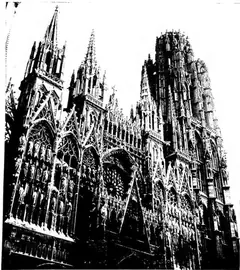
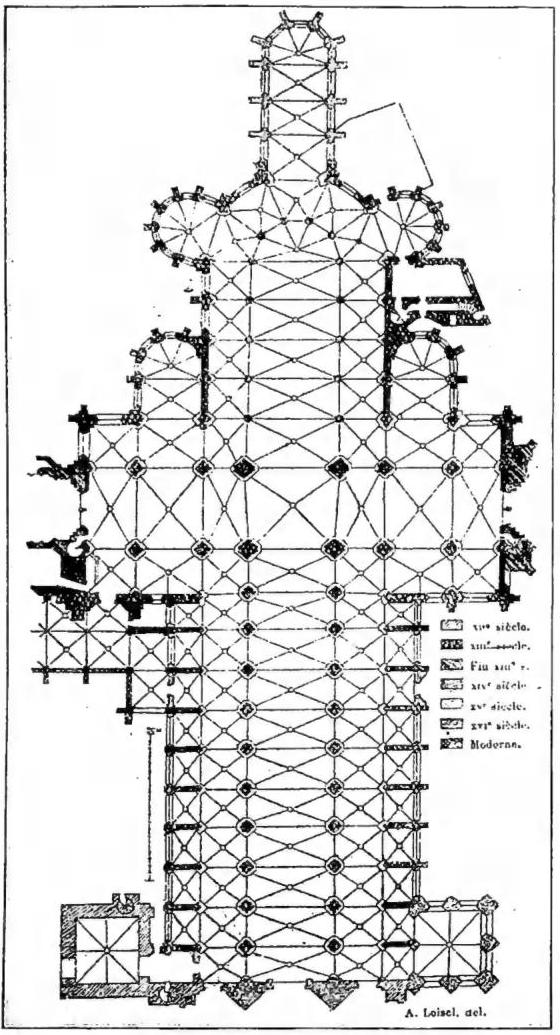
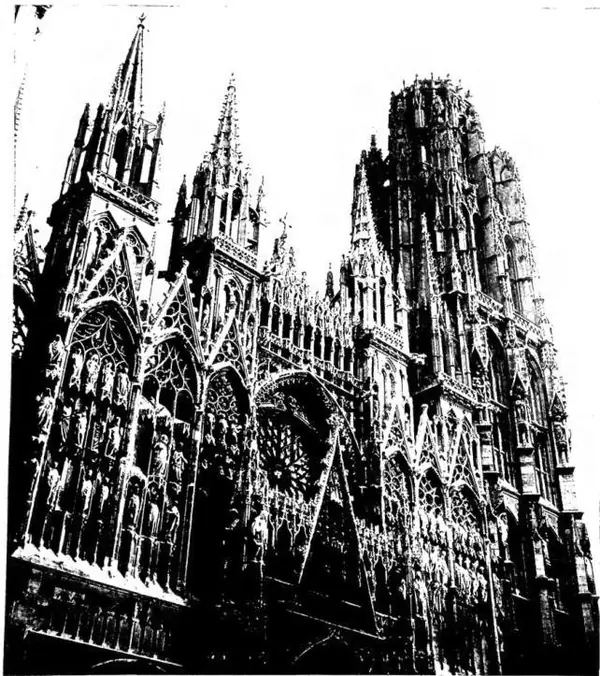
Monuments. Archbishop Robert of Normandy, d. in 1037, built a new cathedral, which was consecrated by Archbishop Maurilius in 1062; work was still going on there, however, in the time of Archbishop Hugh (1145). To the end of the 12th century belongs the tower known as that of St. Romanus. But on the night of Easter 1200 part of the Cathedral burned and was immediately repaired. In 1206 an episcopal consecration was celebrated there. In 1302 Archbishop G. de Flavacourt gave the land for the chapel of the Madonna. The interior measures 135 m. x 31; the vaults of the central nave are 28 m. high; the west façade is 38.65 m. high; the towers measure: the one called that of St. Romanus 82 m.; the one called "de Beurre" 75 m.; the spire measures 151 m. The "de Beurre" tower was erected in 1487 and includes the chapel of St. Stephen. The numerous side chapels belonged to the various guilds and confraternities established at R. during the 14th century. On the exterior, in the west façade, the two portals of St. Stephen and St. John are dated between the end of the 12th century and the first quarter of the 13th. In the tympanum of the first are represented the Stoning of the protomartyr, Christ in majesty, episodes from the life of St. Paul and scenes from the life of the Baptist. The portal called "de la Calende" has in the tympanum The Coronation of the Virgin and scenes of the Passion, on the jambs Jesus Christ, the Apostles, the deacons and episodes of the Old and New Testament, from the lives of St. Romanus and St. Ouen (end of the 13th century). The portal called "des Libraires" has carved in the tympanum the unfinished Last Judgment, the crucifixion of St. Peter and, in 150 medallions, episodes from the creation up to the killing of Abel, alternating with fantastic animals (end of the 13th century).
North of the Cathedral were the cloister and the chapter hall; the present sacristy is located in the ancient Treasury of the 13th century. Of the ancient archbishop's palace built in the 12th century by G. Bonne-Ame some halls remain: the Palace was joined to the Cathedral by covered galleries; great transformations were carried out by Cardinal d'Estouteville (1462-65) and then by Cardinal G. d'Amboise. At the end of the 15th century the conciergerie was erected, in 1716 the present Chapel, in 1738 the monumental Library. The restoration works begun by Msgr. Fuzet were interrupted by the law of separation. In the chapel of St. John the Baptist the stained-glass windows offer scenes from the life of the precursor, then come those of the life of St. Severus bishop of Avranches and the legends of St. Catherine and St. Stephen; all of the 13th century. In the ambulatory the stained-glass windows are dated between 1220-40; that of St. Julian the Hospitaller was offered by the fishermen of R., the other with the story of St. Joseph by the cloth shearers and bears the signature: Clemens vitrarius Carnotensis (of Chartres) me fecit. Other stained-glass windows contain scenes from the life of Christ; those of the transept are of the 14th century. In the chapel of the B. Virgin is the series of the archbishops of R.; the three great rose windows are also of the 14th century, but the western one was restored at the beginning of the 16th century. The stained-glass windows of the choir were executed by L. le Doyen (1430-31), G. de Grainville (1432) and J. de Senlis (1432-33); those of the minor naves are by G. Barbe (1459-85). The confraternity of St. Roman decorated the chapel of the said Saint with its legends, among which characteristic is that of all the virtues gathered around his deathbed. There are moreover the tombs of the archbishops Maurilius, of the Cardinals de Bonne-Chose, Thomas, of Georges I (1460-1510) and of Georges II d'Amboise (1488-1550), of the cardinal prince de Croy (1835). The choir stalls were donated by Cardinal d'Estouteville (1457-69).
The church of St-Maclou or St-Malo was begun in 1437 to the design of P. Robin in flamboyant Gothic; the two Cardinals d'Amboise were its patrons and the second consecrated it in 1521. The present bell tower is of 1868-70. The facade opens onto a portico. On the middle portal are represented the Circumcision and the Baptism of Christ surmounted by seven statuettes. On the tympanum the Last Judgment. In the left door called of the Fonts (baptismal) is the Parable of the Good Shepherd with the Allegories of the Four Seasons. In the interior the central nave has three bays; on the transept is a tower, an ambulatory and a choir with a four-apsed chevet; the stained-glass windows are of the Renaissance; admirable are the Tree of Jesse and the Crucifixion in the transept. St. Andrew: the cloister or atrium (from atrium) is dated between 1526-33; except the south side which is of 1640. The central part was used as a cemetery; it is surrounded by ambulatories supported by stone columns whose capitals were carved with scenes of the dance of death, much disfigured. The church of St-Vivien too is in flamboyant Gothic of the 15th century with a stone bell tower.
The church of St-Eloi is in Gothic of the 16th century, occupied today by the Protestants. The church of Ste-Madeline was begun in 1761 and finished in 1767; over the crossing rises a dome surmounted by a kind of slate obelisk. The church of St-Vincent is famous for its stained-glass windows of the 15th century and for its square central tower in flamboyant Gothic. An elegant portico precedes the facade; on the portal a disfigured bas-relief represents the Ascension of the Lord. The interior presents the raised choir with stained-glass windows of 1515 representing the Triumph of the B. Virgin; in the left chapel the stained-glass windows bear the signature of Engrand le Prince and of his son (1515-30) and represent the Works of Mercy and episodes of St. Anthony of Padua. In the sacristy tapestries of the Renaissance and of the 17th century. The church of St. Patrick, likewise in flamboyant Gothic, was built in 1535. The interior is without transept; the stained-glass windows dated between 1538-1625 have been much restored; except those of the right side-aisle in which the scene of the adulterous woman is of 1549; as well as those with episodes of the Baptist, the Adoration of the Magi and of the shepherds; the Story of Job and the Works of Mercy; also ancient are some of the left side-aisle with episodes of the life of St. Martha (1543), of St. Louis (1583) and above all the Annunciation (1538). Of the ancient church of St-André-aux-Fèbvres only the Gothic tower 32 m. high remains, built in 1452.
The ancient Seminary founded in 1515 by Cardinal de Joyeuse became the Jesuit College (17th-18th centuries); today it is occupied by the «Petit collège de Joyeuse» and by the Lycée Corneille. The artistic chapel was built between 1614 and '56. In the cloister and in the buildings of the ancient convent of the Visitandines (1681-91) is now arranged the «Musée d'Antiquité», with notable Tanagra statuettes, sarcophagi, tombstones, bronzes and Roman mosaics, bas-reliefs, medieval reliquaries, storied stained-glass windows from ancient churches, statues of Apostles from Jumièges etc. The church of St. Roman is the ancient chapel of the Carmelite convent built from 1676 to 1730. The church of St-Godard in Gothic of the 15th-16th centuries with an unfinished square tower in Renaissance style. It is divided by columns into three naves. In the chapel of the B. Virgin stained-glass windows of the 16th century with the Life of the Madonna and the Tree of Jesse dated to 1506; in the chapel of St. Roman evangelical apparitions and life of St. Roman (1555).
The ancient church of St. Lawrence was reduced to profane use in 1791; it was erected between 1444-1554 in flamboyant Gothic style, like the tower (1490-1501) 37 m. high. Restored in 1920, the Musée Le Secq des Tournelles was established there, named after the founder of a precious collection of objects in wrought iron. The church of St. Nicasius is in Gothic of the 16th century with a beautiful stained-glass window of 1555. Modern is the church of St. Severus in the suburb of the same name. In the surroundings of R. is the basilica of Bonsecours on the hill of the same name, erected between 1840-42 in imitation of the Gothic of the 13th century. The high altar is in gilded bronze.
A letter of an Augustinian dated 24 June 1697 narrates the festivities in honor of a St. Columba virgin and martyr translated in that year to R. from a cemetery of the Via Salaria which is probably that of Maximus ([v.]; R. Viellard, Translation des reliques des catacombes à R. au XVIIe siècle, in Riv. di arch. crist., 16 [1939], pp. 135-40). A gold ring with the inscription DOMMA found at R. was illustrated by E. Le Blant, Nouveau recueil des inscr. chrét. de la Gaule, Paris 1892, p. 22, n. 19).
The «Musée des Beaux-Arts» was formed in 1801-1809 by the painter G. Lemonnier with ca. a thousand paintings of various ancient and modern schools; its collection of ceramics has been transferred to the cloister of St-Maclou. The same building contains the municipal Library rich in over 200,000 vols. and 200 manuscripts, of which 150 illuminated between the 11th-17th centuries; rich collection of prints and numismatics; together is the civic Archive with documents prior to 1800. Among the manuscripts are noted a benedictional of Archbishop Robert (10th century) used for the coronation of the Anglo-Saxon kings; a missal called of St-Futhlac (11th century).
The Abbey of St-Ouen. - Clovis or Chlothar I is said to have founded the Abbey of St. Peter, which later took the name St-Ouen from the name of the bishop of R. Of the original building only a few pillars have been found. In 684 the bishop, St. Ouen, was buried there; it was burned by the Normans in 842. In the 10th century the abbey became a destination for pilgrimages to venerate the relics of the holy bishop, who ended up giving the monastery its name. The new church was begun between 1056 and 1066 and dedicated on 17 October 1126. It was damaged by fires in 1136 and 1248; part of it collapsed at the beginning of the 14th century. Reconstruction was begun by Abbot J. Roussel (1303-39), but, after a long interval, it was resumed in the 15th century, especially through the gifts of Cardinal d'Estouteville, who was abbot there from 1462 to 1483. It was damaged in 1562 by the Huguenots and by a hurricane in 1683. During the French Revolution it was turned into a museum; in 1799 festivities of the sovereignities were held there and people danced there; in 1845 the facade was demolished; the side facades, to the north and south, remain. The portal is called "des Marmousets" because of the small statues that decorated it; it dates from the end of the 14th century. In the tympanum are carved the Dormition of the Virgin, her Funeral, the Assumption and the Coronation. In the portals are medallions with the miracles of St. Ouen. The stained-glass windows of the choir date from the 14th century, those of the transept from the 15th, those of the nave from the 16th. The interior has three naves with a very deep choir ending in a polygonal apse, and in the ambulatory six side chapels. In the north transept one of the two-story apsidal chapels remains, now called the "Tour aux clercs." The keystones of the bays of the choir were adorned in the 14th century with historiated medallions, among which are the reliefs of the Baptism of Christ, the Stoning of St. Stephen, the Beheading of St. John the Baptist, and the Coronation of the Virgin. The two orons of the transept are from the 15th century. The monastic dormitory is today converted into a Town Hall. In the great cylindrical tower called the "Tour de Jeanne d'Arc," to which she was brought several times in 1431, a "Jeanne d'Arc" Museum has been established.
The Abbey of St-Wandrille. - It was founded in 648 by St. Wandregisilus (Wandrille), a disciple of St. Columbanus; at first it was called "Fontanelle" from the small stream that flows through the place. It was very flourishing in the Middle Ages; it declined in the 16th century; it was occupied by the Maurists from the 17th century until the French Revolution, which suppressed it. In 1894 it passed to the Benedictines of Ligugé until the suppression under Combes. The Benedictines reoccupied it in 1931. The abbey church was erected from 1255 to 1342; the north side of the transept remains; the very large choir had an ambulatory flanked by 15 chapels. The cloister is well preserved, between two large buildings from the Maurist period. On the southeast side is a portal from the 14th century with the Coronation of the B. Virgin; from the same period is the Madonna known as "Notre-Dame de Fontanelle." The ancient refectory from the 12th century remains; the original chapter hall is today the chapel of the new monastery. On the adjacent hill is the triconch chapel of St. Saturninus from the end of the 12th century. - See plate LXXXVI.
Brac., E. Sauvage, Elocchi episcop. Rothamagouzian, in Anal. Boll., 8 (1880), pp. 406-28; Rubel, I, pp. 425-26; II, pp. 248-49; III, p. 305; IV, p. 298; V, p. 336; E. Vacandard, Vie de St Ouen duque de R. (647-84), Paris 1902; id., Liste chronolog. des archev. de R., in Rev. cult. de Normandie, 1904; L. Pilliou, Les portails latéraux de la cathédrale de R., Paris 1907; L. Duchesne, Fastes épiscopaux de l'ancienne Gaule, II, Paris 1908, pp. 200-11; E. Enart, R., 4th ed., Paris 1921; A. Masson, L'église abbaziale St-Ouen de R., ibid. 1927; A. Loisel, La cathédrale de R., ibid. n.d.; Ch. Descroix, L'église de St-Nicaise, Rouen 1934; Ch. Ledre, Le card. Cambacères, archevêque de R. (1802-18), La réorganisation d'un diocèse au lendemain de la Révolution, Paris 1943; Cottineau, II, cols. 2543-50; Guide de la France chéri. et mission., 1948-49, Paris 1948, pp. 381-82, 721, 1097-1102; P. Le Cacheux, La haute Justice des archevêques de R., comtes de Louvier, 1797-1798, Rouen 1948; id., R. au temps de Jeanne d'Arc et pendant l'occupation anglaise, Rouen 1949.
Enrico Josi