
MICHELANGELO BUONARROTI (in autographs Michelagnolo). - Sculptor, painter, architect and poet, b. at Caprese (today Caprese-Michelangelo) in Tuscany, in the Tiber valley, on 6 March 1475, to Ludovico di Leonardo di Buonarroto Simoni, podestà of that town and of Chiusi, and to Francesca di ser Miniato del Sera and of Bonda Rucellai, both from Florence. The claimed and by him believed descent of the Buonarroti Simoni (an ancient Florentine family) from the counts of Canossa has no foundation.
Brought to Florence a few days after his birth, he was placed as a boy in the grammar school of the humanist
Francesco Galeota da Urbino, called il Greco, but without great profit, so that his father, yielding to his clear vocation, entrusted him on 1 April 1488 to Domenico and David del Ghirlandaio so that he might learn the art of painting. No certain work remains from this period, but the sources recall various drawings, among them a Temptation of St. Anthony (lost), a copy colored from a copper engraving by Schongauer. Frequenting, on the advice of Granacci, his fellow pupil, the Medicean Gardens of S. Marco full of ancient statues and reliefs, and where Bertoldo, a pupil of Donatello, taught sculpture, M. discovered his true path and, around 1489, left Ghirlandaio's workshop. A head of an Old Faun (lost), freely reworked by him after the model of a classical fragment, attracted the attention of Lorenzo the Magnificent, who, having come to an agreement with his father, took him into his house, educating him together with his own sons in an environment of refined humanistic culture, dominated by Poliziano (1490-94). The Neoplatonism of the latter and, later, the fiery sermons of Savonarola profoundly influenced M.'s spirit, and their echoes are felt in his poems.
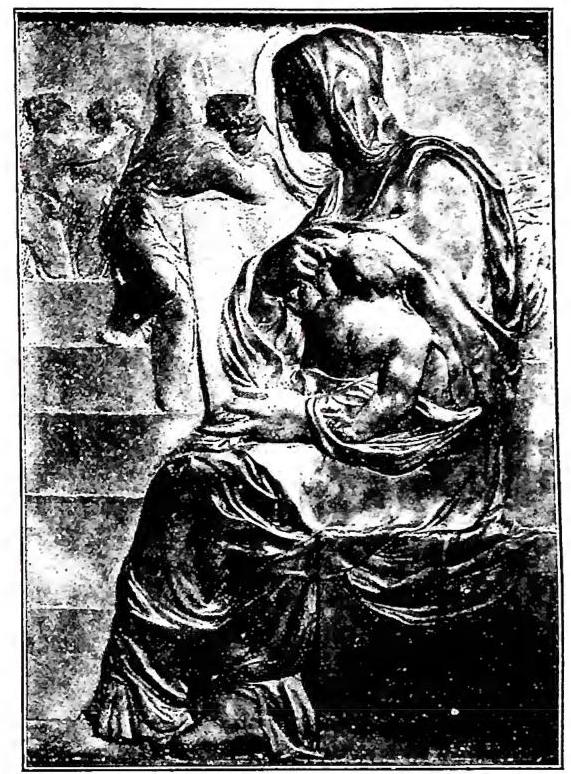
From those early years there remain some drawings, already very personal in their hatching (copies of Giotto's frescoes in S. Croce and of Masaccio's at the Carmine) and two marble bas-reliefs: the Madonna of the Stairs (Florence, Casa Buonarroti) and the Battle of the Centaurs (ibid.), a theme suggested to him by Poliziano, works that reveal in Donatello and in ancient art the twofold source of his early manner. While he was drawing in the Brancacci chapel, a blow from the envious Torrigiani broke his nose, disfiguring his face forever, which contributed not a little to increasing his natural misanthropy. From the same period, but later, are also a marble Hercules, sculpted for the Strozzi in 1492 (disappeared at Fontainebleau in 1713) and a wooden Crucifix for S. Spirito (the one still preserved there is of disputed authenticity). From the very
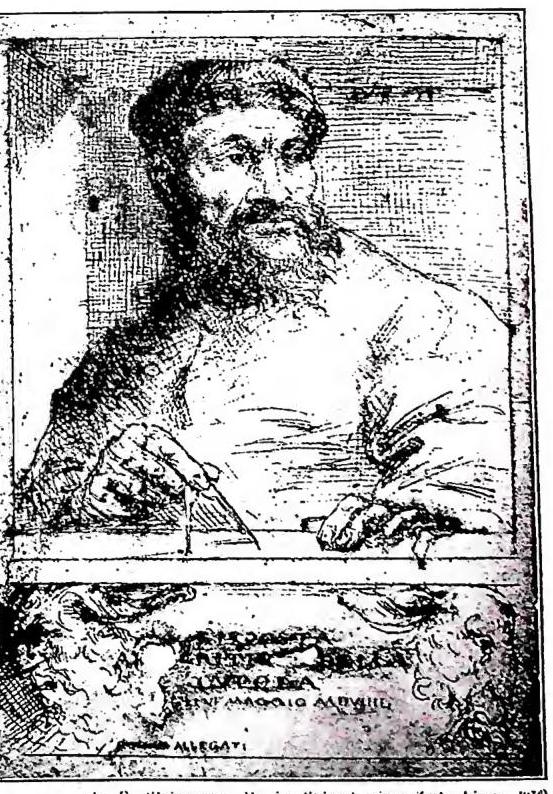
At the outset, then, the naked human figure stands out as the ideal theme of his art, and Vasari recalls his anatomical studies carried out on cadavers. After the death of Lorenzo the Magnificent (8 April 1492), Piero de' Medici continued toward M. the hospitality, not the patronage, of his father: he had him model only a snow statue in the courtyard of the palace on Via Larga (perhaps in 1494). In October 1494, alarmed by the dream of a member of the Medici household who prophesied the imminent expulsion of his masters (which happened on 8 Nov. 1494), M. fled from Florence to Bologna, as the guest of Gianfrancesco Aldovrandi. These sudden and inconsiderate flights would be repeated several times in his life and are a sign of an abnormal nervous sensitivity. In Bologna he came under the influence of Jacopo della Quercia (reliefs of the cathedral doors) and sculpted for the shrine of St. Dominic an Angel holding a candelabrum (Bologna, St. Dominic) and the statuettes of Sts. Petronius and Proculus (ibid.).
Having returned to Florence (1495), dominated by Savonarola, he there modeled a St. John the Baptist as a boy (lost) and a sleeping Cupid (lost), sold as an antique to Cardinal Raffaello Riario, who, having discovered the deception, nonetheless admired the artist, summoning him to Rome, where he arrived on 25 June 1496.
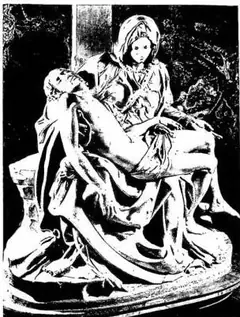
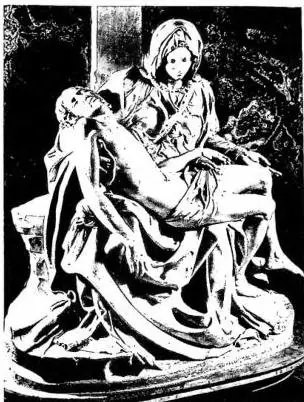
There he drew the cartoon for a St. Francis receiving the stigmata (lost), intended for the church of St. Peter in Montorio. For Jacopo Galli, his Roman patron, he sculpted a Cupid (lost) and, from 1497 to about 1500, the drunken Bacchus (Florence, Bargello), a limpid statue, but cold in its formal perfection, in which is mirrored his new experience of classical sculpture. The restless search of those youthful years is revealed in the wholly different style of another work of his (the only one signed by him), also executed in the same period, namely, the Pietà of St. Peter's in the Vatican, which immediately made him famous. The group was assigned to him by a contract of 27 Aug. 1498 by Cardinal Jean de Bilhères de Lagraulas (and not Villiers de la Groslaye, as is usually read), for the round chapel of St. Petronilla, annexed to the old Vatican Basilica. A milestone between the two centuries of the Renaissance, this marble still recalls the Quattrocento in its many Donatellian, Leonardesque and even Ferrarese reminiscences, while in its ideal naturalism and in the almost Baroque virtuosity of its sculptural technique it already responds, albeit with a certain timidity, to what would be the canons of sixteenth-century aesthetics. In his old age M. would try to explain to Condivi the profound religious feeling that inspired him in carrying out that work.
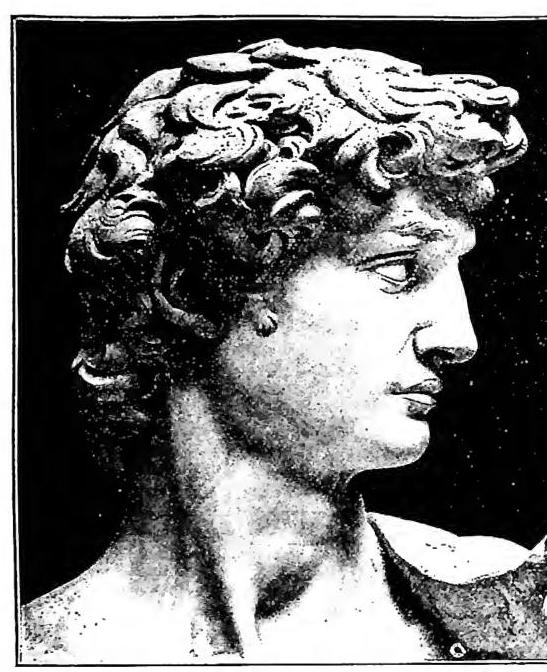
By a private deed of 5 June 1501, dated from Rome, Cardinal Francesco Piccolomini (the future Pope Pius III) entrusted him with the execution of fifteen statuettes of saints for the niches of the altar of Andrea Bregno (Piccolomini altar) in the cathedral of Siena. Having returned to his homeland in the summer of that year, M. sculpted only four of them, namely, Sts. Peter, Paul, Gregory and Pius (Siena, Cathedral), working on them roughly from June 1501 to the autumn of 1504. F. Kriegbaum (1942) rightly reclaimed the interest of these minor works, almost always neglected by scholars. Having obtained from the consuls of the Wool Guild and from the Overseers of St. Mary of the Flower (contract of 16 Aug. 1501) a large block of marble that lay abandoned and badly roughed out in the courtyard of the Works, M. carved from it «for the emblem of the palace» (Vasari) a David (Florence, Accademia), nude with the sling, 5.50 m. high, and therefore called by the Florentines the «Giant». Begun on 13 Sept. 1501, the work was completed in Jan. 1504, and the statue, on the advice of a committee (of which were part, among others, Botticelli, Leonardo da Vinci and Perugino), was placed on 8 June 1504 on the platform in front of the Palazzo Vecchio, where until then stood Donatello's Judith (it was replaced there by a copy in 1873). In the David there manifests itself for the first time in monumental form that heroic conception of the nude that would triumph on the vault of the Sistine Chapel and that sinks its roots in Roman statuary (quite rightly Vasari recalls, in connection with this work, the Dioscuri of the Quirinal, the Tiber and the Nile of the Belvedere). Another David (lost), of bronze, with the head of Goliath under its foot (a pen drawing of it survives in the Louvre) was assigned to him by the Signoria (contract of 12 Aug. 1502) to be donated to Marshal Pierre de Rohan. Completed in Sept. 1508 and retouched by Benedetto di Rovezzano, it was sent to France to Florimond Robertet (Rohan having meanwhile fallen into disgrace), and there it disappeared in the 17th century. Of the Twelve Apostles that he had undertaken to sculpt for the cathedral of Florence (contract of 24 Apr. 1503) he roughed out only the St. Matthew (Florence, Accademia), a Herculean body emerging from the rock, which marks a notable progress with respect to the marble David, beginning the phase of his fullest maturity. M. loved to work the stone directly, without the help of stonecutters, so that his «unfinished» statues, as this one is (and there are many), never appear incomplete: in them the aesthetic phantom is always suggested in its entirety, with a mysterious and almost musical expressive power. From Oct. 1504 to Aug. of the following year he traced the cartoon for the fresco of the Battle of Cascina (lost), intended to adorn one of the long walls of the Hall of the Five Hundred in the Palazzo Vecchio, in competition with Leonardo da Vinci, who, on the opposite facade, had already begun to paint the Battle of Anghiari. The two celebrated cartoons were, for the artistic generation of the early sixteenth century, what Masaccio's chapel at the Carmine had been for the preceding one: a «study of craftsmen» (Vasari) and a school of masters, among them the young Raphael. Unfortunately the paintings were not executed and those sheets were destroyed during the civic tumults of 1512, so that today scarcely a pale reflection of them remains in some original sketches or in contemporary copies and prints of mediocre value. While Leonardo had represented in his smoky chiaroscuro a scuffle of horsemen around a standard, M.'s drawing depicted the Florentine soldiers surprised by the enemy assault during a bath in the Arno (an episode of the war of Pisa, 1564). It was a pretext for exalting the nude in a rich and animated composition, and the fresco would undoubtedly have been very similar, in the precise and marked contour of the forms, in the plastic evidence of the modeling and in the clear sobriety of the color, to that of the Flood, painted a few years later on the vault of the Sistine Chapel. To the same Florentine sojourn there still belongs a group of important works, but of uncertain date, of which a list is now given.
The Madonna of Bruges (Bruges, Notre-Dame), a marble sold by Michelangelo in 1506 to the Mouscron family and sent to Flanders, shows the Virgin pensive, almost foreboding, seated in a hieratic pose (the statue is composed for frontal viewing, like the altarpieces of the thirteenth century), in dramatic contrast with the unaware Christ Child who stands between her knees. Although the forms here are more restrained, especially in the drapery and in the modeling of the putto (analogous to that of the Doni Tondo), the stylistic and technical affinity with the Pietà of St. Peter's is so evident as to make acceptable the hypothesis that the group still dates from the Roman period. Two marble bas-reliefs of circular outline, both unfinished, representing the Virgin with the Child and known as the Madonna Taddei (London, Academy) and the Madonna Pitti (Florence, Bargello), seem to have been executed after 1505, especially the second, not far from the manner of the Sistine Chapel. From that year, in all probability, dates the only panel painting by Michelangelo still preserved, namely the Doni Holy Family (Florence, Uffizi), a composition balanced in a marvelous and novel way within the round field. The absolute completeness of the drawing (as the aesthetics of the Renaissance conceived it) is there clothed in a chromatic vivacity, animated by bold cangiantismi, unique in his art. Slightly earlier seem to be two unfinished paintings: the Madonna with Angels (London, National Gallery) and the Entombment of Christ (ibid.), both still in part tied to stylistic modes of the late fifteenth century, and not admitted by all into the number of his works.
In the first months of 1505, Julius II della Rovere, a pontiff worthy of Michelangelo for the audacious grandeur of his enterprises, summoned him to Rome (on the advice, it seems, of Giuliano da Sangallo) and in March of that year commissioned from him his own Tomb (Rome, S. Pietro in Vincoli), which was to rise in the Vatican Basilica, rebuilt by Bramante. According to the first grandiose project (known only from the descriptions of Vasari and Condivi) this truly imperial mausoleum had the appearance of an isolated funerary aedicule, rectangular in form (approx. 10.80 x 7.20 m), with façades adorned with niches and podiums bearing the statues of the Arts and of the Virtues subdued by the death of the patron Pope and — adds Vasari alone — of the provinces he subjected to the Church (that is, the so-called Prisoners), flanked by Termini supporting the cornice. At the corners of this were to be placed four great seated statues, of which the only one executed is the Moses, but Vasari moreover mentions those of the Active Life, the Contemplative Life and a St. Paul. The roof of the edifice, built with tapering steps and adorned with bronze reliefs depicting the events of the history of Julius II, would have been crowned by the statues of Cybele and Uranus, that is, of Earth and Heaven, supporting an ark, the former sorrowful at having lost so great a sovereign, and the latter joyful at having received his spirit. In the interior of the monument an oval-shaped cell, with two niche entrances on the lesser façades, was to guard the sarcophagus of the deceased Pontiff. In April 1505 Michelangelo went to Carrara and stayed there eight months quarrying the marbles of his choice, dreaming of creating a work that, as for beauty, had « not its equal in all the world » (letter of Michelangelo to G. da Sangallo, of 2 May 1506). Suddenly, however, it is not well known for what reason, the Pope changed his mind and, on 17 April 1506, refused even to receive Michelangelo, who had gone to the Vatican to speak with him about it. The latter, indignant, departed (perhaps the same day) for Florence, where he resumed and carried to completion the cartoon for the Battle, in vain recalled by the Pope with three briefs to the Signoria (the text of that of 20 July 1506 survives). The long dispute that followed with the della Rovere heirs over the fulfillment of the contract was called by him « the tragedy of the tomb » (Condivi), and came to an end only with the agreement of 20 August 1542, the last of the six (also known are those of 6 May 1513 — that is, the second — and of 8 July 1516, one of 1525, of which epistolary notices survive, and that of 29 April 1532) which reduced the majestic original design to the mediocre wall monument built in S. Pietro in Vincoli, and redeemed only by the powerful statue of the Moses (sculpted around 1515), the only one of the 40 originally planned to be put in place, while those of Leah and Rachel in the in the side niches, modelled by M. without enthusiasm around 1542, are of a cold beauty. The remainder is due to collaborators of modest talent, such as Raffaello da Montelupo and other lesser artists. There remain, of the various subsequent projects, the following marbles: the two Prisoners (Paris, Louvre), one rebellious without hope, the other resigned to dreaming (both executed, like the Moses, for the second contract; M. was working on the one bound to it in 1513); the sad Victorious (Florence, Palazzo Vecchio), disdainful of its own triumph (probably modelled in Florence in 1506, and perhaps one of the Virtues), and four other unfinished Prisoners (Florence, Accademia).
But on 11 Nov. 1506 the Pontiff, at war with the Bentivoglio, entered Bologna, and the Signoria, fearing him too close, compelled M. to go and visit him, furnished with a safe-conduct, to make peace with him, which happened towards the end of the month, in the course of a stormy audience. His flight pardoned, he was commissioned with the bronze statue, about three times life-size, of Julius II (now lost), seated on a throne, with the triple crown on his head, his right hand raised in the act of blessing and the sacred keys in the other hand. Because of the little practice he had with the material, M. had it cast, not without difficulty, by master Bernardino d'Antonio del Ponte, and, on 21 Feb. 1508, it was raised with great festivity within a marble aedicule on the facade of S. Petronio, as a sign of dominion. But it remained there only a short while, for the Bentivoglio, having reconquered the city, had it hurled down onto the churchyard and bestially destroyed by the fury of the populace, on 30 Dec. 1511, without any record of it remaining in drawing or print, beyond some summary description.
M. had scarcely returned to Florence, at the beginning of March 1508, with the intention of completing the Apostles for the Cathedral, when Julius II summoned him to Rome and, taking up a project he had cherished since 1506, ordered him to fresco the Vault of the Sistine Chapel (Vatican). Hoping to be able to continue the work of the Se-
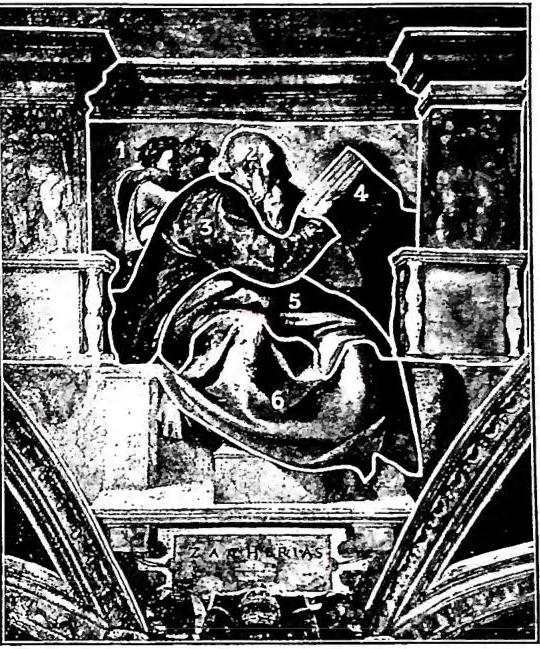
burial, M. tried to evade the new assignment, pleading that he was not a painter, but then had to yield to the Pope's insistence, and indeed, he replaced the first modest design (the twelve Apostles seated on thrones on the pendentives) with a vast cycle representing the story of Genesis, from the first instant to the Flood and the beginning of life anew on earth in the family of Noah. In the choice of theme there clearly appears the desire to link up with the two series of fifteenth-century paintings which, on the side walls, show episodes from the lives of Moses and Christ: to the drama of original sin there is added, in fact, the promise of Redemption, guarded for centuries by Israel and fulfilled in the Messiah. On 10 May 1508 M. began the undertaking of the Vault (according to an autograph "memorandum"), assisted by a group of six painters specially summoned from Florence, less, perhaps, to help him than to show him how to paint in fresco, an art he had little or not at all practiced until then. In fact, once the panel of the Flood was finished, with which he had begun and where (judging by the observations made by Biagetti during the last restorations) traces of this collaboration are still visible, he sent almost all of them back, keeping only a few for help with minor matters (painted cornices, etc.). On 14 Aug. 1511 Julius II wished to unveil the first half of the Vault, finished since the previous Sept., and on 31 Oct. 1512 he had the rest of the scaffolding removed, inaugurating it the following day (All Saints). The biblical themes treated by M. are: the Separation of Light from Darkness, where the Spirit of God moving over the chaos is barely hinted at with a minimum of pictorial matter; the Creation of the Sun, the Moon and the Plants, a powerful synthesis, in which the figure of the Eternal appears twice, suggesting an act of material creation, in time and space; the Separation of the Earth from the Waters and the Creation of the Fish, an episode later than the following one, but placed here to leave the latter the greater space; the Creation of Man, who in his already formed limbs, of an ideal beauty, receives the spark of life from God's finger brought close to his; the Creation of Woman, drawn forth clinging from the side of the sleeping Adam; Original Sin and the Expulsion from Paradise, a diptych in which sin and punishment seem to spring from the same trunk of the tree of Good and Evil; the Sacrifice of Noah, who remained faithful to God in a corrupt world; the Universal Flood, which shows the painter's initial inexperience in figures too minute for the great height, and finally the Drunkenness of Noah, a sorrowful epilogue to the solemn cycle, where one sees the evil that survived the Flood with the few survivors. The figure of the first patriarch links the stories of Genesis to the fifteenth-century ones of the Life of Moses (below), making the whole pictorial decoration of the Sistine Chapel a single complex. The individual scenes are distributed in five larger and four smaller rectangles alternating along the axis of the vault, and seem to appear through the openings of the rich architectural frame, almost as if they were heavenly visions. Yet they are painted without illusionistic foreshortening, as simple wall frescoes made to be seen from the entrance door, arranged in a roughly chronological order that begins above the altar and is therefore the reverse of the order in which they were executed. The drama is reflected in the joy and sorrow of the twenty genii, the Ignudi, flanking, two on each side, the smaller rectangles; it echoes in the thought of the seven Prophets and the five Sibyls seated on thrones in the pendentives, and lives with the promised Redemption in the obscure faith of the so-called Ancestors of Christ (the medieval "Tree of Jesse") encamped on the corners and in the lunettes. In the vault webs are four episodes alluding to the Messiah: David and Goliath, Judith and Holofernes, the Punishment of Haman and the Brazen Serpent. The unveiling of the Sistine Vault perhaps marks the most memorable date. The apogee of the Tuscan Renaissance, which beheld in it the perfect fulfillment of its fundamental aesthetic principle: that of "design," as it had been forming from Giotto to Masaccio and to Ghirlandaio. In those frescoes, a theme of the highest human interest was translated into images whose realism must have seemed to contemporaries idealized in the very sense suggested by the "true," after the example of classical art, and whose expressive power was entrusted above all to design, understood as linear harmony of contour and sense of plastic relief, given by chiaroscuro and enlivened by color in a subordinate role. M.'s famous saying, that sculpture is the "lantern of painting" (letter of M. to B. Varchi of 1549), finds a marvelous commentary in the Sistine Vault, where he has in part transferred, since he could not express them in marble, certain motifs akin to those imagined for the mausoleum of the Pope della Rovere. And yet these frescoes, executed by a sculptor and almost by imposition, are the most monumental pictorial work of the sixteenth century, of decisive importance for the further evolution of Italian art.
On the death of Julius II (21 Feb. 1513), M. had returned to the beloved work of the Tomb, having made a new design for it (in the form of a chapel built against the wall) and a second contract (6 May 1513). But on 5 Dec. 1516 he had to go to Rome, from Carrara where he was staying for the marbles of that monument, summoned by Leo X, of the Medici (elected 11 March 1513), who had chosen his Design for the facade of S. Lorenzo in Florence (contract of 19 Jan. 1518), presented in competition with other artists, among them Antonio da Sangallo and Raphael. M. began the execution of his design, determined to make it "the mirror of all Italy in architecture and sculpture" (letter of M. to D. Buoninsegni, of 2 May 1517), but after more than three years spent in vain in the quarries of Pietrasanta, on 10 March 1520 he regained his freedom from the Pontiff, eager to "make the aforesaid facade more quickly" ("memorandum" of M. under that date), of which, beyond the foundation, only a wooden model remains (Florence, Casa Buonarroti). Between 1519 and 1520 he had also sculpted for Metello Vari (contract of 14 June 1514) a Risen Christ with the Cross (Rome, S. Maria sopra Minerva), a marble partly damaged by his assistant
Pietro Urbani, but then reworked by Federico Frizzi and finished by M. himself in 1521. This is perhaps, as it appears today, the least Michelangelesque of his figures.
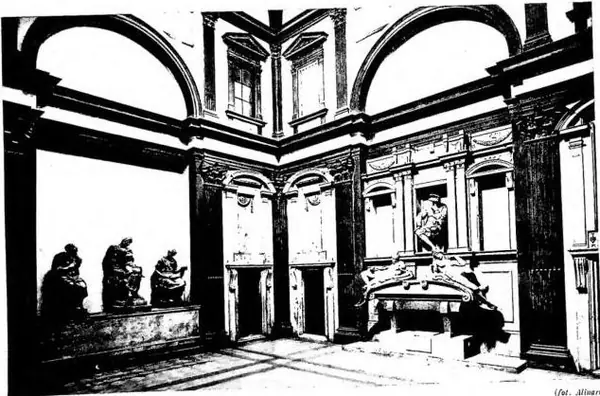
Leo X, who died on 1 Dec. 1521, was succeeded on 9 Jan. 1522 by the Dutchman Adrian VI Florenz, a pope of severe morals but no friend to men of letters and artists, who deserted Rome during his brief reign, which closed on 14 Sept. 1523. At that time M. was attending in Florence to the Tomb of Julius II. Cardinal Giulio de' Medici, elected on 18 Nov. 1523 under the name Clement VII, confirmed to M. the commission given him as early as the end of 1520 (the works had begun in March 1521), to build the interior of the New Sacristy of S. Lorenzo (Florence) and to carve there the tombs of Giuliano duke of Nemours, of Lorenzo duke of Urbino, of Lorenzo the Magnificent, of his brother Giuliano, those of Leo X and his own (commissioned in 1524 and never executed), intending to make it the mausoleum of his House. M., following the example of Brunelleschi, clothed the white walls, which were to be partly frescoed, with a solid framework of cornices, arches and pilasters, divided into two superimposed orders and cut in brown sandstone, covering the rectangular space (extended by a small sanctuary) with a hemispherical coffered dome surmounted by a lantern of new form (completed in 1525). In this architecture the elegance of the Florentine modules reveals unsuspected possibilities of energy, relived as they are in a highly personal style, whose absolute novelty Vasari already noted, though it respected classical tradition. The original design (1520 to 1524) grouped the monuments in the center of the chapel, but it was soon abandoned for a new project of three tombs resting against the wall, each adorned with two figures lying on the sarcophagi and with two Rivers reclining on the ground, on which M. worked from 1524 to 1526. From this phase date the marbles of Day (unfinished), of Night (famous also for the exchange of epigrams between G. Strozzi and M.), of duke Lorenzo (an ideal figure, not a portrait, as is also that of Giuliano), the fragmentary clay model of a River (Florence, Accademia) and the Crouching Boy (Leningrad, Hermitage), perhaps a sketch for a caryatid. The Madonna with the Child (unfinished) was instead begun much earlier; it recalls the youthful one of the Staircase, absorbed in the same sorrowful meditation. After 1531 the duke Giuliano, Twilight (unfinished) and Dawn were carved. Day and Night were to lie upon the flat lid of a sarcophagus at the foot of the Madonna, with two Rivers on the ground; their present and hardly felicitous placement (the legs have no support), due to Tribolo, is later than M.'s definitive departure for Rome in 1534. Of the various projects there remain today the monument of the restless Giuliano with the statues of Day, in an attitude of defense, and of Night, tormented by a nightmare (to the right of one looking at the altar), that of Lorenzo (opposite), the sad Pensive one, with the resigned Twilight and the hopeless Dawn, as well as, facing the altar, the anguished Madonna and the statues of Sts. Cosmas and Damian (patrons of the House of Medici), executed after the master's design by Montorsoli and by Raffaello da Montelupo. In their finished parts these marbles come close to the art of the chisel, yet without sacrificing anything of their essential sobriety and plastic power. The New Sacristy is the only monumental complex of M. that matured somewhat beyond the pale reflection of the initial idea. Its statues and its architecture, animated by one and the same passion, show the same limpid completeness as the frescoes of the Sistine vault, and in this most carefully controlled language of theirs they express the almost desperate vision with which M. already then regarded every human thing.
Of analogous style (and Vasari rightly notes its «resolute grace») is the reading room of the Medicean Library (today the Laurentian Library), built next to S. Lorenzo and commissioned from him, together with the wooden ceiling and benches, by Clement VII in 1524. M. directed its works from about 1526 until 1534, when they ceased at the Pope's death, and still in 1558 he sent to Ammannati the design of the whimsical staircase of the vestibule, completed only in our own days.
On hearing the news of the sack of Rome, the Florentines again drove out the Medici (17 May 1527) and restored the Republic. When the reconciled armies of Clement VII and the Emperor moved against the city, M. was appointed one of the Nine of the Militia (10 Jan. 1529) and general governor of the fortifications (6 Apr. 1529). In that capacity he took an active part in the defense, carrying out missions of a military character to Pisa, Livorno and Ferrara, and fortifying the hill of S. Miniato. Warned during the siege of the imminent treachery of Malatesta Baglioni, he fled to Ferrara (21 Sept. 1529) and then to Venice, so that he was banished by the Republic (22 Sept. 1529). Shortly afterward, however, he returned to his homeland and, his sentence having been commuted (23 Nov. 1529), resumed his duties. After the fall of Florence (2 Aug. 1530), M., pardoned by the Pontiff, devoted himself entirely to the undertakings of the Sacristy and of the Laurentian Library. Also from this period are the Shrine for the relics above the main door of S. Lorenzo (1531), a Leda painted on panel for Alfonso d'Este, but afterward given to Antonio Mini and destroyed in France, the cartoon for a Venus Kissed by Cupid, colored by Pontormo (Florence, Uffizi) and an Apollo (Florence, Bargello) in marble, unfinished, for Baccio Valori.
From 1532 to 1534 M. divided his activity between Florence and Rome, where he had resumed work on the Tomb of Julius II, which he hoped to bring finally to completion, when, on 23 Sept. 1534, he moved forever to Rome. But within two days Clement VII died, and his successor Paul III, Farnese (elected on 13 Oct. 1534), appointed him painter, sculptor and architect of the Sacred Palaces (brief of 1 Sept. 1535), imposing on him, despite his resistance, the execution, at the age of sixty, of the immense fresco of the Last Judgment in the Sistine Chapel (Vatican). The cartoon (now lost) of this work, seen by the new Pontiff during a visit to M.'s studio, had been drawn at the request (1533) of Pope Clement, who had revived this theme, unusual in the art of the Renaissance, and had decided to have it painted not on the main door of the Chapel, its traditional place—
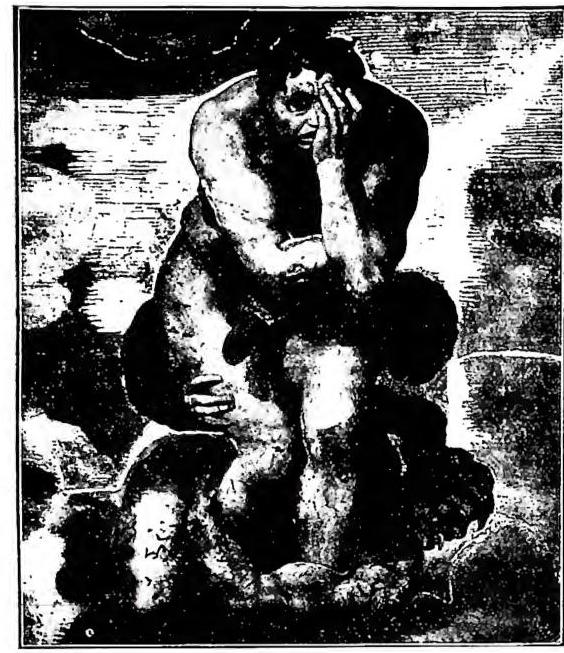
nal and corresponding to the liturgy, but on the altar wall (Condivi), perhaps in memory of the Sack of Rome of May 1527, considered by many as a judgment of God upon the excesses of the Renaissance. For Paul III, on the other hand, the psalm of the unhappy Medici pope became the grandiose manifesto of the Catholic Reform, which he tenaciously willed and later carried out at the Council of Trent. This interpretation seems confirmed by not a few details of the fresco alluding to the pre-Tridentine theological controversies. These, and especially the disputes over Grace and works, deeply interested M., above all from the time when, through Vittoria Colonna, whom he came to know around 1536, he had come into contact with the circle of her friends (Contarini, Pole, Morone, Lattanzio Tolomei and others), the center of so-called Italian evangelism (v.), whose theories concerning Grace were inspired by an extreme Augustinianism. The preliminary work began in Apr. 1535 and the execution of the fresco lasted from the summer of 1536 to the autumn of 1541. Paul III had the painting unveiled on 31 Oct. 1541, to the "stupor and marvel" (Vasari) of his contemporaries, astounded by M.'s new manner and by the "terribilità" (as they said) of that work which truly seemed the Dies Irae of a dying Renaissance. In its essential iconographic elements and in its arrangement in superimposed zones, the composition, apparently confused, does not depart much from the usual scheme of medieval Judgments. The two lunettes at the top show the angels bearing the instruments of the Passion. In the upper zone the blessed (men on the right and women on the left) fix their terrified gazes on the condemning gesture of Christ the Judge (at the center), around whom, with Sts. Peter, Andrew, Lawrence and Bartholomew (in whose skin appears a portrait of M.), are seen the Madonna and the Baptist (the Byzantine deesis), a figure erroneously believed by many to be Adam. In the middle part are the risen ascending into heaven (on the left), the angels (at the center) with the trumpets and the books of Life and Death (the first small, the other very large), and the ruin of the damned vainly rebelling against the heavenly host (on the right). In the lower zone is the resurrection of the dead, contested between angels and demons (on the left), a cavern full of devils (at the center), and the boat of Charon which overturns its cargo on the threshold of Hell, where Minos (a portrait of Biagio Martinelli da Cesena, master of ceremonies of Paul III and unwitting critic of the Judgment) receives the sinners (on the right). These two episodes are taken from the Divine Comedy (others, indicated by Steinmann, remain uncertain), while the influence of Holy Scripture (particularly investigated by Thode) acts indirectly, through the iconographic tradition. That of the Dies Irae manifests itself in many details, as, for example, in the terror of the just (dum vix iustus sit securus) and in the pensive skull among the rising dead (Mors stupebit). Classical reminiscences are evident in the trumpet-blowing angels, similar to Aeoluses, but above all in Christ, where the limbs are those of a Hercules, and the face, with strange syncretism, recalls the Apollo Belvedere. M., wishing to represent the body of the risen Son of God, here attempts, as a man of his time, to Christianize the ancient symbols of strength and beauty, while he was unjustly reproached for paganizing a Christian ideal. Other elements of the fresco, on the other hand, refer to the pre-Tridentine religious controversies, such as the Virgin enclosed, almost as co-redemptrix, in the same nimbus as the Redeemer, the value of good works symbolized in the martyrs who present to the Judge the instruments of their torment, the importance given to the gigantic figure of St. Peter with his enormous keys, and finally the efficacy of Marian devotion shown in the two risen souls drawn into heaven by an angel, clinging to a rosary.
Thus, after having evoked on the Vault the principle of the universe, M. describes its end on the immense wall. In the quarter-century that separates the two works, his spirit and his art have changed. In that profoundly Christian spirit, his affection for Vittoria Colonna, the nightmare of death and the storms raging against the Church had exalted his religious feeling to the point of mysticism. And thus was born his so-called "third manner," the result of an ethical and aesthetic crisis at one and the same time, which manifests itself for the first time in the Judgment. Before the urgency of expressing in any way the hopes and anguish of his tormented faith, his interest in the "beautiful," as his century conceived it, gave way: "Mettimi in odio quanto il mondo vale — he prayed, — E quante sue bellezze onoro e colo" (C. Frey [v. bibl.], no. CL). And in the Judgment he treats proportion and perspective, the two fundamental aesthetic dogmas of the Renaissance, with a freedom that would have been inconceivable at the time of the Vault, and which proved incomprehensible to his contemporaries, no less, perhaps, than the other audacities of that work (such as the nudity of the figures, the wingless angels and the beardless Christ) reproached to him in the well-known Dialogi of Gilio da Fabriano (1565).
From the same period is the unfinished but splendidly sketched bust of Brutus (Florence, Bargello), sculpted after 1539 at the request of Donato Giannotti for Card. Ridolfi, and alluding to Lorenzino de' Medici, the slayer of the despotic Duke Alessandro (1537). The manly effigy of the tyrannicide, perhaps inspired by an ancient bust of Caracalla, even in its incompleteness (and perhaps precisely by virtue of this), proclaims M.'s love for the freedom of his homeland with a vehemence all the stronger in artistic expression the more it was repressed in life. And still from those years is the so-called Palestrina Pietà
(Florence, Accademia), likewise unfinished, a colossal marble group, not mentioned in the sources, nor considered by all critics to be his work, attributed to M. in L. Cecconi's Storia di Palestrina (Ascoli 1756), but then forgotten, rediscovered only in 1875 by P. Gori and finally published in 1907 by A. Grenier, a group in which Mariani rightly sees the style of the Judgment transported into sculpture.
In Oct. 1541, when the wall of the Sistine was not yet unveiled, Paul III had already asked M. to fresco in the Pauline Chapel (Vatican) the Conversion of Saul and the Martyrdom of St. Peter (a theme perhaps substituted for an original Delivery of the Keys). The work, slowed by two illnesses of M. and troubled by the death of Vittoria Colonna (25 Feb. 1547), lasted from the last months of 1542 to about the middle of 1545 for the first painting, and from Aug. of that year until about March 1550 for the second. Here the "third manner" triumphs unchallenged, already more than hinted at in the Judgment, so that the incomprehension of contemporaries and posterity toward these late works has always been total. M. himself was perhaps struck by the profound change in his art: certainly, as long as he lived he never touched a brush again, consecrating his final years to the abstract and non-human beauty of architecture, almost as if seeking peace there, although even into that he poured the reflection of his spiritual conflicts.
After the death of Antonio da Sangallo, M. succeeded him in the office of architect of the basilica of St. Peter (brief of Paul III dated 1 Jan. 1547, dispatched 11 Oct. 1549), serving there "for the love of God and without any reward" (Vasari). He returned to Bramante's Greek-cross plan and simplified it further, making the elevations, with a single order of grandiose Corinthian pilasters, the base of the dome, which dominates the atrium facade. When M. died, the construction had reached the drum, and the architects G. Della Porta and D. Fontana, charged with bringing it to completion, departed slightly from the Modello ligno (Vatican City, St. Peter's), by giving the outer cupola a less hemispherical profile for reasons of statics, and by refining its ribs.
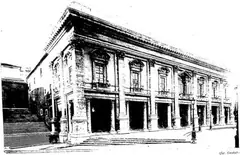
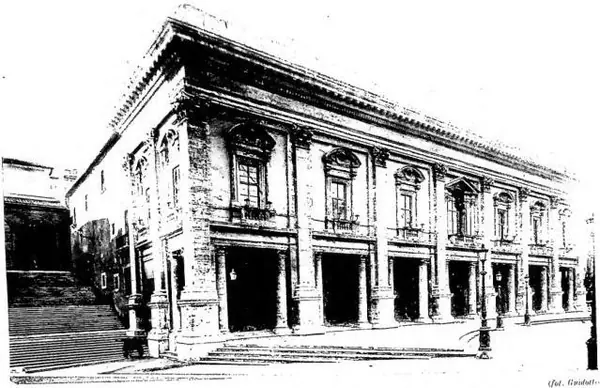
Other architectural works of that period are: the Funerary Monument of Cecchino dei Bracci (Rome, S. Maria in Aracoeli), built in 1545, where there is also a bust of the deceased, probably executed from his model; various parts and in particular the cornice of the Palazzo Farnese (Rome), from the following year; the rearrangement of the Piazza del Campidoglio with the new Palazzi dei Conservatori and del Senatore, carried to completion from his designs, but not without alteration of the original plan, especially in the central windows, after his death (M. had received Roman citizenship on 17 Dec. 1537); the Porta Pia (Rome, ca. 1561), and other constructions, such as the Vigna di Giulio III (Rome), or the destroyed Ponte di S. Trinità of (Florence), to which he contributed with designs or advice.
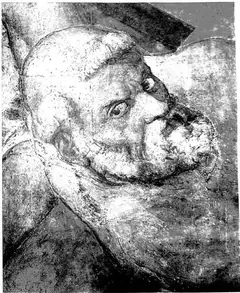
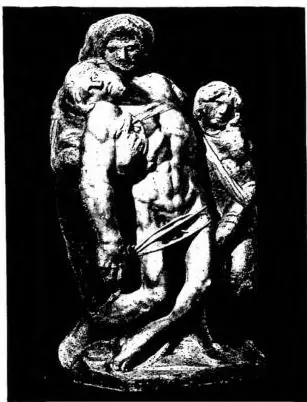
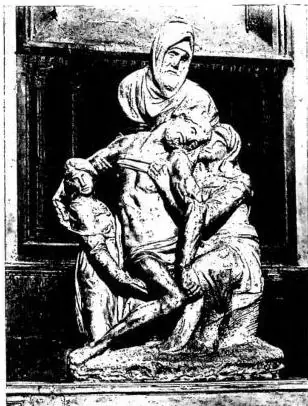
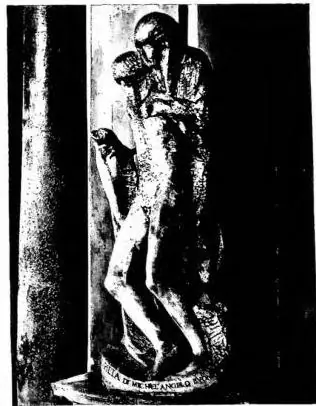
These are his public works in those years, but for himself alone and almost in secret (as Vasari affirms), he sculpted for his own tomb, between 1550 and 1553 ca., the Pietà del Duomo (Florence, S. Maria del Fiore), with the self-portrait in the figure of Nicodemus, and in the last days of his life he was still chiseling away at the phantom-like Pietà Rondanini (Rome, house of the counts Sanseverino), both unfinished. In this, his extreme work, on the threshold of his ninetieth year, M. still attempts to change his style entirely, reducing the titans of a previous and equally unfinished group (a detached arm remains beside the Christ) to spectral bodies, of an almost Rembrandtesque appearance, consumed to the minimum indispensable for making the spirit perceptible. M.'s predilection for this theme of the Pietà, a sign of his intense faith, finds its counterpart in the invocation to the embrace of the Crucified that closes one of his sonnets and proclaims the great renunciation: "Né pinger, né scolpir fié più che quieti - L'anima, volta a quell'amor divino - C'aperse a prender noi 'n croce le braccia" (C. Frey [v. bibl.], no. CXLVII).
M. died in Rome, in his house at Macel de' Corvi (destroyed), on 18 Feb. 1564, and was provisionally buried in SS. Apostoli, whence he was later exhumed in secret, transferred to Florence and laid to rest with solemn obsequies in the monument executed from Vasari's design in S. Croce. - See pls. LIX-LX.
Bibliography21 works
Deoclecio Redig de Campos